


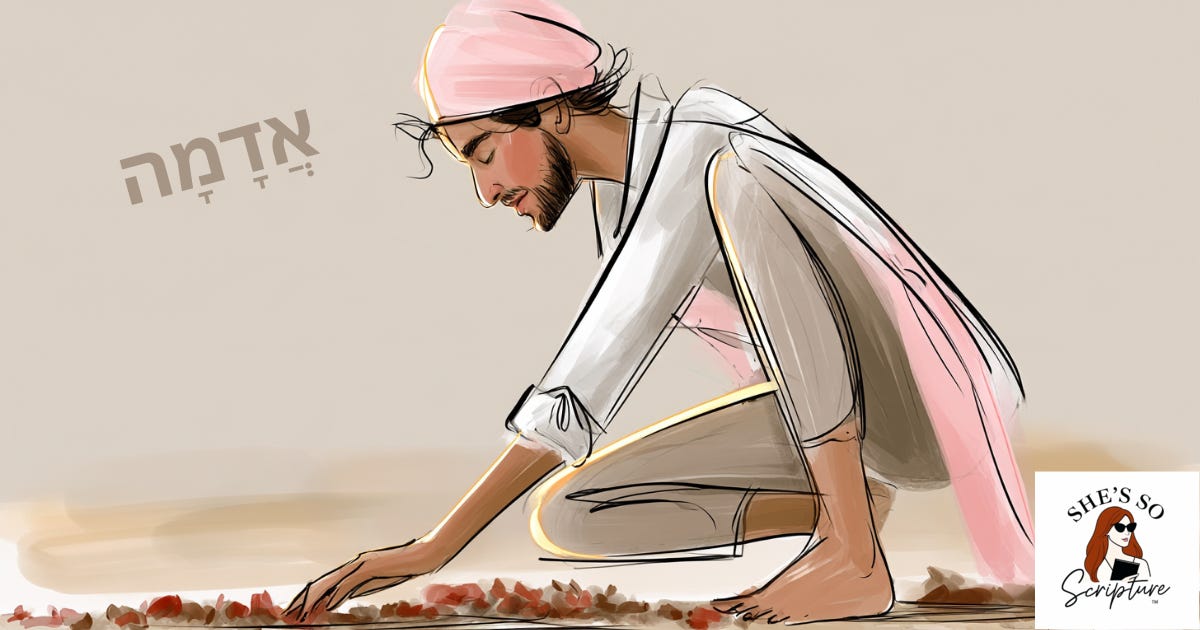
Genesis 2:7 tells you that God formed the man from the dust of the ground. It doesn’t tell you, unless you’re reading in Hebrew, that God was playing with sound while He did it. But He was!
The Hebrew makes a wordplay English doesn’t capture: ha-adam (הָאָדָם), the human, formed from ha-adamah (הָאֲדָמָה), the ground. The words share the same core consonants, alef-dalet-mem, and Genesis wants you to hear this relationship, whether one word is technically derived from the other or not.1
English doesn’t really have a way to capture the wordplay here, so most of us have read right past it. The human is named in connection with the very ground he was formed from. Think of something like groundling… the one formed from the ground.
As a special treat, I have something really amazing for you. My friend and teacher, Inbal from Hebrew by Inbal, created a special video just for our community, and I’m so happy to share her with you. If you’ve ever wanted to study Hebrew with a wonderful native Hebrew speaker who is warm, clear, patient, and deeply knowledgeable, Inbal is the one I recommend.
She has also generously offered our community $20 off her Practically Speaking Hebrew program when you choose the single-payment option. You can use the code shessoscripture at checkout.
And this recommendation is very personal for me. I’m a student of Inbal’s programs myself, so I would never point you toward something I haven’t actually used. I can tell you from experience that she is truly wonderful to study with. She makes Hebrew feel approachable, she teaches with such clarity, and she creates the kind of learning environment that makes you want to keep going.
What the Ground Actually Is
Biblical Hebrew has a few words that English translates as “earth” or “ground.”2
Eretz (אֶרֶץ) can mean land, territory, country or the earth more broadly, depending on the context. If you hear Eretz Israel it means the land of Israel.
Aphar (עָפָר) is dust, loose earth, the material Genesis has the human is formed from.
Adamah (אֲדָמָה) is ground or soil, often especially the ground people cultivate.
None of these are rigid categories but Biblical writers can and do place them side by side to make a distinction, and Deuteronomy 26:2 is a good place to demonstrate this.
Deuteronomy 26:2 has the Israelite farmer bring “the first of all the fruit of the adamah.,” produce grown “from your eretz,” the land GOD swore to his ancestors.3
Same sentence with two different words. The eretz is the land GOD gives Israel, the covenant territory. The adamah is the soil which actually produces the crops that go into the firstfruits basket. Torah keeps them both in plain sight: the land you inherited, and the dirt you’re supposed to work.
A Red Word
Here’s a detail that I love. You all know I love me some patterns!
The same cluster of consonants, א־ד־ם, also appears in the word adom, “red”. Esau comes out of the womb admoni, ruddy (Genesis 25:25), and the stew he trades his birthright for is red enough that people start calling him Edom. The same consonantal family keeps surfacing around words for humanity, ground, and redness.
The dirt of the hill country in Israel really does run reddish, the kind of iron-rich clay that stains your shoes, and older lexicons have connected adamah with that redness.4
Exactly how adam, adamah, and the Hebrew words associated with redness are historically related is still debated. What isn’t in dispute is that Genesis 2:7 is using the resemblance on purpose and the narrator doesn’t want it to go unnoticed.
The Ground Remembers
Once the wordplay is planted (pun very much intended), adamah keeps showing up at exactly the moments you’d expect from a Hebrew narrator who loves this kind of thing.
After the man and woman eat the fruit, the ground itself takes the hit: “cursed is the adamah because of you” (3:17). The relationship that opened the chapter, human formed from soil, turns adversarial. Thorns, thistles, sweat. And then the sentence that closes it out is more precise than most translations ever show: “until you return to the adamah…for aphar you are, and to aphar you will return” (3:19).
Two different ground-words in one sentence. First he returns to the adamah, the soil itself. Then he becomes aphar…dust.5
Then… there’s our old friend Cain. He’s introduced to us as “a worker of the adamah” (4:2), a farmer, before everything goes sideways. After he kills Abel, the ground itself is called as a witness, having “opened its mouth to receive your brother’s blood from your hand” (4:11), and Cain is cursed from the adamah, no longer able to make it yield its strength to him (4:12).
There’s one more Hebrew word close to this whole cluster: dam (דָּם), “blood.” It sounds very similar to adam and adamah, though the history of the words is uncertain enough that I would not claim they all come from the same root.
Genesis 4 still places dam and adamah right beside each other.
Abel’s dam, his blood, cries out from the adamah, the ground. Cain, who has spent his life working that ground, is then cursed from the same adamah that received his brother’s blood. 6 He can still exist. He just can’t farm anymore, not really, and he’s sent out as a wanderer. His whole identity was tied to soil, and that’s exactly what gets taken from him.
So the words gather around the same scene: adam, adamah, dam. Human. Ground. Blood. Genesis brings them into the same scene as the story moves from creation into violence, showing how deeply human life, the soil, and spilled blood are bound up with one another.
What the Rabbis Did With It
Jewish interpreters kept circling this image for centuries after the Biblical text was finished. Here’s what they said.
The Babylonian Talmud, a vast compilation of rabbinical legal debate, Biblical interpretation, and storytelling that reached the form we have no centuries after the New Testament period, preserves a teaching in tractate Sanhedrin (38a) in the name of Rabbi Meir: the dust used to form the first huan was gathered from every part of the world, not just one region.7
A related midrashic tradition, preserved by Rashi and traced back to Midrash Tanchumas (Pekudei 3), gives that image its explanation.8 God gathered Adam’s dust from everywhere so that wherever a person dies, the earth there can receive him. Nobody’s ground gets to say “you don’t belong to me, go back to where you were made.”
A second, competing tradition, also preserved through Rashi and traceable to Genesis Rabbah 14:8 (redacted somewhere around the fifth century, itself already centuries removed from the New Testament), has GOD taking the dust from one specific spot instead: the future site of the Temple altar, so the very ground the first human came from would one day be the ground where atonement happens.9
These later sources can’t by themselves establish what Jews in the first century believed. They’re rabbinic and midrashic reflections, far downstream from both Genesis and Yeshua. Still, two very different instincts are playing tug-of-war with the same word. One says every human being belongs everywhere. The other says humanity is somehow already oriented toward the place where forgiveness happens.
I don’t think you have to pick a winner. These are rabbinic and midrashic readings, not canon, so they give us a window into how people in that world were thinking about the text rather than a final answer we are required to accept. Both readings are trying to answer the same question Genesis raises and never fully settles: what does it mean that human beings were made from the dirt?
Yeshua and the Mud
There’s a scene in John 9 that I find impossible to read now without thinking of Genesis 2:7. Yeshua is standing in front of a man born blind, and instead of simply speaking healing into being, the way He does elsewhere:
“He spat on the ground, made mud with the salive, and spread the mud on the man’s eyes” (John 9:6, TLV).10
John doesn’t give us the connection, so I’ll offer it up as a possible one and not a proven one. God forms the first human from dust taken from adamah in Genesis 2. Centuries later, Yeshua stoops down to the ground, makes a mud pie, and used it to restore sight to a man born blind “so that the works of GOD might be displayed in Him” (9:3), It’s hard for me not to read that as a callback, even though John never spells it out himself.
Paul uses the same imagery in Greek, even though the pun itself doesn’t survive in the translation. In 1 Corinthians 15:47 he writes that the first man from “from the earth, dusty” (ek gēs choikos), using choikos, a word derived fro chous, the same Greek noun the Septuagint uses for the dust in Genesis 2:7.11
Paul isn’t reproducing the adam/adamah wordplay. He can’t because Greek doesn’t have it. What he does do is he brings forward the underlying Genesis anthropology: humanity made from earth, from dust.
My Final Thoughts
I know how unflattering the origin story can seem and how little Genesis does to make it pretty. The raw material isn’t impressive. Dust is dust, dirt is dirt, the kind you’d scrape off your shoes without giving it a second thought. Whatever dignity is here comes from what happens to that dust afterward: formed, breathed into, already called GOD’s image back in Genesis 1, before any of this dust language even shows up.
That’s probably why the rabbis kept returning to this word long after the Biblical authors had moved on. If we’re all made from the same basic stuff, gathered, in one telling, from everywhere at once (again…that is NOT in Scripture. It is more a devotional thought), nobody gets to claim a superior batch of dirt…because you KNOW someone would!
Questions for Further Study
Read Genesis 2:7 and 3:19 side by side. What does it mean that the wordplay connectiong adam and adamah opens the passage, and then closes it in two stages, ground and then dust?
Compare Genesis 4:2 with 4:11-12. What exactly does Cain lose when he’s cursed “from the adamah,” and why does that punishdment fit the crime?
Read Deuteronomy 26:11. Why might Torah want the Israelite farmer reciting the Exodus story out loud while holding a basket of dirt-grown produce?
If you have Sefaria open, look up Rashi on Genesis 2:7, and Genesis Rabbah 14:8 for yourself. Which of the three traditions about Adam’s dust do you find most compelling and why?
Read John 9:1-7 again. Does the mud change how you read the healing, or does it feel incidental to you?

About the Author

Diane Ferreira is a Jewish believer in Yeshua, a published author, seminary student, wife, proud mom, and a stroke survivor. She is the founder of She’s So Scripture and She Opens Her Bible. She is the author of several books, including The Proverbs 31-ish Woman, which debuted as Amazon’s #1 New Release in Religious Humor, as well as Holy, Hormonal and Holding On.
She is currently pursuing her graduate degree in Jewish Studies in seminary, with her favorite topics being the early church and Biblical Hebrew. Diane writes and teaches from a unique perspective, bridging her Jewish heritage with vibrant faith in the Messiah to bring clarity, depth, and devotion to everyday believers.
When she’s not writing, studying, or teaching, you’ll find her curled up with a good book, crocheting something cozy, traveling, or playing her favorite video games.
Tree of Life (TLV) – Scripture taken from the Holy Scriptures, Tree of Life Version*. Copyright © 2014,2016 by the Tree of Life Bible Society. Used by permission of the Tree of Life Bible Society.
Notes
Hebraists differ on the exact relationship between the words: whether adam is denominative from adamah, whether adamah is a feminine formation from adam, or whether both derive independently from a shared root. Genesis doesn’t resolve the direction, it just puts the sound relationship to work.
BDB glosses eretz as earth, land, or territory depending on context; aphar as dry, loose earth, dust, or clay; and adamah as arable ground or soil. None of the three is a fixed technical term, which is part of why English translations flatten them so easily.
Hebrew: מֵרֵאשִׁית כָּל־פְּרִי הָאֲדָמָה אֲשֶׁר תָּבִיא מֵאַרְצְךָ. Rashi, citing Sifrei and the Talmud, connects this verse to Deuteronomy 8:8’s list of the seven species (wheat, barley, grapes, figs, pomegranates, olive oil, and date honey), reading the two “land” texts together to conclude that bikkurim applies specifically to those seven. That’s a rabbinic reading built from putting two verses side by side, not something Deuteronomy 26 states on its own.
BDB (Brown-Driver-Briggs) glosses adamah as soil “from its general redness,” deriving it from the same root as adam, “to be red.” How strong or original that connection actually is, whether it’s real etymology or something closer to ancient folk etymology, is genuinely disputed among Hebraists.
Hebrew: עַד שׁוּבְךָ אֶל־הָאֲדָמָה... כִּי־עָפָר אַתָּה וְאֶל־עָפָר תָּשׁוּב. The Septuagint collapses the two-stage Hebrew wordplay into a single Greek word, γῆ (”earth”), for both adamah and aphar. The staging is a Hebrew effect; it doesn’t survive into Greek.
Hebrew: לֹא־תֹסֵף תֵּת־כֹּחָהּ לָךְ, literally “it will not continue to give its strength to you.” The verb for “continue” (yasaph) implies an ongoing relationship that’s now being cut off, not simply a one-time failure to produce.
Rabbi Meir was a second-century Tanna. The Babylonian Talmud in the form we have it wasn’t redacted until centuries later, traditionally associated with Rav Ashi and Ravina in the fifth century, with the text considered essentially closed by the early sixth. What we have, then, is the Talmud’s record of Rabbi Meir’s teaching, not a document from his own hand or era.
Rashi lived 1040–1105. The standard printed Tanchuma is itself later than Genesis Rabbah, generally placed somewhere in the range of the sixth through ninth centuries, and its composition history is genuinely contested among scholars. Rashi is preserving older material, but the document he’s drawing from has its own complicated transmission history.
Genesis Rabbah is generally dated to the fifth century, with some scholars narrowing that to the first half of the century. Jewish tradition attributes it to Rabbi Hoshaiah, but modern scholarship on its authorship and compilation remains inconclusive.
John’s Greek word for “mud” here is πηλός (pēlos), not the word the Septuagint uses for “dust” in Genesis 2:7 (χοῦς). The vocabulary doesn’t match. If John intends an echo of Genesis 2:7, it’s conceptual rather than a deliberate quotation of the Greek text.
1 Corinthians 15:47: ὁ πρῶτος ἄνθρωπος ἐκ γῆς χοϊκός. The Septuagint’s Genesis 2:7 reads God forming man χοῦν ἀπὸ τῆς γῆς, “dust from the earth,” using the accusative of χοῦς. Choikos is built directly on that noun.