


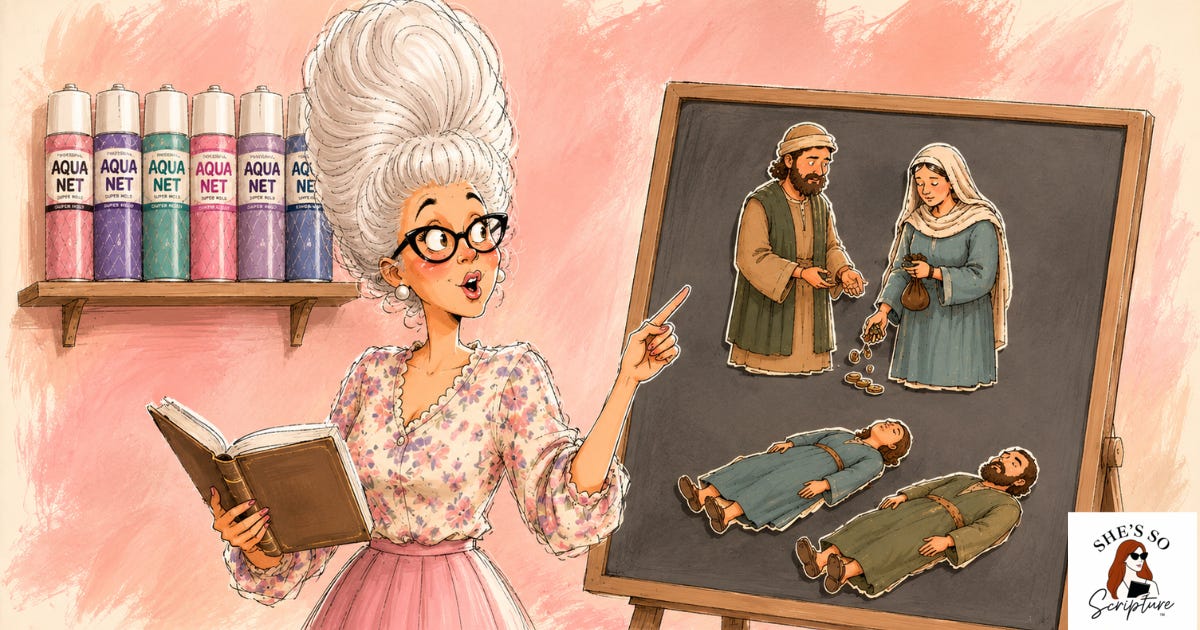
Miss Patty may have taught you this story once in the older kids’ class. She probably had a slightly uncomfortable look on her face, because it’s one of those Bible passages that makes Sunday school teachers pull at their collar a little.
She said something like: “Ananias and Sapphira lied to God about how much money they gave to the church, and God struck them both dead. The lesson is: don’t lie about your offering.”
Then she moved on pretty quickly, because honestly, what else do you even do with that?
Here’s the thing. That reading isn’t wrong exactly. It’s just incredibly shallow. And shallow readings of a story this serious will have you afraid of the offering plate and missing the entire theological earthquake happening underneath this passage.
Let’s actually read it.
The Setup Nobody Told You About
You cannot read Acts 5 without reading Acts 4 first. Miss Patty skipped that part.
Acts 4 closes with this description of the early community of believers in Jerusalem:
“For there was not a needy person among them, for all who were owners of land or houses would sell them and bring the proceeds of the sales and place them at the feet of the emissaries, and it was distributed to each, as anyone had need” (Acts 4:34-35, TLV).
This wasn’t a suggestion. This wasn’t a pledge drive. This was a covenant community operating out of a shared theological conviction that they belonged to each other and to God. And then Luke introduces us to a man named Barnabas, who sells a field and lays every shekel of the proceeds at the apostles’ feet. Full stop. No hidden envelope.
That’s the backdrop. That’s the contrast. Luke sets Barnabas up on purpose so that when we meet Ananias and Sapphira in the very next verse, we understand exactly what they were trying to imitate.
They saw how Barnabas’s generosity was received by the community. They saw what that kind of sacrifice looked like when it landed. And they wanted that for themselves.
So they sold a piece of property, kept some of the money back, and brought the rest to Peter. Presenting it as the full amount.
The Actual Sin
Here’s what is usually missed entirely. Peter says something in Acts 5:4 that completely changes the frame of this story. He says to Ananias:
“While it remained unsold, it was your own, wasn’t it? And after it was sold, wasn’t it at your disposal?”
Read that carefully. Peter is explicitly saying: you were never required to give any of this!! Selling was voluntary. Giving was voluntary. The amount was voluntary. Nobody made you do this!
The sin was never the amount. The sin was the lie. They performed a generosity they didn’t actually have so they could receive an honor they hadn’t actually earned.
They wanted to be seen as Barnabas without being Barnabas.
This is a spiritual identity fraud. They presented themselves as people fully surrendered to covenant community while privately holding a different set of values altogether.
Scholars have noted that the first-century Roman world ran on a patronage economy where public generosity was a currency for social status, and it’s hard to read this story without hearing that echo. But whether or not Luke had that critique consciously in mind, what the text gives us directly is this: they wanted the reputation of sacrifice without its reality.
And the community wasn’t the only one they offended. Peter is clear that their deception wasn’t merely against the people around them. It was ultimately directed against the Holy Spirit himself.
Acts 5:3-4, TLV:
“Ananias, why has Satan filled your heart to lie to the Ruach ha-Kodesh and keep back part of the proceeds of the land?... You haven’t lied to men but to God.”
When Your Greek Has Something to Say
The word Luke uses for “kept back” in Acts 5:2 is the Greek word nosphizomai (νοσφίζομαι). Lexicons define it as to keep back secretly for oneself, to misappropriate what has been marked as devoted. It’s a deliberately loaded word. And Luke’s choice of it is precise and theologically intentional.
This is the same word used in the Septuagint, the Greek translation of the Hebrew Scriptures, in Joshua 7:1 to describe what Achan did when he stole from the devoted things after the fall of Jericho.
F.F. Bruce, one of the most respected New Testament scholars of the twentieth century, put it plainly: the story of Ananias is to the book of Acts what the story of Achan is to the book of Joshua.¹
In both cases, a single act of internal deception threatened to corrupt and unravel the entire forward movement of God’s people at a critical juncture. Achan’s sin came right at the start of Israel’s entry into the land. Ananias and Sapphira’s sin came right at the start of the Spirit-empowered expansion of the early church.
Luke chose that word on purpose. He wanted his readers to feel the weight of what had just happened.
What the Community Actually Was
The early believers in Jerusalem weren’t just a nice church small group. They were operating as a covenanted people, holding resources with open hands, building something together that the Roman world had never seen.
The word Luke uses for their shared life is koinonia, which means something closer to active, mutual participation than the English word “fellowship” can convey. This wasn’t potluck and handshakes. This was a reordering of how people related to money, to each other, and to God.
They didn’t just fudge a number on a form. They wanted the status that genuine sacrifice produced, without the sacrifice. And when they walked in and laid that money down, they were performing a spiritual identity they hadn’t actually taken on.
Peter names it twice. You lied to the Ruach haKodesh. You lied to God. The community witnessed the deception, yes. But the offense ran deeper than the community.
What This Actually Means for Us
The story isn’t asking you whether you tithe correctly. It’s asking you something harder.
It’s asking whether the version of yourself you present to your faith community is the same person you are when nobody’s watching.
Because the thing that condemned Ananias and Sapphira wasn’t a math error. It was that they performed a spiritual identity they hadn’t actually taken on. They wanted the reputation of surrender without the reality of it. They wanted to be seen as people fully devoted to God’s kingdom while privately keeping one foot somewhere else entirely.
That question lives in every room where believers gather. And here’s the sobering part: Peter says the Ruach haKodesh can be lied to, even though he cannot be fooled. Which means the attempt is real. The intention to deceive was real. And God took it seriously enough to act.
The invitation in this passage isn’t to give more money, even though we do see that taught from many a pulpit today. The invitation is to stop performing a version of yourself that doesn’t exist.
Verse Mapping Aid
Nosphizomai (Greek: νοσφίζομαι) Pronunciation: nos-FID-zo-my Meaning: to keep back secretly for oneself; to misappropriate what has been marked as devoted
This verb appears only twice in the entire New Testament: here in Acts 5:2 and in Titus 2:10, where it describes a slave stealing from his master. In the Septuagint, it appears in Joshua 7:1 to describe Achan’s theft of devoted things after Jericho. Luke’s deliberate use of this rare word draws a direct line between Achan and Ananias. Both sinned at the threshold of a new movement of God. Both introduced internal corruption at the very moment God’s people were advancing. Both were confronted, exposed, and judged with a severity that shocked everyone around them.
The word describes a particular kind of betrayal: quietly rerouting for your own purposes what you have represented as fully given, while presenting yourself as someone who did no such thing.
My Final Thoughts
I want to consider the part of this story that doesn’t get mentioned: Sapphira came in three hours later. Alone. And she lied too.
She had three hours she didn’t know she had. Three hours in which, if someone had found her and told her what had happened to her husband, everything might have gone differently.
She didn’t know. She came in and she stuck to the story.
And I think about how many times the posture we’ve committed to publicly becomes the thing we can’t walk back from, even when the Spirit is giving us a quiet moment to tell the truth. We’ve already decided who we’re going to be in this room. We’ve already made the agreement. So we walk in and say what we said we’d say.
The Ruach haKodesh cannot be fooled. But this couple tried. And God’s response to that attempt, at this particular moment in the life of his fledgling covenant community, was swift and final.
The grace for us is that we’re reading this story at all. Which means there’s still time to close the gap between the version of ourselves we perform and the person God is actually calling us to be.
Bible Study Questions
Peter makes clear in Acts 5:4 that Ananias and Sapphira were under no obligation to give the full proceeds of the sale. Knowing this, how does it change your understanding of what their actual sin was?
Read Acts 4:32-37. How does the description of the covenant community there set up what happens in Acts 5? What were Ananias and Sapphira attempting to imitate, and why does that matter?
F.F. Bruce connects Ananias to Achan in Joshua 7. Read that passage. What similarities do you notice beyond the shared Greek word? What does this connection suggest about how seriously God takes internal covenant betrayal?
Reflection Questions
Peter says they lied not to men but to God. Where in your own life are you presenting a version of your faithfulness that doesn’t match your private reality?
Sapphira had three hours she didn’t know she had. Is there an area of your spiritual life right now where you’ve been given a window to tell the truth before the story catches up with you?
Action Challenges
Read Acts 4:32 through Acts 5:11 in one sitting as a single narrative. Write down two or three observations you notice when you read it as a continuous story rather than isolated verses.
This week, identify one area where you are performing spiritual commitment you haven’t fully taken on. Bring it honestly before God in prayer and ask for the grace to close the gap between the performance and the reality.
If these lessons are doing something in you, think about who in your life needs to be in this conversation. You can gift a Vault subscription to a friend directly through Substack. It makes a genuinely good gift for the woman in your life who loves to go deep in the Word and isn’t interested in surface-level spirituality. You know exactly who that is. 🎁

About the Author
Diane Ferreira is a Jewish believer in Yeshua, a published author, speaker, seminary student, wife, and proud mom. She is the founder of She’s So Scripture and She Opens Her Bible. She is the author of several books, including The Proverbs 31-ish Woman, which debuted as Amazon’s #1 New Release in Religious Humor, as well as Holy, Hormonal and Holding On.
She is currently pursuing her graduate degree in Jewish Studies in seminary, with her favorite topics being the early church and Biblical Hebrew. Diane writes and teaches from a unique perspective, bridging her Jewish heritage with vibrant faith in the Messiah to bring clarity, depth, and devotion to everyday believers.
When she’s not writing, studying, or teaching, you’ll find her curled up with a good book, crocheting something cozy, traveling, or playing her favorite video games.
Tree of Life (TLV) – Scripture taken from the Holy Scriptures, Tree of Life Version*. Copyright © 2014,2016 by the Tree of Life Bible Society. Used by permission of the Tree of Life Bible Society.
¹ F.F. Bruce, The Book of the Acts, New International Commentary on the New Testament (Grand Rapids: Eerdmans, 1988), 102.
Thanks for sharing this. I love this line:
The sin was never the amount. The sin was the lie. They performed a generosity they didn’t actually have so they could receive an honor they hadn’t actually earned.
Keep writing.
These are powerful insights here. More and more I'm seeing that while reading God's Word is important, we don't get all that He wants us to see if we only read the English at face value and never go back to the original language.