


There’s a certain kind of promise that costs you nothing to make.
You say “I’ve got you” to a friend and mean it, warmly, generally, in the way people mean things at two in the morning over a second glass of wine. Nobody’s asking you to sign anything. It’s a nice sentiment unattached to any real risk to your person. Like a pinky promise you made as a kid.
Judah’s story isn’t that kind of promise. It’s a full reversal of who he is.
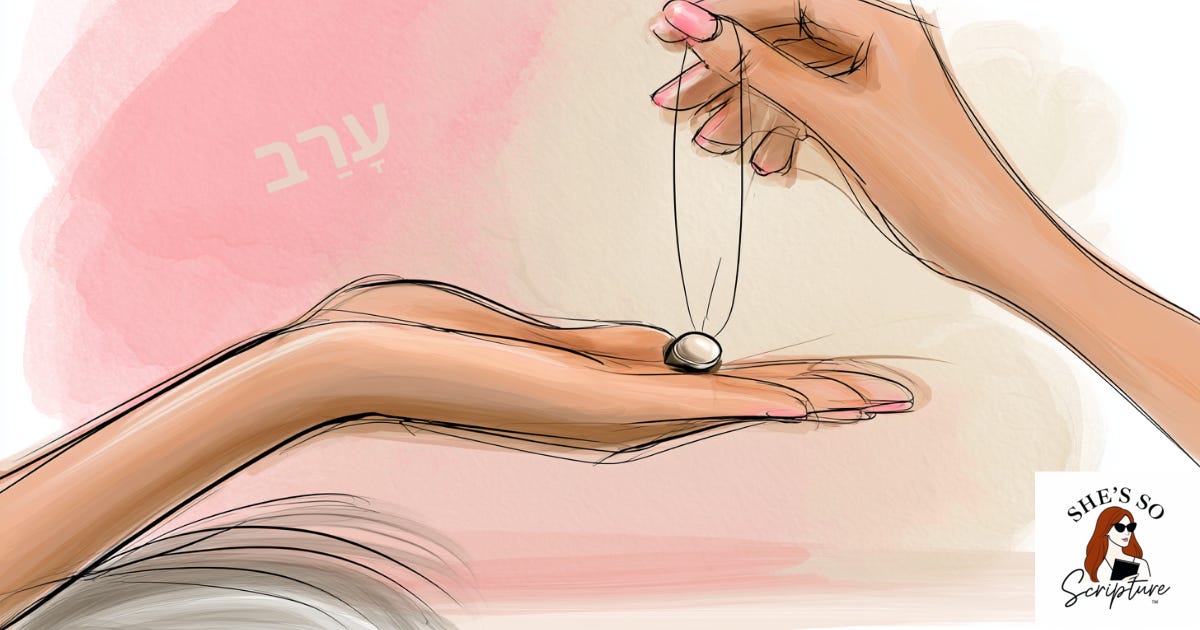
Quick definition, before we get into the story: arav (עָרַב) is a Hebrew root meaning to pledge, to give security, or to stand as surety for someone else's obligation. It shows up in Judah's story in two forms: the noun eravon (sort of like collateral… a pledge or deposit held until a debt is paid) and the verb form, where a person "stands surety," making himself personally answerable for someone.
That's the word we're tracking. Now, the story.
The Hebrew Word - Arav (עָרַב)
The Hebrew root ערב (arav) turns up in Judah’s story in two closely related forms, both having to do with pledges, surety, responsibility. In Genesis 38 we meet the noun eravon (עֵרָבוֹן), which is a pledge or security held until an obligation is fulfilled.
In Genesis 43 and 44 we meet the verb itself: Judah “stands surety” for Benjamin, making himself answerable for his brother.
Same root, three scenes. Its basic meaning remains the same, but each time it appears, more is at stake. 1
Now, I need to take a step back here for a minute because this doesn’t actually start with a pledge… it starts with a sale.
Where Judah Actually Begins
Genesis 37. Joseph is sitting in a pit while his brothers debate whether to kill him. Judah has another idea: why murder your brother when you can sell him and make a profit?
“What profit is there if we kill our brother and cover up his blood? Come on! Let’s sell him to the Ishmaelites. Let’s not lay our hand on him, since he’s our brother, our own flesh.” His brothers listened to him. 2
Twenty pieces of silver changed hands, and Judah went home while Joseph went to Egypt as a slave. That’s our introduction to Judah. Not exactly his finest hour. He is the brother who talks the others out of murder and into a transaction instead.
Hold that thought! We’re coming back to it.
The Pledge (Eravon) in Genesis 38
One chapter later, Judah gets tangled up in a mess of his own making on the road to Timnah. He’s approached a veiled woman, thinks she’s a prostitute, and negotiates payment: a young goat from the flock.
Except he doesn’t have the goat with him, so the woman — who is actually his daughter-in-law Tamar in disguise — asks a reasonable question.
“Provided you give a pledge until you send it,” she said.
“What kind of pledge shall I give you?” he asked. “Your seal, and your cord, and your staff in your hand,” she said. So he gave them to her and he slept with her, and she got pregnant by him. 3
That’s eravon. And Tamar wasn’t asking Judah to leave a few coins behind. She asked for his signet, cord, and staff. His signet identified him and carried his authority. Put all three together and, well, Judah practically handed her his ancient-world ID.
Tamar didn’t just takecollateral for a goat. No… our girl took the very evidence that could identify the man who gave it to her.
Objects. Things a man can hand over and still be fully himself on the other side of the transaction.
Genesis doesn’t let him walk away that easily.

When the Pledge Comes Back
Three months later, word gets back to Judah that his daughter-in-law is pregnant by prostitution. He calls for her to be burned. But then Tamar shows her hand.
“Do you recognize whose these are, the seal, the cords and the staff?” 4
The chickens (or objects in this case) come home to roost. And when they do, they don’t just identify Tamar’s case. They identify Judah!
“Then Judah recognized them and said, ‘She is more righteous than I, since I didn’t give her to my son Shelah.’” 5
That’s no small admission. A man is confronted with physical proof of his own failure, and he says it out loud, in front of everyone, rather than let her die to cover it (which he could have done). His first eravon didn’t just secure a promised goat. It became the evidence that brought Judah face to face with himself.
Before we meet the Judah who answers for Benjamin, Genesis first gives us a Judah forced to answer for what he did to Tamar.
The Guarantor - Judah's Pledge for Benjamin (Genesis 43)
Years later… different crisis, same family. Jacob won’t let Benjamin go down to Egypt for grain unless someone guarantees his safe return. Reuben tries first. Back in chapter forty-two, he told Jacob he could kill Reuben’s own two sons if Benjamin didn’t come home safe. 6 It’s personal responsibility, in his own grim kind of way. Jacob wasn’t moved by it one bit.
Then Judah steps forward and puts the obligation in sharper terms.
“I myself will be his pledge. You can demand him back from my own hand. If I don’t bring him back to you and place him before you, then you can blame me all my days.” 7
Reuben offers his sons as the penalty for failure. Judah offers himself. In his own hand, his own name.
The rabbis noticed how strong this language was. In b. Bava Batra 173b (Talmud), Rav Huna cites Genesis 43:9 while asking why a guarantor can be held legally responsible. Rav Hisda pushes back… not because Judah’s words are too weak to count as a guarantee.
His objection runs the other direction. Judah’s offer may be stronger than an ordinary guarantee. The sages aren’t debating whether Judah sounds like a guarantor. They’re debating what kind of guarantor he’s actually become. 8

The Reversal
The vow gets made in chapter 43. It gets tested in chapter 44, when Joseph’s cup turns up in Benjamin’s sack (spoiler… Joseph put it there).
Back in Genesis 37, Judah was the brother who proposed selling Joseph. A son of Rachel went into slavery, and Judah went home. Now another son of Rachel is at risk of being lost.
“So now, please let your servant remain as a slave to my lord instead of the boy, and let the boy go up with his brothers.” 9
The man who once let a brother’s freedom get traded away now is offering up his own. Joseph never actually enslaves him. The offer itself is what breaks Joseph, who then reveals himself to his brothers. But Judah didn’t know that would happen when he made it. He meant it.
Not some collateral sitting in someone else’s hand. Judah himself, standing in Benjamin’s place.
The Guarantee - Hebrews 7:22 and Engyos
Centuries later, a different writer chooses a related idea, in a different language, for a different kind of guarantee entirely.
“How much more then has Yeshua become the guarantee of a better covenant.” 10
The Greek word is engyos (ἔγγυος)—a guarantor, someone who stands behind an obligation and guarantees it will be fulfilled. And would you like to know how many times engyos appears in the Apostolic Writings? Once. Right here.
Hebrews has already told us, eight verses earlier, that…
“our Lord has sprung forth from Judah.” 11
Then in verse 22, we see that this Messiah from Judah is called the guarantor of a better covenant.
Now, am I going to tell you the writer of Hebrews was deliberately reaching back to Judah’s pledge for Benjamin in Genesis 43? No. I personally like evidence and Hebrews never says that. But as a canonical echo? Come on. It’s hard not to hear it. 14
Judah once pledged himself for his brother. Then, generations later, the Messiah from Judah’s own line is called OUR guarantor.
Hebrews takes that picture of a guarantor much further than Judah ever could. Judah could pledge himself for Benjamin, but he was still mortal. Yeshua’s priesthood rests on God’s own oath, and death has no power to end it.
Other priests died, and their service ended with them. Yeshua “continues forever.” He holds His priesthood permanently and “always lives to make intercession” for those who draw near to God through Him. 12
Judah could say, hold me responsible. Yeshua’s very life is the guarantee that His priestly work never ends by death, failure, or succession. Baruch Hashem (Praise God)!
Bonus Word Nerd Note
And because apparently one word rabbit hole wasn’t enough, there’s another connection here I have to show you.
When Genesis was translated into Greek, Tamar’s eravon became arrabōn (ἀρραβών), a Greek loanword that comes from this same Semitic language of pledging and guaranteeing. That word turns up three times in the Apostolic Writings, just not in Hebrews. Paul uses it for the Ruach HaKodesh, the Holy Spirit, as God’s pledge or down payment of what’s still to come. 13
Genesis 38 gives us a pledge held until a promised goat arrives. Paul takes that familiar pledge language and uses it for God’s own Spirit, given in anticipation of a fullness still on its way.
Hebrews 7:22 uses a different word entirely, engyos, and the image shifts. Yeshua isn’t handing over something as security for the covenant. He Himself is the guarantor. The language has changed, but the idea of guarantee is still there.
My Final Thoughts
I can’t help but to think about how low-key Genesis does this. There’s no verse announcing, "and here Judah changed." so watch him. No… Genesis apparently trusts us to keep up.
Judah sells one brother for silver and then apparently just goes on with his life. Then Tamar shows up holding his own pledge and, well… receipts are biblical. Suddenly Judah has nowhere to hide from himself. He admits, out loud, “She is more righteous than I.”
And something in him changes. The next time a brother’s life is on the line, Judah puts himself there too. By Genesis 44, the man who once stood by while Joseph was carried off as a slave is begging to become a slave himself so Benjamin can go home.
Excuse me, Genesis. I see you!
Judah begins as the man willing to let a brother pay the price. He becomes the man willing to pay the price for a brother. Wow.
And Tamar is standing right in the middle of that story holding the evidence that made Judah finally take a good look at Judah. Which makes Genesis 38 considerably harder to dismiss as that weird Tamar chapter interrupting the Joseph story, doesn’t it? She didn’t interrupt Judah’s story. She absolutely changed it
Dig Deeper
Read Genesis 37:26-27 alongside Genesis 44:33 and notice what Judah is offering in each scene.
Then really spend time in Genesis 38:26, the moment Judah recognizes his own pledge and tells the truth about himself in front of everyone.
Then read Hebrews 7:14-25 slowly, and ask what it means that the Messiah who comes from Judah’s own line becomes the guarantor Judah could only gesture toward.
Where in your own life have you offered the staff-and-cord version of a promise, the kind that costs little, when the moment actually called for the kind that puts you on the line?
Common Questions
What does arav mean in Hebrew?
Arav (עָרַב) is a Hebrew root meaning to pledge, exchange, or stand as surety. It shows up in two related forms in Judah’s story: the noun eravon, a deposit held until an obligation is fulfilled, and the verb form, where someone makes himself personally responsible for another person’s safety or debt.
What is eravon in Genesis 38?
Eravon is the pledge Judah gives Tamar in Genesis 38:17-18, his seal, cord, and staff, as security for a goat he promised to send her. These were deeply personal, identifying objects, which is exactly why they come back to expose him three chapters later.
How is Judah’s pledge to Tamar connected to his offer for Benjamin?
Both use the same root word, arav, but the weight they carr is completely different. In Genesis 38, Judah hands over objects. In Genesis 43-44, he hands over himself, offering to become a slave in Benjamin’s place. Same word, but Judah has become the pledge instead of just giving one.
What does Hebrews 7:22 mean by “guarantee”?
Hebrews 7:22 calls Yeshua the “guarantee” (Greek engyos) of a better covenant. It’s the only time this word appears in the New Testament. Read next to Judah’s own surety language in Genesis 43, it’s hard not to hear that connection: a guarantor from Judah’s own line, whose guarantee never lapses because He never dies.
If this study stirred something in you, share it with a friend who might need it too.
And if it left you wanting to go slower and deeper into the Word, I’ve got you!
Paid subscribers get access to live Bible studies, extended studies, devotionals. theological teaching, spiritual formation practices, and a community of people who want depth without pressure or performance.
If you’re ready to step further into the Word, you’re welcome inside.
If a paid subscription isn’t feasible right now but this space has blessed you, you can leave a one-time tip here. Every gift helps sustain this work. 💕
About the Author
Diane Ferreira is a Jewish believer in Yeshua, a published author, speaker, seminary student, wife, and proud mom. She is the founder of She’s So Scripture and She Opens Her Bible. She is the author of several books, including The Proverbs 31-ish Woman, which debuted as Amazon’s #1 New Release in Religious Humor, as well as Holy, Hormonal and Holding On.
She is currently pursuing her graduate degree in Jewish Studies in seminary, with her favorite topics being the early church and Biblical Hebrew. Diane writes and teaches from a unique perspective, bridging her Jewish heritage with vibrant faith in the Messiah to bring clarity, depth, and devotion to everyday believers.
When she’s not writing, studying, or teaching, you’ll find her curled up with a good book, crocheting something cozy, traveling, or playing her favorite video games.
Notes
The connection between Genesis 38’s noun eravon and Genesis 43-44’s verbal surety language is drawn from contemporary scholarly treatment of Judah’s character arc.
Genesis 37:26-27, TLV.
Genesis 38:17-18, TLV.
Genesis 38:25, TLV.
Genesis 38:26, TLV.
Genesis 42:37, TLV.
Genesis 43:9, TLV.
b. Bava Batra 173b. Rav Huna cites Genesis 43:9 while asking for the scriptural basis of a guarantor’s legal responsibility; Rav Hisda argues Judah’s undertaking may represent a stronger form of liability, and brings Reuben’s promise into the discussion.
Genesis 44:33, TLV.
Hebrews 7:22, TLV.
Hebrews 7:14, TLV.
Hebrews 7:20-25, TLV.
The Septuagint renders Hebrew eravon in Genesis 38:17, 18, and 20 with Greek arrabōn (ἀρραβών). The same Greek noun appears in 2 Corinthians 1:22, 2 Corinthians 5:5, and Ephesians 1:14 for the Spirit as God’s pledge or deposit.
Thomas Goodwin explicitly compares Messiah’s suretyship with Judah’s pledge for Benjamin, citing Genesis 43:9. See Thomas Goodwin, Christ Set Forth (originally published 1642), in The Works of Thomas Goodwin, vol. 4, in his discussion of Messiah’s continuing intercession as surety. This is a typological comparison, not evidence that Hebrews 7:22 intentionally alludes to Genesis 43:9.
Tree of Life (TLV) – Scripture taken from the Holy Scriptures, Tree of Life Version*. Copyright © 2014,2016 by the Tree of Life Bible Society. Used by permission of the Tree of Life Bible Society.
What a gift of a study! Thank you for tracing arav through Judah's pledges. 🫶
Here's where it undoes me. Proverbs says: never become surety, you cannot escape the snare.
Yet God "swears to His own hurt, and changes not" (Ps 15:4). Because the foolishness of God is wiser than man. The Lion of Judah becomes the true arav: the pound of flesh, the bruised arm of the LORD, paid in full.