


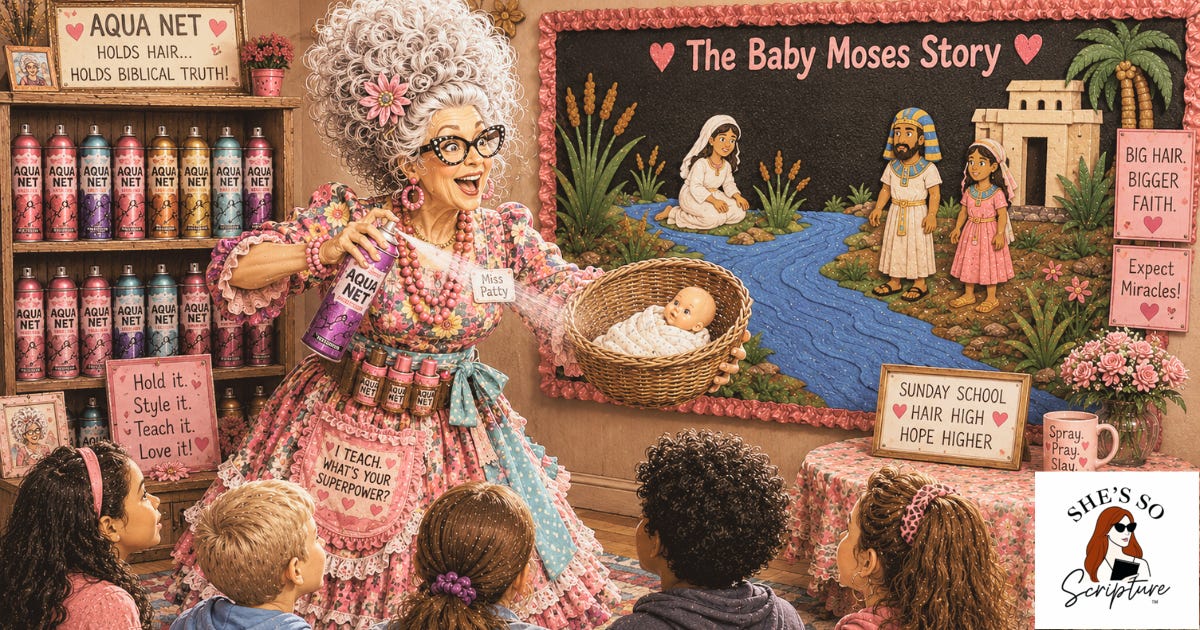
Miss Patty had a wicker basket she brought from her own kitchen. Every year, same basket. She’d tuck a baby doll into it, wrapped in a dish towel, and slide it across the blue felt Nile while twelve of us held our breath like Pharaoh was standing in the doorway.
I’m not here to take the basket away from her. She was working with a felt board, a can of Aqua Net for pitch, and a church budget.
But I was reading Exodus 2 in Hebrew a while back, just working through it slowly with my lexicon and my reading glasses, and I hit the word for basket and stopped in my tracks. Because it wasn’t a basket word. Hebrew has basket words. This wasn’t one of them.
The word was tevah.
I knew that word. You know that word too, even if you don’t know Hebrew, because tevah is what Noah built.
Two Arks
I did what any normal person would do at ten o’clock at night, which is pull out the concordance and look up every place tevah shows up in the Hebrew Bible. It took less time than I expected. The word appears in the flood account, over and over. Then it appears twice in Exodus 2. Then it disappears like a friend when you say you need help moving.
No bread baskets. No harvest baskets. Nothing. Hebrew uses other words for all those, and Exodus itself uses a different word later when the story needs an ordinary container. This word belongs to exactly two vessels in the Hebrew Bible.¹
Here’s the verse:
“But when she could no longer hide him, she took a basket of papyrus reeds, coated it with tar and pitch, put the child inside, and laid it in the reeds by the bank of the Nile.” (Exodus 2:3, TLV)
Even the TLV says basket, and I understand why. In English, a papyrus container the size of a bassinet is a basket. The translators aren’t wrong. They’re just more subtle than the Hebrew.
Now the first tevah:
“Make for yourself an ark of gopher wood. You shall make the ark with compartments and smear pitch on it, both inside and out.” (Genesis 6:14, TLV)
Pitch on Noah’s ark. Tar and pitch on Moses’s. Jochebed waterproofed her son’s vessel the same way Noah waterproofed his, and the writer wants us to notice, because the writer picked the word that would MAKE us notice.²
Which brings up something I find amazing. If we read Exodus in its traditional setting, Moses is describing his own infancy here, decades later, and out of every Hebrew word available for the thing his mother wove, the flood word is the one on the page. However you understand the authorship, the narrator is telling us how to read Moses’s life. He just isn’t going to spell it out for us.
What a Tevah Actually Is
Neither Noah’s tevah nor Moses’s is described as having a rudder, a sail, or oars. Last I checked, a three month old infant can’t row anyway.
Genesis 6 gives us Noah’s ark in careful detail, dimensions and stories and a door, and steering never once comes up. It wasn’t a ship. It was a box that floats. You get in, God shuts the door, and the vessel goes wherever the water and the LORD take it.
That’s the same word the text gives us for the thing Jochebed made.
Think about what the Nile was at that moment. Pharaoh had ordered every Hebrew baby boy thrown into that river. The Nile was the murder weapon. And Jochebed takes her son down to the water and puts him in it. She fulfills Pharaoh’s command in a way that flips it on its head. Her baby boy goes into the Nile. He just goes in floating.³
I’ve read Exodus 2 my whole life and I never noticed that until recently. She took a death decree and delivered her son through the very words of it. The river Pharaoh weaponized is the same river that carried Israel’s deliverer into Pharaoh’s own house, where Pharaoh’s own daughter paid Moses’s own mother to nurse him.⁴
Egypt funded the exodus’s childcare. I need us all to just appreciate that for a moment.
The Older Pattern
So the flood and the Nile are talking to each other. Water as judgment. One life carried through it in a sealed vessel. Something new waiting on the far side. Noah comes out of the tevah into a washed world. Moses comes out of his into the house of the empire he’ll one day empty, and years later he walks an entire nation through walls of water.
Peter saw it too. In 1 Peter 3 he connects the flood to baptism through the resurrection of Yeshua, which tells me the apostles were reading these water stories as one long narrative.⁵
One more thing, and this one I will tell you… take it with a grain of salt. I am just tossing it out there.
The verb translated “smear pitch” in Genesis 6:14 is vekhafarta, from the Hebrew root kaphar. Same root that stands behind kippur, as in Yom Kippur.⁶
The covering that sealed Noah’s ark against the waters of judgment and the covering of atonement grow from the same soil in the language. Now, in Genesis 6 the word is just out there doing plain construction work. Noah is waterproofing a vessel.
But I wrote kaphar in my margin next to that verse years ago and I’ve never been able to leave it alone. Hebrew does this. The everyday word and the holy word share a root, and you can’t always tell if the echo is intended or if the language is just built that way.
Maybe both. I’m comfortable not settling it and you should be too. It’s just food for thought. You can tell me in the comments what you think!
The Part I Can’t Get Over
Jochebed built the thing herself and it did not come from IKEA!
She gathered the papyrus. She worked tar and pitch into every seam with her own hands, and I’d bet everything she went over those seams more than once. Mothers check things twice.
There’s an old Jewish tradition, preserved in the Talmud, that she put the clay on the inside and the pitch on the outside so her baby wouldn’t have to smell the tar.⁷ The rabbis who passed that down understood something about mothers. But this is just tradition, not canon. I just want to stress that!
Then she carried her son to the water and set him down and walked away, and Exodus gives her no speech, no prayer, nothing. Miriam, his sister, stays to watch. Jochebed goes home to a house with an empty spot in it.
Hebrews 11 puts her and Amram in the hall of faith for this. By faith Moses was hidden three months by his parents. The New Testament looked at a woman sealing a little basket with tar and called it faith, right alongside Abraham, and the parting of the sea.
Faith mostly looks like that, I think. Not the sea splitting. The pitch under your fingernails.
Verse Mapping Aid
Word: tevah (תֵּבָה), pronounced tay-VAH
Where it appears: The flood account in Genesis 6 through 9, and Exodus 2:3 and 2:5. Nowhere else in the Hebrew Bible.
What it is: A floating vessel built to preserve life. Neither account describes a rudder, sail, or oars. A tevah is defined by what it protects rather than where it can go, because Scripture never shows it going anywhere on its own. It even had a lid; Pharaoh’s daughter has to open it before she sees the child (Exodus 2:6). Sealed top to bottom, like the first one.
Don’t confuse it with: The Ark of the Covenant, which is a different Hebrew word entirely, aron, a chest or coffer.⁸ English hands us “ark” for both, and the difference disappears in translation. The Hebrew keeps the two words far apart. The tevah carries life through water. The aron carries the testimony and hosts the Presence.
From my margin to yours: The verb vekhafarta in Genesis 6:14, from the root kaphar, and its relative kippur. Read the flood account once with covering language in mind and see what you find.
My Final Thoughts
Some of you have set something on the water this year. A child you can’t protect anymore. A marriage. A calling you released before you could see where it would land. You built the best vessel you could out of what you had, you sealed the seams twice, and now you’re Miriam in the reeds, watching something you love drift somewhere you can’t follow.
A tevah was never meant to be steered. Neither was Noah’s. God didn’t apologize for that in either story.
He just kept the vessel afloat.
Dig Deeper
Genesis 6:14–22; Genesis 7:17–23; Exodus 1:22–2:10; Exodus 14:21–31; Psalm 69:1–2, 13–15; Isaiah 43:1–2; Hebrews 11:23; 1 Peter 3:18–22
Let’s Talk in the Comments
What have you had to place on the water and let God steer? What did the letting go actually cost you?
Jochebed fulfilled Pharaoh’s decree in a way that undid it. Where else in Scripture do you see a woman work that kind of holy reversal?
Be honest, did you get the basket version growing up? What changes for you now that it’s an ark?
Share prompt: If a felt-board basket just became an ark in front of your eyes, send this to a friend who grew up on the flannelgraph version. They’ve been reading half the story too.
And if it left you wanting to go slower and deeper into the Word, I’ve got you! Paid subscribers get access to live Bible studies, extended studies, devotionals, theological teaching, spiritual formation practices, and a community of people who want depth without pressure or performance. If you’re ready to step further into the Word, you’re welcome inside.
If a paid subscription isn’t feasible right now but this space has blessed you, you can leave a one-time tip here. Every gift helps sustain this work. 💕

About the Author
Diane Ferreira is a Jewish believer in Yeshua, a published author, speaker, seminary student, wife, and proud mom. She is the founder of She’s So Scripture and She Opens Her Bible. She is the author of several books, including The Proverbs 31-ish Woman, which debuted as Amazon’s #1 New Release in Religious Humor, as well as Holy, Hormonal and Holding On.
She is currently pursuing her graduate degree in Jewish Studies in seminary, with her favorite topics being the early church and Biblical Hebrew. Diane writes and teaches from a unique perspective, bridging her Jewish heritage with vibrant faith in the Messiah to bring clarity, depth, and devotion to everyday believers.
When she’s not writing, studying, or teaching, you’ll find her curled up with a good book, crocheting something cozy, traveling, or playing her favorite video games.
Notes
The noun tevah (תֵּבָה) occurs in Genesis 6–9 and in Exodus 2:3, 5, and nowhere else in the Hebrew Bible; see the entry in Brown-Driver-Briggs, A Hebrew and English Lexicon of the Old Testament, and the Encyclopaedia Judaica entry on the ark of Moses. Hebrew’s everyday basket words appear elsewhere: sal (Genesis 40:16), tene (Deuteronomy 26:2), dud (2 Kings 10:7). Exodus 2 uses none of them. In later Hebrew the word takes on new life; the Mishnah uses tevah for the synagogue reading desk, as in “the one who passes before the tevah“ (Mishnah Ta’anit 2:1, sefaria.org/Mishnah_Taanit.2.1).
Umberto Cassuto observes that tevah “occurs in only two sections of Scripture” and calls this “certainly no coincidence,” arguing that the Torah used the verbal parallel to draw attention to the parallel of theme (A Commentary on the Book of Exodus, on 2:3). Nahum Sarna makes the same connection in The JPS Torah Commentary: Exodus.
Pharaoh’s decree in Exodus 1:22 commands that every son born be thrown into the Nile. Jewish tradition noticed the irony long before we did; the Talmud discusses Jochebed’s preparations in Sotah 12a (sefaria.org/Sotah.12a), and Rashi’s comment on Exodus 2:3 (sefaria.org/Rashi_on_Exodus.2.3) draws on that discussion.
Exodus 2:9.
1 Peter 3:20–21.
The verb וְכָפַרְתָּ (vekhafarta, “you shall cover”) and the noun כֹּפֶר (kopher, “pitch”) in Genesis 6:14 both come from the root k-p-r, the same root standing behind kippur; see Brown-Driver-Briggs under כפר. The lexical relationship is standard. How much theological weight it should bear is debated, which is why it’s offered here as an echo rather than a doctrine. Note that Exodus 2:3 uses different Hebrew words for its tar and pitch; the k-p-r root belongs to the Genesis account.
Sotah 12a (sefaria.org/Sotah.12a); Rashi on Exodus 2:3 (sefaria.org/Rashi_on_Exodus.2.3): clay within and pitch without, so the righteous child would not have to smell the foul odor of the pitch.
Aron (אֲרוֹן), e.g., Exodus 25:10. The same word describes Joseph’s coffin in Genesis 50:26, which is its own quiet echo for another day.
Tree of Life (TLV) – Scripture taken from the Holy Scriptures, Tree of Life Version*. Copyright © 2014,2016 by the Tree of Life Bible Society. Used by permission of the Tree of Life Bible Society.