


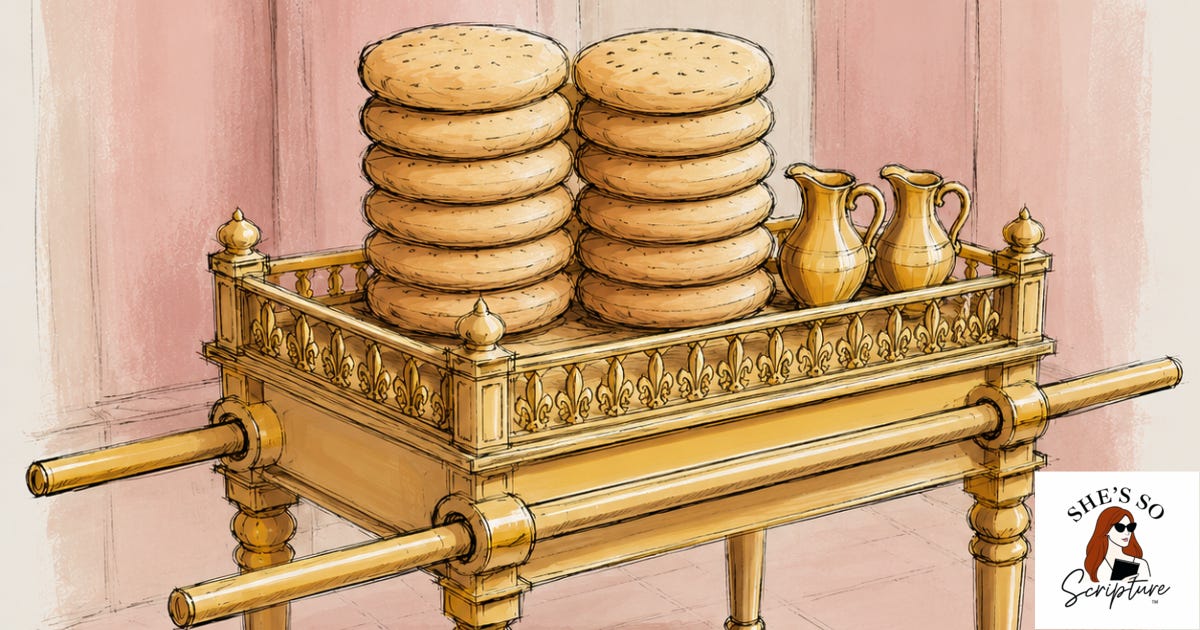
There’s a table sitting in the Tabernacle that almost nobody talks about. Not the ark. Not the altar. The table. It’s made of acacia wood, overlaid with pure gold, and it sits in the Holy Place, right there in God’s living room, if you want to think of it that way. And on that table, every single week, without exception, there is bread.
Not a symbol of bread. Actual bread. Twelve loaves, baked from fine flour, arranged in two rows of six on a golden table, sitting there in the presence of God. And the instruction is not complicated: don’t let the table go empty. Ever.
That one small detail, that the table must never be bare, turns out to be one of the most loaded theological statements in the entire Torah. And most people stroll on right past it. Let’s fix that!
The Table That Told a Story
God gives Moses the blueprint for the Tabernacle in Exodus 25, and right there in verse 30, tucked between the ark instructions and the lampstand design, is this command:
“Always set the bread of the Presence on the table before Me.” (Exodus 25:30, TLV)
Always. Not on feast days. Not seasonally. Always.
The Hebrew name for these loaves is lechem hapanim, which translates directly as “bread of the faces” or “bread of the Presence.” The word panim is the same word used throughout Scripture for the face of God. To stand before God is to stand lifnei Adonai, before His face.
So these loaves weren’t just sitting on a piece of furniture. They were sitting before the face of God. They were an act of constant audience with the presence of the Lord.
That already changes things, doesn’t it?
What the Loaves Were and Why Twelve
Leviticus 24 fills in the details. The instructions are precise in a way that clearly matters: fine flour, twelve loaves, two rows of six, pure frankincense placed alongside each row.
Every Shabbat, Aaron changes the bread. The old loaves are removed and eaten by the priests in the holy place, and a fresh set replaces them immediately, so the table is never empty even for a moment.
According to rabbinic tradition, this handoff happened with both sets of priests present (the incoming priestly division arriving as the outgoing division completed its week of Temple service), so the table wouldn't sit bare for even a moment.
“Also you are to take fine flour, and bake twelve cakes of it, with two tenths of an ephah in each cake. Then you are to set them in two rows, six in a row, on the pure gold table before Adonai... Every Yom Shabbat he is to set it in order before Adonai continually. It is an everlasting covenant on behalf of Bnei-Yisrael.” (Leviticus 24:5-6, 8, TLV)
Twelve loaves, one for each tribe of Israel. The people don’t come in. They don’t see this bread, they’re not allowed past the outer court. But they are represented before God’s face in bread form, every single Shabbat, through the priestly intermediary, as an everlasting covenant.
The word there is brit olam, an eternal covenant. This isn’t merely a ritual. It’s a relational commitment expressed through ritual. God is saying: my people belong at My table. Their presence before Me does not expire.
The frankincense is burned when the loaves are changed. Not the bread itself; the incense is the fire offering. The bread becomes the food of the priests, eaten in the holy place. It never hits the ground. It never goes to waste. It goes directly from God’s table to the priests’ mouths, which is its own remarkable thing.
The Bread Nobody Was Supposed to Touch
Here’s where Scripture does something so typically Scripture, which is to immediately complicate its own categories. I do love that about Scripture, not gonna lie!
In 1 Samuel 21, David is on the run from Saul. He’s hungry, his men are hungry, and he shows up at the sanctuary at Nob and basically tells the priest Ahimelech, I need food.
The only food Ahimelech has available is the lechem hapanim, the bread of the Presence that has just been changed out for a fresh set. This bread is normally reserved for the priests. Leviticus couldn’t be clearer on this. And yet Ahimelech gives it to David.
Yeshua will later point to this exact story when He’s challenged by the Pharisees over His disciples plucking grain on the Shabbat.
He asks them: haven’t you read what David did? He entered the house of God and ate the bread of the Presence, which was unlawful for him to eat, and shared it with his men. (See Matthew 12:3-4.)
He uses this moment to say something about how the purposes of God for human beings sometimes exceed the letter of the law, and that mercy matters. The bread of the Presence shows up in that argument because of what it represents: life sustained by the presence of God, even when the rules seem to say otherwise.
The Verse Mapping Aid: Lechem Hapanim (לֶחֶם הַפָּנִים)
Lechem (לֶחֶם) is simply bread, the basic Hebrew word for it. You’ll find it in Bethlehem, the city whose name means “house of bread.” It’s ordinary and essential.
Hapanim (הַפָּנִים) is where it gets interesting. Panim means faces, or presence. It’s plural in its construction, which is worth noting, because in Hebrew the word for “face” is grammatically always plural, the way we say “glasses” for one pair.
Panim is used throughout Scripture for the face and presence of God. The priestly blessing in Numbers 6 says “may the Lord make His face shine upon you.” The verb panah means to turn toward. So panim is relational. It’s directional. It implies orientation toward someone.
The bread of the panim is bread that is perpetually turned toward God’s face. It sits in orientation toward His presence. And by extension, it represents Israel in orientation toward God, always, without interruption, an everlasting covenant.
Some translations render this “showbread,” which reduces the meaning considerably. This isn’t bread on display. It’s bread in relational audience. There is a difference, and it’s not a small one.

The Table That Ends in John 6
Now Yeshua is standing in front of a crowd in Capernaum. They have just watched Him feed five thousand people with five loaves and two fish. It was the original free catered event, and nobody forgot it.
So they follow Him across the lake hoping for another miracle meal, another sign, another moment where lunch appears without anybody having to pack a basket.
“I am the bread of life. Whoever comes to Me will never be hungry, and whoever believes in Me will never be thirsty.” (John 6:35, TLV)
He says it again a few verses later, in case they missed it:
“I am the bread of life. Your fathers ate the manna in the desert, yet they died. This is the bread that comes down from heaven, so that one may eat and not die. I am the living bread, which came down from heaven. If anyone eats this bread, he will live forever. This bread is My flesh, which I will give for the life of the world.” (John 6:48-51, TLV)
This is not some random bread illustration Yeshua grabbed because He looked around and saw somebody eating lunch.
This is a man who knew the Tabernacle. He knew Leviticus 24. He knew the bread of the Presence had been sitting on a golden table before the face of God for over a thousand years. Every Sabbath, twelve fresh loaves. Every Sabbath, a reminder that all twelve tribes stood continually before the Lord in covenant relationship.
And now Yeshua is standing in Capernaum essentially saying, “You know that bread? That was about Me.”
That is a bold statement.
The twelve loaves represented all Israel before God’s face. Yeshua says, “I fulfill that.”
The bread reserved for the priests and eaten in the holy place? He says, “I fulfill that too.”
The bread David received when he was hungry and in need, even when the rulebook seemed to say otherwise? Yeshua says, “Yep. That was pointing here too.”
Do you see what is happening?
The bread of the Presence was never ultimately about flour. It was never about baking techniques. Nobody in ancient Israel was standing around saying, “Wow, look at those carbs.”
The bread represented access.
Presence.
Provision.
Relationship.
The table was a visible reminder that God desired his people near Him. And now Yeshua is standing right in front of them saying, “The table you’ve been studying for centuries has a pulse.”
Honestly, if I had been standing there, I might have needed a moment. Because the crowd thinks they are having a conversation about bread. Yeshua is having a conversation about Himself.
The table was never empty. The invitation was always there. And now the One to whom the table pointed is standing in front of them offering access not just to priests, not just to Israel’s leaders, but to anyone willing to come.
No wonder this conversation went sideways. The crowd wanted another free lunch.
Yeshua was offering covenant access to the presence of God.
My Final Thoughts
The Tabernacle contained a lot of things, but one of the things it contained constantly, week after week and year after year, was bread. That detail is easy to overlook because bread feels ordinary. Gold catches our attention. The menorah catches our attention. The Ark certainly catches our attention. Bread sounds like lunch.
Yet God intentionally placed bread in His sanctuary and kept it there perpetually. That was not incidental. It was theological.
The bread of the Presence sat before the face of God as a visible reminder that the twelve tribes of Israel stood before Him in covenant relationship. Every Sabbath, fresh loaves were placed on the table. Every Sabbath, the cycle continued.
The bread was not removed because Israel had a bad week. It was not withheld because someone failed. It didn’t disappear every time the nation wandered into another round of rebellion (if that were the case it would hardly ever be there).
The table remained supplied because God’s covenant remained intact. Week after week, fresh bread testified to a relationship that God Himself was sustaining.
This is why Yeshua’s declaration in John 6 carries so much weight. When He says, “I am the bread of life,” he’s not reaching for a convenient spiritual metaphor because the crowd happens to be thinking about food.
He is stepping into a conversation God has been having with His people for centuries. He is drawing together the manna that sustained Israel in the wilderness and the bread of the Presence that stood continually before God’s face in the Tabernacle. Both had been telling a story all along.
And then Yeshua does something astonishing. He points to Himself and says, in essence, “That story is about Me.”
The manna fed Israel for forty years, but it could not ultimately satisfy. The bread of the Presence represented Israel before God for centuries, but it was still a symbol waiting for its fulfillment.
Yeshua stands in front of the crowd and declares that both realities find their meaning in Him. He is the true bread from heaven. He is the place where covenant, provision, presence, and access converge.
I have to smile when I think about it because the crowd came looking for another free meal. They are asking questions about bread, and Yeshua keeps answering questions they are not asking.
They want lunch. He is talking about covenant. They want another miracle. He is talking about access to the Father. They are focused on what fills a stomach. He is inviting them to consider what sustains a life.
By the time we reach the end of the story, the trajectory feels unmistakable. The bread of the Presence was never merely about bread. It was about belonging. It was about communion.
It was about a God who desired His people near Him. And if that is the story the bread has been telling from the beginning, then perhaps the invitation was always larger than anyone imagined.
You were never meant to stand outside staring at the table. The bread was always meant to be shared. The invitation was always meant to include you.
Dig Deeper
Exodus 25:23-30 | Leviticus 24:5-9 | Numbers 4:7 | 1 Samuel 21:1-6 | Matthew 12:1-8 | John 6:25-58 | Hebrews 9:1-5 | Revelation 3:20
Let’s Talk About This
Before today, had you ever thought about the bread of the Presence as a relational act rather than a ritual one? What shifts for you when you see it that way?
The table was never allowed to be empty even for a moment. What does that tell you about how God views our access to His presence?
Yeshua connects Himself directly to this Tabernacle bread in John 6. How does seeing that Old Testament background change how you read his “I am the bread of life” statement?
If this study stirred something in you, share it with a friend who’s been wondering if there’s more depth to the Bible than they’ve been given access to.
And if it left you wanting to go slower and deeper into the Word, I’ve got you! Paid subscribers get access to live Bible studies, extended studies, devotionals, theological teaching, spiritual formation practices, and a community that wants depth without pressure or performance. If you’re ready to step further into the Word, you’re welcome inside.
👉🏻 Join The Vault.
If a paid subscription isn’t feasible right now but this space has blessed you, you can leave a one-time tip here. Every gift helps sustain this work. 💕

About the Author
Diane Ferreira is a Jewish believer in Yeshua, a published author, speaker, seminary student, wife, and proud mom. She is the founder of She’s So Scripture and She Opens Her Bible. She is the author of several books, including The Proverbs 31-ish Woman, which debuted as Amazon’s #1 New Release in Religious Humor, as well as Holy, Hormonal and Holding On.
She is currently pursuing her graduate degree in Jewish Studies in seminary, with her favorite topics being the early church and Biblical Hebrew. Diane writes and teaches from a unique perspective, bridging her Jewish heritage with vibrant faith in the Messiah to bring clarity, depth, and devotion to everyday believers.
When she’s not writing, studying, or teaching, you’ll find her curled up with a good book, crocheting something cozy, traveling, or playing her favorite video games.
Tree of Life (TLV) – Scripture taken from the Holy Scriptures, Tree of Life Version*. Copyright © 2014,2016 by the Tree of Life Bible Society. Used by permission of the Tree of Life Bible Society.
Thank you for this. I love the deep dives. So good.
So beautiful- thank you💕