


I’ve signed a lot of contracts in my life. Mortgage. Phone plan. My daughter’s wedding venue contract with more cancellation clauses than I knew existed. A contract exists to spell out exactly what happens if somebody flakes. Who owes what, how the whole thing ends if it ends badly.
Biblical covenant has some of that same DNA, honestly. Stipulations. Consequences. Real legal teeth in places. So I’m not going to stand here and tell you covenant and contract are complete opposites, because that’s not quite true. What I WILL tell you is that covenant does something a contract was never built to do. It doesn’t just spell out an exchange. It makes you belong to somebody.
Cutting a Covenant
Genesis 15 has one of those scenes you skim past in a read-through-the-Bible-in-a-year plan and then feel a little robbed when you finally slow down and actually look at it. God tells Abram to bring some animals, split them in half, lay the halves out in two rows. No explanation given yet for why.
Jeremiah 34 fills in the blank for us, way later, in a completely different context. Officials in Jerusalem cut a calf in two and walked between the pieces to seal a covenant, and when they went back on their word, God tells them through Jeremiah exactly what’s coming, using that same imagery right back at them.
Most scholars read that ritual as a self-curse. Something like, may I end up like this animal if I break what I just swore.
Now here’s the detail that gets me every time. Genesis 15 doesn’t say Abram walked through those pieces. Abram’s asleep, a deep sleep, the same phrase used for Adam back in chapter 2. While Abram sleeps through the covenant’s ratification, God alone passes between the pieces, the smoking oven and the flaming torch representing His own presence, placing the covenant’s founding guarantee entirely on His faithfulness.
That doesn’t mean Abram has zero responsibility from here on out. Genesis 17 is going to ask circumcision of him. Genesis 18 is going to describe his household keeping the way of the LORD. But the foundation, the thing everything else gets built on top of, rests on God’s word… not Abram’s performance.
Sinai Has Both
There’s a phrase that shows up over and over, different centuries, different prophets, same words every time: “I will be your God, and you will be My people.” It’s relational to its bones. But as most of us know, Sinai wasn’t all warmth and no rules, because Exodus, Leviticus, and Deuteronomy are an absolute mountain of commandments, blessings, curses, consequences. Israel gets called a treasured people and a kingdom of priests in one breath and handed a detailed law code in the next.
Here’s what I want you to catch though. Look at the order. God doesn’t say obey Me and maybe I’ll consider rescuing you. He rescues them out of Egypt first and THEN hands them the commands. Rescue, then responsibility. Not the other way around, and that order is doing ALL the things.
After the people agree out loud to the terms, Moses doesn’t pass around paperwork and call a notary. He takes blood and throws it on them. Yeah… actual blood, actual people, standing right there.
“Behold the blood of the covenant, which ADONAI has cut with you, in agreement with all these words.” Exodus 24:8 (TLV)
Public. Witnessed. Representatives from the whole nation, Moses and Aaron and the elders, going up the mountain and sharing a meal in God’s presence on behalf of everybody watching from below.
People Break Covenant, But God Remains Faithful
I need to be straight with you here, because I could make this post sound tidier than it actually is. But if you have studied with me long enough, you know I’m not going to.
Jeremiah 31:32 doesn’t dance around it. God says plainly:
“My covenant which they broke.”
Broke. Not bent, not strained. Israel really did break faith, and real consequences followed, exile being chief among them. Hosea 6:7 might even compare it to Adam specifically, though I want to be honest, that verse is genuinely disputed among people much smarter than I.
It could mean Adam the man, or “like men” in general, or even a place called Adam. I’m not going to pretend that’s settled just because it makes a cleaner sentence.
Here’s what didn’t break though. God’s own sworn faithfulness. His promises to Abraham, Isaac, and Jacob. Israel’s actual standing as His people. Judgment happened, and it was real, but it happened inside the relationship, not as the ending of it.
Even the covenant curses laid out in Leviticus 26 and Deuteronomy 28 already assume restoration waiting on the other side of them. Leviticus 26 goes as far as putting these words in God’s own mouth, after page after page of consequences:
“I will not reject them, nor will I hate them into utter destruction, and break My covenant with them, for I am Adonai their God.” Leviticus 26:44 (TLV)
The covenant anticipated Israel’s failure before Israel ever failed and it also anticipated God's faithfulness after they did.. That’s the tension running through this entire story, and I don’t think we’re supposed to resolve it too fast. God’s faithfulness was never an excuse for Israel’s unfaithfulness. And Israel’s unfaithfulness was never, not once, the end of God’s faithfulness.

Jeremiah’s New Covenant is Renewal, Not Replacement
This is the section where I have to slow way down, because it’s really easy to read Jeremiah 31 and hear “well, that one didn’t work out, here’s the new model,” like God’s returning a defective product. That’s not what’s happening.
Look who the new covenant gets made with. Not a fresh batch of people. The house of Israel and the house of Judah, named specifically, same family.
“I will put My Torah within them. Yes, I will write it on their heart. I will be their God and they will be My people.”
That’s not a new religion handed to strangers. That’s the same people, renewed.
And yes, Jeremiah does call this covenant “not like” the one at the Exodus. Both things are sitting in the text at the same time. Real sameness, real newness. I know that’s uncomfortable if you like your theology in one tidy lane, but Scripture rarely obliges.
I want to gently push back on something a lot of us absorbed without meaning to; the idea that this is Torah of cold stone tablets versus a new religion of the warm heart. The idea of God’s Torah belonging in the heart was never the new part. In fact, Moses had already looked ahead to this exact day.
“Also Adonai your God will circumcise your heart and the heart of your descendants—to love Adonai your God with all your heart and with all your soul, in order that you may live.” Deuteronomy 30:6 (TLV)
That’s Deuteronomy, centuries before Jeremiah. What’s new in Jeremiah isn’t the concept. It’s God Himself promising to finish what the people kept struggling to sustain on their own. He’s not introducing the idea. He’s announcing its fulfillment.
And Jeremiah doesn’t even let this chapter end there. A few verses later, God says the sun would have to stop rising before Israel stops being a nation before Him. Then Jeremiah 33 goes even further and flatly rejects the idea that He’s cast off Jacob’s descendants. This isn’t a swap. This is the same faithful God, holding fast to the same covenant people all along.
Why This Actually Matters for Supersessionism
Here’s the thing supersessionism gets wrong, and I want to be precise about it because the sloppy version of this argument gets picked apart pretty easily. It doesn’t fail because covenant can’t include conditions or can’t be broken. It clearly can. We just spent two sections proving that. It fails because God keeps refusing to treat Israel as disposable, and He says so out loud, repeatedly, not just implied by a Hebrew grammar point.
Paul picks this exact thread back up centuries later, and he does it beautifully.
“for the gifts and the calling of God are irrevocable.” Romans 11:29 (TLV)
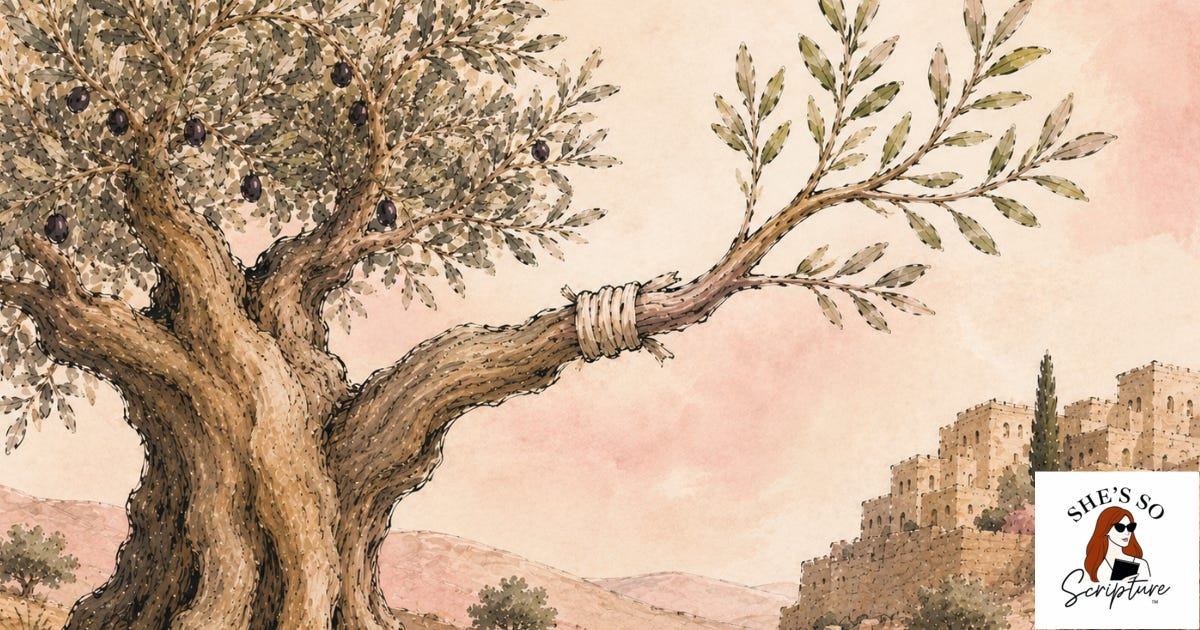
No wiggle room in that sentence. His picture for how Gentiles get folded in isn’t a new tree planted somewhere else to replace the old one. It’s not even one planted alongside the other one. It’s grafting.
A wild branch gets cut off its own tree and grafted into Israel’s cultivated root, drawing life from roots that were never its own to begin with. Paul pictures Gentiles receiving nourishment from Israel's cultivated root. He doesn't picture them replacing Israel.
Ephesians 2 says Gentiles used to be strangers to the covenants of promise, and now, through Messiah’s blood, they’ve been brought near. Near to Israel’s God. Near to Israel’s covenants. Not handed a separate set of their own.
Room gets made at the table. Nobody swaps out the table.
Verse Mapping Aid
Berit (בְּרִית) — Hebrew noun, covenant, treaty, or binding agreement. Frequently paired with the verb karat, to cut, forming the idiom karat berit, “to cut a covenant.” Likely reflects the ceremonies involving sacrifice and solemn oath described vividly in Genesis 15 and Jeremiah 34. Biblical covenants can carry promises, obligations, signs, sanctions, and legal stipulations, and they’re still relational and identity-forming at the center. God’s covenant with Israel isn’t just an exchange of duties. It forms a people, gives them an identity, and hands them a calling.
My Final Thoughts
I’m not going to pretend covenant has no conditions, because it clearly does, breaking included, and I’d rather tell you the true version than the tidy one. What I want you walking away with is what stayed put on God’s side of things even when it didn’t stay put on ours. Same faithful God. Same people, never swapped out.
Torah, always meant for the heart, finally written there by God’s own hand instead of our best efforts. None of that gives you a pass to treat this relationship carelessly. It’s the reason you can trust it’s still standing on the days you’ve got nothing left to bring to it.
Dig Deeper
Genesis 15:1-18, Exodus 24:1-8, Leviticus 26:40-45, Deuteronomy 30:1-10, Jeremiah 31:31-37, Jeremiah 33:19-26, Romans 11:11-29, Ephesians 2:11-22
Let’s Discuss
Where have you been treating your relationship with God like something more conditional, more fragile, or more transactional than Scripture actually describes?
If this study stirred something in you, share it with a friend who’s been quietly running their faith like a contract without ever noticing it. And if it left you wanting to go slower and deeper into the Word, I’ve got you! Paid subscribers get access to live Bible studies, extended studies, devotionals, theological teaching, spiritual formation practices, and a community of people who want depth without pressure or performance. If you’re ready to step further into the Word, you’re welcome inside.
If a paid subscription isn’t feasible right now but this space has blessed you, you can leave a one-time tip here. Every gift helps sustain this work. 💕

About the Author
Diane Ferreira is a Jewish believer in Yeshua, a published author, speaker, seminary student, wife, and proud mom. She is the founder of She’s So Scripture and She Opens Her Bible. She is the author of several books, including The Proverbs 31-ish Woman, which debuted as Amazon’s #1 New Release in Religious Humor, as well as Holy, Hormonal and Holding On.
She is currently pursuing her graduate degree in Jewish Studies in seminary, with her favorite topics being the early church and Biblical Hebrew. Diane writes and teaches from a unique perspective, bridging her Jewish heritage with vibrant faith in the Messiah to bring clarity, depth, and devotion to everyday believers.
When she’s not writing, studying, or teaching, you’ll find her curled up with a good book, crocheting something cozy, traveling, or playing her favorite video games.
Tree of Life (TLV) – Scripture taken from the Holy Scriptures, Tree of Life Version*. Copyright © 2014,2016 by the Tree of Life Bible Society. Used by permission of the Tree of Life Bible Society.
When I truly think about our covenant God, I can't doubt Him or His love.
Im so thankful that our God is a covenantal God and that He is in it for the long haul. We humans are messy and needs lots of forgiveness. He is willing to do that, as we are willing to seek. How great is He!!!