


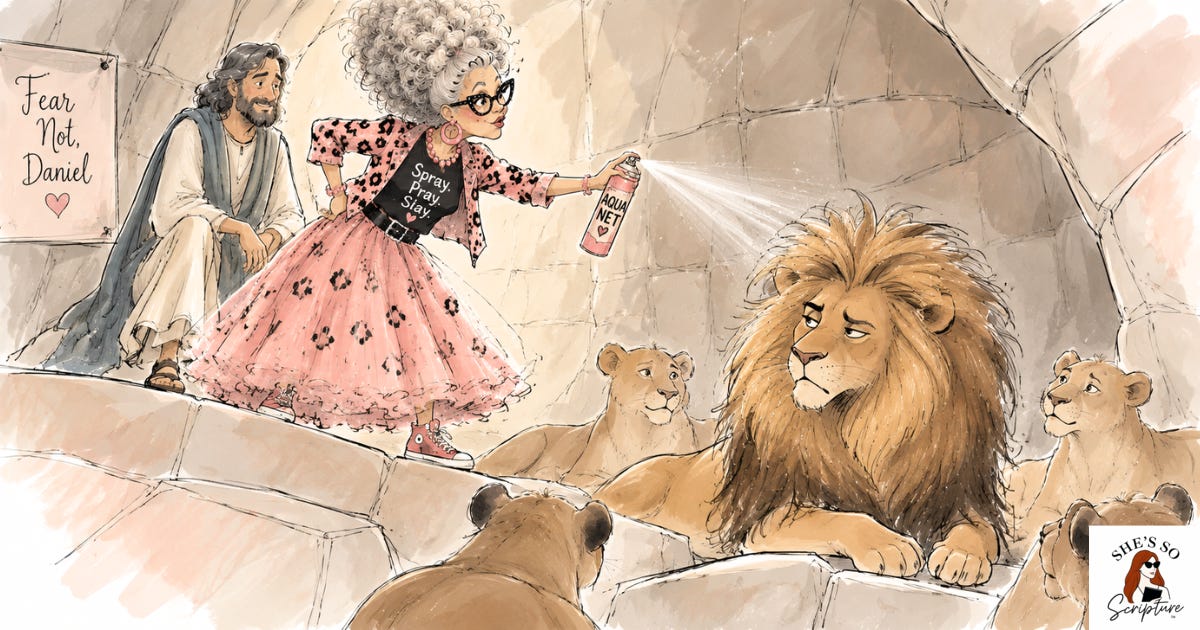
I had a felt board Daniel once. Well, I didn’t have him, my Sunday school did (the one I taught), and he came out every time this story got told. There he was in all his glory, with his little felt robe next to two very round, entirely too friendly looking lions. Nobody made these lions look hungry.
Miss Patty loved this one. Brave Daniel jealous coworkers, a king who cried a little, lions who just… didn’t. The moral, delivered in the tone normally reserved for stories where God clearly wins, was be brave and God will protect you.
I want to tell you what actually happens in Daniel 6. By this point, Daniel is likely an old man. When the decree is issued, he goes home and does exactly what he’s apparently been doing for years. He opens his windows toward Jerusalem, gets on his knees, and prays. Same place. Same practice. Same GOD. The only thing that changed was that now it could get him killed.
Daniel does it anyway.
A Law Built for One Man
Daniel is one of three administrators under Darius the Mede, an he’s so good at his job that the king is planning to put him in charge of the entire kingdom. The other officials go looking for a way to take him down. They comb through his HR files looking for corruption, negligence, anything. They find absolutely nothing. The text is almost funny about how thoroughly they fail.
At this time the supervisors and satraps tried to find ground for a charge against Daniel regarding the kingdom. But they were unable to find fault or corruption, because he was trustworthy and no negligence or dishonesty could be found in him. (Daniel 6:5, TLV)
So they stop looking for a crime and start building one instead.
For thirty days, anyone who prays to any god or any man except the king gets thrown into a den of lions. Darius signs off on it, probably flattered. The text doesn’t tell us whether he had any idea what he’d just handed his enemies: a weapon aimed directly at one man in his court who couldn’t be bought, bullied or blackmailed.
What they needed from Daniel was amazingly simple… that he keep doing what he’d always done, on schedule, where they could watch.
He Just Kept Doing His Thing
Daniel hears about this decree. He goes home, and in his upper room, where the windows open toward Jerusalem, he kneels down just like he does three times each day. (Daniel 6:11)
He doesn’t get louder. He doesn’t fling the windows open dramatically so everybody can see what a rebel he is. Daniel just goes home and does what he’s been doing all along. The text makes a point of telling us that this was already his habit. He had been praying this way long before anyone decided to make it illegal. Daniel didn’t suddenly start praying toward Jerusalem because somebody told him he couldn’t. Apparently, the decree wasn’t important enough to rearrange his schedule.
It was just another day for Daniel and a habit that was well established.
The Window That Wasn’t for Show
There’s a reason those windows faced Jerusalem, and it wasn’t feng shui. Centuries earlier, when Solomon dedicated the Temple, he prayed about this exact situation. If Israel was ever carried into exile and turned back toward Jerusalem and the house of GOD in prayer, he asked GOD to hear them from heaven.1 Daniel is doing exactly that.
A man far from home, decades into exile by the tine this happens, still orienting his body toward Jerusalem, still praying in the direction of a promise that hadn’t finished coming true yet.
The King Who Couldn’t Eat or Sleep
Darius isn’t the cartoon villain Miss Patty’s version needs him to be. Once he realizes what he signed and exactly who it has trapped, he’s genuinely distressed. He spends the rest of the day trying to figure out some way to get Daniel out of it. He can’t. At least as Daniel presents the law of the Medes and Persians, once the king signs it, even the king can’t simply take it back.
So, they toss Daniel in. Darius spends the whole night verklempt… he is torn up, can’t eat, can’t sleep, nothing to entertain him. Once the sun comes up he runs to the den, and the text says he “hurried” and he calls out to Daniel before he even knows if there’s anything left to answer him.
Now that is a man who liked someone, made a catastrophic error, and spent a very long night finding out if he could fix it. That’s no villain.

“My God Sent His Angel”
Daniel answers from inside the den:
“My God sent His angel to shut the lions’ mouths so that they haven’t harmed me, because I was found innocent before Him. Nor have I committed any crime against you, O king.”
(Daniel 6:23, TLV)
He doesn’t say the lions suddenly became friendly. This wasn’t an episode of VeggieTales where they all ordered pizza and called it a night. The lions were still lions. GOD sent an angel and shut their mouths. The danger was still right there in the den with Daniel. GOD intervened between Daniel and what could destroy him.
Darius has him pulled out, and the text tells us, almost clinically:
“No injury of any kind was found on him because he had trusted in his God.”
(Daniel 6:24, TLV)
What happens next isn’t something Sunday school typically covers, at least with the younger age groups.
The accusers are thrown into the den, and the text says their children and their wives go in with them, and the lions overpower them before they reach the bottom (Daniel 6:25, TLV)
I once had a snake. His name was Norman. Norman loved mice and toads and when I would bring one to his tank, he would have it in his mouth before it even hit the bottom. That is what I envision with these lions.
I miss Norman.
Anyway, I’m not going to dwell on it (or on Norman), but I’m also not going to pretend it’s something it’s not. The same den that couldn’t hold Daniel becomes exactly what his accusers built it to be, and the text never spares us the cost of that. Just look at Haman in the book of Esther. We see this happen time and time again in the Bible.
Written in the Empire’s Language
Daniel does something interesting partway through the book. At Daniel 2:4b, the language switches from Hebrew to Aramaic, and it stays there through the end of chapter 7. That makes sense in this setting. Aramaic was widely used across the Ancient Near East and became an important language of government and official correspondence under the Persian Empire.2
That’s a fitting language for this section of Daniel. Satraps, administrator, royal decrees, accusations, court politics, all of it unfolds in the language associated with the imperial world Daniel had been forced to live in.
And then there’s Daniel’s name, right in the middle of it all. Daniyyel (דָּנִיֵּאל) means “GOD is my judge” combining dani “my judge” with El “GOD”.
Daniel, whose very name points to another Judge is put on trial by an empire, and the whole thing gets narrated in the empire’s own language. Love that for him.
My Final Thoughts
I used to think this story was about courage under pressure, like some spiritual action movie where the hero stared down danger and wins. I obviously don’t think that anymore. I think it’s a story of what happens when an ordinary act of faithfulness, kept over time, gets discovered in public under the worse circumstances.
Daniel didn’t suddenly rise to the occasion. He just kept doing what he had already been doing.
The writer of Hebrews almost certainly has Daniel in mind when he praises those who, by faith, “shut the mouths of lions” in the Hall of Faith (Hebrews 11:33). He doesn’t name Daniel. He didn’t need to.
And I love that this is how Daniel is remembered. The lions get one night. The faithfulness behind that night had been built over years.
Several years ago, at my old church, we did a Bible study on habits. It involved leaving sticky notes around the house and I remember writing one that said “a habit is a kind of courage”. I think about it when I read this chapter of Daniel.

Dig Deeper
Daniel 3 - the fiery furnace, an earlier story where three of Daniel’s friends face an empire that tries to make faithfulness to God a capital offense.
1 Kings 8:46-49 - Solomon’s prayer at the Temple dedication, the promise Daniel’s windows were facing.
Psalm 34:7 - another biblical picture of the angel of the LORD bringing deliverance to those who fear Him.
Hebrews 11:32-34 - where Daniel shows up centuries later, unnamed, in someone else’s sermon about faith.
2 Timothy 4:17 - Paul awaiting his own trial, borrows Daniel’s language about being delivered from the mouth of the lion.
Let’s Talk in the Comments
Daniel’s faithfulness wasn’t something new. He’d been at it for years, decree or no decree. What’s something in your own life that has become so ordinary that nobody would think much of it until circumstances made continuing it costly?
Darius spends the entire night distressed over a law he can’t undo. Have you ever made a decision in good faith and only later realized what it was going to cost someone else?
And then there’s the lions’ den itself. GOD doesn’t keep Daniel out of it. Daniel spends the night in there. Where have you seen GOD meet you in the middle of something hard rather than removing it before you ever had to face it?
If you know someone who is white-knuckling her way through an ordinary season of faithfulness right now, send this to her. Sometimes faithfulness looks remarkably unimpressive from the outside. Daniel’s probably did too, right up until somebody made it illegal.
And if you want to study Scripture like this with me every week, come join us in the Chavurah. We have live Bible studies, deeper teaching, devotionals, courses, and plenty of room for the questions that don’t fit neatly into a Sunday post.
If a paid subscription isn’t feasible right now but this space has blessed you, you can leave a one-time tip here. Every gift helps sustain this work. 💕

About the Author

Diane Ferreira is a Jewish believer in Yeshua, a published author, seminary student, wife, proud mom, and a stroke survivor. She is the founder of She’s So Scripture and She Opens Her Bible. She is the author of several books, including The Proverbs 31-ish Woman, which debuted as Amazon’s #1 New Release in Religious Humor, as well as Holy, Hormonal and Holding On.
She is currently pursuing her graduate degree in Jewish Studies in seminary, with her favorite topics being the early church and Biblical Hebrew. Diane writes and teaches from a unique perspective, bridging her Jewish heritage with vibrant faith in the Messiah to bring clarity, depth, and devotion to everyday believers.
When she’s not writing, studying, or teaching, you’ll find her curled up with a good book, crocheting something cozy, traveling, or playing her favorite video games.
Notes
The connection between Daniel’s Jerusalem-facing prayer and Solomon’s Temple dedication prayer in 1 Kings 8:46-49 is a widely drawn intertextual reading; Daniel 6 doesn’t state this connection explicitly.
Daniel 2:4b through 7:28 is written in Biblical Aramaic, a major language of international communication and imperial administration across the ancient Near East. Persian imperial administration was multilingual, though Aramaic was widely used for official correspondence and bureaucracy.
The Hebrew name דָּנִיֵּאל (Daniyyel) is most naturally rendered “God is my judge,” from dani, “my judge,” and El, “God.”
Tree of Life (TLV) – Scripture taken from the Holy Scriptures, Tree of Life Version*. Copyright © 2014,2016 by the Tree of Life Bible Society. Used by permission of the Tree of Life Bible Society.