

What Your Sunday School Never Told You: David and Goliath Isn't a Story About Your Personal Giant

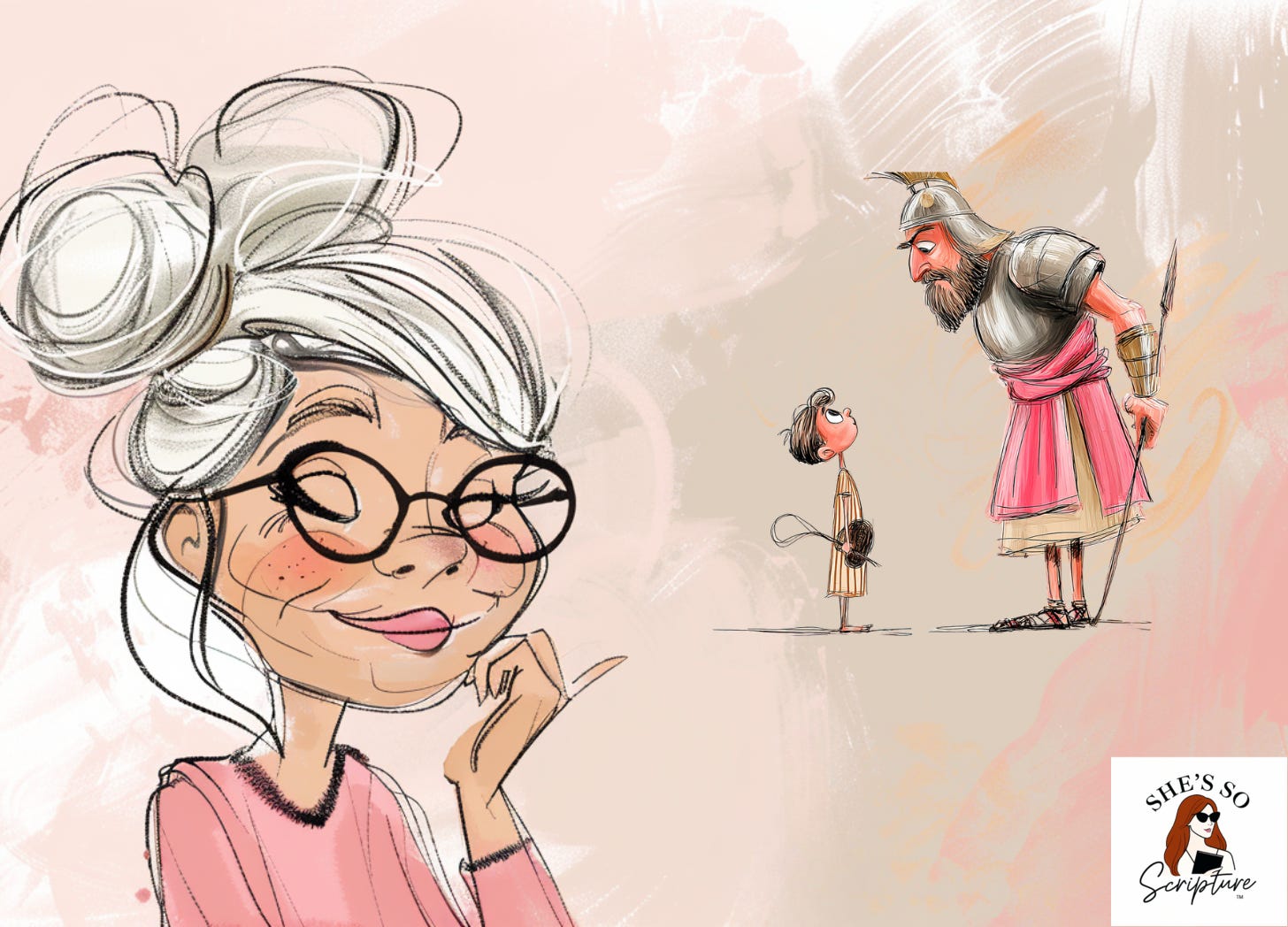
If you’ve ever heard a sermon on David and Goliath, you’ve probably been told to identify your giant. Maybe it’s fear. Maybe it’s debt. Maybe it’s that coworker who keeps scheduling meetings that could have been emails.
‘Miss Patty’ in Sunday school class certainly taught it that way. Big felt Goliath on the flannel board, little felt David with a sling, and a life lesson about facing your problems with courage. Gold star, animal cracker, see you next Sunday.
And I’m going to be honest with you. I wrote an entire blog post years ago with that exact angle. What’s your giant? How will you face it? I was sincere and I meant every word of it and I was also completely missing the point of the text. So if this one rewrites something for you today, just know it once rewrote something for me too.
Because David and Goliath isn’t a motivational speech. It’s a covenant confrontation. And David’s speech to Goliath is one of the most theologically loaded statements in the entire Old Testament, and it has absolutely nothing to do with your Monday morning.
“You are coming to me with a sword, a spear and a javelin, but I am coming to you in the Name of ADONAI-Tzva’ot, God of the armies of Israel, whom you have defied.”
1 Samuel 17:45 (TLV)
That’s not a man psyching himself up. That’s a covenant representative announcing whose authority he’s operating under. And the difference between those two things changes the entire story.
What’s Actually Happening in This Scene
First, we need to understand the military practice David is stepping into, because this isn’t just some random fight.
What’s happening in 1 Samuel 17 is representative combat. Two armies face each other across the Valley of Elah, and instead of a full-scale battle, one side sends out a champion to fight on behalf of the entire army. The winner determines the outcome for both nations.
Goliath isn’t just trash talking. He’s issuing a formal challenge under an established ancient Near Eastern military convention.
“Then the Philistine said to David, ‘Come to me, so I may give your flesh to the birds of the sky and the beasts of the field.’” 1 Samuel 17:44 (TLV)
When Goliath steps out, he’s representing the Philistine nation. Whoever fights him represents Israel. The stakes aren’t personal, they’re national. Whoever wins, wins for their entire people.
That’s why Saul should have been the one out there. He’s the king. He’s the tallest man in Israel. He’s the one anointed to lead in exactly this kind of moment. And he’s hiding in his tent. Forty days of Goliath issuing this challenge, morning and evening, and the king of Israel has nothing to say.
But it gets worse than silence. When David finally volunteers, Saul does something that tells you everything about where his faith actually is. He tries to put his own armor on David.
“Then Saul clothed David with his own garments. He put a bronze helmet on his head and clothed him with armor.” 1 Samuel 17:38 (TLV)
Think about what’s happening here. Saul won’t go fight the battle himself, but he wants to insert himself into it by having David wear his equipment. He wants his armor in the fight even though he refuses to be in the fight. That’s a man trying to participate in a victory he’s too afraid to pursue.
And it also reveals something deeper. Saul’s instinct is to solve this problem with human resources. Better armor. Better weapons. More protection. He’s looking at Goliath and calculating the odds in human terms, which is exactly why he’s been paralyzed for forty days.
David tries the armor on and can’t move in it.
“David said to Saul, ‘I can’t walk in these, because I’m not used to them.’ So David took them off.”
1 Samuel 17:39 (TLV)
And there it is. David knew something Saul didn’t. You can’t fight the enemy in someone else’s armor. You can’t step into a covenant battle wearing the equipment of a king who doesn’t have the faith to wear it himself. Saul’s armor represented Saul’s approach: human calculation, human strength, human strategy. David didn’t need any of it. He had a sling, five stones, and the Name of ADONAI-Tzva’ot. And that was more than enough.
David didn’t reject the armor because he was being stubborn. He rejected it because he understood that this battle required a different kind of preparation entirely. The king trusted armor. The shepherd trusted God. And that contrast is the whole point of the chapter.
David shows up to deliver lunch to his brothers and hears the challenge for the first time. And his response isn’t “I can take this guy.” His response is:
“Who is this uncircumcised Philistine, that he should defy the armies of the living God?”
1 Samuel 17:26 (TLV)
That word “uncircumcised” tells you EXACTLY what David is thinking. This isn’t about size or strength. It’s about covenant. Goliath stands outside the covenant of Israel. He has no standing before the God of Israel. And he has the AUDACITY (did you hear how I said that? LOL) to challenge the armies of the living God. David’s offense isn’t personal. It’s theological.
Verse Mapping Aid
David’s speech to Goliath in verses 45–47 is one of the most important theological declarations in all of 1 Samuel, and it’s structured with precision.
He begins by naming what Goliath trusts in: a sword, a spear, and a javelin. Three weapons. Military technology. Human power.
Then David names what he trusts in: the Name of ADONAI-Tzva’ot, God of the armies of Israel.
The Hebrew title צְבָאוֹת (Tzva’ot) means “of hosts” or “of armies.” This is a military title for God. David isn’t invoking a soft, devotional version of God’s name. He’s invoking the Commander of heaven’s armies. He’s saying you brought your weapons and I brought mine, and mine outranks yours by an infinite margin.
Then David states the purpose. Not “so I can win” or “so I can be brave.” Listen to what he actually says:
“This day ADONAI will deliver you into my hand...that all the earth may know that there is a God in Israel. Then all this assembly will know that ADONAI does not save with sword and spear. For the battle belongs to ADONAI, and He will give you into our hands.”
1 Samuel 17:46–47 (TLV)
David’s purpose statement has nothing to do with himself. It’s entirely about the reputation of God before the nations and before Israel. “All the earth” will know there is a God in Israel. “All this assembly” will know that the Lord doesn’t save through conventional military power.
David is making a public theological argument while walking toward a nine-foot-tall warrior. That takes more than courage. That takes conviction about whose battle this actually is.

What We Keep Missing
Here’s what happens when we turn this into “face your giant.”
We put ourselves in David’s place. WE become the hero. The giant becomes our personal problem. And the whole story becomes about our bravery.
But David isn’t the point of this story. God is.
David says it himself. “The battle belongs to the Lord.” He’s not claiming personal courage. He’s claiming divine authority. He’s not fighting for himself. He’s fighting as a representative of the covenant people on behalf of the covenant God. The victory that follows belongs to God, not to David’s slingshot skills.
And there’s a layer here that most sermons skip entirely. David is doing what the king was supposed to do. Saul, the anointed king, failed to represent Israel. He tried to send his armor into a battle he wouldn’t enter himself. David, the shepherd boy who has already been secretly anointed by Samuel in chapter 16, steps into the role that the current king has abandoned.
This is a kingship narrative disguised as a battle scene. David’s willingness to face Goliath demonstrates that he’s the leader Israel actually needs, and Saul’s refusal demonstrates that he’s already lost the throne in every way that matters.
The text is telling you something about the kind of king God chooses. Not the tall one hiding in the tent trying to dress someone else in his armor. The one who runs toward the fight because he understands whose name is at stake.
The Bigger Story
If you keep reading, the trajectory gets even more significant.
David defeats Goliath, and from that point forward, the narrative accelerates toward David’s kingship. The shepherd becomes the warrior, the warrior becomes the fugitive, and the fugitive becomes the king through whom God establishes an eternal covenant (2 Samuel 7). The line from David leads to Yeshua, the son of David. The ultimate representative who fights the ultimate enemy on behalf of all humanity.
When you turn David and Goliath into a personal empowerment story, you miss the fact that it’s a chapter in the longest story Scripture tells. It’s about representation, covenant, kingship, and the God who wins through the unlikely and the overlooked. David’s victory over Goliath prefigures a much larger victory that would come through his descendant, and that victory wouldn’t involve a slingshot. It would involve a cross.
My Final Thoughts
David and Goliath is a stunning story. But it’s not stunning because a brave kid beat a big bully.
It’s stunning because a shepherd boy with no armor and no military credentials walked into a covenant confrontation and declared the name of God before two nations while the anointed king sat paralyzed in his tent trying to dress someone else for a battle he wouldn’t fight.
The story isn’t asking you to find your inner David. It’s asking you to notice whose name David invoked, whose battle it actually was, and what kind of king God was already raising up while everyone else was looking at the wrong person.
The battle belongs to the Lord. It always has.
And that’s a far better foundation for your Monday morning than “be brave like David.”
Bible Study Questions
How does understanding representative combat as an ancient Near Eastern military convention change the way you read this narrative?
What does David’s use of the word “uncircumcised” in verse 26 reveal about how he’s framing this confrontation?
What does Saul’s attempt to put his own armor on David reveal about his approach to the battle and his faith?
How does David’s purpose statement in verses 46–47 redirect the focus from personal courage to the reputation of God?
How does the title ADONAI-Tzva’ot (Lord of Armies) shape the theological claim David is making?
Reflection Questions
Where have you been taught to read yourself as David in this story, and how does reading God as the central figure change the lesson?
Have you ever tried to fight a spiritual battle in someone else’s armor, using someone else’s methods or strategies instead of the way God has equipped you?
How does the idea that “the battle belongs to the Lord” reframe a current struggle in your life?
How does knowing that David’s victory is part of a larger kingship narrative that leads to Yeshua deepen what this story means to you?
Action Challenges
Read 1 Samuel 17 in its entirety and underline every statement David makes about God. Notice how few statements he makes about himself.
Read 1 Samuel 16 alongside chapter 17 and trace the kingship transition already underway before the battle even happens.
Study David’s speech in verses 45–47 and identify the three parts: what Goliath trusts, what David trusts, and the purpose of the victory. Sit with that structure.
Identify one area where you’ve been trying to fight in borrowed armor, using someone else’s approach or strategy, and ask God what it looks like to step into the battle with what He’s actually given you.
If this study stirred something in you, share it with a friend who’s been turning David and Goliath into a motivational poster and needs to hear what David actually said to that man.
And if it left you wanting to go slower and deeper into the Word, I’ve got you!
Paid subscribers get access to live Bible studies, extended studies, devotionals, theological teaching, spiritual formation practices, and a community of women who want depth without pressure or performance.
If you’re ready to step further into the Word, you’re welcome inside.
If a paid subscription isn’t feasible right now but this space has blessed you, you can leave a one-time tip here. Every gift helps sustain this work. 🤍

About the Author
Diane Ferreira is a Jewish believer in Yeshua, a published author, speaker, seminary student, wife, and proud mom. She is the founder of She’s So Scripture and She Opens Her Bible. She is the author of several books, including The Proverbs 31-ish Woman, which debuted as Amazon’s #1 New Release in Religious Humor, as well as Holy, Hormonal and Holding On.
She is currently pursuing her graduate degree in Jewish Studies in seminary, with her favorite topics being the early church and Biblical Hebrew. Diane writes and teaches from a unique perspective, bridging her Jewish heritage with vibrant faith in the Messiah to bring clarity, depth, and devotion to everyday believers.
When she’s not writing, studying, or teaching, you’ll find her curled up with a good book, crocheting something cozy, or playing her favorite video games.
Tree of Life (TLV) – Scripture taken from the Holy Scriptures, Tree of Life Version*. Copyright © 2014,2016 by the Tree of Life Bible Society. Used by permission of the Tree of Life Bible Society.
This was amazing, Diane! Though it’s always been good as a motivational study (lol), it is SO much better as a theological and covenantal truth when we are ready to accept that truth. Shalom!