


I promise you Miss Patty never touched this one. No felt board, no flannel Ehud, no craft where you glue a cotton ball beard on a judge of Israel. And once you actually read Judges 3 in full, you understand exactly why.
Somebody decided that was not felt board material. Fair enough. But it's still Scripture, and it's stranger and funnier and more theologically loaded than anything I learned as a kid.
The Judge They Left Off the Rotation
Ok, quick setup, because Judges runs on a pattern you’ll recognize even if you’ve never read this book all the way through. Israel does evil, God lets an oppressor move in, Israel cries out, and God raises up a deliverer.
By the time we get to chapter three, the oppressor is Eglon, king of Moab, and Israel had been paying him tribute for eighteen years.1 Eighteen years is most of a generation growingup under someone else’s thumb.
So now, enter Ehud, son of Gera, from the tribe of Benjamin. And the very first thing the text tells us about him, before going into any other details, is that he is left-handed.2 Hang onto that detail because we will come back to it.
The Detail Nobody Explains
The Hebrew phrase that describes Ehud is closer to “restricted” or “bound” in his right hand than to our simple “left-handed.” Commentators genuinely disagree about what that means.3 Some read it as an actual physical limitation. Others point to the Septuagint (LXX), the ancient Greek translation, which uses “ambidextrous” and argue that this describes a trained skill rather than a ‘disability’. 4
What makes me lean more toward the trained skill reading is Judges 20:16, later in the same book, where seven hundred handpicked Benjaminite men are described the same way and are famous for being able to sling a stone at a hair and not miss. 5
It’s hard to imagine seven hundred men sharing one ‘disability’ by coincidence. Benjamine seems to have had a tradition of specially trained southpaw fighters.
The debate isn’t resolved but, either way, this detail carries some weight in the story beyond biography.

Where He Hid the Blade
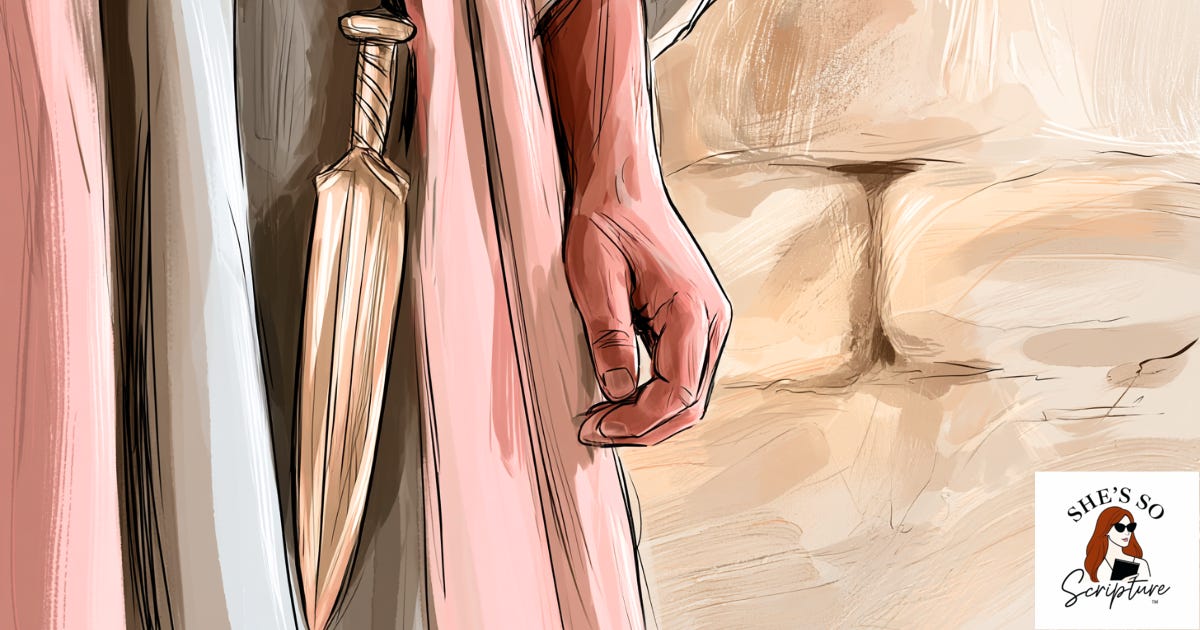
Ehud makes himself a short, double-edged sword. Its length is given in Hebrew as a gomed, which is a word that turns up absolutely nowhere else in the Bible. So no one can give you an exact modern measurement. Most translations come out around a cubit. 6 But, however long it actually was, it was short enough that he could strap it to his right thigh, under his cloak.
A sword was normally worn on the left side, for a right-handed draw. Ehud hides his on the unexpected right thigh instead. I think, and commentators agree, that his left-handedness is what let him carry a concealed weapon without attracting the usual suspicion.7 The text doesn’t describe a search taking place. What it does say is that Ehud placed his weapon somewhere nobody expected it.
He strolls on into Eglon’s court carrying Israel’s tribute money like a good, harmless vassal. And once the gifts are delivered and the crowd is dismissed, he turns back.
The King the Text Wouldn't Let Be Dignified
One more detail before the scene itself. Eglon is described as “a very fat man.” 8 Some scholars have pointed to his name echoing the Hebrew word for a young bull or a calf, and that the narrator keeps describing him in language reserved for livestock being fattened for slaughter!9
A name connection like that is one scholar’s literary proposal. I’m passing it along as that and nothing more. The narrator sets up a punchline at the expense of the oppressor and I am not even mad.
The Filth Came Out
Ehud tells Eglon he has a secret message from God. The king gets up from his seat… maybe out of respect for receiving a divine message but the text doesn’t say why. Alone in his private roof chamber, Ehud drives the sword into his stomach. The description after that is graphic on purpose. The handle goes in after the blade. The fat closes over it. And then comes a word that we see exactly one time in the entire Hebrew Bible, translated here as “the filth came out.”10
One longstanding interpretation reads that word as bodily waste, which definitely fits the humiliation bathroom humor that’s been built around this whole scene. Other scholars think it describes the wound itself, the blade essentially making its way out the other side.
The Hebrew is actually uncertain enough that at least one modern translation leaves the clause out of its main text completely. They treat it as maybe garbled in copying, since the word resembles another word, “vestibule,” that turns up one verse later.11
This one is genuinely up in the air, and I really want you to feel how much uncertainty is packed into a line that most of us never read twice. I, personally, am going with the bathroom humor. That is my interpretation and I am dying on that hill.
Ehud gets out, locks the doors behind him and he’s gone! The servants come and find the doors locked, and reach for the most polite explanation they could find. Surely he’s relieving himself.12 So they wait. They wait a while longer, past the point of comfort, because who wants to be THAT servant that interrupts the king in the bathroom?
By the time they finally get the key, Ehud is long gone, and their king is on the floor.
The narrator wanted you laughing, even if it is a little uncomfortably, at the exact moment something enormous was happening (no pun intended), and that kind of timing is way too careful to be serendipitous. Deliverance turns up here as a very awkward wait outside a locked door, and nobody in the room has a clue that’s what they’re witnessing.
The Rest of the Story
No, I am not trying to be Paul Harvey but I will tell you the rest of the story.
Ehud makes it past the idols near Gilgal, a place the text names twice… once on his way in and once on his way out, like a checkpoint.13 He gets to the hill country, sounds the shofar, and Israel rallies behind him. They seize the fords of the Jordan so no Moabite can make their way back across and escape, and the text says ten thousand of Moab’s strongest men fall that day.
Then it says something almost startling in how utterly simple it is: the land had peace for eighty years. 14 Eighty years, bought by a left-handed man, a hidden blade, and a very embarrassing bathroom joke.

Verse Mapping Aid:
Itter Yad-Yemino (אִטֵּר יַד־יְמִינוֹ) -Literally, “restricted of his right hand.” The phrase is deeper than our ordinary way of saying someone favored their left hand, a sense of being bound or shut up on that side, which is why translators have never fully agreed on whether it points to disability or to specialized training. 15 Whichever way you land, notice what the text does with it: the very trait that may have made Ehud look unremarkable, maybe even overlooked, becomes central to how he conceals the weapon and carries out his plan.
My Final Thoughts
I think about how carefully this story avoids making its hero impressive in the typical ways. Ehud isn’t strong like Samson. He’s not a general. He’s just a guy with a southpaw and a short sword he made himself who walked into a room carrying a tribute for a king who had no clue what was hidden beneath his clothes.
Judges is just full of deliverers that the Sunday School feltboard never quite knew what to do with. Ehud is just the one where the discomfort seems to be the loudest. Scripture let a bathroom joke bring eighty years of peace and it never once apologized for it! And again, I’m not even mad!
Dig Deeper
Read Judges 3:12–30 out loud, all the way through, and notice where you want to laugh and where you feel like you need to stop yourself. What does it do to your reading of Scripture to admit it’s allowed to be funny?
Ehud’s most overlooked trait turned out to be the whole plan. Where have you assumed some limitation, or just an oddity about yourself, ruled you out of something that might actually have been the opening?
Notice the servants outside that door, too polite and too patient to check on their own king. Do you ever feel that your own politeness might be keeping you from asking a question that needs asking?
If this study stirred something in you, share it with a friend who needs it. And if it left you wanting to go slower and deeper into the Word, I’ve got you! Paid subscribers get access to live Bible studies, extended studies, devotionals, theological teaching, spiritual formation practices, and a community of people who want depth without pressure or performance. If you’re ready to step further into the Word, you’re welcome inside!
If a paid subscription isn’t feasible right now but this space has blessed you, you can leave a one-time tip here. Every gift helps sustain this work. 💕
About the Author

Diane Ferreira is a Jewish believer in Yeshua, a published author, speaker, seminary student, wife, and proud mom. She is the founder of She’s So Scripture and She Opens Her Bible. She is the author of several books, including The Proverbs 31-ish Woman, which debuted as Amazon’s #1 New Release in Religious Humor, as well as Holy, Hormonal and Holding On.
She is currently pursuing her graduate degree in Jewish Studies in seminary, with her favorite topics being the early church and Biblical Hebrew. Diane writes and teaches from a unique perspective, bridging her Jewish heritage with vibrant faith in the Messiah to bring clarity, depth, and devotion to everyday believers.
When she’s not writing, studying, or teaching, you’ll find her curled up with a good book, crocheting something cozy, traveling, or playing her favorite video games.
Notes
Judges 3:12-14.
Judges 3:15.
The Hebrew phrase itter yad-yemino, literally “restricted/bound of his right hand,” is read by some commentators as physical impairment and by others as trained left-hand dominance; the debate is not resolved. See Ellicott’s Commentary and Keil-Delitzsch on Judges 3:15.
The Septuagint renders the phrase in a way generally understood as “ambidextrous,” cited by multiple commentaries as evidence for the trained-skill reading.
Judges 20:16.
Judges 3:16. The Hebrew term for the sword’s length (gomed) occurs only here in the Hebrew Bible; its precise length is uncertain, with most translations approximating a cubit.
The reading that the right-thigh placement helped conceal the weapon is a scholarly and literary inference drawn from ancient Near Eastern sword-wearing conventions (swords ordinarily worn on the left side for a right-handed draw); the text itself does not narrate a search or state this as Ehud’s explicit motive.
Judges 3:17.
H. Ausloos, “The Story of Ehud and Eglon in Judges 3:12-30: A Literary Pearl as a Theological Stumbling Block,” discusses the widespread, though not unanimous, scholarly reading connecting Eglon’s name and description to Hebrew terms for a calf or fattened animal, and argues for intentional sacrificial wordplay. Presented here as an established literary proposal rather than certain etymology.
Judges 3:21-22. The underlying Hebrew word (transliterated parshedonah) occurs only this one time in the Hebrew Bible.
Scholarly proposals for this word’s meaning include bodily waste, a description of the wound itself, or a possible scribal error connected to a similar word (”vestibule”) appearing in the following verse; at least one modern translation (NET) omits the clause from its main text for this reason. The meaning remains genuinely unresolved.
Judges 3:24.
Judges 3:19 and 3:26, both reference “the idols” near Gilgal as a location marker.
Judges 3:29-30.
Same sourcing as note 3.
I love it. It's one of my favorite stories. I'm left-handed and have suffered from right-handed bigotry for my entire life. I'm clumsy because I was forced to learn to play all sports right-handed in public school. I've read that if I was in the presence of jihadis, I could well be killed because they see left-handed people as evil. Another term for left-handed is sinister. So, I love the fact that the Lord does not have that bigotrous side to his character [blowing a raspberry]. >chuckle<
Pretty sure my Sunday School never even went near Ehud 🤣