


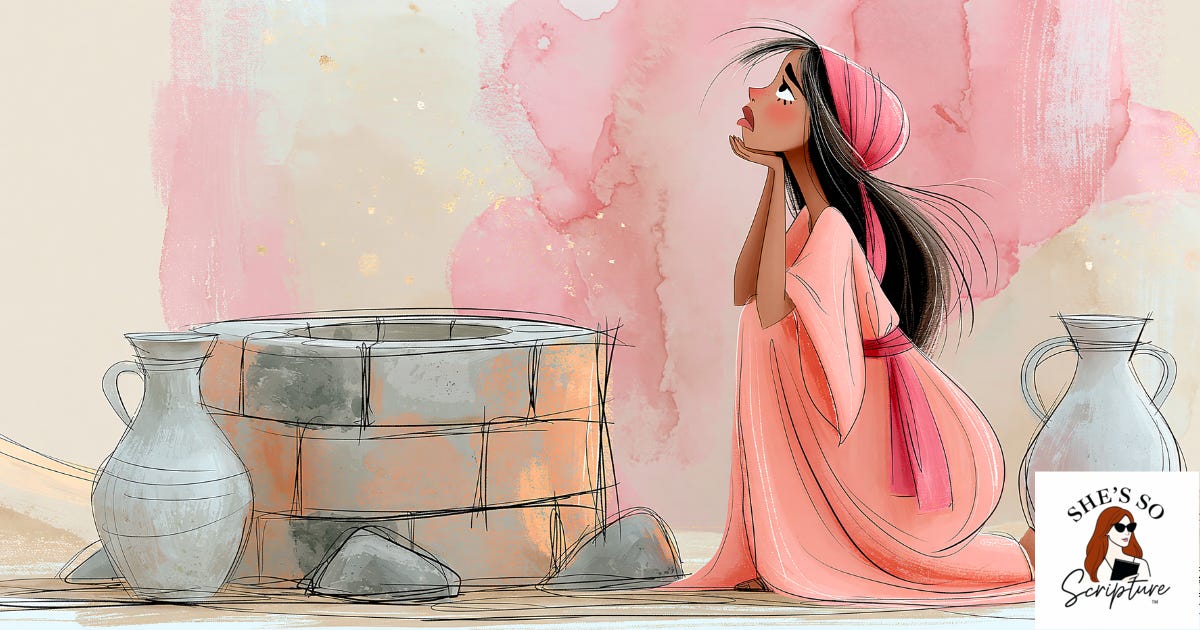
Miss Patty gave Hagar about ninety seconds of airtime. Somewhere between “Sarai got impatient” and “then Isaac was born,” Hagar shows up, has a baby, causes some drama, and exits stage left so the “real story” can continue. She’s a supporting character in somebody else’s faith journey. A plot device with sandals if you will.
Here’s what Miss Patty probably never told you. Hagar is one of the few Genesis figures to receive direct divine speech, and unlike Sarah or Isaac, she’s the one who names God in response.
She receives two divine interventions across her story. In Genesis 16, the angel of the LORD finds her in the wilderness. In Genesis 21, the angel of God calls to her from heaven.
And in the middle of that first encounter, an enslaved Egyptian woman standing outside the covenant line that God would establish through Isaac, though not outside God’s blessing, becomes the first person in Scripture recorded addressing God by a new title of her own.
Lock in and let’s learn more about Hagar.
A Slave Girl Addresses God by Name
Quick context, because Genesis 16 does not open gently at all. Sarai gives her slave-girl Hagar to Abram to bear a child on her behalf. Arrangements like this were a known ancient Near Eastern household practice, and Genesis narrates it here as a human attempt to secure the promise, one that spirals into humiliation, rivalry, and suffering almost immediately.
Hagar conceives, the relationship between the two women curdles fast, and Sarai treats her harshly enough that Hagar runs. Not toward anything. Just away.
Notice the direction of the story here. Hagar isn’t seeking God. God is seeking Hagar. This is also the first wilderness encounter in Scripture where God goes looking for someone who has been driven into the desert. It won’t be the last.
And that’s where He finds her. Not in a temple. Not in a moment of prayer. By a spring of water in the wilderness, a woman with nothing and no household she could truly call her own.
“Then the angel of Adonai found her by the spring of water in the wilderness, next to the spring on the way to Shur. He said, ‘Hagar, Sarai’s slave-girl, where have you come from and where are you going?’”
— Genesis 16:7-8 (TLV)
He calls her by name before reminding her of the social reality everyone else reduced her to. God doesn’t erase that reality. He speaks directly into it, and in doing so, hands back the personhood everyone else kept treating as incidental.
What follows is a promise that echoes the one Abram already received.
“I will bountifully multiply your seed, and they will be too many to count.”
— Genesis 16:10 (TLV)
That’s language deliberately echoing God’s promises to Abraham, extended here to a woman with no standing of her own within his household.
Then comes the part that should stop you in your tracks.
“So she called Adonai who was speaking to her, ‘You are the God who sees me.’”
— Genesis 16:13 (TLV)
El Roi. The Hebrew is debated, which we’ll get into below, but the plain fact stands on its own. In a book full of men receiving covenants, altars, and land grants, the first person in Scripture recorded addressing God with a new divine title is a foreign slave woman crying by a well.
A Preview of Israel’s Own Story
Here’s where the story gets almost too on the nose. The Hebrew word behind Sarai’s harsh treatment of Hagar in Genesis 16:6, often translated “afflicted,” shares its root with the word Scripture later uses for what Egypt does to Israel in Exodus.
An Egyptian woman is afflicted by the Hebrew matriarch. She flees into the wilderness. The LORD sees her affliction, meets her there, speaks to her personally, and promises her descendants a future as a nation.
Turn that around a few hundred years and Israel is the one enslaved, afflicted, and crying out in a wilderness, met by the God who hears and sees. Genesis lets an Egyptian slave woman become a mirror in which Israel would one day see its own story looking back at it.
The God Who Doesn’t Forget the Second Time Either
You’d think that would be the end of Hagar’s story, one dramatic wilderness encounter and then back to the margins. It isn’t. Genesis 21 sends her out a second time, years later, after Isaac is born and Sarah decides Hagar and her teenage son Ishmael can’t stay.
Abraham sends them off with bread and a skin of water, which runs out fast in the wilderness of Beer-sheba.
Hagar does what any mother would do. She can’t watch her son die, so she puts distance between them and weeps. And the text tells us whose cry is heard first. Not Hagar’s own voice. Ishmael’s.
“Then God heard the boy’s voice and the angel of God called to Hagar from heaven.”
— Genesis 21:17 (TLV)
The wording shifts here, from the angel of the LORD finding her in the flesh back in chapter 16 to the angel of God calling out from heaven now, but the personal attention doesn’t change.
The text doesn’t want you to miss this. Years earlier, before Ishmael was even born, God had told Hagar what to name him. Ishmael, יִשְׁמָעֵאל, means “God hears.”
Now a teenage boy is dying of thirst in the wilderness, and the promise folded into his own name is the thing that saves his life. His name was the commentary on the moment before the moment ever happened.
God doesn’t leave either of them there.
“Then God opened her eyes and she saw a well of water.”
— Genesis 21:19 (TLV)
It doesn’t say God made a well of water appear. It doesn’t say Hagar opened her eyes and saw a well. The well, her answer, was there the whole time. She just couldn’t see it until He opened her eyes to it.
The Well Isaac Would Later Call Home
Here’s the detail that seems to get buried every single time this story gets taught. The well Hagar named back in Genesis 16, Beer-lahai-roi, the Well of the Living One Who Sees Me, doesn’t disappear from the story. It shows up through Isaac’s life at two separate points.
Genesis 24 finds Isaac coming from Beer-lahai-roi at the very moment Rebekah arrives to become his wife. Genesis 25 tells us that after Abraham’s death, Isaac settled there for good.
Hagar’s well isn’t a footnote quietly tucked away after everyone else has died. It sits on the edge of Isaac’s wedding story and then stays in his orbit for the rest of his life.
Think about it for a second. The covenant son ends up making his home at the well an enslaved, cast-off woman named for the God who saw her. Her testimony became a landmark on Isaac’s own map.
And Isaac’s well isn’t the last one. Rebekah gets found at a well. Jacob meets Rachel at a well. Moses meets Zipporah at a well. And centuries later, Yeshua meets another marginalized woman beside another well and reveals Himself to her.
By the time you reach the rest of Scripture, wells have become places where God repeatedly meets people at turning points in the story. Hagar’s well is the first of many.

Verse Mapping Aid: El Roi (אֵל רֳאִי)
The Hebrew here is El Roi, from the root ra’ah, meaning to see. Scholars debate the exact nuance, and it goes a little deeper than a simple either/or. The suffix on the word can be read as “the God who sees me,” “the God of my seeing,” or even “the God whom I see.” However it’s translated, Hagar’s point comes through clearly. She has encountered the God who truly saw her in her distress.
Genesis 16:13 also records Hagar’s own reaction to the encounter, and the second half of that verse is famously one of the hardest phrases in the Hebrew Bible to translate.
“Would I have gone here indeed looking for Him who looks after me?”
— Genesis 16:13 (TLV)
That’s a real, defensible translation, but it’s one interpretive decision among several rather than a lexical slam dunk, and other English versions render the same quite differently. I won’t build too much theology on that exact wording since the Hebrew itself is genuinely contested.
What IS stable across the different renderings is verse 14. The well gets a name, Beer-lahai-roi, “the well of the Living One who sees me,” and that name is the one that survives and travels with the story into the next generation.
El Roi itself doesn’t reappear elsewhere in Scripture the way a title like El Shaddai does. But the well sure does. Hagar’s testimony didn’t need to become a repeated divine title to matter. It became a fixed point on the map that Isaac himself would later call home.
My Final Thoughts
Hagar was foreign. She was enslaved. She was a woman with no legal voice in the household that controlled her future. By every measure the ancient world used to determine whose story mattered, she should have been invisible.
None of this makes her story tidy, either. In Genesis 16, the angel sends her back into the very household that mistreated her. In Genesis 21, God tells Abraham to listen to Sarah’s demand that Hagar and Ishmael leave, even while promising to care for them both.
Those aren’t comfortable resolutions, and I’m not going to pretend they are. Genesis lets the sharp edges of this story stay exactly where they are.
God found her anyway. Twice.
If you’ve ever felt like the supporting character in somebody else’s story, like the details of your life were too messy or too far outside the promise to matter to God, Hagar’s well has your name on it too.
He didn’t wait for her to have status before He saw her. He saw her in the wilderness, with nothing, and gave Scripture one of its most unforgettable portraits of the God who sees.
Dig Deeper
Genesis 16:1-14, Genesis 17:20, Genesis 21:8-21, Genesis 24:62, Genesis 25:11, Exodus 3:7, John 4:1-26
Let’s Talk in the Comments
Hagar is the first person in Scripture recorded addressing God by a new title, even though she stands outside the covenant line God would establish through Isaac. What does that tell you about who gets direct access to God’s presence?
Isaac later makes his home at the well Hagar named. Have you ever seen God repurpose someone else’s painful season into a landmark for your own life?
I read every comment, so don’t be shy.
If this one stirred something in you, share it with a friend who’s ever felt like a background character in her own life.
And if it left you wanting to go slower and deeper into the Word, I’ve got you! Paid subscribers get access to live Bible studies, extended studies, devotionals, theological teaching, spiritual formation practices, and a community of people who want depth without pressure or performance. If you’re ready to step further into the Word, you’re welcome inside.
If a paid subscription isn’t feasible right now but this space has blessed you, you can leave a one-time tip here. Every gift helps sustain this work. 💕

About the Author
Diane Ferreira is a Jewish believer in Yeshua, a published author, speaker, seminary student, wife, and proud mom. She is the founder of She’s So Scripture and She Opens Her Bible. She is the author of several books, including The Proverbs 31-ish Woman, which debuted as Amazon’s #1 New Release in Religious Humor, as well as Holy, Hormonal and Holding On.
She is currently pursuing her graduate degree in Jewish Studies in seminary, with her favorite topics being the early church and Biblical Hebrew. Diane writes and teaches from a unique perspective, bridging her Jewish heritage with vibrant faith in the Messiah to bring clarity, depth, and devotion to everyday believers.
When she’s not writing, studying, or teaching, you’ll find her curled up with a good book, crocheting something cozy, traveling, or playing her favorite video games.
Tree of Life (TLV) – Scripture taken from the Holy Scriptures, Tree of Life Version*. Copyright © 2014,2016 by the Tree of Life Bible Society. Used by permission of the Tree of Life Bible Society.
Thank you, Diane, for more on Hagar. I was especially intrigued by the significance of the well, and of God's use of wells as places of encounter.
It’s interesting that Hagar was treated so badly by Sarai, who apparently believe that the promised son would come to Abram and Sarai through Hagar. 🤔
Jesus, another Promised One, was treated the same way by His very own people. 😢
But El Roi sees it all! 🙌