


THE CASE FILE
Habakkuk 2 may be one of the most frequently lifted-out-of-context passages in Christian conversation. It often gets turned into a verse about personal vision, ministry strategy, or future planning. In Habakkuk itself, though, the vision is not a dream board. It is God’s own word about judgment, delay, and the kind of faithful trust that survives the wait.
You’ve seen it on journals. Business retreat slides. Ministry conference banners. “Write the vision and make it plain” has become shorthand for permission to dream big.
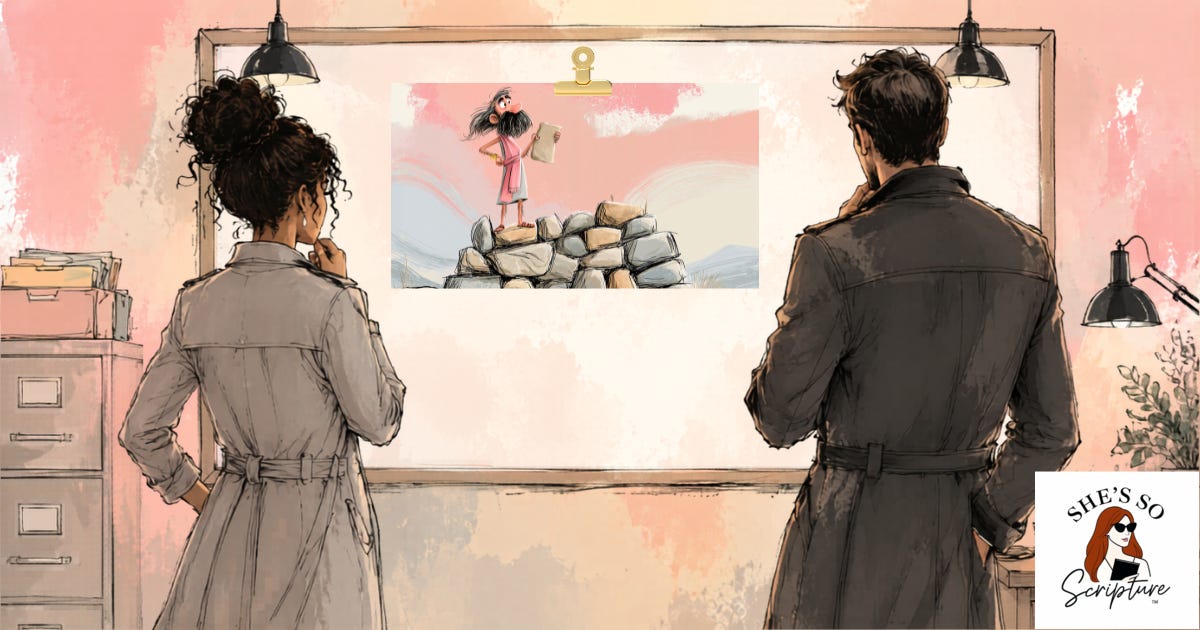
But Habakkuk wasn’t at a planning retreat. He was standing on a rampart, bracing for an answer he wasn’t sure he could live with. Case File No. 005 is open. Let’s investigate.
CASE SUBJECTS
The Accused: Habakkuk 2:2, currently doing time as motivational content across approximately every Christian productivity platform in existence.
The Charge: Detachment from a prophetic oracle about divine sovereignty and judgment, repurposed as a slogan for personal ambition.
The Victim: The actual word God spoke to a prophet in crisis, which is richer, more demanding, and honestly more beautiful than the motivational-poster version.
THE SCENE
Habakkuk speaks into the late seventh century BC, when Babylon was rising and Judah was under judgment. Many place the book during the reign of Jehoiakim.
He wasn’t prophesying at the people. He was talking directly to God, and he wasn’t holding back. Chapter 1 opens with a lament about violence and injustice in Judah that nobody was addressing.
God answered, and the answer was worse than the silence: I am raising up the Babylonians. They’re coming. They’re My instrument of judgment.
Habakkuk pushed back. He wasn’t questioning whether Babylon was evil.¹ He was questioning how a holy God could employ a nation even more wicked than Judah as His instrument.
That’s not a minor complaint. That’s a man wrestling with a genuinely disturbing picture of providence. So he planted himself on the rampart at the top of chapter 2 and waited.
“I will take my stand at my post, and station myself on the rampart, and I will watch to see what He will say to me, and what I will answer regarding my argument.”
(Habakkuk 2:1, TLV)
That’s the scene we walk into at verse 2.
EXHIBIT A: THE LANGUAGE
The word translated “vision” is the Hebrew chazon (חָזוֹן, pronounced khaw-ZONE), You can find it in Strong’s H2377.
In the Hebrew Bible, this is prophetic vision language, not the language of self-invented life goals.² It’s the word used to title entire prophetic books. Isaiah 1:1 opens with “the chazon of Isaiah.” Nahum 1:1 is “the chazon of Nahum.” Habakkuk 2:2 is not about personal branding or strategic life planning. It’s God’s revelatory word entering a crisis.
“Make it plain” doesn’t necessarily mean “make it easy to understand,” the way we tend to read it. Rashi, the great medieval commentator, reads the verse as an instruction to write the vision clearly enough on the tablets that it could be read.³
Other scholars have understood the phrase “so that the reader may run with it” a few different ways: that the writing was to be large or clear enough to be read at a glance, or that a herald could proclaim it accurately while running with the message. Either way, the emphasis is on legibility for urgent public proclamation, not on simplifying a complicated idea. Write it clearly so it can be publicly proclaimed.
The Hebrew word luach refers to a writing tablet, a term that naturally conveys the idea of permanent, publicly displayed writing. It may remind readers of Sinai-style tablet imagery from Exodus, where the same word describes the stone tablets of the Ten Commandments. That connection is suggestive, not conclusive.
It doesn’t mean Habakkuk’s oracle is a second Sinai, but it does underscore that this revelation was meant to be preserved as a lasting, authoritative public witness, a point the scholar Francis Andersen makes well in his commentary on the emphasis these verses place on permanence and public transferability.⁴
And verse 3 slows the whole thing down deliberately, in a way that’s easy to skip past on the way to the famous line in verse 4:
“For the vision is yet for an appointed time. It hastens to the end and will not fail. If it should be slow in coming, wait for it, for it will surely come, it will not delay.” (Habakkuk 2:3, TLV)
This vision is for an appointed time, and if it seems delayed, Habakkuk is told to wait. Pay attention to that because that’s not a footnote. That’s one of the chapter’s main controls on how everything after it should be read.
EXHIBIT B: WHAT THE VISION ACTUALLY WAS
If the misreading of verse 2 is bad, what’s worse is that almost nobody reads what the vision actually contained.
After the contrast in verse 4 between the proud and the righteous, Habakkuk 2:6–19 presents five woe oracles directed against the oppressor.
Woe to the one who builds on plunder.
Woe to the one who gains by violence.
Woe to the one who builds a city on bloodshed.
Woe to the one who humiliates his neighbor.
Woe to the one who worships what his own hands made.
Verse 20 then closes the section by calling the whole earth to silence before the LORD, a separate and climactic moment we’ll come back to.
This is a prophetic indictment of an empire. The vision God told Habakkuk to write down was a declaration that Babylon’s apparent invincibility was all an illusion, and that the God of Israel remained sovereign over the rise and fall of nations. Its immediate historical reference is Babylon’s reckoning.
EXHIBIT C: THE VERSE THAT ACTUALLY ANSWERS THE QUESTION
Verse 4, right after the famous verse, is the theological hinge of the entire book and somehow the least quoted line in it:
“Behold, the puffed up one, his soul is not right within him, but the righteous will live by his trust.” (Habakkuk 2:4, TLV)
The Hebrew word behind “trust” here is emunah (אֱמוּנָה, eh-moo-NAH), Strong’s H530. In Habakkuk’s context, emunah conveys steadfast, faithful trust rather than mere intellectual assent or abstract belief. This isn’t a contradiction of what believers mean by faith. It’s a thicker word underneath it.
The righteous person here isn’t commended for optimism or correct doctrine alone. He’s contrasted with the proud and unstable one. The emphasis falls on a steady, faithful mode of life that holds up under pressure, not a single moment of believing the right thing.
Jewish tradition itself recognized the enormous significance of this verse. The rabbis treated it as a summary of the Torah’s ethical demands, the final reduction of all 613 commandments down to a single principle:
“But it is Habakkuk who came and based them all on one principle, as it is said, But the righteous shall live by his faith.”⁵
That’s no small claim. That’s centuries of Jewish interpretive tradition recognizing this verse as the very heartbeat of covenant faithfulness, long before the Reformation ever got there.
Christians are not wrong to hear Habakkuk echo through the New Testament. Paul quotes this verse in Romans and in Galatians. The book of Hebrews draws on it too, and does more than quote the line about faith. As the author of Hebrews understood it, Habakkuk’s message wasn’t merely “believe.” It was “wait faithfully”:
“For yet in a very little while, the Coming One will come, and He will not delay. But My righteous one shall live by emunah; and if he shrinks back, My soul takes no pleasure in him.” (Hebrews 10:37-38, TLV)
Hebrews pulls in Habakkuk’s waiting language from verse 3 and fuses it with the faithfulness language of verse 4: don’t shrink back, wait, live by faithful trust. That’s very close to Habakkuk’s own emotional climate.
We don’t miss something by hearing Habakkuk in Paul and in Hebrews. We do miss something important when we quote the line about faith without the earlier lines about waiting, judgment, and the collapse of false security.
Habakkuk wasn’t dreaming big. He was hanging on.

EXHIBIT D: THE VERDICT THE BOOK BUILDS TOWARD
Habakkuk’s story doesn’t resolve at verse 4. It resolves at verse 20, the standalone closing line of the chapter, after the five woes have run their course:
“But Adonai is in His holy Temple. Let all the land be silent before Him.”
(Habakkuk 2:20, TLV)
Whether readers picture the Jerusalem Temple specifically or God’s heavenly throne room more broadly, the force of the verse lands the same way: the LORD reigns, and the earth falls silent before Him.
Habakkuk opened the book demanding an explanation. He’s arguing with God, pressing Him, standing at his post insisting on an answer. By the end of chapter 2, the posture has completely changed. The arguing turns to silence before God’s presence. And by chapter 3, that silence becomes one long prayer of trust, ending with one of the most stunning declarations of faith in the entire Hebrew Bible.
That arc, from demanding an explanation to silent worship to declared trust, is the real shape of the book. Verse 2 is the opening instruction inside that arc. It was never meant to stand alone as a productivity slogan.
If this case file cracked something open for you, drop your verdict in the comments. I want to know what verse you’ve heard misused the most, the one that makes you wince a little every time someone quotes it out of context.
And if you’re reading this as a free subscriber and you just got a taste of how deep these case files go, this is what The Chavurah has been all along. (Chavurah, pronounced khah-voo-RAH, is an ancient Hebrew word for a fellowship community that gathers to study and go deep in the Word together.) Full access means every Evidence Room file, live Tuesday Bible studies, audio lessons, devotionals, and a community that wants depth without pressure or performance. If you’re ready to step further into the Word, you’re welcome inside.
If a paid subscription isn’t feasible right now but this space has blessed you, you can leave a one-time tip here. Every gift helps sustain this work. 💕

FOOTNOTES
IVP Bible Background Commentary: Old Testament, on Habakkuk 1-2.
Theological Wordbook of the Old Testament and standard lexical usage of chazon (H2377) across the prophetic corpus.
Rashi, Commentary on Habakkuk 2:2.
Francis I. Andersen, Habakkuk: A New Translation with Introduction and Commentary, Anchor Yale Bible.
Babylonian Talmud, Makkot 23b-24a.
Tree of Life (TLV) – Scripture taken from the Holy Scriptures, Tree of Life Version*. Copyright © 2014,2016 by the Tree of Life Bible Society. Used by permission of the Tree of Life Bible Society.