


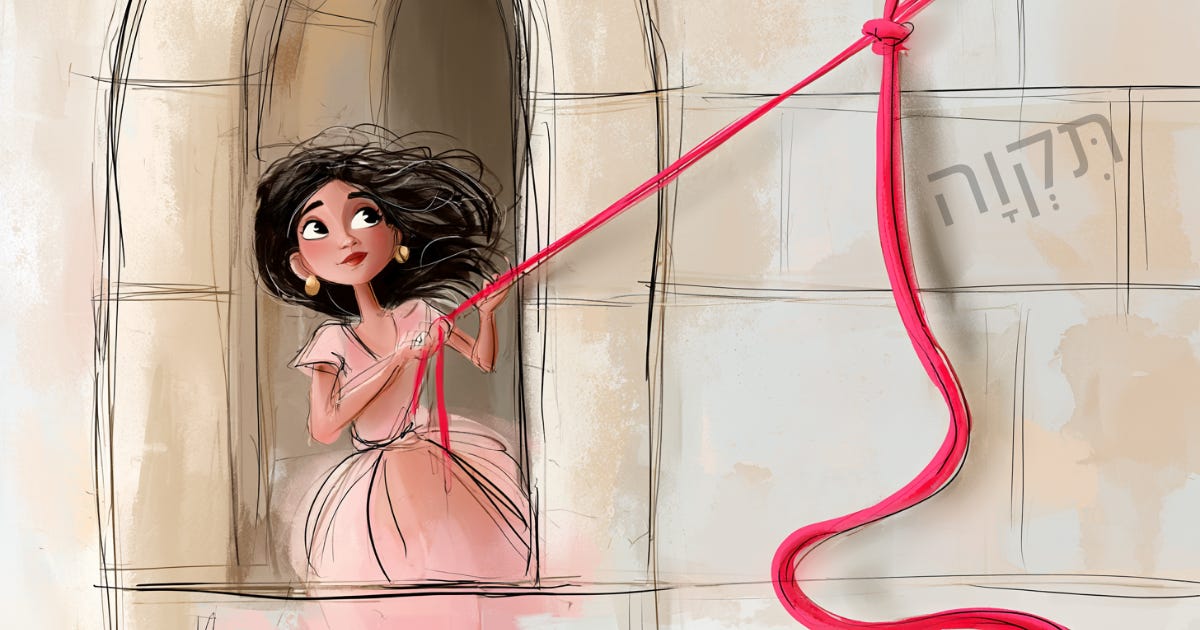
I was making a list. Every occurrence of the Hebrew noun tikvah in the Tanakh, verse by verse, because I wanted to write about hope and I like to know where a word has been before I trust it. Jeremiah 29:11 was on the list, obviously: “For I know the plans that I have in mind for you,” declares Adonai, “plans for shalom and not calamity—to give you a future and a hope.” (Jeremiah 29:11, TLV). Proverbs was on the list. Job was on the list.
And then Joshua 2:18 was on the list, and I sat there side-eyeing it, because Joshua 2 is not a passage about hope. It’s a passage about spies.
That’s how I ended up in Jericho. At a window. Holding a rope.
A Word Hiding in Rahab’s Window
Two Israelite spies slip into Jericho, and the person who saves their lives is Rahab, a prostitute whose house sits on the city wall. She hides them, lies to the king’s men for them, and confesses more accurate theology than most of Jericho combined. Then she lowers them out her window by a rope and asks them to spare her family when the city falls.
Here’s their answer:
“unless when we come into the land, you tie this line of scarlet thread in the window through which you lowered us down...” (Joshua 2:18, TLV)
And she does exactly that.
“So she said: ‘According to your words, so be it.’ Then she sent them away. After they had gone, she tied the scarlet cord to the window.” (Joshua 2:21, TLV)
The word translated “line” in verse 18 is what stopped me at my desk. It’s tikvah, sitting there in its construct form, tikvat, “the cord of.” Same noun. In Joshua 2, tikvah is a cord you can tie a knot in. In Jeremiah 29, tikvah is hope.
Now, I’ll be honest with you about the dictionaries, because y’all know that’s how we do things around here. Some traditional lexicons connect “cord” and “hope” under one root.
Others list them as separate nouns that happen to be spelled identically. The popular picture of strands stretched or twisted into a rope is evocative, but the etymology behind it is not settled, and I’m not going to pretend the scholars have shaken hands on it.
What nobody debates is what’s sitting on the page. The same Hebrew noun that usually means hope elsewhere in the Tanakh is, in this story, a scarlet cord tied to a window. Rahab’s hope hung where anyone could see it. It marked her house before the walls ever shook. Her hope had a knot in it.
Waiting Like a Rope Pulled Tight
The hope-sense of tikvah is commonly connected with the verb qavah, which usually gets translated “wait” or “hope.” You’ve already met this verb, even if you didn’t know it, because it’s hiding in one of the most quoted verses in Isaiah:
“but they who wait for Adonai will renew their strength. They will soar up with wings as eagles. They will run, and not grow weary. They will walk, and not be faint.” (Isaiah 40:31, TLV)
“They who wait” is this same root. And if we let the traditional rope association serve as devotional image, biblical waiting starts to look less like sitting in the dentist’s office flipping through a 2019 magazine and more like a line held under tension, stretched between you and the thing you’re anchored to. The rope only holds because both ends are attached to something.
Which honestly explains a lot about why waiting on God feels the way it feels. Nobody describes a season of waiting as relaxing. It pulls on you. Maybe the pulling is what the image is for.
Job uses this word too, of all people.
Job uses this word too, of all people. In Job 7:6 he compares his days to a weaver's shuttle, the little wooden piece that carries the thread back and forth across a loom, flying past faster than the eye can follow. My days go by like that, Job says, and they come to an end without tikvah.
Some readers hear a possible wordplay there. If the cord-sense resonates faintly behind the word, then the picture is a weaver running out of thread, and Job's hope runs out with it.
The Exiles and the Anchored Hope
Back to Jeremiah.
Jeremiah 29 is a letter to people sitting in Babylon, seven hundred miles from home, being told the exile will last seventy years. Do the math on seventy years and you realize many of the adults hearing that letter would never personally return. God was telling a devastated people to build houses, plant gardens, raise families, and trust Him across a distance most of them would never cross back over themselves.
And into that, He speaks tikvah. A future and a hope.
I doubt optimism would have survived Babylon. Optimism is a mood, and moods run out somewhere around year four. What God gave them was something fastened at the far end, a line running from their present captivity to His promised future, and He was holding it. They could pull on it. They could live by it for seventy years.
I keep noticing the order of things in both stories. Rahab’s cord went up before Jericho fell. The letter arrived in Babylon decades before anyone called for the moving truck. The hope shows up first, tied to something outside the situation entirely, and the deliverance comes later.
Israel’s national anthem, by the way, is called HaTikvah, “The Hope.” Written in the modern return-to-Zion movement, it gave national voice to a hope the Jewish people had carried through centuries of exile and loss.

Verse Mapping Aid
Tikvah (תִּקְוָה) is a Hebrew noun usually translated “hope” or “expectation” in the Tanakh. In Joshua 2, the same noun refers to a cord or line, the scarlet cord Rahab tied in her window.
Word: tikvah (תִּקְוָה), pronounced teek-VAH
Root: the hope-sense is commonly connected with qavah, to wait, to hope. Traditional lexicons differ on whether the “cord” sense and the “hope” sense share one root or are identically spelled homonyms. The rope imagery often preached from this word is a devotional picture, not a settled etymology.
Translated as: hope, expectation (Jeremiah 29:11, Proverbs 23:18, Job 7:6); cord or line (Joshua 2:18, 21, where it appears in construct form as tikvat)
Related verb in action: “they who wait for Adonai” in Isaiah 40:31 uses the root qavah
Watch for it: wherever your English Bible says “hope” in the Old Testament, check whether the underlying word is tikvah. When it is, ask what that hope is fastened to in the passage. There’s almost always an anchor point in the context.
My Final Thoughts
I keep returning to the window.
Rahab didn’t hide the cord under her mattress. Our girl tied it where every neighbor could see it, on a house built into the wall of a city that was about to be judged. Anyone walking past could look up and think, “What is Rahab doing??” She had no proof yet. Just the cord.
Most of us keep our hope tucked away like a savings bond, something we technically have but never look at. Hebrews 11 and James 2 remember the faith and courageous action of which that cord became a visible sign, and Matthew 1 goes further and places Rahab in the genealogy of Yeshua. The woman who tied a scarlet cord to her window ends up knit into the line that leads to Him.
So the question I’m thinking about this week is simple. If someone looked at my life from the street, could they see what my hope is tied to?
Dig Deeper
Joshua 2:1-21 and Joshua 6:22-25. Jeremiah 29:4-14. Isaiah 40:27-31. Job 7:6. Proverbs 23:17-18. Psalm 130:5-7. Hebrews 11:31. Matthew 1:5.
Let’s Talk in the Comments
Rahab tied her cord before a single wall fell. What would a “cord in the window” look like in your life right now?
The exiles were given tikvah alongside a seventy-year wait. How does knowing the original audience change the way you read Jeremiah 29:11?
Have you ever lived through a season where waiting on God felt like tension on a rope rather than rest? What was holding the other end?
If this study stirred something in you, share it with a friend who loves Jeremiah 29:11 and deserves to know about the rope.
And if it left you wanting to go slower and deeper into the Word, I’ve got you! Paid subscribers get access to live Bible studies, extended studies, devotionals, theological teaching, spiritual formation practices, and a community of people who want depth without pressure or performance. If you’re ready to step further into the Word, you’re welcome inside.
If a paid subscription isn’t feasible right now but this space has blessed you, you can leave a one-time tip here. Every gift helps sustain this work. 💕
Represent She’s So Scripture and Your Love of Exegesis!
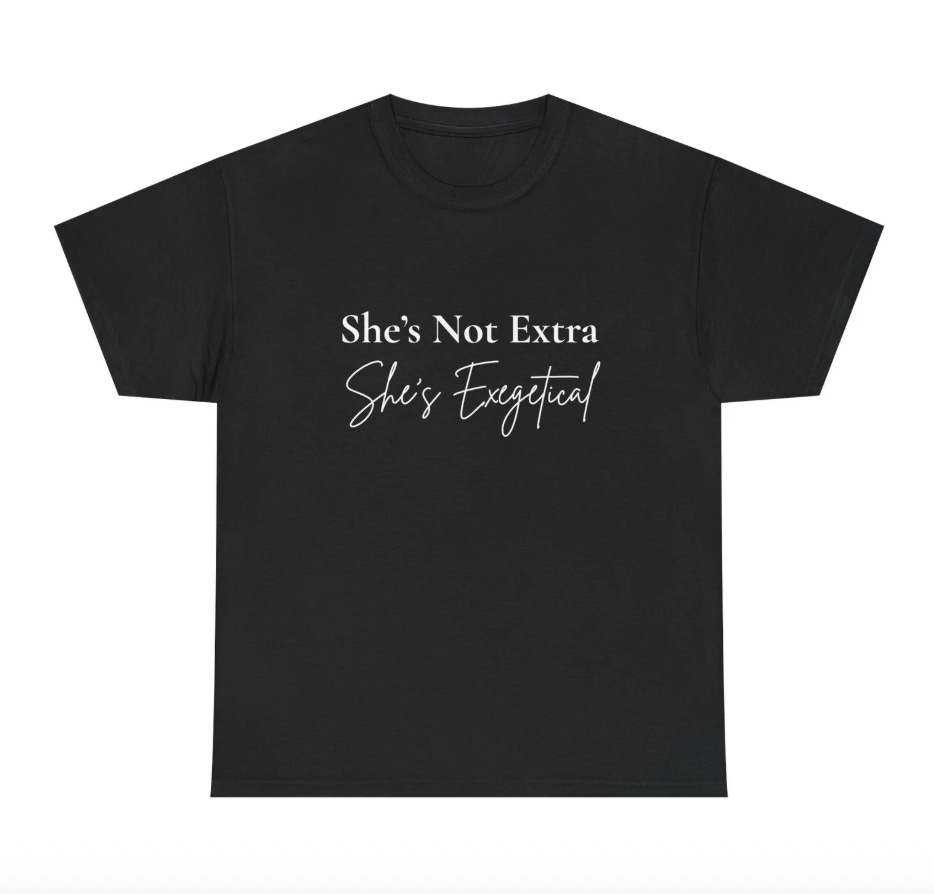
This is what we’re building here. Women who actually engage the text and don’t apologize for it.
If that’s “extra,” we’re fine with that.
In fact… we put it on a t-shirt.
“She’s not extra. She’s exegetical.”
You can get yours here.

About the Author
Diane Ferreira is a Jewish believer in Yeshua, a published author, speaker, seminary student, wife, and proud mom. She is the founder of She’s So Scripture and She Opens Her Bible. She is the author of several books, including The Proverbs 31-ish Woman, which debuted as Amazon’s #1 New Release in Religious Humor, as well as Holy, Hormonal and Holding On.
She is currently pursuing her graduate degree in Jewish Studies in seminary, with her favorite topics being the early church and Biblical Hebrew. Diane writes and teaches from a unique perspective, bridging her Jewish heritage with vibrant faith in the Messiah to bring clarity, depth, and devotion to everyday believers.
When she’s not writing, studying, or teaching, you’ll find her curled up with a good book, crocheting something cozy, traveling, or playing her favorite video games.
Tree of Life (TLV) – Scripture taken from the Holy Scriptures, Tree of Life Version*. Copyright © 2014,2016 by the Tree of Life Bible Society. Used by permission of the Tree of Life Bible Society.
That's interesting. If I got the picture right, it's like a "tow rope" and we are skiing with the rope constantly in "tension" as we follow Jesus. If we try to go to fast, the rope goes slack .... head over heels.
If we don't hold on, we sink.
I thought the color red in the Jericho story suggested the blood line of Jesus.
I heard a preacher say that was irrelevant. He denied the supernatural in every day life. Like finding a parking spot.
Thanks,
Jim