



Mark opens his Gospel by bringing several passages together. He begins with Malachi 3:1, which itself uses language from Exodus 23:20. Then he moves to the familiar voice crying in the wilderness. That’s the part that actually comes from Isaiah.
And yet Mark introduces the whole thing as though it came from one source: “as it is written in Isaiah the prophet.” Why he does that is debated among people much smarter than I and I won’t pretend that there’s a settled answer.
What we CAN say is that our earliest Greek manuscripts, found across different regions, read “Isaiah the prophet.” That’s also the reading you’ll find in nearly every modern critical edition. Later manuscripts make it more general and simply say “the prophets.” Poor Isaiah still gets his name attached to the whole thing, even though only the second half of the quotation actually belongs to him.
I’ll get to that. But first, we need to back up. Past Mark. Past John standing in the Jordan. Even past 1947, when Bedouin shepherds stumbled across the first Dead Sea Scrolls and gave biblical scholars enough work to keep them busy for the foreseeable future. Isaiah 40 already had a history of interpretation long before John stepped into that water. And knowing some of that history helps us see what the Gospel writers are doing with it.
Comfort, Comfort My People
Read Isaiah 40:1-11 on its own without John the Baptist looking over your shoulder in your mind. You get something very different from a prediction about some wilderness prophet six centuries out.
The chapter opens in the middle of a conversation, almost like we’re eavesdropping on God speaking to a heavenly council.
“Comfort, comfort my people,” says your God. Speak kindly to Jerusalem and tell her that her time of warfare is over, that her punishment is completed. For the Lord has made her pay double for all her sins.” (Isaiah 40:1-2, NET)
In the Hebrew it is נַחֲמוּ נַחֲמוּ עַמִּי, Nachamu, nachamu ami - Comfort, comfort my people.
This is an announcement to a community that has been through some things and has just stopped expecting good news.
Now, many scholars place the original audience near the end of the Babylonian exile, around the middle of the 6th century BC. Who actually wrote the passage, and when, is much more debated.
Some say that the 8th century prophet Isaiah wrote these words a century and a half before the events they describe. Others argue chapters 40-55 come from some later unknown voice working inside Isaiah’s own prophetic tradition, sometimes called Deutero-Isaiah in critical scholarship.
That’s a real scholarly fight but it’s also not one that I am planning to referee here. Whoever wrote it, the audience in the text is undeniable; a beaten-down people who need to hear, urgently, that God hasn’t forgotten them.
Then someone, or something, cries out that a road needs to be built. The first time around, Israel traveled through the wilderness after leaving slavery in Egypt. That journey only became forty years of wandering after the rebellion over the spies in Numbers 13–14.
Isaiah picks up that same imagery and turns it toward the road home from Babylon. This time, the wilderness is prepared in advance. Valleys are filled, mountains are leveled, crooked ground is straightened, and a highway is cleared for a king’s procession. Ancient Near Eastern (ANE) kings actually had roads prepared ahead of them, with workers sent out to clear obstacles before the king arrived. Isaiah takes that familiar royal image and gives it to God. 1
The passage ends much more gently than it began. God is pictured as a shepherd gathering the lambs in His arms and carrying them “close to His heart.”
But here is where it gets really interesting!
Where You Put the Comma
Unless someone has spent some real time in the Hebrew, this is the part almost nobody notices. And don’t worry… I’m not planning on giving you six paragraphs of Hebrew grammar.
Isaiah 40:3 in its earliest written form didn’t have the vowel points (niqqud) and cantillation marks later readers came to rely on. Ancient scribes still used spaces, paragraph breaks, and other marks, so this was not just a big wall of letters. But the Masoretic system that tells you exactly where pauses fall inside a sentence did not exist yet.
The consonants read something like ‘voice calling in the wilderness clear the way of the LORD’, and WHEN you hear the pause changes what the sentence is actually saying.
Centuries later, the Masoretes settled on one way of reading it. They placed a strong break after qore (קוֹרֵא), “calling,” so that “in the wilderness” goes with what comes next. In other words, the voice isn’t necessarily crying FROM the wilderness. The voice is saying, “In the wilderness, prepare the way of the LORD.”
That little pause can change how you hear the whole sentence.
The wilderness is WHERE the road gets prepared and not necessarily where the voice is standing. This is the traditional Jewish reading, not the one most Christians grew up with, and you’ll find it in lots of modern English translations too!
The NET Bible Full Notes Edition says:
A voice cries out, “In the wilderness clear a way for the LORD:” (Isaiah 40:4, NET)
The JPS Tanakh has:
A voice rings out: “Clear in the desert a road for GOD! Level in the wilderness a highway for our God! (Isaiah 40:3, JPS - Numbering is different here as well)
The Septuagint’s translators, who worked centuries before the Masoretes finished their system but were almost certainly drawing on an old reading tradition of their own, heard it differently.
In their version, “in the wilderness” belongs with “crying” and not with “prepare the way”. The voice itself is in the wilderness. This is the reading every Gospel writer follows, and it isn’t a mistranslation. A Hebrew line with parallel commands, with nothing connecting them, genuinely allows both readings.
So we have two readings, two different sentences.
The Hebrew allows for both and two ancient reading traditions simply heard the line differently. One of those readings turned out to matter a lot for how a wilderness prophet centuries later would get understood.
Into the Desert
Long before Matthew, Mark, Luke and John wrote anything down, at least one other Jewish community had already decided Isaiah 40:3 was about them, specifically. Track with me on this one.
Sometime in the 2nd or 1st century BC, a group of Jews organized into a tightly disciplined community and withdrew into the wilderness near the Dead Sea. Josephus and Philo, our two main 1st century sources for the varieties of Judaism in this period, describe something that resembles this group under the name Essenes, although the exact relationship between that label, the site of Qumran, and the scrolls that were found in its caves is still argued over by specialists, so I want to make sure you know that.
The community referred to itself as the Yachad, a Hebrew word that is typically translated as “community” or “the unity”. It left behind a foundational document scholars call the Community Rule, or Serekh ha-Yachad, catalogued as 1QS.2
Near the end of column eight, the Community Rule explains why the group physically separated and relocated to the desert. In Florentino Garcia Martinez and Eibert Tigchelaar’s translation, the members are told they are “to be segregated from within the dwelling of the men of sin to walk to the desert,” quoting Isaiah 40:3 directly to justify the move, and then explaining what “the way” actually is.
It’s “the study of the Law which He commanded through the hand of Moses.”3 A later column repeats the theme, describing the community’s ongoing task as “making ready the path to the desert.”
They weren’t building an actual highway! They physically withdrew toward the wilderness, but they interpreted the road-building itself as an intensive study of the Torah given through Moses, done together, far from the Jerusalem establishment the community considered corrupt.
Now, it would be really easy to overstate the connection to John the Baptist and I’ve watched plenty of popular teachings do just that so I want to be cautious. There’s no evidence that John belonged to this community, or any direct evidence linking him to Qumran at all!
What the Community Rule does show is that Isaiah 40:3 already had a defined communal meaning in one corner of 2nd Temple Judaism before John’s ministry. Go to the wilderness, and understand that move through Isaiah.
And it’s easy to forget, once you’ve got a vivid example in front of you, that the Yachad was one Jewish group among several operating during this period. It’s not a catch-all term for “the Jews” generally. Pharisees, Sadducees, and this separatist wilderness community all read the same Scripture and end up in very different spaces about how to live faithfully under it.

You Can Actually Go Look at This
One of the genuinely good things about working on 2nd Temple Judaism right now is that “Dead Sea Scrolls background” doesn’t have to be taken on faith anymore. The Israel Museum has digitized both the Community Rule and the Great Isaiah Scroll, and you can pull up high-resolution images from the comfort of your living room!4
The Great Isaiah Scroll, designated 1QIsaa, was among the first seven scrolls found in Cave 1 near Qumran. According to the traditional story, a Bedouin shepherd wandered into the cave looking for a stray animal and came out holding one of the oldest Biblical manuscripts ever recovered, and still the only nearly complete copy of Isaiah among all the Dead Sea Scrolls.
Paleographic and radiocarbon analysis place it around 125 BC, roughly 1,000 years older than the previously known complete Hebrew manuscripts of Isaiah. Its text tracks closely with the medieval Masoretic tradition that later became standard, while still preserving thousands of spelling differences and other textual variants.
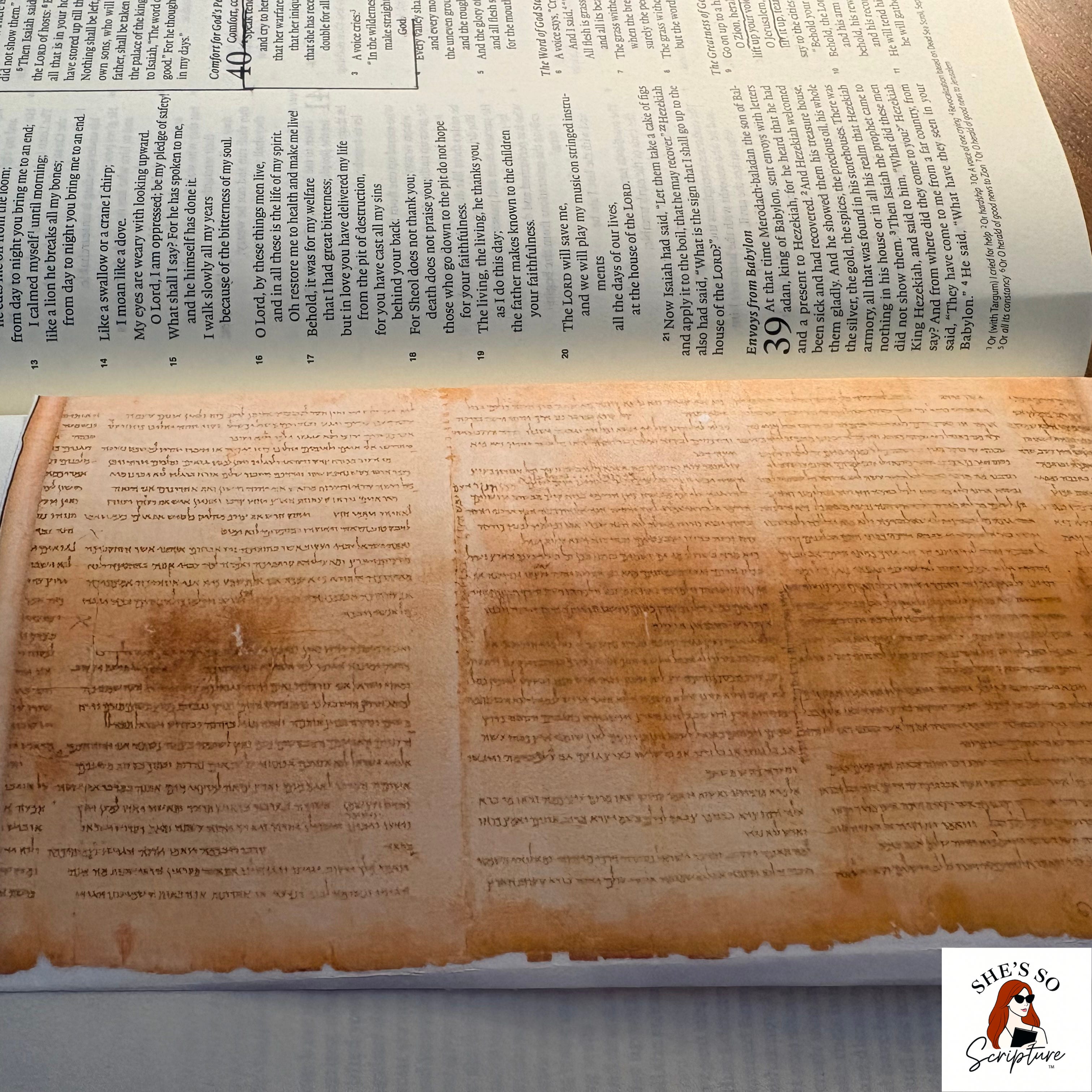
Isaiah 39 and the opening of chapter 40, the very texts we’ve been discussing, sit together around columns thirty-two and thirty-three, unpunctuated, exactly as ambiguous as I mentioned above. And of course they are… no one had the accents yet.5
I keep a printed photo of one of these columns inside Isaiah in my interleaved study Bible. It’s an occasional reminder that the text I’m parsing in my own Hebrew Bible has an actual physical history, handled by actual scribes, hidden in a cave for reasons that had nothing to do with me ever reading it two thousand years later!
One Voice, Four Writers
By the time we get to the Gospels, Isaiah 40:3 already had a history of interpretation. Generations before John, the Yachad had applied the verse to its own life in the wilderness. Each Gospel writer then uses the verse a little differently.
Mark’s citation does more than leave us sorting out which prophet said what. He brings Malachi’s messenger, who is connected with Elijah elsewhere, together with Isaiah’s voice in the wilderness. So before John even opens his mouth, Mark has already connected him to both.
Luke makes the Elijah connection clear elsewhere, describing John as coming “in the spirit and power of Elijah” (Luke 1:17), and Mark’s own description of John a few verses later, camel’s hair and a leather belt, is just how 2 Kings 1:8 describes Elijah himself.
Matthew keeps it simpler. He quotes Isaiah 40:3 by itself, attributed correctly, and applies it directly to John, who turns up in the wilderness of Judea dressed and eating like a man who has fully committed to the role.
Luke does something different again, and it is my favorite of the four.
He dates the scene with almost comical precision before he even gets to Isaiah: the fifteenth year of Tiberius, Pontius Pilate governing Judea, Herod tetrarch of Galilee, his brother Philip over Iturea and Trachonitis, Lysanias over Abilene, Annas and Caiaphas as high priests, and only THEN does the word of GOD come to John son of Zechariah out in the wilderness (Luke 3:1-2).
Luke brought receipts!
But it’s an oddly formal framing for a man who is eating bugs and calling people a brood of vipers. Very Luke.
He wants you to know this is dated history, tied to named officials you could, in principle, check against other sources.
He also keeps quoting past verse three, running the citation through verse five or six depending on your versification, all the way to “all flesh shall see the salvation of GOD.” That wording follows the Septuagint more closely than the Hebrew. The Hebrew simply says that all flesh will see God’s glory “together.”
Commentators have long pointed out that this exact phrase, “the salvation of GOD,” resurfaces almost word for word at the very end of Acts, when Paul tells Rome’s Jewish leaders that this salvation has now gone out to the Gentiles (Acts 28:28). I think the case for a deliberate bookend is strong, though we can’t prove it.
If it IS deliberate, Luke has used Isaiah’s ancient promise of a highway for GOD to frame his entire two-volume narrative (Luke-Acts), wilderness prophet to Gentile audience an ocean away.
John’s Gospel saves the most interesting move for last: John the Baptist quotes Isaiah about himself.
Priests and Levites arrive from Jerusalem to ask who he is, and he answers:
“I am the voice of one crying in the wilderness” (John 1:23, TLV)
That puts John in almost the same interpretive posture as the Qumran community before him. A Jewish figure reaching for this specific verse to explain his own strange wilderness vocation, in his own words.
There’s also the Jordan itself, and I don’t think we should miss this. Israel crossed this river under Joshua to enter the promised land, the very end of the wilderness generation’s story.
Technically, that crossing completes the exodus rather than repeating it. Still, the connection is pretty hard to miss. John is immersing repentant Israelites in those same waters while the Gospel frames the scene with Isaiah’s promise of a new road home from exile. One wilderness story is ending right where another is beginning.
Whose Way Exactly
Isaiah 40:3 isn’t vague about who is coming: the LORD, GOD of Israel, arriving in person to lead His exiled people back home.
Nobody in the 6th century BC would have read this as advance notice about a human forerunner clearing the way for another person.
Which is exactly what makes the Gospel writers’ move so bold. Mark opens his entire account, “the beginning of the good news (Besorah) of Yeshua the Messiah,” and immediately follows it with a citation about clearing the way for the LORD’s own arrival. Mark’s not being subtle and neither is Matthew, Luke or John, each of whom places this exact text at the threshold of Yeshua’s public appearance.
The claim that lies underneath the citation is enormous: the one whose coming requires this cosmic road-clearing, whose arrival Isaiah says will reveal divine glory to all flesh together, is being identified with a Galilean rabbi about to get wet in a river.
A 1st century Jewish reader who knew Isaiah would have felt that right away, whether or not they accepted it.
The Yachad reads ‘preparing the way’ as a communal task carried out through Torah study. The Gospels attach that same Isaiah text to the arrival of Yeshua. Same verse, very different claim.
My Final Thoughts
I don’t think the point of all this is “look how clever the Gospel writers were,” though they were and I’ll argue that over coffee with anyone who wants to.
The point, for me is that John doesn’t step into some vacuum. He steps into a text Jewish readers had already been arguing over, reinterpreting and applying to their own communities well before his ministry began.
The Yachad had already built part of its own wilderness identity around this verse. The Gospels take that living Jewish text and make a much bolder claim about Yeshua. And they do it from inside the Jewish interpretive conversation, not outside it.
A man from Nazareth, dripping in the Jordan, with Isaiah’s oldest promise now resting on him. Some who saw it believed… plenty didn’t.
If this study stirred something in you, share it with a friend who might need it too.
And if it left you wanting to go slower and deeper into the Word, I’ve got you!
Paid subscribers get access to live Bible studies, extended studies, devotionals, theological teaching, spiritual formation practices, and a community of people who want depth without pressure or performance.
If you’re ready to step further into the Word, you’re welcome inside.
If a paid subscription isn’t feasible right now but this space has blessed you, you can leave a one-time tip here. Every gift helps sustain this work. 💕

About the Author

Diane Ferreira is a Jewish believer in Yeshua, a published author, seminary student, wife, proud mom, and a stroke survivor. She is the founder of She’s So Scripture and She Opens Her Bible. She is the author of several books, including The Proverbs 31-ish Woman, which debuted as Amazon’s #1 New Release in Religious Humor, as well as Holy, Hormonal and Holding On.
She is currently pursuing her graduate degree in Jewish Studies in seminary, with her favorite topics being the early church and Biblical Hebrew. Diane writes and teaches from a unique perspective, bridging her Jewish heritage with vibrant faith in the Messiah to bring clarity, depth, and devotion to everyday believers.
When she’s not writing, studying, or teaching, you’ll find her curled up with a good book, crocheting something cozy, traveling, or playing her favorite video games.
Notes
On ancient Near Eastern royal road preparation as background to Isaiah’s imagery, see standard critical commentaries on Isaiah 40.
On the dating of the Community Rule and its association with the Essenes described by Josephus and Philo, see James C. VanderKam, The Dead Sea Scrolls Today, 2nd ed. (Grand Rapids: Eerdmans, 2010).
Translation of 1QS VIII:12–16 and IX:19–20 from Florentino García Martínez and Eibert J. C. Tigchelaar, eds., The Dead Sea Scrolls Study Edition (Leiden: Brill, 1997–1998).
Israel Museum, Digital Dead Sea Scrolls: Community Rule (dss.collections.imj.org.il/community); Great Isaiah Scroll (dss.collections.imj.org.il/isaiah).
On column divisions, dating, and textual character of 1QIsaa, see Eugene Ulrich and Peter W. Flint, Qumran Cave 1: II, The Isaiah Scrolls, Discoveries in the Judaean Desert XXXII (Oxford: Clarendon Press, 2010), and the Israel Museum’s own scroll documentation.
Tanakh: a New Translation of the Holy Scriptures According to the Traditional Hebrew Text. Philadelphia: Jewish Publication Society, 1985
Biblical Studies Press. The NET Bible. New English Translation. Biblical Studies Press, L.L.C., 1996–2017. https://netbible.com
Tree of Life (TLV) – Scripture taken from the Holy Scriptures, Tree of Life Version*. Copyright © 2014,2016 by the Tree of Life Bible Society. Used by permission of the Tree of Life Bible Society.