

How to Read the Scary Books of the Bible - Lesson Seven
New Creation, the Dwelling of God, and the Healing of the Nations

After dragons and beasts. After Babylon collapses under the weight of her own excess. After judgment has done its necessary, terrible work.
Revelation does not end in ashes.
It ends in renewal, and if we have been reading carefully, that should not surprise us at all.
From the very first pages of Scripture, the story has been moving toward restoration, not evacuation. Revelation does not abandon what began in Genesis. It brings it forward. Not backward to some recovered paradise, but forward into something the world has never yet seen.
A New Heaven and a New Earth
Revelation 21 opens with language that would have landed immediately for a first-century Jewish reader steeped in Isaiah. A new heaven and a new earth. Not a replacement for what was, but a renewal of what was always meant to be.
This matters more than we sometimes let ourselves sit with. The biblical story doesn’t end with God deciding the material world was a failed experiment. It ends with God restoring it. Creation was declared good at the beginning. Sin fractured it, yes, but the answer to the fracture is not destruction. It is healing.
And then there is the sea. John says the sea was no more, and if we read that as a geographical observation, we miss the point entirely.
In the apocalyptic imagination of the ancient world, the sea represented chaos, threat, the dark and uncontrollable forces that swallowed people whole (tohu v’vohu). Its absence in the new creation isn’t about coastlines. It is a theological declaration: chaos does not get the last word. What once symbolized instability no longer has a place in the world God is making.
The City Comes Down
Here is the detail that most people rush past, and it is the one that changes everything.
The New Jerusalem does not ascend. It descends.
The movement in Revelation 21 is downward. The holy city comes down out of heaven from God, like a bride adorned for her husband. God does not extract humanity from the earth and relocate us to some distant spiritual realm. God moves toward us. God descends. God dwells with humanity on a renewed earth.
This is not some new idea dressed up in apocalyptic imagery. This is the fulfillment of the oldest idea in Scripture.
From the garden where God walked with Adam and Eve in the cool of the day, to the tabernacle in the wilderness where the glory of God settled like a cloud, to the temple in Jerusalem where the presence of God took up residence among his people, to the prophets who promised that one day God would dwell among the nations, the whole of Scripture has been tracing a single, insistent thread. God with us. Emmanuel. Not someday in a far-off heaven, but here. Among. With.
Revelation doesn’t introduce a new theology… it fulfills an ancient promise.
“Behold, the dwelling of God is with humanity. He will dwell with them, and they will be his people, and God himself will be with them as their God.”
That is the whole story arriving at its destination.
If you want to go deeper on what the New Jerusalem meant in its first-century context, the architectural imagery, the tribal symbolism, the way John is deliberately layering temple and city and garden into a single vision, I wrote an entire book on this.
The New Jerusalem traces exactly that thread, from the Hebrew prophets through John’s vision, and I think it will change the way you read these final chapters. You can find it on Amazon or anywhere my books are sold.
The End of Tears
Revelation slows down here, and we should really let it.
God will wipe every tear from their eyes. Death will be no more. Mourning and crying and pain will be no more, for the former things have passed away.
This is one of the most tender moments in all of Scripture, and it is easy to read it as sentimental comfort, the kind of thing you put on a sympathy card. But it is so much more than that.
Remember where we have been in this book. Remember the martyrs beneath the altar in chapter six, crying out, “How long, O Lord?” Remember the souls of the faithful who suffered under empire, under accusation, under violence. Their suffering was never minimized in Revelation. It was witnessed. It was held.
And now it is answered.
The wiping away of tears is not God patting us on the head and telling us it wan’t all that bad. It is justice completed. It is the full weight of what was suffered met by the full weight of what God restores.
Restoration is not sentiment. It is the fulfillment of a promise made to every person who ever wept in faithfulness and wondered if anyone was paying attention.
God was paying attention.
The City as Garden
John is doing something remarkable in these final chapters, and once you see it you cannot unsee it.
He is bringing us back to the beginning.
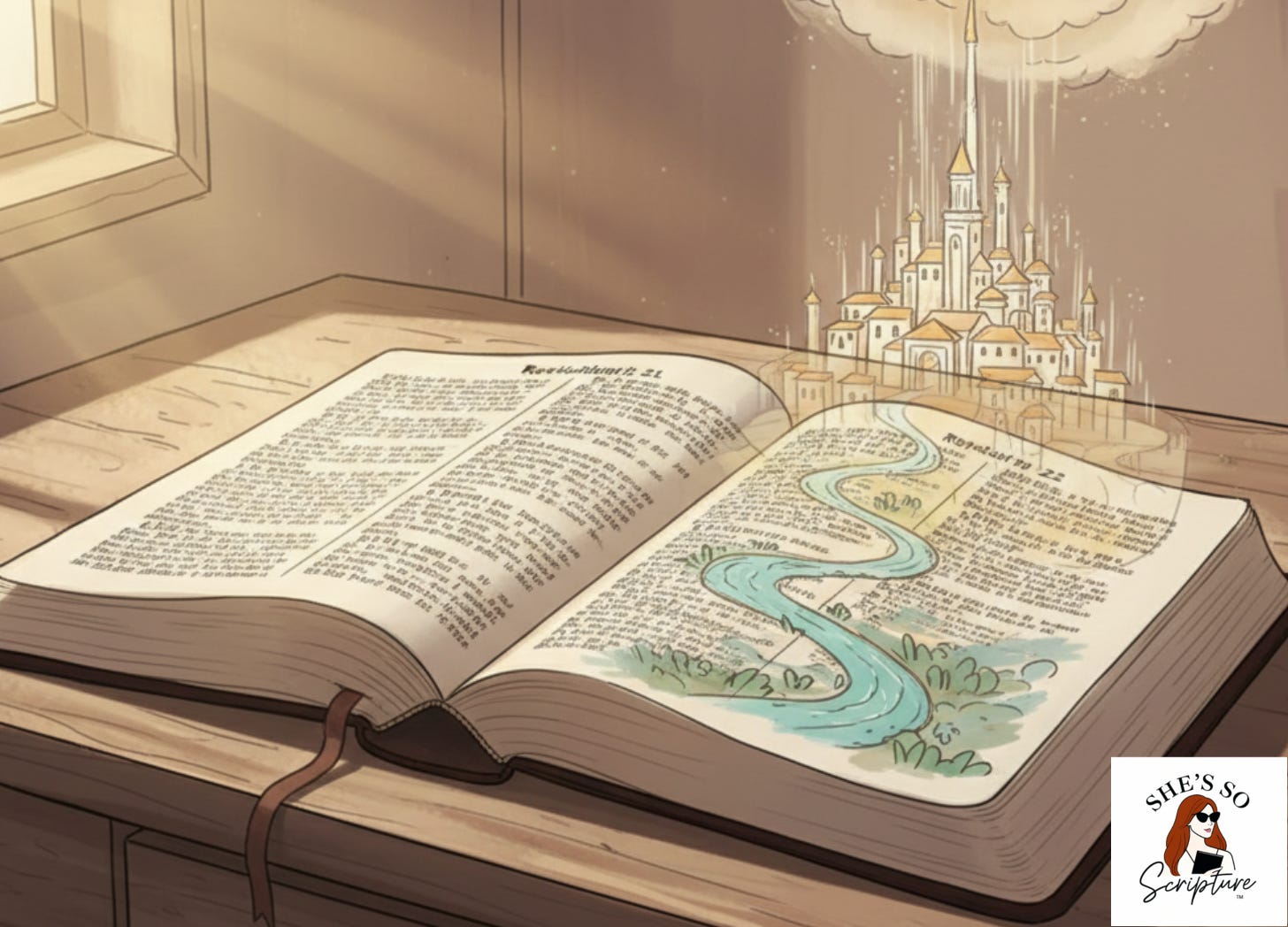
A river flows from the throne of God through the middle of the city. The tree of life appears, the same tree that was guarded by cherubim after the expulsion from Eden, the tree humanity lost access to. And the curse is lifted. The curse that fell over creation in Genesis 3, the fracture that sent thorns and toil and death into the fabric of human life, is simply and finally gone.
This is architecture. John is showing us that the story God has been telling since Genesis is coherent. It is going somewhere. The river that flowed in Eden now flows through a redeemed and renewed world.
The tree once guarded by a flaming sword is now accessible to all. The garden that was lost is not simply recovered. It is transformed into a city, a place of culture and community and full human flourishing.
The arc of Scripture bends toward restoration, not replacement. Toward fulfillment, not erasure.
The Healing of the Nations
This is the line I want to stay with for a moment, because I think it is one of the most quietly radical statements in all of Revelation.
Chapter 22 tells us that the leaves of the tree of life are for the healing of the nations.
Not the erasure of the nations. Not the flattening of every human distinction into some undifferentiated mass. The healing of the nations.
Nations are present in the new creation. The glory and honor of the nations are brought into the city. And the tree, this ancient symbol of life and access to God, exists for their healing.
Think about what John’s first readers would have understood by the word “nations.” They lived under Roman imperial power, which organized the world into hierarchies of domination. Nations were instruments of conquest, rivalry, violence. And yet John’s vision doesn’t imagine them destroyed. It imagines them healed.
The future God is making is not monochrome. It is reconciled. It is the full, beautiful, diverse family of humanity finally at peace, not because difference or distinction has been eliminated, but because everything that distorted and weaponized difference has been redeemed.
The Lamb Still at the Center
One final thing.
The throne at the center of the New Jerusalem is described as the throne of God and of the Lamb.
The Lamb who was slain is still the Lamb. Even in the fullness of renewal, even when all has been restored, the identity of Jesus is not rewritten. The one who gave himself remains at the center. The cross is not undone. It is vindicated.
This means the scars are part of the story forever. Redemption doesn’t erase history or pretend it never happened. It redeems it. Every wound, every loss, every faithful act of endurance becomes part of the testimony that fills the renewed creation.
What This Means for How We Live Now
If Revelation ended only in judgment, fear would be understandable. But it doesn’t end there. It ends in a city full of light, with a river running through it, and a tree whose leaves are still healing things.
That changes how we live in the present.
If God intends to renew creation, then what we do within creation matters. The work of justice, the practice of love, the cultivation of beauty, the care of bodies and communities, none of it is wasted.
If the nations are to be healed, then how we relate across difference right now is not trivial. If the Lamb reigns, then power must be understood differently in our present lives than the empires of every age would have us believe.
Revelation doesn’t end with a call to escape the world. It ends with an invitation to participate in the world’s renewal, beginning now, in the ordinary faithfulness of our daily lives.
The last word in Revelation is not a warning.
It is an invitation.
Come.
A Practice for This Week
Read Revelation 21 and 22 slowly, and resist the urge to rush through it. These are chapters are not meant to be read. They are meant to be inhabited.
Notice the echoes of Genesis. Pay attention to the downward movement of the city. Observe how the imagery transforms the themes you have been sitting with throughout the whole book. Chaos becomes calm. Exile becomes homecoming. The cries of the suffering become the occasion for tears that are wiped away.
Ask yourself: what is restored here rather than simply replaced? How does this vision answer the questions Revelation raised earlier? And what might it mean for you, right now, to live as a person whose future is not destruction but renewal?
Write your reflections slowly. This vision is too good to rush.
If this study stirred something in you, share it with a friend who might need it too.
And if it left you wanting to go slower and deeper into the Word, I’ve got you!
Paid subscribers get access to extended studies, devotionals. theological teaching, spiritual formation practices, and a community of women who want depth without pressure or performance.
If you’re ready to step further into the Word, you’re welcome inside.
If a paid subscription isn’t feasible right now but this space has blessed you, you can leave a one-time tip here. Every gift helps sustain this work. 🤍

Good post!