


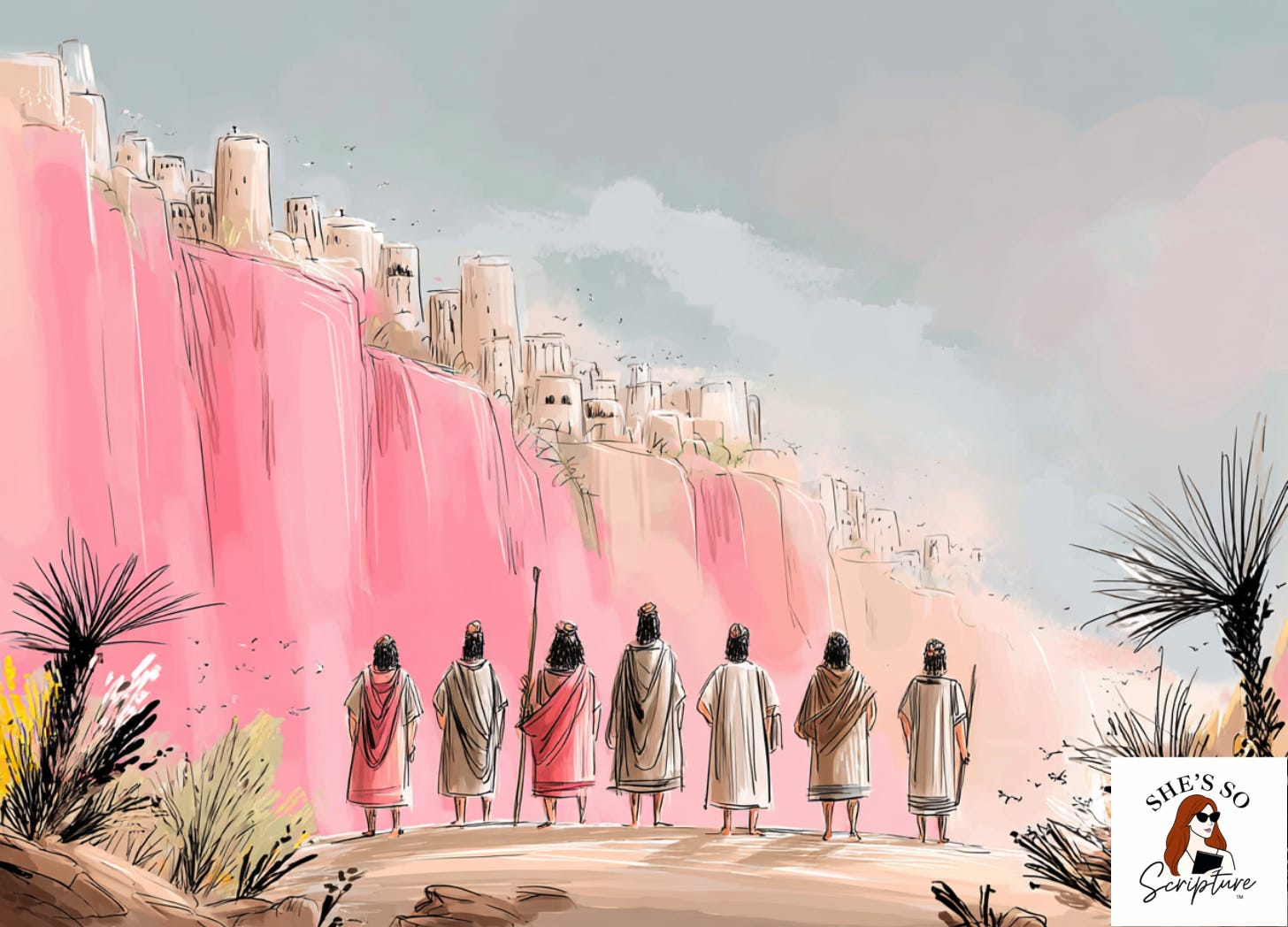
Numbers 13 and 14 often get reduced to a lesson about bravery. Twelve spies enter the land, ten spiral, two hold steady, and the story becomes a warning about negativity.
But a slower and more intentional reading reveals something far more serious.
The spies step into the land and confirm exactly what God had said. It flows with milk and honey. The fruit is so abundant that it must be carried between two men. The promise is visible and heavy in their hands. Nothing about the terrain contradicts the word spoken over it. Where the fracture appears is in the interpretation.
The cities are fortified and the people are strong. The descendants of Anak are there. Then comes the sentence that exposes the deeper shift: “We seemed like grasshoppers in our own eyes.”
That line reaches far beyond mere military assessment. It reveals how they see themselves.
They speak about their own smallness before ever assigning that perception to anyone else. The collapse begins internally and only later becomes communal. Identity skews first; action follows.
Egypt had formed them under slavery. Sinai had formed them under covenant. At the border of promise, the memory of bondage speaks louder than the memory of deliverance.
This is what gives the moment its gravity. They are not inexperienced wanderers encountering God for the first time. They knew better. They have crossed the sea. They have stood at Sinai and entered covenant. They have eaten bread that appeared with the morning dew. Redemption is already behind them and inheritance waits ahead.
Caleb responds with movement. The Hebrew verb he uses is עָלָה (alah), to go up, to ascend. His words assume direction. The land requires forward motion, and he speaks as though that motion is possible because the promise stands.
By chapter 14 the emotional atmosphere thickens. The people raise their voices and weep. The narrative names what follows with the verb מָרָה (marah), to resist or defy authority. The weeping doesn’t remain grief; it hardens right into opposition.
Then comes the divine assessment.
“How long will these people treat Me contemptibly? How long will they neglect to trust in Me—in spite of all the miraculous signs I have performed among them?”
Numbers 14:11 (TLV)

The word נָאַץ (na’ats) means spurning or treating with contempt… despising, abhoring. God does not describe the moment as hesitation… He describes it as rejection. The history of plagues, manna, and provision stands in full view, and still the promise is weighed as though it were uncertain. The breach occurs in trust.
Discussion of returning to Egypt begins almost immediately. The land remains what it was. The promise remains what it was. It’s the community’s posture that shifts, and oh does it ever. Familiar oppression begins to feel steadier than covenant inheritance. Predictability exerts its own pressure. Running back to known slavery was better in their eyes than the promise of God ahead because it came with the unknown.
Once identity settles into smallness, obedience starts to appear unsafe. The future God described feels misaligned with their internal narrative. A people formed by deliverance now narrate themselves as incapable of possession.
Numbers 13 and 14 trace the anatomy of communal unraveling. The word spoken by God remains unchanged; the lens through which it is heard becomes distorted. Agreement migrates from covenant memory to fear-shaped imagination.
The land was still good, the promise still stood. The invitation remained open.
The difference was no longer the terrain; it was the internal agreement of the people standing at its edge.
Numbers does not portray a God who retracts what He said. It portrays a generation unable to inhabit what He had already confirmed.
Wilderness wandering, in this sense, was not random punishment. It was the outworking of an identity that had not yet caught up to redemption. A people delivered from slavery still carried the posture of slaves. They had left Egypt geographically; Egypt had not entirely left them.
That is what makes this passage enduring. It exposes how covenant memory can be present and still overridden by a smaller self-understanding. It shows how quickly provision can be forgotten when the next step feels costly. It reveals that agreement with God’s promise is not merely intellectual assent; it is the willingness to move in alignment with it.
The border of promise is rarely dramatic. It often looks like a decision about how you see yourself in light of what God has already done.
And once that decision settles, the direction of a generation follows.
Bible Study Questions
How does Israel’s covenant history in Exodus 14 and Exodus 19 deepen the weight of their response in Numbers 13–14?
What does the phrase “grasshoppers in our own eyes” reveal about the internal nature of the crisis?
How does the Hebrew verb alah (to ascend, go up) shape Caleb’s response to the report?
What is the significance of the word marah (to resist, defy) in describing the people’s reaction?
Why does God use the word na’ats (to spurn, treat with contempt) in Numbers 14:11, and what does that suggest about the seriousness of this moment?
Reflection Questions
Where has your internal narrative shaped how you interpret what God is doing in front of you?
How do past seasons of deliverance inform your present response to uncertainty?
In what areas of your life does predictability feel safer than promise?
What would it look like for your identity to fully align with what God has already done in your story?
Action Challenges
Read Numbers 13–14 in one sitting and trace the shift from observation to interpretation.
Write down one promise of God you believe intellectually but hesitate to step toward practically.
Spend time this week thanking God for past deliverance and asking Him to align your self-understanding with covenant truth.
If this study stirred something in you, share it with a friend who might need it too.
And if it left you wanting to go slower and deeper into the Word, I’ve got you!
Paid subscribers get access to extended studies, devotionals. theological teaching, spiritual formation practices, and a community of women who want depth without pressure or performance.
If you’re ready to step further into the Word, you’re welcome inside.
If a paid subscription isn’t feasible right now but this space has blessed you, you can leave a one-time tip here. Every gift helps sustain this work. 🤍

About the Author
Diane Ferreira is a Jewish believer in Yeshua, a published author, speaker, seminary student, wife, and proud mom. She is the author of several books, including The Proverbs 31-ish Woman, which debuted as Amazon’s #1 New Release in Religious Humor, as well as Holy, Hormonal and Holding On.
She is currently pursuing her graduate degree in Jewish Studies in seminary, with her favorite topics being the early church and Biblical Hebrew. Diane writes and teaches from a unique perspective, bridging her Jewish heritage with vibrant faith in the Messiah to bring clarity, depth, and devotion to everyday believers.
When she’s not writing, studying, or teaching, you’ll find her curled up with a good book, crocheting something cozy, or playing her favorite video games.
Tree of Life (TLV) – Scripture taken from the Holy Scriptures, Tree of Life Version*. Copyright © 2014,2016 by the Tree of Life Bible Society. Used by permission of the Tree of Life Bible Society.
Excellent!
Another excellent study!
I'll admit, I've never considered that angle of "grasshoppers in our own sight" before. And you're absolutely right. It definitely speaks to an insecurity that is incompatible with faithfully living out God's plan.