

What Your Sunday School Never Told You - The Parable of the Sower Isn’t Only About You

There’s a quiz that most of us took without realizing it.
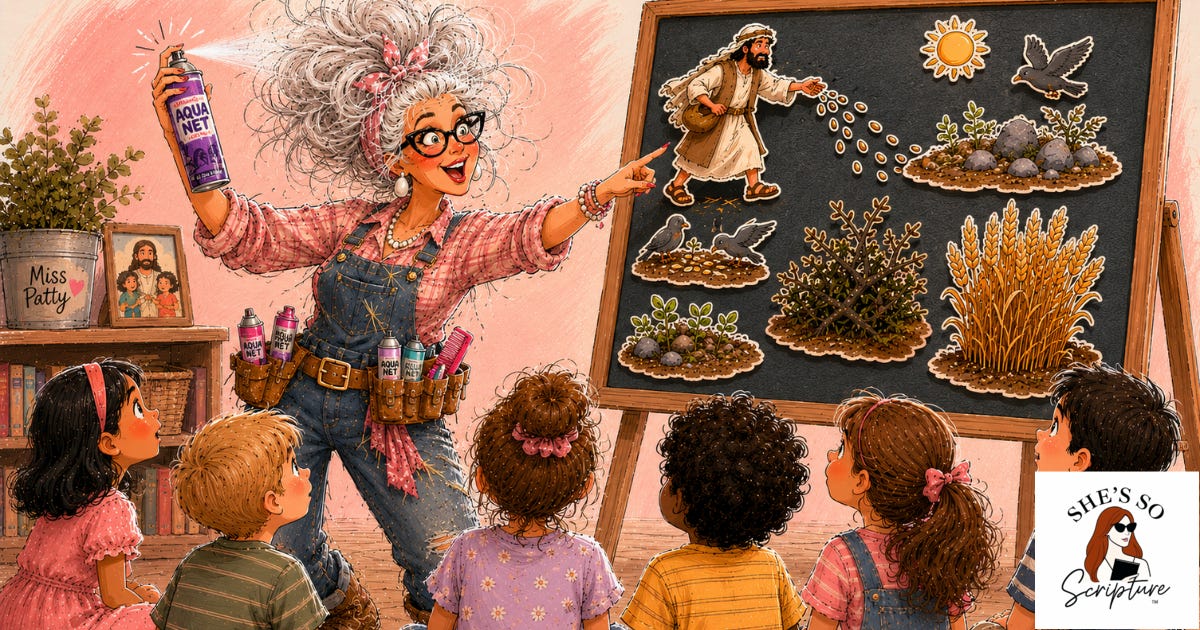
It happened sometime in Sunday school, or maybe at a church camp, or during one of those felt-board lessons where Miss Patty arranged colorful patches of ground while explaining what each one meant. She asked the question with such confidence, Aqua Net holding every hair in place: “So, which soil are you?”
And every hand in that room shot up for the good soil. Every single one.
Nobody raised their hand for the rocky ground. Nobody claimed the thorns. We all diagnosed ourselves as productive, fruit-bearing, thirty-sixty-a-hundredfold believers, and then we moved on to snack time.
Here’s what Miss Patty didn’t tell you: that wasn’t the only question the parable was asking.
Yeshua Didn’t Start With the Soils
Open your Bible to Mark 4. The parable of the sower is right there in verses 3 through 9, and it’s one of those passages so familiar that we stop actually reading it. We think we know it, so we skim it. That’s the first problem.
The second problem is that we skip right past the verses that change everything: verses 10 through 12.
After Yeshua tells the parable to the crowd, He and his disciples pull away. They’re alone. And his followers ask Him what the parable means. His answer is not what we were taught.
“To you has been given the secret of the kingdom of God. But for those who are outside, everything is in parables, so that ‘Seeing, they may see and not perceive, and hearing, they may hear and not understand, so they may not turn back and be forgiven.’” (Mark 4:11-12, TLV)
Read that again. Because Yeshua is not saying the parables are clever teaching illustrations designed to help everyone understand spiritual truth more easily.
The parables both reveal and conceal. That tension is built into Yeshua’s own explanation, and most of us were never taught to sit inside it.
The Part Nobody Wants to Talk About
Before we go any further, we need to talk about what a paradox actually is, because Mark 4 is built on one.
A paradox is something that appears contradictory on the surface but points toward a deeper truth underneath. Both sides seem true. They just don’t seem like they can be true at the same time. And yet they are.
Nobel Prize-winning physicist Niels Bohr put it this way:
“The opposite of a correct statement is a false statement. But the opposite of a profound truth may be another profound truth.”
That’s exactly what Mark is doing across this entire chapter. God conceals. God reveals. Both are true. Neither cancels the other out. That’s not a contradiction to be resolved, it’s a paradox to be held.
And this is where things get uncomfortable, which is probably why Miss Patty quietly glossed over verses 11 and 12 on her way to the soil chart.
Yeshua quotes Isaiah 6:9-10 here, and He quotes it with full intention. The language is stark. People are seeing without perceiving. Hearing without understanding. The word in Greek is hina, a term that often introduces purpose or result. Either way, the tension remains.
God both conceals and reveals according to his purposes. That’s the paradox Mark is building across this entire chapter and it’s the framework for everything.
Now before you panic, stay with me. Because verse 22 is coming.
“For there is nothing hidden that will not be revealed, nor anything kept secret except that it would come to light.” (Mark 4:22, TLV)
That’s the telos, the aim, the end point. Concealment is not the final word. It’s the beginning of a process. Hiddenness in God’s kingdom is always moving toward revelation. The concealment is the setup, not the conclusion.
The Sower Who Sows Indiscriminately
Now go back to verses 3 through 9, because once you have that framework, the parable reads completely differently.
Notice first that, after introducing the sower, Mark rarely repeats the word “seed” in the parable itself.
In the Greek, what is sown is referred to simply as “some” and “other,” allowing the focus to stay on the act of sowing and on the different soils receiving it. English translations often supply the word “seed” for readability, but in doing so they slightly obscure something Mark is doing deliberately. He lets the seed recede quietly into the background until Yeshua names it in verse 14:
“The sower sows the word.”
That’s the reveal. The seed was never really the point. What it is doesn’t become clear until Yeshua tells you directly, and by then you’ve already watched it land on four different kinds of ground.
Notice second that interpreters have not always agreed on who the sower is. The ancient texts and analogous literature, including Hosea, Jeremiah, and several Second Temple Jewish writings, picture God as the sower.
In Mark’s Gospel, there’s a strong case that the sower is Yeshua as God’s agent. But here’s what the text actually makes clear: the sower sows everywhere, on every kind of ground, without sorting first.
He doesn’t pre-screen the soil. He doesn’t wait for perfect conditions. He throws seed on the path, on the rocks, among the thorns, and into good earth, all of it, all at once. The scattering is indiscriminate. And that raises serious questions about the sower’s strategy that most of us were never encouraged to ask.
Why would a good farmer waste seed on obviously bad ground?
Because this isn't ultimately a lesson in agricultural efficiency. The sower isn't calculating return on investment. He is revealing the astonishing generosity of God's kingdom. The Word goes everywhere. The invitation goes everywhere. The question is never whether the sower is willing to sow. The question is what happens when the Word lands.
Maybe the indiscriminate sowing tells us something about the sower before it tells us anything about the soil. God's Word is not rationed to those who appear most promising. It is scattered with astonishing generosity.
The Mystery That Can’t Be Solved
Verse 11 uses the Greek word mysterion, which is the same root we get “mystery” from in English. But in first-century Jewish usage, a mystery isn’t a puzzle waiting to be solved.
The Hebrew equivalents are raz and sod, words that appear in Daniel and in the Dead Sea Scrolls, words that point to something in God’s hidden counsel that only He can disclose. It can’t be investigated and cracked like a cold case. It can only be received.
Scholar Adela Yarbro Collins puts it plainly:
the mystery of the kingdom of God is “the divinely willed way in which the rule of God will manifest itself and come to fulfillment through the agency of Jesus.”
You can’t figure that out from the outside. It’s given to you or it isn’t.
And this is where Mark gets genuinely strange, in the best kinda way. Because Yeshua then turns around and tells the disciples, the ones who just received the mystery, that they don’t understand it either! Verse 13:
“Don’t you grasp this parable? Then how will you understand all the parables?”
The insiders don’t fully have it either. They’ve been given something they can’t yet fully receive. That’s one of the most honest things in the entire Gospel of Mark, and it should make every one of us breathe a little easier.
Verse Mapping Aid
Mark 4:11 | mysterion (μυστήριον)
Transliteration: mys-tay’-ree-on
This word appears across the Septuagint (Greek Old Testament) and the New Testament to describe something that belongs to the hidden counsel of God, not something obscure for its own sake, but something that can only be known by divine disclosure. Its Hebrew equivalents are raz (רַז), which appears in Daniel 2 in the Aramaic sections, and sod (סוֹד), which carries the sense of a council, a secret, or intimate divine knowledge. You see sod in Psalm 25:14: “The counsel of Adonai is with those who fear Him.” (TLV) The mystery isn’t an intellectual puzzle. It’s an intimacy. It’s the difference between knowing about someone and being known by them.
Three Parables, One Direction
After the parable of the sower and its interpretation, Mark doesn’t move on. He stacks three more parables in the same chapter, all of them operating on the same concealment-to-revelation logic.
The lamp parable in verses 21 and 22 makes the principle explicit: lamps don’t get lit to be hidden under baskets. Hiddenness that leads nowhere is a waste. The point of hiddenness is always its eventual exposure.
The growing seed in verses 26 through 29 is quietly devastating. A farmer throws seed on the ground. Then he sleeps. He gets up. He goes about his life. The seed sprouts and grows, and the farmer has no idea how. He doesn’t know. The text is honest about that. And yet the harvest comes.
God’s activity in the kingdom can be entirely hidden from human comprehension and still be moving toward an inevitable result.
The mustard seed in verses 30 through 32 completes the arc. What begins as the smallest of seeds ends up as a shelter for birds. The ordinary becoming extraordinary. The hidden becoming undeniably visible.
The paradox isn’t resolved in a single verse. It’s resolved over the course of the entire chapter, and even then, the mystery remains.
My Final Thoughts
Here’s the thing about Miss Patty’s soil quiz that has always bothered me: it made the parable entirely about us. Our hearts, our receptivity, our soil quality. And Yeshua does interpret the soils in terms of human response. That part is real and it matters. The problem is that most of us stopped there, never looking up to see the larger frame around the whole parable.
That larger frame is about God’s activity. He’s the one who reveals and conceals according to his purposes. He’s the one who gives the mystery to some and gives everything in parables to others. He’s the one who sends the sower. He’s the one who brings the harvest. He’s the one working invisibly underneath the surface while the farmer sleeps, not because the farmer is lazy, but because there are things only God can do.
We live in the tension of Mark 4. Concealment and revelation coexist right now, in this finite world, in this lifetime. We see in part. We perceive in part. We receive a mystery we can’t fully hold.
And Yeshua looks at us exactly the way He looked at his disciples in verse 13 and says, essentially, you don’t fully understand this yet. But here’s a lamp. Here’s a growing seed. Here’s a mustard seed. Keep watching. Keep listening. The telos is coming.
Nothing that is hidden stays hidden. That’s not wishful thinking. That’s the design.
I have to tell you that I didn’t arrive at this reading of Mark 4 on my own. My dear friend and professor of Apostolic Writings, Rabbi Dr. Vered Hillel, is the one who opened this text for me in a way I will be eternally grateful for. She’s the kind of teacher who hands you a lens and then watches while the passage you thought you knew becomes something you’ve never actually read before. I am a better student of Scripture because of her, and this post exists because of what she taught.
Dig Deeper
Isaiah 6:1-13 | The original commission and the hardened-heart language Yeshua quotes in Mark 4:12
Deuteronomy 29:29 | “The hidden things belong to Adonai our God, but the revealed things belong to us and to our children forever.” (TLV)
Daniel 2:27-30 | God reveals mysteries to Daniel that no human wisdom could uncover
Psalm 25:14 | “The counsel of Adonai is with those who fear Him.” (TLV)
Ecclesiastes 11:5-6 | You don’t know the work of God. Sow anyway.
Mark 8:22-26 | The man who sees people like trees walking, a staged healing that mirrors staged understanding
Let’s Talk in the Comments
Which part of Mark 4 have you read the most times without really registering what it was doing? Is it the Isaiah quote in verse 12, the fact that the sower doesn’t sort the soil first, or the growing seed where the farmer genuinely doesn’t know how it works?
And honestly: were you always the good soil in Miss Patty’s quiz? Be honest. We all were.
If this study made you look at a passage you’ve read a hundred times completely differently, share it with a friend who thinks they already know this parable.
And if it left you wanting to go slower and deeper into the Word, I’ve got you! Paid subscribers get access to live Bible studies, extended studies, devotionals, theological teaching, spiritual formation practices, and a community that wants depth without pressure or performance. If you’re ready to step further into the Word, you’re welcome inside.

About the Author
Diane Ferreira is a Jewish believer in Yeshua, a published author, speaker, seminary student, wife, and proud mom. She is the founder of She’s So Scripture and She Opens Her Bible. She is the author of several books, including The Proverbs 31-ish Woman, which debuted as Amazon’s #1 New Release in Religious Humor, as well as Holy, Hormonal and Holding On.
She is currently pursuing her graduate degree in Jewish Studies in seminary, with her favorite topics being the early church and Biblical Hebrew. Diane writes and teaches from a unique perspective, bridging her Jewish heritage with vibrant faith in the Messiah to bring clarity, depth, and devotion to everyday believers.
When she’s not writing, studying, or teaching, you’ll find her curled up with a good book, crocheting something cozy, traveling, or playing her favorite video games.
Tree of Life (TLV) – Scripture taken from the Holy Scriptures, Tree of Life Version*. Copyright © 2014,2016 by the Tree of Life Bible Society. Used by permission of the Tree of Life Bible Society.
I've often thought of this as a deeply humorous parable: Jesus is telling a bunch of peasant farmers - for whom every seed would have been precious, saved for sowing when it could have fed their family - about a sower who is clearly utterly mad. He thoughtlessly chucks that precious seed anywhere and everywhere, into places where there was *almost* no chance of it fully growing. Then Jesus suggests that God is like that mad farmer ... and they should be too!
We never know who will respond and our judgements of who is most likely to are deeply flawed.
Great stuff, Diane! It’s easier to skip to the “good” application or allegorize parables. Love the “conceal–reveal” insight! This is so often skipped over or misconstrued. Going back to Isaiah for context helps, as always.
Also, love the hairspray pic! 😆