


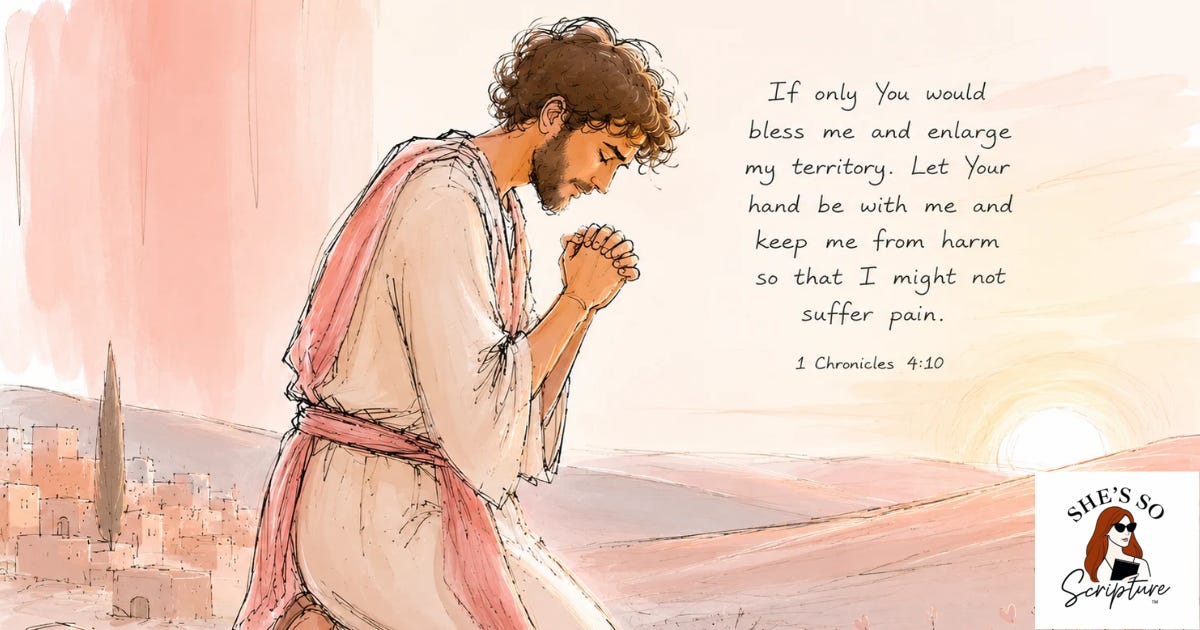
It was 2000 or 2001, and you just couldn’t escape The Prayer of Jabez. I know because I tried.
It was everywhere! Friends from church wouldn’t stop talking about it. Christian TV had Bruce Wilkinson on CONSTANTLY, walking through his four-point outline as though generations of rabbis and scholars had somehow missed the obious and, thank the Lord, he was finally here!
The book sold over 9,000,000 copies in the first two years alone and, for a while there, it felt like every conversation in evangelical circles eventually circled back to territory and blessing and a man named Jabez.
What is the Prayer of Jabez
The Prayer of Jabez comes from 1 Chronicles 4:9-10, two verses buried in a genealogy, where an otherwise unknown man named Jabez asks God for four things:
Blessing
Enlarged Territory
God’s hand upon him
Protection from harm
The text tells us God granted the request. That’s the whole prayer. What got built on top of those two verses over the next twenty-five years is a totally different story and it’s the one I actually want to tell.
Why? Because I eventually fell for the created version too. I prayed the prayer every morning for a while, the way the book instructed you to, just waiting for my territory to enlarge. I didn’t know a lick of Hebrew at the time so I wasn’t able to ask the text the difficult questions. I just knew the book made two little verses in a genealogy feel like the magic key to unlocking God’s blessings and purpose in my life.
Twenty-five years later, I want to go back and read those two verses. I have no interest in a paraphrase or a four-point outline. I want the actual text.
What the Prayer Actually Says
"Jabez was more honorable than his brothers. His mother named him Jabez, saying, 'Because I bore him with pain.' Jabez called out to the God of Israel, saying, 'If only You would greatly bless me, and enlarge my territory. Let Your hand be with me and keep me from harm so that I might not suffer pain.' Adonai granted what he asked." (1 Chronicles 4:9–10, TLV)
That’s it. That’s the whole thing. We get one verse of introduction, one verse of prayer and a single line telling us God said yes.
There isn’t a whole lot of room in two verses for an entire theology, which means whatever gets built on it has to come from somewhere else. I want to look at what got added, what’s actually there, and what got lost somewhere between some obscure Juadahite and a self-help shelf at a Christian bookstore.
Meet the Man Nobody Introduces
The Chronicler is in the middle of chapter after chapter of names… father begetting son. The kind of pages many people just kind of skim. We all did it!
And then, without warning, he pivots. He gives us a person instead of a lineage. A person with a mother, and a name, and a reason for that name, and a moral judgment attached to him before he even says a word.
His name is Yabetz and the name is connected by the narrator through wordplay with otzev: pain or sorrow.
Now the connection is not a clean dictionary etymology. Even the lexicons handle the derivation of the name as uncertain: BDB says that Jabez in interpreted in verse 9 as being akin to otzev.
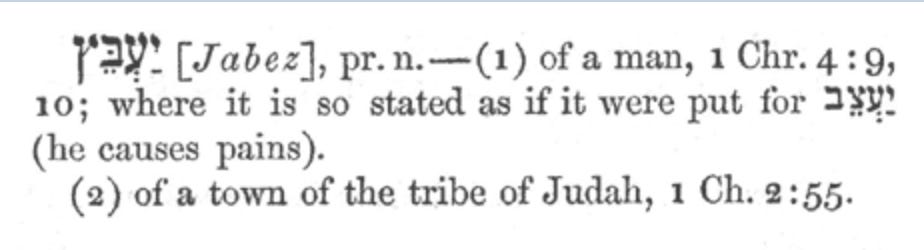
The NET Bible just says the name SOUNDS like otzev and the Revised JPS Tanakh states in a note on 1 Chronicles 4:9: pain Heb. ʻoṣeb, connected with “Jabez.” 1
[I had considered describing this as metathesis, letters rearranged for effect, but three standard references (BDB, the NET Bible, and the Revised JPS Tanakh 2023) independently descrive the Yabetz/otzev connection as wordplay or association rather than direct derivation. 2 So that is what I am going with… not a single source’s guess.]
Imaging growing up with a name your own mother connected with the pain of bringing you into the world. Every introduction, every time she called your name, every time someone else said your name, her worst memory came rushing back.

Four Requests, One Breath
Bless me. Enlarge my territory. Let Your hand be with me. Keep me from harm.
There’s something the prosperity version skips right on over. The last line circles back to his name. This matters!
Verse 9 gave us ‘beotzev’ (in pain). Verse 10 ends with otzbi, from that same root… “so that it might not cause me pain.”
The Chronicler didn’t just tell us Jabez’s name sounded like pain and then moved on. He framed both verses with it. His mother’s pain at the start and Jabez’s own prayer against that pain at the end.
I read that as Jabez asking God that his history doesn’t get the last word on his life. That’s my read on it and not a claim about what the Hebrew says. But the vocabulary choice is the Chronicler’s on both sides of the prayer and not something I am inserting into it.
A man looking at the sentence life wrote about him and asking God to edit it. One specific man, one specific prayer over one specific situation. He didn’t want his name to speak his future.
Where the Book Went Off the Rails
Ok, let me just say that I am not here to torch Bruce Wilkinson personally. I feel like there is a level of sincerity that lies under The Prayer of Jabez that doesn’t deserve any mockery at all. The publisher itself describes the book as encouraging readers to offer this prayer regularly, in expectation of extraordinary blessing, favor, power, and protections.
That’s a fair description of what Wilkinson actually argued and “territory” in his interpretation often meant ministry reach and influence as much as anything financial.
BUT… in the Name It and Claim It culture that grew up around the book over the following twenty-five years, “enlarge my territory” could easily become shorthand for more money, more success, more of everthing!
A two-verse prayer from that obscure Judahite got turned around into something closer to a technique. Pray these words, in this order, with enough faith, and things expand.
That is not at all what the text does. The text does NOT give Jabez a formula. It gives us a plea from a man whose story had been marked from birth by the language of pain. There’s actually a small grammatical detail I think is worth pointing out.
The prayer opens with the Hebrew im, “if”… a construction the NET Bible notes may reflect an oath or vow formula rather than a simple casual request. We don’t know what, if anything, Jabez vowed since the text only preserves the petition itself. But the grammar may carry more weight than “please” implies in English.
And God, we’re told simply, granted his request. What is important here is that there is absolutely no commentary on technique, no promise that the “formula” repeats for the next guy who just says the same words. We are just told he asked and it was granted.
A Prayer Not a Spell
Jabez prayed like someone who believed God was listening, not like someone who believed he cracked some secret code. The honor described in verse 9, before we ever hear him pray, matters more than the prosperity crowd tends to give it credit for.
He was already “more honorable than his brothers,” nikhbad me’echav. The prayer wasn’t what made him honorable. The prayer came from a man who already was.
That is not a story about a technique that works if you say it right. It’s a story about a man whose name held his mother’s pain, and who took that history straight to God instead of trying to run away from it.

Verse Mapping Aid
Hebrew term: Yabetz (יַעְבֵּץ), rendered “Jabez.” Connected by the narrator through wordplay to otzev (עֹצֶב), “pain” or “sorrow,” in verse 9, and echoed again by the related form otzbi (עָצְבִּי) in Jabez’s own prayer in verse 10. Three standard references converge on this being wordplay rather than settled etymology.²
Key phrase: harbeita et-gevuli, “enlarge my border/territory.” Gevul is boundary, border, territory language, often used for actual land and territorial limits in the Tanakh, not a built-in metaphor for personal ambition or income.
Grammar note: The prayer opens with im, “if,” which the NET flags as a possible oath or vow formula. Worth knowing, though the text doesn’t preserve what any such vow might have been.
How it Moves Through Scripture
1 Chronicles 4:9-10 - Jabez’s prayer, both verses, our whole text
Genesis 3:16 - the same otzev word group appears in the curse language to Eve, a legitimate lexical connection worth noting even without assuming Chronicles is deliberately invoking her
Joshua 13-19 - territorial allotment language, useful background for how “border” language functions elsewhere in the Tanakh
Deuteronomy 12:20 —-God’s own promise to enlarge Israel’s territory, language Jabez may be echoing back to God in his own prayer
My Final Thoughts
I don’t think Jabez needs to be turned into a formula, and I definitely don’t think he needs a bracelet. Honestly, the two verses are interesting enough without everything we piled onto them.
Two verses about a man whose name held his mother’s pain, who took that history straight to God, and asked that it not determine what comes next.
That’s no formula. I don’t think it was ever meant to be.
Dig Deeper
Genesis 32:22-32 - Jacob wrestling for a new name and a blessing he refused to let go of
1 Samuel 1:10-11 -Hannah’s prayer, another prayer born out of personal pain
Psalm 34:17-19 - the LORD near to the brokenhearted
Deuteronomy 12:20 - God’s own promise of enlarged territory to Israel
Tell me in the comments…
Has a label from your past ever tried to write the ending of your story for you? What did you do with it?
If this study stirred something in you, share it with a friend who's been handed a bracelet with this verse on it and never actually read the two verses behind it. And if it left you wanting to go slower and deeper into the Word, I've got you! Paid subscribers get access to live Bible studies, extended studies, devotionals, theological teaching, spiritual formation practices, and a community of people who want depth without pressure or performance. If you're ready to step further into the Word, you're welcome inside.
If a paid subscription isn’t feasible right now but this space has blessed you, you can leave a one-time tip here. Every gift helps sustain this work. 💕
About the Author

Diane Ferreira is a Jewish believer in Yeshua, a published author, speaker, seminary student, wife, and proud mom. She is the founder of She’s So Scripture and She Opens Her Bible. She is the author of several books, including The Proverbs 31-ish Woman, which debuted as Amazon’s #1 New Release in Religious Humor, as well as Holy, Hormonal and Holding On.
She is currently pursuing her graduate degree in Jewish Studies in seminary, with her favorite topics being the early church and Biblical Hebrew. Diane writes and teaches from a unique perspective, bridging her Jewish heritage with vibrant faith in the Messiah to bring clarity, depth, and devotion to everyday believers.
When she’s not writing, studying, or teaching, you’ll find her curled up with a good book, crocheting something cozy, traveling, or playing her favorite video games.
Notes
NET Bible, note on 1 Chronicles 4:9: the name “sounds like” the Hebrew ‘otseb, “pain.”
Brown-Driver-Briggs Hebrew and English Lexicon, entry for יַעְבֵּץ (Ya’betz), which notes the name is interpreted in 1 Chronicles 4:9 as akin to עצב (‘atsav/otzev), without asserting a direct derivation; NET Bible, note on 1 Chronicles 4:9; THE JPS TANAKH: Gender-Sensitive Edition (Philadelphia: Jewish Publication Society, 2023), note on 1 Chronicles 4:9: “pain: Heb. ‘otseb, connected with ‘Jabez.’”
Tree of Life (TLV) – Scripture taken from the Holy Scriptures, Tree of Life Version*. Copyright © 2014,2016 by the Tree of Life Bible Society. Used by permission of the Tree of Life Bible Society.