


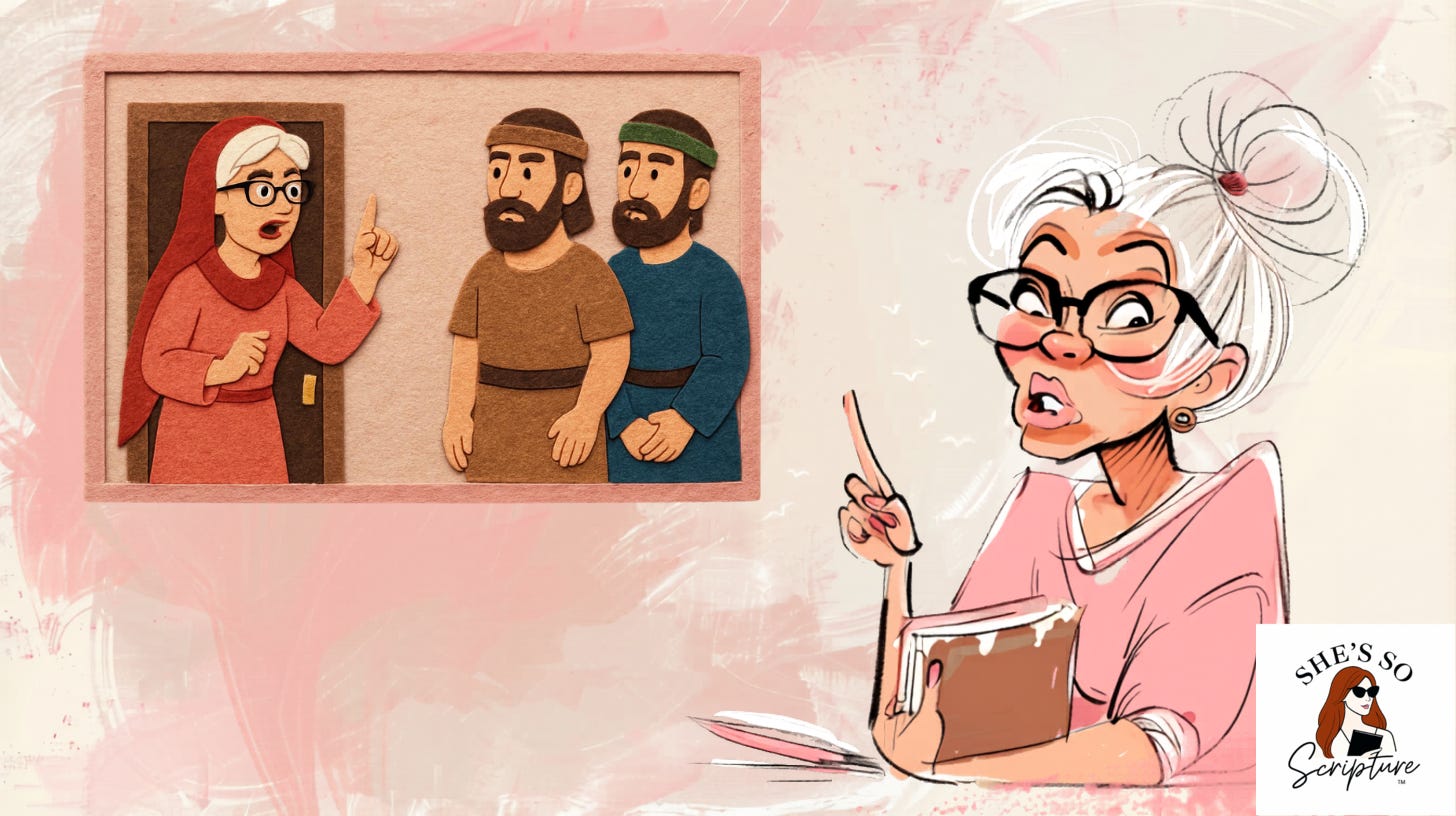
Oh Miss Patty. She told you about Rahab. She probably mentioned it quickly, in that tone she used for stories that were a little uncomfortable to explain to nine-year-olds. You learned that there was a woman in Jericho, she helped some spies, she hung a red rope out her window, and things worked out okay for her. Then Miss Patty moved along to the walls falling down because that was the part with the flannelgraph cutouts and the fun marching song.
What Miss Patty never told you is that Rahab is one of the most theologically layered figures in all of Scripture. She’s not a side character in Israel’s story. She’s a cord (pun intended) woven directly into the lineage of the Messiah, cited by name in three separate books of the New Testament, and she’s carrying a word in her hands that you need to know about.
Let’s head back to Jericho.
She Was Already Paying Attention
When the two spies showed up at Rahab’s house, she already knew who they were and who their God was. She didn’t need a sermon… she had been watching. She had heard what God did at the Red Sea. She’d heard what happened to Sihon and Og. And she had drawn a conclusion that every other person in Jericho had access to and most of them refused to make.
Listen to what she says to the spies in Joshua 2:9–11 (TLV):
“I know that Adonai has given you the land — dread of you has fallen on us and all the inhabitants of the land are melting in fear before you. For we have heard how Adonai dried up the water of the Sea of Reeds before you when you came out of Egypt, and what you did to the two kings of the Amorites that were beyond the Jordan, to Sihon and Og, whom you utterly destroyed. When we heard about it, our hearts melted, and no spirit remained any more in anyone because of you. For Adonai your God, He is God, in heaven above and on earth beneath.”
That is a confession of faith coming out of the mouth of a Canaanite woman who had every cultural, religious, and social reason to say the opposite. The whole city had heard the same reports. The whole city’s hearts had melted with fear. But Rahab did something no one else in Jericho did: she let the fear become faith.
She made a theological conclusion and then she acted on it. That’s faith taking shape in real allegiance.
The Cord Was Not Just a Cord
Here’s where Miss Patty really left you hanging. Again, pun absolutely intended.
The spies made a deal with Rahab. She would hang a scarlet cord from her window, keep her family inside the house, and when Israel came through, everyone under that roof would be protected. Simple enough, right?
Here is what the Hebrew does that the English translation can’t fully show you.
The word used in Joshua 2:18 for the “line” of scarlet thread is tiqvah (תִּקְוָה). The spies told her:
“Unless when we come into the land, you tie this line of scarlet thread in the window through which you lowered us down, and gather to yourself in the house your father, your mother, your brothers and all your father’s household.”
Tiqvah can mean cord or rope. But elsewhere in Scripture, it often carries the meaning of hope. The national anthem of the State of Israel is called HaTikvah, which means The Hope, from this same root.
So when Rahab hung that scarlet cord from her window, she wasn’t just fulfilling the terms of an agreement. She was hanging her hope.
The Hebrew allows for this layered meaning. Rahab’s cord and Rahab’s hope are bound together in the language itself, and they were both the color of blood.
The Color Was Not Accidental Either
Scarlet in the Hebrew sacrificial system was not a random color choice. It appears in purification rites in Leviticus. It’s sewn through the tabernacle curtains. It shows up in the cleansing of tzaraat (skin disease often labeled leprosy) in Leviticus 14.
Scarlet, often alongside elements like hyssop, shows up in contexts connected to cleansing, restoration, and sacred space.
When Rahab hung that scarlet cord, she was stepping into a visual language of redemption before she had any idea she was doing it. She was a Canaanite woman outside the covenant, and God used that image to mark her house for protection.
It echoes the logic of Passover. Blood on the doorpost. Everyone inside stays alive.
I love typology and that’s typology pointing forward to the covering that comes through Yeshua.
Then the New Testament Refuses to Forget Her
You might assume that after Jericho fell, Rahab faded into history. But Matthew opens his Gospel, the very first chapter, with the genealogy of Yeshua, and he lists her by name.
Matthew 1:5 (TLV):
“Salmon fathered Boaz by Rahab, Boaz fathered Obed by Ruth, Obed fathered Jesse.”
Rahab is one of only four women Matthew includes in the lineage of the Messiah. That is a pointed, countercultural, theologically loaded choice. First-century Jewish genealogies did not typically include women at all. Matthew includes four, and every single one of them has a complicated story. Tamar. Rahab. Ruth. Bathsheba.
Matthew is telling you something about the kind of people God builds His redemption through, and it is not what you’d expect.
And then the New Testament mentions her two more times.
Hebrews 11:31 (TLV):
“By faith Rahab the prostitute did not perish with those who were disobedient, because she welcomed the spies with shalom.”
She’s in the Hall of Faith. Right there alongside Abraham, Moses, and Noah. A Canaanite woman from a city under divine judgment.
And then James 2:25 (TLV):
“And likewise, wasn’t Rahab the prostitute also proved righteous by works when she welcomed the messengers and sent them out another way?”
James uses her as his second example, right after Abraham, to make the case that real faith produces action. He doesn’t reach for a patriarch. He reaches for Rahab. Because what she did was unmistakably, visibly faith-in-motion.
Verse Mapping Aid: Tiqvah (תִּקְוָה)
Pronunciation: tik-VAH
Root: qavah (קָוָה) meaning to wait, to look toward, to stretch like a cord toward something
Primary meanings:
Cord / rope / line — a physical object, something stretched and held together
Hope / expectation — the emotional and spiritual equivalent; a forward-leaning trust in what is coming
First appearance: Joshua 2:18 — the scarlet cord Rahab ties in her window.
Why it matters: The word Rahab ties to her window is the same word used elsewhere in Scripture for hope. The connection between cord and hope isn’t accidental in how the language works. The scarlet cord becomes a visible expression of trust. Something stretched outward toward a salvation she couldn’t yet fully see.
My Final Thoughts
Rahab is not in the Bible to make you feel better about your past. She’s in the Bible because God was doing something specific with her story, and He wanted you to see it.
She heard what God had done and she made a decision. She hid people who needed hiding. She hung her hope out a window in the color of blood. She gathered everyone she loved under one roof and trusted that what covered the doorway would be enough.
And it was.
The walls came down everywhere in Jericho. Everywhere except the house marked by the scarlet cord.
If you’ve ever felt like you were on the wrong side of the wall, outside the covenant, too far gone, too much history, wrong city, wrong background — Rahab is not a consolation prize story. She’s a theological statement.
God wrote her into the bloodline of Yeshua on purpose. The author of Hebrews put her in the Hall of Faith on purpose. James chose her as his example of embodied faith on purpose.
There is no one too Jericho for grace.
Bible Study Questions
In Joshua 2:9-11, Rahab describes what she’s heard about God and the conclusion she’s drawn. What specific acts of God does she reference, and what does this tell you about the nature of her faith?
The whole city of Jericho had heard the same reports Rahab had heard (Joshua 2:9). What made Rahab’s response different from everyone else’s?
Hebrews 11:31 says Rahab did not perish with those who were “disobedient.” What does that word choice suggest about why Jericho fell and what Rahab’s faith represented?
James places Rahab directly alongside Abraham as his two examples of faith made visible through works (James 2:21-25). What do you think it means that he chose a patriarch and a foreign woman to make the same point?
Reflection Questions
Rahab acted on incomplete information. She didn’t have the full picture. She just knew enough to make a move. Is there an area in your own life where God is asking you to act on what you know, even when you can’t see the whole plan?
Everyone in Rahab’s family who was saved had to be in the house. They couldn’t be protected from outside the covering. What does this ask of you in terms of where you’re positioning yourself spiritually?
The Hebrew word tiqvah ties together the idea of a physical cord and the concept of hope. What does it mean to you that Rahab’s hope was something she had to physically, visibly hang in her window rather than just feel internally?
Action Challenges
Read Joshua 2 and Joshua 6:22-25 in full this week. Pay attention to how Rahab is described each time she appears and what changes or stays the same.
Write down one thing you’ve heard about God, the same way Rahab had heard about Him, where you haven’t yet let the information move you to action. Sit with that honestly.
Rahab gathered her whole household under the protection of the scarlet cord. Think about who you’re actively gathering. Who in your life needs to be under the covering of God’s protection, and what does it look like for you to bring them there?
Before You Go
If this study stirred something in you, share it with a friend who has ever felt like they were on the outside looking in when it comes to God’s grace. And if it left you wanting to go slower and deeper into the Word, I've got you! Paid subscribers get access to live Bible studies, extended studies, devotionals, theological teaching, spiritual formation practices, and a community of women who want depth without pressure or performance. If you're ready to step further into the Word, you're welcome inside.
👉🏻 Join The Vault.
If a paid subscription isn’t feasible right now but this space has blessed you, you can leave a one-time tip here. Every gift helps sustain this work. 💕

About the Author
Diane Ferreira is a Jewish believer in Yeshua, a published author, speaker, seminary student, wife, and proud mom. She is the founder of She’s So Scripture and She Opens Her Bible. She is the author of several books, including The Proverbs 31-ish Woman, which debuted as Amazon’s #1 New Release in Religious Humor, as well as Holy, Hormonal and Holding On.
She is currently pursuing her graduate degree in Jewish Studies in seminary, with her favorite topics being the early church and Biblical Hebrew. Diane writes and teaches from a unique perspective, bridging her Jewish heritage with vibrant faith in the Messiah to bring clarity, depth, and devotion to everyday believers.
When she’s not writing, studying, or teaching, you’ll find her curled up with a good book, crocheting something cozy, traveling, or playing her favorite video games.
Tree of Life (TLV) – Scripture taken from the Holy Scriptures, Tree of Life Version*. Copyright © 2014,2016 by the Tree of Life Bible Society. Used by permission of the Tree of Life Bible Society.
Love this! 💕
I always explained to my kids in Sunday School that Rahab had lots of boyfriends who bought her pretty things and helped her buy groceries. When my 18 year old granddaughter won the “Social Butterfly” superlative at her high school last week she reminded me that Rahab would have won it too. We laughed and laughed. 🥰