


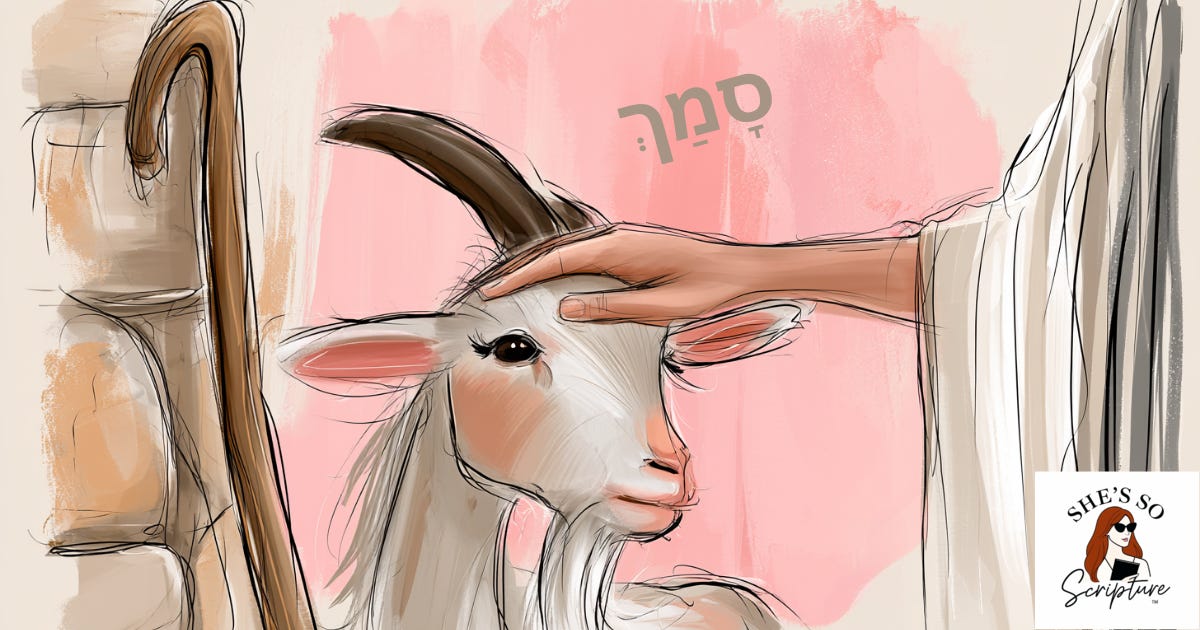
I want to tell you about the day I finally understood why my orthopedic doctor keeps telling me my posture is "compensating."
You know how that works. Something in your body gets weak or hurt, so something else steps in to keep you vertical instead. You don't even notice it happening. You just notice, eventually, that your shoulder or your knee hurts for no reason, and it turns out the reason is your hip decided three years ago it wasn't going to pull its weight anymore.
Hebrew has a word for that moment something else holds your weight up. It’s samakh (סָמַךְ).
The dictionary gives you “lean”, “lay”, “rest”, “support”. 1 True! Also, completely useless until you notice what it’s doing when it comes to actual sentences.
Samson braces himself against the two middle pillars of the Philistine temple, one hand on each, and the text uses samakh for that physical leaning. 2 His actual weight, pressed into the stone.
Later, when the Assyrian Rabshakeh is taunting Judah for trusting Egypt, he says that if a man samakh-leans on Egypt, it will pierce his hand like a broken reed. 3 Same word, completely different outcome because, what you’re leaning on, matters!
And in Psalm 3, David is lying down at night with people rising up against him on every side, and he says he can sleep because the LORD sustains him (Psalm 3:6).
It is the same root. He’s not gritting his teeth throughout the night, full of anxiety. He’s put his full weight down on something else and gone to sleep.
Lean. Sustain. Rest against something that either holds or doesn’t. That’s samakh.
Then Leviticus happens, and the word turns up someplace I never expected and I had missed it for many years.
When Leaning Walks Into the Sanctuary
Here’s Leviticus 1:4 describing the burnt offering:
"He is to lay his hand on the head of the burnt offering, so that it will be accepted for him to make atonement on his behalf." (TLV)
“Lay his hand” is samakh. It is the same verb as Samson on the pillars and a tired man leaning on a staff.
Now, here is the thing I got wrong the first time I worked through this, because you know I try to keep it 100 with you.. blemishes and all. I initially was going to say that samakh itself means “transfer”. But it doesn’t work that way. This exact gesture, the hand on the animal’s head, turns up all over Leviticus and Numbers and it is doing different things depending on where you find it. 4
It’s there for the ordination of the Levites in Numbers 8. It’s there for when Moses commissions Joshua. It’s even there when witnesses layhands on a man before his execution in Leviticus 24. The verb doesn’t specialize… context does.
So what does Leviticus actually claim happens on Yom Kippur? Here’s Leviticus 16:21, and this is one of the rare places the Torah spells it out for us instead of leaving us to infer it:
“Aaron should lay both his hands on the head of the live goat and confess over it all the iniquities of Bnei-Yisrael and all their transgressions, all their sins. He should place them on the head of the goat and send it away into the wilderness.” (TLV)
Both hands, with confession spoken over the goat. That two-handed detail is easy to miss. Most other hand-laying texts just say “his hand,” singular. This one goes out of its way to tell you both.
But the theological work in that verse isn’t coming from the word samakh by itself. It’s the whole sentence. Aaron confesses for all of Israel. The text says the sins are placed on the goat. The goat is sent away. That’s what tells you the ritual is enacting removal.
Verse 22 goes even further and says the goat will carry their iniquities away, into the wilderness (Leviticus 16:22).
The hand-laying gesture is part of how this happens, but the verb “lay hands” doesn’t mean “transfer sin” every time you see it in the Torah.
Numbers 27 is useful here because the surrounding words tell us what a different instance of this hand-laying means.
Moses lays his hand on Joshua and publicly commissions him, and the text separately instructs Moses to place some of his hod, his authority or splendor, on Joshua too. This is a distinct action with its own verb. 5
Deuteronomy 34:9 later connects Moses’ hand-laying directly to Joshua being filled with the spirit of wisdom. 6 So the gesture clearly matters to Joshua’s commissioning. It just isn’t carrying guilt the way it does in Leviticus 16. It’s the same verb but hbere the gesture belongs to commissioning and leadership, not sin-bearing.
One Gesture, Several Jobs
I want to be honest that what follows is my own interpretation and so I want to be clear that this is not anything the text says. 7
The physical picture we see all through the uses of samakh is one of leaning upon, supporting, placing something firmly on another. Scripture keeps taking that one bodily vocabulary into different situations. A man leaning against a pillar because he’s exhausted. An offerer identifying with his sacrifice. A leader being commissioned for the road ahead. And on the one day of the year built for it, a nation’s confessed sin, placed on an animal that walks it out of the camp.
Context is what tells you what it is doing.
Which sent me back to Isaiah 26:3, a verse I’d read a hundred times without connecting it to any of this. But when you start to study a word in Hebrew you stumble upon all the places it’s used. You can go down many, many rabbit holes when you open up a lexicon.
“You keep in perfect peace one whose mind is stayed on You, because he trusts in You.” (TLV)
The word there for “stayed” is samukh, the adjectival form from the same root as samakh,8 describing a mind that has already done the leaning and is now, at rest, actually resting there.
I don’t think that’s an accident of vocabulary. I think it’s the same posture, doing what it does. Putting weight somewhere other than your own strength.
What that gesture means depends on the room it’s standing in. But samakh keeps bringing theology back into the body: leaning, supporting, laying a hand upon another.
Verse Mapping Aid
Leviticus 1:4 -samakh as the hand-laying gesture on a voluntary burnt offering, commonly understood as expressing the offerer’s identification or participation with the offering
Leviticus 16:21-22 -samakh, explicitly two hands, paired with confession; the text explicitly states the sins are placed on the goat and carried away
Judges 16:29 -samakh (Niphal) for Samson bracing himself against the temple pillars
2 Kings 18:21 / Isaiah 36:6 -samakh as leaning on Egypt, a support that fails
Psalm 3:6 -samakh as Adonai sustaining David through the night
Isaiah 26:3 -samukh, the adjectival form from the same root, describing a mind at rest because its weight is elsewhere
Numbers 27:18-20 / Deuteronomy 34:9 -hand-laying on Joshua, associated with his being filled with the spirit of wisdom, with authority (hod) conferred by a separate statement
My Final Thoughts
When I started studying Hebrew in seminary, I started a running list in the back of one of my notebooks that I call “posture words.” They’re Hebrew words where the body itself tells you something about what’s happening. I haven’t pulled it out for some time. But I am going to.
I’m adding samakh to the list. And honestly, it may go right up near the top.
We tend to talk about faith and forgiveness in pretty abstract terms. Trust. Belief. Peace. Atonement. All true, but pretty easy to leave floating around as nice ideas. Hebrew keeps insisting on bodies. A hand laid down. A man leaning his whole weight against a wall because he cannot hold himself up one more hour (been there, done that, bought the t-shirt)!
What that gesture means, each time, depends on the room it’s leaning in. And as a devotional picture, I love the weight in it. Leaning. Resting. Placing a hand on something, or someone, else.
Dig Deeper
If you want to keep tracing this one, look at Exodus 29:10-19 (the ordination ram, same gesture, different offering), Numbers 8:10-12 (the Levites, hands laid by the whole community), and Hebrews 6:1-2, where “laying on of hands” shows up in a New Covenant list of foundational teachings, still with that Hebrew gesture behind it.
What’s actually being conferred or transferred in each case, and what stays constant about the physical act even when the object changes?
Let’s Talk in the Comments
Where in your life right now do you know you’re supposed to be leaning instead of holding yourself up?
Does knowing the same verb describes both leaning for support and laying hands on the Yom Kippur goat change how you picture the Day of Atonement?
What’s a burden you’re still carrying that you thought you’d already laid down?
If this one stuck with you, send it to a friend who’s been white-knuckling something they were never meant to carry alone.
And if you want to keep going deeper into words like this every week, along with live studies, extended teaching, and a community of people who want depth without pressure or performance, I’ve got you.
If a paid subscription isn’t feasible right now but this space has blessed you, you can leave a one-time tip here. Every gift helps sustain this work. 💕

About the Author

Diane Ferreira is a Jewish believer in Yeshua, a published author, speaker, seminary student, wife, and proud mom. She is the founder of She’s So Scripture and She Opens Her Bible. She is the author of several books, including The Proverbs 31-ish Woman, which debuted as Amazon’s #1 New Release in Religious Humor, as well as Holy, Hormonal and Holding On.
She is currently pursuing her graduate degree in Jewish Studies in seminary, with her favorite topics being the early church and Biblical Hebrew. Diane writes and teaches from a unique perspective, bridging her Jewish heritage with vibrant faith in the Messiah to bring clarity, depth, and devotion to everyday believers.
When she’s not writing, studying, or teaching, you’ll find her curled up with a good book, crocheting something cozy, traveling, or playing her favorite video games.
Notes
BDB (Brown-Driver-Briggs Hebrew Lexicon), סָמַךְ (samakh), “to lean, lay, rest, support.”
Judges 16:29. Samakh, Niphal form (reflexive: “braced himself”).
2 Kings 18:21; Isaiah 36:6.
Cf. Numbers 8:10-12 (Levites); Numbers 27:18 (Joshua); Leviticus 24:14 (witnesses and the blasphemer). Same verb, ritual function determined by context in each case.
Numbers 27:18-20. The hand-laying and the conferral of hod (authority/splendor) are two distinct actions in the text.
Deuteronomy 34:9.
Interpretive framing (the “posture word” through-line) is my own devotional reading, not a claim about the lexical definition of samakh itself.
BDB lists סָמוּךְ (samukh) as the passive participle/adjectival form of the root סמך, the same root as samakh.
Tree of Life (TLV) – Scripture taken from the Holy Scriptures, Tree of Life Version*. Copyright © 2014,2016 by the Tree of Life Bible Society. Used by permission of the Tree of Life Bible Society.
Brilliant. This deep dive into some of the occurrences and possible meaning of this word is so interesting. For those of us who have had the benefit of biblical education, particularly being able to read the earlier versions of scripture in the ancient languages, we should never take for granted what this provides.
As a lifelong student of the Bible, I try to help others mine some of the rich seams that access to texts, lexicons and concordances provide.
Very much needed today. Thank you.