


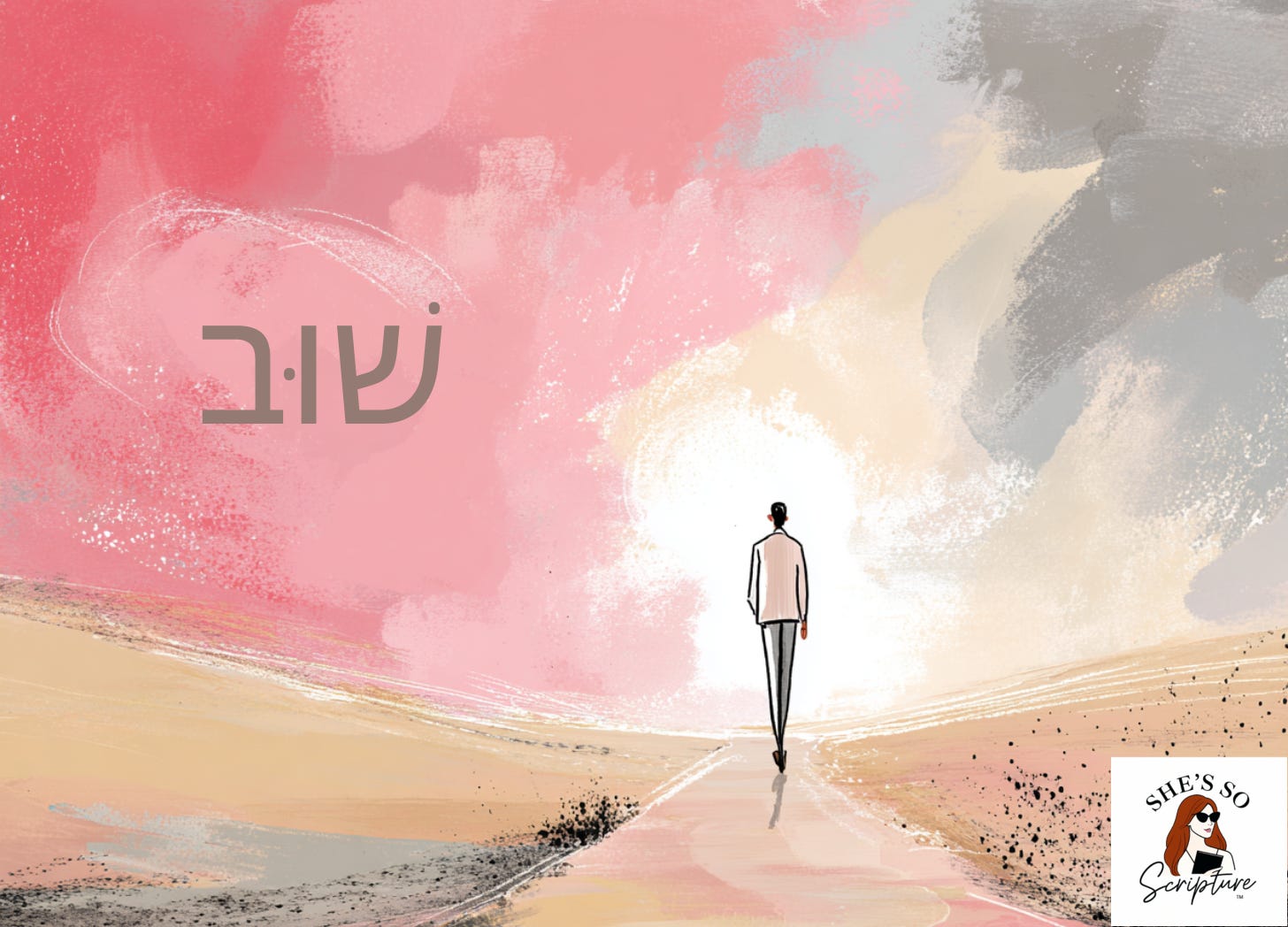
Pronunciation: shoov
Meaning: to turn back, to return, to change direction and move toward what you left
Shuv is the primary Hebrew word behind what English Bibles often translate as “repent.” And unfortunately, English absolutely fumbles the ball on this one.
Repent has come to mean feeling bad, being sorry, having an emotional moment. Maybe crying. Maybe making a promise to do better.
That is not shuv.
Shuv is not about remorse, it’s about movement.
This Word Assumes You’re Facing the Wrong Way
When Scripture calls someone to shuv, it is not asking them to generate guilt. It is stating a directional problem.
You are going the wrong way. Turn back.
This is why shuv shows up constantly in the prophets, especially when God is addressing covenant breach.
“Return to Me, and I will return to you,” says Adonai-Tzva’ot.”
Malachi 3:7 (TLV)
That “return” is shuv on both sides. The issue is not that the people feel nothing. The issue is that their lives are pointed elsewhere.
Repentance here is not an internal regret… it is reorientation.
God is not saying, “Convince Me you are worthy.”
He is saying, “You know where home is. Turn around.”
Shuv Is Measurable
One of the reasons shuv matters so much is because it produces visible change. You can tell when someone has turned around.
If you are walking east and God tells you to go west, shuv is the act of turning your body around and actually heading west. No speech required, no mood lighting. Just obedience.
Western Christianity often treats repentance like a feeling state.
Ancient Hebrew treats repentance like a GPS correction.
That’s why the prophets are far less interested in apologies than they are in behavior. Shuv shows up in actions, not speeches.
You stop going the way you were going, you stop reinforcing the same patterns.
You move back toward covenant alignment.
Emotion may accompany that but emotion is not the engine.
This is why Scripture can talk about returning to the Lord even when the people are emotionally numb, stubborn, or exhausted. The focus isn’t their inner turmoil, it’s their trajectory.
God Uses This Word About Himself
Now this is where shuv gets even more interesting.
Scripture sometimes uses this word to describe God’s response. For instance, we see in Jonah:
“God relented from the calamity that He said He would do to them, and did not do it.”
Jonah 3:10 (TLV)
The word translated “relented” is built on shuv. God “turns” from the announced outcome when the people turn from their ways.
God is not fickle here. It means relationship is real. Covenant includes responsiveness an direction matters.

Shuv and Teshuvah
You cannot talk about shuv without mentioning teshuvah, the noun form that grows out of it. Teshuvah is often translated as repentance, but it literally means returning.
It doesn’t require a public meltdown.
It doesn’t require wallowing in shame for a socially acceptable amount of time.
Which honestly tells you everything you need to know about how God views repentance.
Why This Word Still Matters
A lot of modern faith language treats repentance like a feeling check. Do you feel sorry enough? Did you mean it?
Shuv asks a different question. Where are you headed now?
It doesn’t demand perfection, it demands honesty. It is impossible to turn without admitting where you are currently facing. And you cannot return without movement.
My Final Thoughts
Shuv reminds us that repentance in Scripture is not about self-flagellation. It’s about reorientation.
You don’t repent by staying where you are and feeling worse about it.
You repent by turning and walking back toward what gives life.
This word carries mercy in its bones because if returning is possible, then distance is not final.
And Scripture is very clear about that.
If this study stirred something in you, share it with a friend who might need it too.
And if it left you wanting to go slower and deeper into the Word, I’ve got you!
Paid subscribers get access to extended studies, devotionals. theological teaching, spiritual formation practices, and a community of women who want depth without pressure or performance.
If you’re ready to step further into the Word, you’re welcome inside.
If a paid subscription isn’t feasible right now but this space has blessed you, you can leave a one-time tip here. Every gift helps sustain this work. 🤍

Tree of Life (TLV) – Scripture taken from the Holy Scriptures, Tree of Life Version*. Copyright © 2014,2016 by the Tree of Life Bible Society. Used by permission of the Tree of Life Bible Society.
Perhaps church teaching needs to teshuvah.
I read Matthew 27 this morning, where Judas felt remorse for betraying Jesus. It says he wept and even tried to return the money, but then hung himself. A commentary I read said his actions were sorrowful but not true repentance. Now, reading this, I see that the timing was for me to learn more about repentance.