


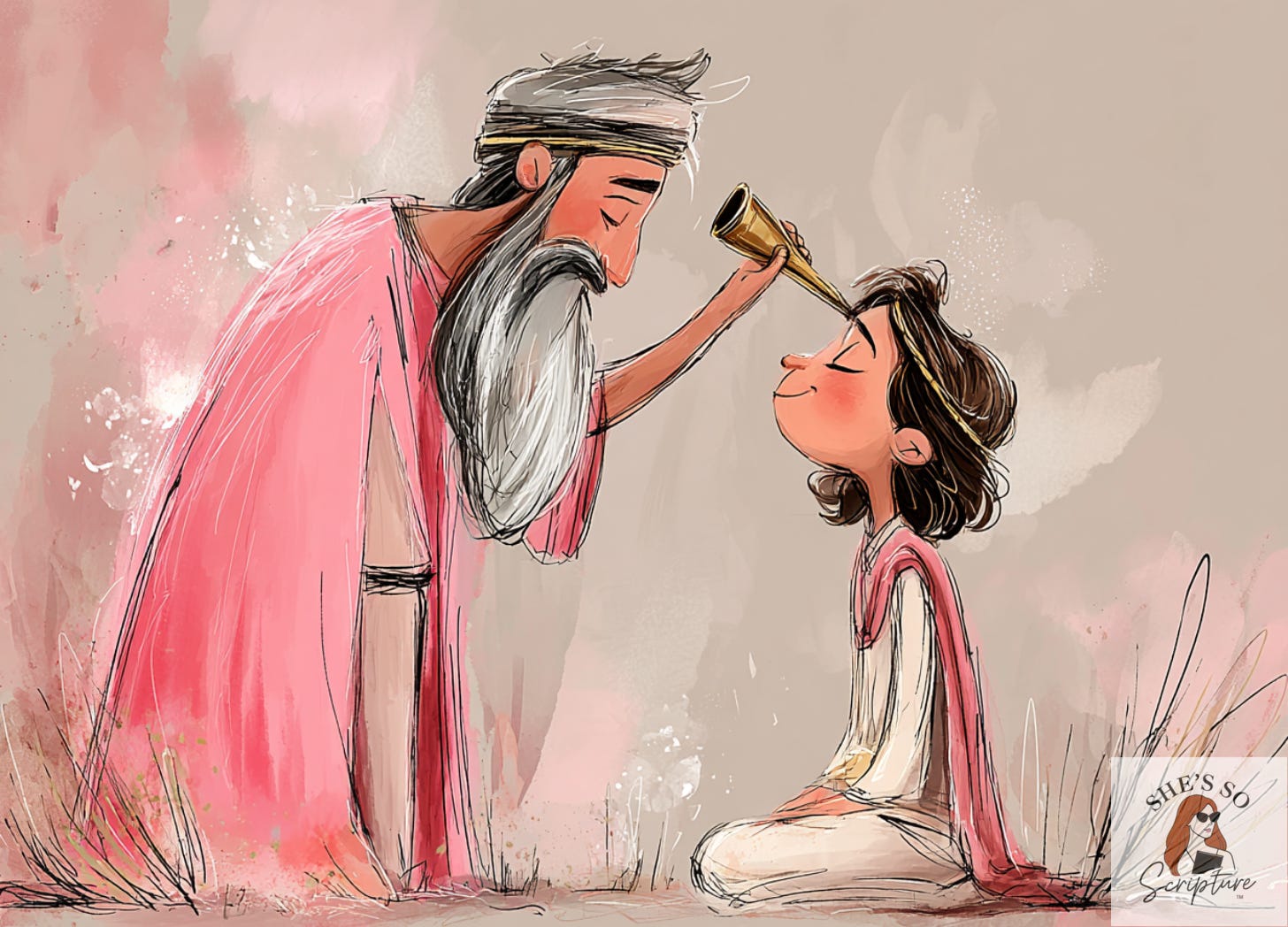
“So Samuel took the horn of oil and anointed him in the midst of his brothers. From that day on Ruach Adonai came mightily upon David. Then Samuel rose up and went to Ramah.”
1 Samuel 16:13 TLV
Most of us know the broad outline. Saul was Israel’s first king. David was Israel’s greatest king. One failed. One flourished. But tucked inside these whole anointing stories is a detail that reveals the difference long before either man sat on a throne.
Saul was anointed with a vial.
David was anointed with a horn.
Two containers.
Two symbols.
Two different trajectories.
Once you see the contrast, it becomes impossible to unsee.
Saul’s Anointing Came from a Man-Made Vessel
When Samuel anoints Saul in 1 Samuel 10, Scripture gets very specific about the container he uses. Saul is anointed with oil from a pakh (פַּךְ), a small flask or vial. It was usually ceramic or glass, crafted by human hands, easily broken, and designed for common use. Nothing about it signaled authority or permanence.
And that is exactly the point.
Israel wanted a king for all the wrong reasons. They weren’t responding to a divine call. They were reacting to fear, national insecurity, and the desire to look like the nations around them. God granted their request, but the pakh tells the deeper story.
A man-shaped vessel. It was fragile, ordinary, limited.
It reflects a kingship rooted in human impatience rather than divine intention. Saul was the king the people demanded. The vessel holding his anointing matches that reality. His calling carried legitimacy, but its foundation was thin. The symbolism was already preaching LONG before Saul ever opened his mouth.
The container reveals the moment: a kingship permitted by God, but shaped by human desire.
David’s Anointing Came from a Natural Horn
When we reach 1 Samuel 16, the scene shifts. Samuel doesn’t bring a vial. He brings a qeren, a horn. Not crafted. Not shaped by hands. This horn likely came from a ram. A natural symbol used throughout Scripture to represent strength, abundance, and divine authority.
David’s kingship did not emerge from Israel’s wish list.
It emerged from God’s choosing.
A horn is solid. It endures. It carries weight. And in ancient Israel, a horn was associated with power that comes from God, not from public opinion. It is why the symbols of the horn were part of the altar of the tabernacle and, later, the temple.
David’s anointing wasn’t a response to national insecurity. It was the continuation of a covenant story God had been writing long before David stepped into the room.
David didn’t look like a king.
He didn’t carry the presence of someone impressive.
He carried the presence of someone seen by God.
The vessel matches the calling.
The Kind of Vessel Reveals the Source of the Calling
The contrast between the pakh and the qeren is more than symbolic. It’s theological.
A vial is fragile.
A horn is durable.
A vial is shaped by hands.
A horn is shaped by God.
A vial holds what is temporary.
A horn carries what is meant to last.
Saul’s leadership fractures under pressure because its foundation was fragile from the start. David’s leadership expands under pressure because its foundation was rooted in God’s intention, not Israel’s demand.
This doesn’t make David flawless. Scripture is very honest about his failures for sure. But David returns to God consistenly, while Saul drifts toward fear and self-protection. The difference starts with the anointing, and it plays out in every chapter that follows.
Foundations matter.
The Spirit Responded Differently to Each Anointing
After Saul is anointed, the Spirit comes upon him, but the empowerment is situational. It strengthens him for specific moments, then recedes.
After David is anointed, the Spirit remains. Scripture says it plainly. From that day forward, something in David’s life carries divine steadiness.
The horn held more than oil. It held intention.
When God initiates the calling, God sustains the calling. The Spirit’s response reflects that truth with striking clarity.
My Final Thoughts
The story of Saul and David isn’t just about two kings. It’s about two kinds of anointing. One emerges from human expectation. The other emerges from divine purpose.
Saul’s anointing looked official, but the vessel was fragile.
David’s anointing looked unlikely, but the vessel carried strength.
There is a difference between a calling you assemble and a calling God establishes. One drains you. The other develops you. One collapses under pressure. The other deepens under pressure.
David’s anointing wasn’t glamorous. It was grounded.
Sometimes the strongest callings begin in places nobody is looking.
Trust the horn, not the vial.
Bible Study Questions
Read 1 Samuel 10 and 1 Samuel 16. What stands out about the differences in Saul’s and David’s anointings?
How does the type of vessel used in each anointing reflect the nature of their callings?
Where do you see God emphasizing internal character over external appearance in David’s story?
How does the Spirit’s role in each anointing clarify the difference between the two kings?
Reflection Questions
Which areas of your life feel shaped by human expectations rather than divine intention?
How has God used an unlikely place or season to prepare you for something significant?
What part of your calling feels more like a “vial” that needs to be released so God can bring the “horn”?
Action Challenges
Read 1 Samuel 16 and note how God defines true leadership.
Journal about any areas where you feel pressured to construct your own calling.
Ask God to reveal where He is shaping something in you that He—not people—initiated.
For more on Saul and David, check out my blog post here.

If this post hit home for you, send it to a friend who could use a little Bible-study glow-up today.
You’re reading one of Substack’s Bestseller Publications and that’s because of readers like you. Thank you for showing up, sharing, and growing with this community.
If a monthly subscription isn’t feasible but you’ve been blessed by this space and want to support the work, you can always leave a one time tip here. Every gift, big or small, keeps this ministry thriving. 💛
🔥 Want to go deeper?
Step further into the Word with our paid subscriber community. When you upgrade, you unlock The Vault… and if you’re ready to go all in, the Founders Level opens every door.
🔐 Inside The Vault:
💛 Weekly devotionals with depth and application
🌿 Monthly teachings on the Jewishness of Jesus
💬 Private community chats
✨ Our weekly spiritual disciplines program (Mussar)
🎁 30% off all digital products
🚨 Access to our Peppery Bible Study Group in Signal
…and more!
👑 Founders Level includes everything in The Vault, plus:
🎧 Weekly audio teachings
💻 Monthly Bible Study Q&A Calls
📓 Printable studies & reflection tools
⏰ Early access to new releases
🖊️ Exclusive journal
💸 50% off all digital products + 10% off merch
…and more!
👉🏽 Join now to unlock your access and walk deeper in truth, boldness, and biblical beauty.
Tree of Life (TLV) – Scripture taken from the Holy Scriptures, Tree of Life Version*. Copyright © 2014,2016 by the Tree of Life Bible Society. Used by permission of the Tree of Life Bible Society.
Reflection Question 2: I am entering year 5 of a very long season that began in 2021. So much growth and preparation and physical malady has taken place. He only revealed His anointing on Christmas night of 2024.
Now is a period of expectation as to when G-d’s plans will unfold. It is difficult to wait patiently when filled with emotional and physical pain.