

The Examined Text — What Genesis 1 Looks Like When You See the Whole Shape
Where serious students learn to read like they were always meant to.


A student asked his teacher: “I’ve read Genesis 1 more times than I can count. I know it well.”
The teacher said: “Then read it again. This time, look at the shape of it.”
The student read it again. He came back the next day and said: “I’ve never read it before.”
You’ve heard Genesis 1 your whole life. You’ve heard it at the beginning of Bible studies kicking off a new season. You may have it memorized. You might be able to tell me what happened on each day without looking.
And here’s my question for you: Have you ever looked at the whole thing as one, single, intentional structure?
Because that’s the skill we’re building today. Not just reading what a text says, but reading how it’s arranged.
Biblical authors, and especially the author of this particular text, were not just recording information. They were architects. They built their material into forms that carry meaning the way a building’s design carries meaning before you ever walk through the door.
Genesis 1:1-2:3 is one of the most architecturally deliberate pieces of writing in the entire Torah. And after this, you will see it.
The Hebrew Word Box
Two words before we read the text, because they’ll matter.
בָּרָא (bara) — This is the Hebrew verb translated “created” in verse 1. Here’s what’s interesting about it: in the Hebrew Bible, בָּרָא is used exclusively for God’s creative activity. Human beings make things, craft things, build things. Only God bara.
The word carries a distinct kind of divine creative action. In the Hebrew Bible, God alone is its subject. And it’s not the only word for making in the creation account — you’ll also see עָשָׂה (asah, “made”) — but bara is reserved for the most significant moments: the heavens and earth (v.1), the sea creatures (v.21), and humanity (v.27). Three times in the chapter, and not once for anything less than foundational.
תֹּהוּ וָבֹהוּ (tohu vavohu) — This is the TLV’s “chaos and waste” in verse 2. The phrase appears elsewhere in Scripture — Jeremiah 4:23 uses it to describe devastation, Isaiah 34:11 uses it for desolation — and it evokes something unstructured, undefined, waiting.
The world doesn’t start as nothing. It starts as tohu vavohu, a raw, unordered state. What God does in Genesis 1 isn’t simply making things appear out of thin air. It’s the act of giving shape, order, and function to what existed in formlessness.
That second word matters a lot for what we’re about to see in the structure.
Reading the Structure
Open your Bible to Genesis 1:1-2:3. Read the whole thing before you keep going. I mean it. Don’t skip this step.
Done? Good.
Now read it again. This time, every time you see one of these phrases, put a mark next to it:
“And God said”
“And it happened so” (or “And it was so”)
“And God saw that it was good”
“So there was evening and there was morning”
Just mark them. You don’t have to do anything with them yet.
Here is an example from one of my Bibles. You can see the architecture just looking at those highlighted sections.
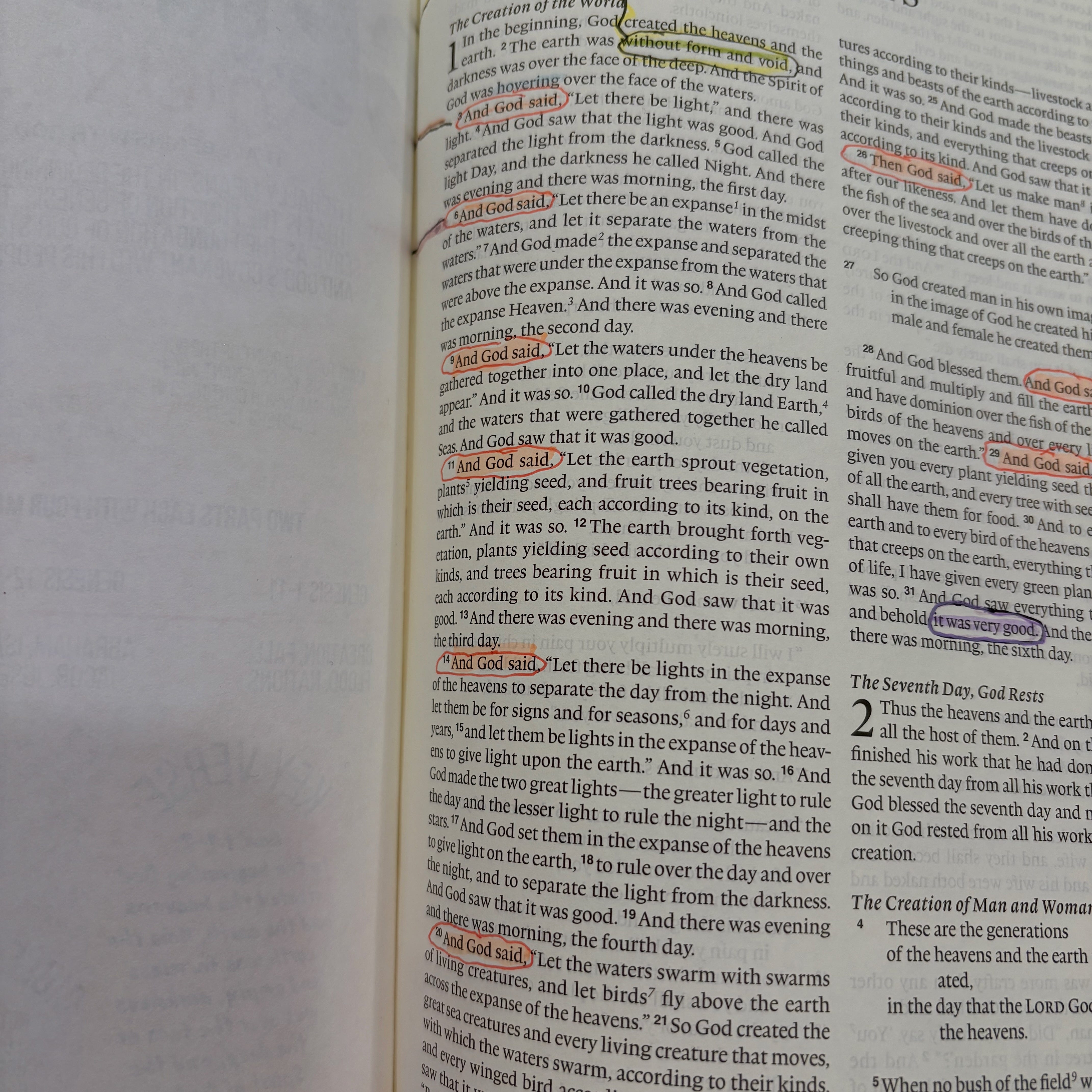
If you did that, you probably noticed something: the text has a rhythm. Not a poetic rhythm exactly, but a structural one. Every day follows a pattern. God speaks. Something happens. God evaluates it. The day closes. Over and over, six times in a row.
But here’s what I want you to see next.
Look at what God makes on each day:
Day 1 — Light and darkness (separation)
Day 2 — Sky and waters (separation)
Day 3 — Land and seas, then vegetation (separation and filling)
Day 4 — Sun, moon, and stars (lights to govern Day 1’s realm)
Day 5 — Sea creatures and birds (to fill Day 2’s realm)
Day 6 — Land animals and humanity (to fill Day 3’s realm)
Do you see it?
Days 1-3 create the realms. Days 4-6 fill those realms. Ancient readers often noticed that this isn’t merely chronology. It’s symmetry.
Day 1 makes light; Day 4 makes the lights that govern it. Day 2 makes sky and sea; Day 5 fills them with birds and fish. Day 3 makes land; Day 6 fills it with animals and with the creature who will tend it.
The Hebrew text is doing this deliberately. The author arranged the creative days into two parallel panels of three, so that the second panel answers the first.
The world begins as tohu vavohu — unformed and unfilled. The creation week is the story of God solving both problems at once. He forms first, then fills. He builds the realms, then populates them. Creation is ordered. That’s the point.
Now ask yourself a harder question: Why does this matter? What difference does it make that the structure is intentional?
Here’s one answer: it tells you something about the character of the God you’re reading about.
This is not a God who creates haphazardly and cleans up afterward. This is a God who works with deliberate purpose, who structures before He fills, who builds the container before He pours in what it holds. The architecture of the creation week is a theological statement about the Creator.
This procession of scriptural record is a blueprint for Redemption. GOD always starts with a mess and redeems it into perfection. Even the formation of a "day" tells this. Evening, then morning. Dark and unidentifiable, chaotic and void, all being "made" to shine with the Light of GOD's Glory revealed in and through the process. Wow!! I just preached myself happy! That is ALL from The Father!
Finally, after over 50 years the Ruach has taught me how to be filled—and therefore fulfilled in a way I only dreamed pf.