


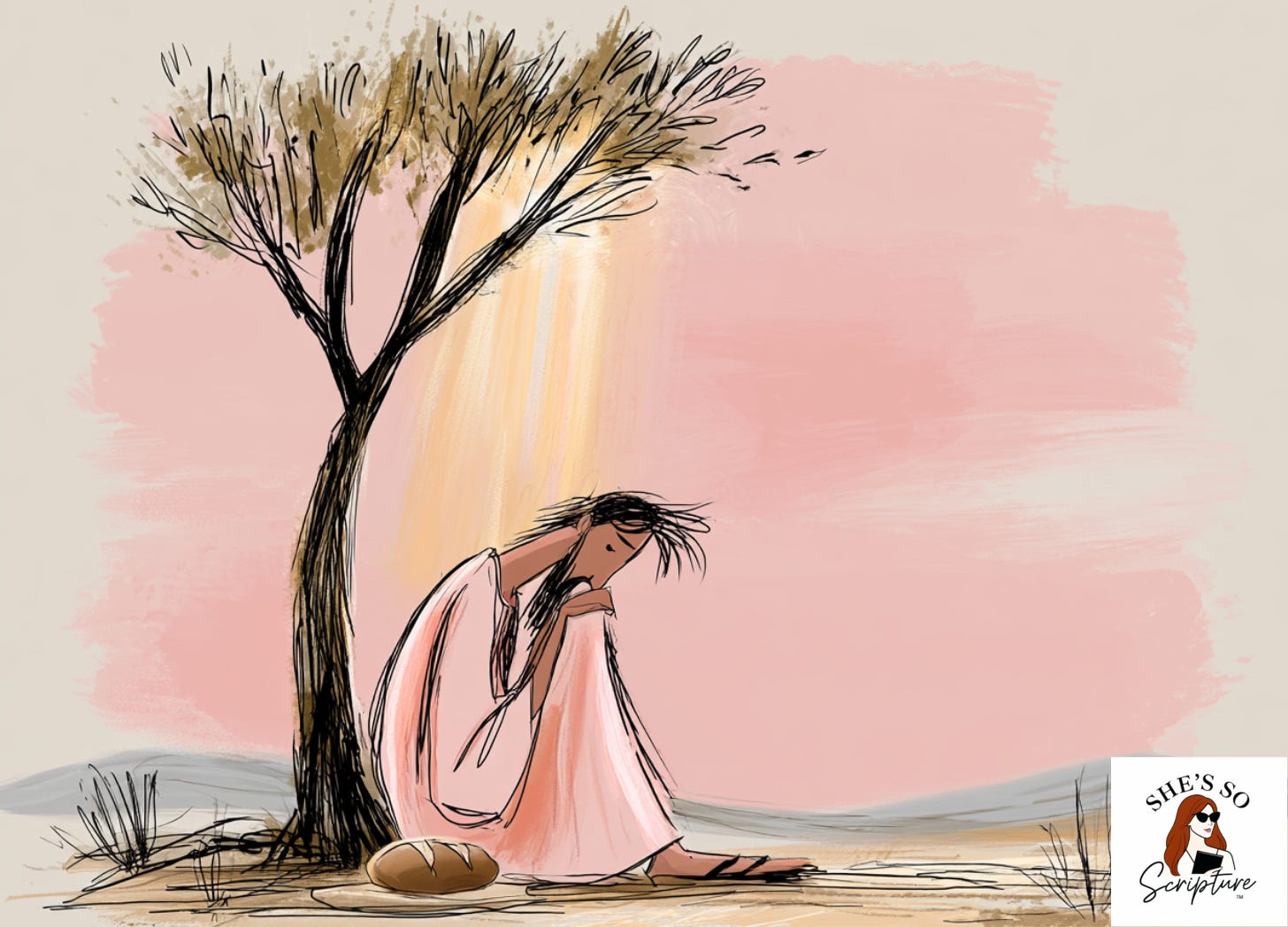
I used to think a prophet was someone who stood at a podium with a microphone and a PowerPoint slide that said “THUS SAITH THE LORD” in Impact font. Maybe they had a word for you. Maybe they were selling their anointed prayer cloths on TV at 2 a.m. Maybe they had a very specific revelation that somehow always required your credit card number.
Yeah. We’ve seen that version. We’ve all seen that version.
But here’s the thing. That version has almost nothing to do with what the Hebrew Bible actually describes when it talks about a navi. And if you’ve spent any real time in the prophetic books wondering why they feel so strange, so uncomfortable, so unlike what you expected, it’s because you’ve been reading them through the wrong lens.
The prophetic voice in Scripture isn’t a gift you develop. It isn’t a personality type. It isn’t an office you apply for. In the ancient Hebrew world, the prophetic voice was something that happened to you. And the people it happened to were often the last ones anyone would have picked.
What Navi Actually Means
The Hebrew word for prophet is navi (נָבִיא). The exact origin of the word is debated among scholars. 1 Many connect it to an Akkadian root associated with calling or appointment, while others suggest imagery connected to speech that comes forth under divine compulsion. Either way, the biblical picture is not of someone building a spiritual platform, but someone seized by a message they didn’t create.
Neither of these is passive and neither is polished.
The navi wasn’t someone who sat around spiritually curating their brand and waiting for a download. The navi was someone in whom the word of God created an internal urgency that just couldn’t be managed. Jeremiah tried to quit. He literally said he wasn’t going to speak anymore. And then he wrote:
“But if I say, ‘I will not mention Him or speak any longer in His Name,’ then His word becomes a fire burning in my heart, shut up in my bones. I am weary of holding it in. Indeed, I cannot.”
(Jeremiah 20:9, TLV)
That’s not a person who chose a career. That is a person who got overtaken.
The Divine Council and the Sod
Here’s where it gets interesting, and where most of our church sermons completely missed the boat.
In the ancient Near Eastern world, the prophetic office was understood in terms of access. Not access to power, not access to a platform, but access to the divine council.
The Hebrew word for this is sod (סוֹד), which means “secret counsel” or “intimate deliberation.” It’s the word used in Amos 3:7:
“Surely the Lord God does nothing without revealing His secret to His servants the prophets.”
(Amos 3:7, TLV)
The word “secret” there is sod. And the picture being painted is of a heavenly council, a royal court where decisions are made, where God’s purposes are deliberated. The prophets are often portrayed as those granted access to the room. 2
Jeremiah 23 makes this explicit. God is condemning the false prophets specifically because they didn’t stand in the sod, the divine council. They didn’t receive the word. They borrowed the words of each other and called it prophecy. They gave comfort when God had not authorized comfort. They preached peace when God was not at peace with what He was seeing.
The indictment wasn’t that they lacked charisma. The indictment was that they’d never been in the room.

Foretelling Versus Forthtelling
One of the biggest misunderstandings about the prophets is that their job was primarily about predicting the future. We get this from centuries of reading prophetic texts backward from Yeshua and assuming that’s the whole point.
But in the Hebrew context, prophecy was overwhelmingly forthtelling before it was foretelling. The prophet often functions like a covenant prosecutor. The prophetic books frequently take the shape of what scholars call the rib pattern, a Hebrew legal term meaning “covenant lawsuit.” 3
God, through the prophet, is bringing Israel to court. He’s reading the charges. He’s recounting the terms of the covenant that were agreed to at Sinai, and He’s calling out the breach.
When Isaiah walks in front of the people and says…
“Hear, O heavens, and listen, O earth!”
(Isaiah 1:2, TLV)
… he’s invoking the heavens and earth as the witnesses called at Sinai in Deuteronomy 30:19. This is covenant language. The prophet is standing between the people and their covenant God, delivering a case that God Himself is making.
That is a completely different job description than what most people imagine when they think “prophet.”
Not All Prophets Were the Same
Here’s something that will help you make sense of the whole prophetic landscape: not all prophets in Scripture functioned the same way, and knowing the difference changes how you read the entire story.
The earliest ones are what scholars often call the pre-classical prophets, and we don’t know them through books they wrote but through the stories surrounding their ministries. Samuel. Nathan. Elijah. Elisha. Their stories live in the historical books because their ministry was primarily oral, relational, and often shockingly dramatic. And a significant portion of their work was directed straight at kings.
In the ancient world, the king was the covenant representative of the entire nation. What he did, the nation did. So when God had something to say to His people, He often went directly to the throne room… usually without an appointment.
Nathan is the textbook example of a court prophet. He was embedded in David’s royal household as a spiritual advisor and covenant watchdog. He’s the one who delivered the Davidic covenant in 2 Samuel 7. He’s also the one who walked into that same throne room after the Bathsheba disaster and told the most powerful man in Israel a story about a stolen lamb that made David convict himself before he even saw it coming.
That is the court prophet doing exactly what he was commissioned to do: keeping the king accountable to the covenant when every human incentive said to stay quiet and stay comfortable.
Elijah functioned very differently. He operated outside the court system almost entirely. He arrived in scenes, explosive ones, and then vanished. His target was King Ahab, and when Jezebel had run the prophets of God underground and replaced them with 450 prophets of Baal, Elijah showed up on Mount Carmel and called down fire. He was the most dramatic person in every room he entered, and God used every single bit of it.
Then came the shift. Around the eighth century BCE, the classical prophets emerged, and this is when extended prophetic books began to take shape. Amos, Isaiah, Hosea, Micah, Jeremiah, Ezekiel. Their audience expanded beyond the palace to the whole covenant community. They still confronted kings when they needed to.
Isaiah confronted and advised Hezekiah. Jeremiah stood in the gates of Jerusalem and preached to everyone who would listen and a whole lot of people who absolutely would not. But their message was aimed at the nation as a whole, calling an entire people back to covenant faithfulness while empires were closing in from every direction.
Different assignments. Different audiences. Different methods. But again and again, the prophets are portrayed as people sent to audiences they did not select, carrying messages they did not invent. That part never changed.
The People God Actually Chose
God has this habit of picking the people who are very clear on their own inadequacy. If you haven’t noticed this pattern yet, go back and read your Bible slowly.
Moses said he couldn’t speak well. Isaiah saw the vision of God’s holiness and his first response was that he was a man of unclean lips living among a people of unclean lips. Jeremiah told God he was too young. Ezekiel was given a message so hard that God had to literally feed it to him before he could deliver it.
And then there’s Amos. A shepherd. A sycamore fig farmer from Tekoa, which was a small town south of Jerusalem, not exactly the address of the prophet school. When the priest Amaziah told him to go back to Judah and prophesy for money like a professional, Amos answered:
“I am no prophet, nor am I a son of a prophet. Rather, I am a shepherd tending fig trees. But the Lord took me from following the flock and the Lord said to me: ‘Go, prophesy to My people Israel.’”
(Amos 7:14-15, TLV)
“I am no prophet.” That’s his credential. That’s his resume. God took him from the flock. The verb “took” there is laqach, and it carries the sense of being taken from one sphere of life and brought into another. Nobody asked Amos if he wanted a ministry platform.
This is the pattern. Again and again, God bypasses the people society assumes would carry His voice. He calls. He takes. He sends. And the person being sent is usually the most surprised one in the room.
Today, we have people casually calling themselves prophets and prophetesses, assigning themselves titles that, throughout Scripture, were never self-appointed. The prophetic call was not a role people campaigned for. It was something God initiated, often against the wishes of the person being called.
Verse Mapping Aid: Navi (נָבִיא)
Pronunciation: nah-VEE
The word navi appears over 300 times in the Hebrew Bible, which tells you something about how central this concept is to the whole story of Scripture. What’s striking about the word is that it almost never appears in a context of celebration. The navi is rarely welcomed. He’s sent to people who don’t want what he’s carrying.
The verb form connected to navi is used reflexively in Hebrew, which means it describes an action that affects the one performing it. The prophet doesn’t just deliver the word. The prophet is shaped by it, marked by it, changed by it. You cannot carry the word of God without it leaving a mark on you.
What changes when you understand this? You stop reading the prophets as ancient newsletters and you start reading them as accounts of people who were changed by what they witnessed and then went and said the hardest thing, in the most hostile rooms, to the people most invested in not hearing it.
That’s the prophetic voice. Not a gift. Not a self-assignment. A commission with a cost.
The arc from Moses to Isaiah to Jeremiah to Amos to Yeshua Himself is the arc of a God who keeps speaking into the silence, keeps calling people out of their ordinary lives, keeps finding the one who will stand in the gap and say what needs to be said even when no one is ready to hear it.
And Yeshua is the fullness of this. He is the Word made flesh. The Memra. The ultimate expression of God’s voice breaking into human history. Every prophet before Him was pointing to the One in whom all of God’s speech would be embodied. The prophetic voice finds its completion not in an office or a gift, but in a person.
My Final Thoughts
The prophets weren’t running spiritual enterprises. They were reluctant, overtaken, often miserable people who had encountered the living God and couldn’t unknow what they knew.
That matters for how you read your Bible. When you sit with Isaiah or Jeremiah or Amos, you’re reading the testimony of someone who got pulled into the sod, brought into the room where the decisions are made, handed a message that wasn’t going to be popular, and sent anyway.
And maybe that matters for how you think about your own life too. If God has put something in you that you can’t shake, something that feels like a fire in your bones that you’re tired of holding in, that’s not restlessness. That’s not anxiety. That might be the word doing what it does.
And like every prophetic voice in Scripture, it must be tested, humbled, and rooted in the character and word of God.
Not because you’re special. Because He said go.
Bible Study Questions
How does understanding the Hebrew word navi reshape the way you’ve traditionally thought about prophets and prophecy?
Amos 3:7 describes God revealing His sod, His secret counsel, to His servants the prophets. What does it suggest about the relationship God desires with those He calls?
Read Jeremiah 20:9. What does Jeremiah’s attempt to stop speaking reveal about the nature of a true prophetic call?
The rib pattern, God’s covenant lawsuit through the prophets, assumes the people already know the terms of the agreement. What does that say about God’s expectations of those in covenant with Him?
How does Yeshua represent the fullness of the prophetic voice as described in the Hebrew Scriptures?
Reflection Questions
Have you ever experienced something like what Jeremiah describes, a word or conviction you tried to suppress but couldn’t? What did that feel like, and how did you respond?
Amos was taken from his ordinary life to deliver an extraordinary word. Where in your own life have you been called out of comfort into something you didn’t choose?
The false prophets in Jeremiah 23 spoke without standing in the sod. What practices help you ensure that what you speak and teach is grounded in genuine encounter with God rather than borrowed ideas?
Action Challenges
Choose one of the major prophets this week (Isaiah, Jeremiah, or Amos) and read the first three chapters with this question in mind: What is God actually saying, and to whom? Write down what you notice about the tone, the audience, and the cost to the prophet delivering it.
Sit with Jeremiah 1:4-10 this week as a personal lectio divina. Read it slowly. Let God’s words to Jeremiah land personally. Journal what surfaces.
Share this study with someone who’s been wrestling with a word they’re afraid to say out loud. Sometimes the most prophetic thing we can do for each other is remind each other that the fire in the bones isn’t a malfunction.
If this study stirred something in you, share it with a friend who’s been wrestling with a calling they can’t quite explain or a word they keep trying to put down.
And if it left you wanting to go slower and deeper into the Word, I’ve got you! Paid subscribers get access to live Bible studies, extended studies, devotionals, theological teaching, spiritual formation practices, and a community of women who want depth without pressure or performance. If you’re ready to step further into the Word, you’re welcome inside.
👉🏻 Join The Vault.
If a paid subscription isn’t feasible right now but this space has blessed you, you can leave a one-time tip here. Every gift helps sustain this work. 💕

About the Author
Diane Ferreira is a Jewish believer in Yeshua, a published author, speaker, seminary student, wife, and proud mom. She is the founder of She’s So Scripture and She Opens Her Bible. She is the author of several books, including The Proverbs 31-ish Woman, which debuted as Amazon’s #1 New Release in Religious Humor, as well as Holy, Hormonal and Holding On.
She is currently pursuing her graduate degree in Jewish Studies in seminary, with her favorite topics being the early church and Biblical Hebrew. Diane writes and teaches from a unique perspective, bridging her Jewish heritage with vibrant faith in the Messiah to bring clarity, depth, and devotion to everyday believers.
When she’s not writing, studying, or teaching, you’ll find her curled up with a good book, crocheting something cozy, traveling, or playing her favorite video games.
Tree of Life (TLV) – Scripture taken from the Holy Scriptures, Tree of Life Version*. Copyright © 2014,2016 by the Tree of Life Bible Society. Used by permission of the Tree of Life Bible Society.
“What Is the Meaning of the Word Navi?,” Jewish Link, accessed May 15, 2026, https://jewishlink.news/what-is-the-meaning-of-the-word-navi/
Daniel Rose, “Introducing Sod into the Tanakh Classroom,” Jewish Educational Leadership 25 (Spring 2025), accessed May 14, 2026, https://www.lookstein.org/journal-article/w_25/introducing-sod-into-the-tanakh-classroom/
Richard M. Davidson, “The Nature of the Prophetic Call in the Old Testament,” Journal of the Adventist Theological Society 4, no. 1 (1993): 13–43, accessed May 15, 2026, https://digitalcommons.andrews.edu/cgi/viewcontent.cgi?article=2949&context=pubs
Great post. In recognising prophets didn’t want to be prophets, we might also consider that the prophets today may be the people we don’t expect! Just because they don’t fit our idea of what a prophet might look like doesn’t mean God hasn’t called them.
Way to call me out, Diane!
Seriously though, I know the struggle of being called to something I didn't choose. It took me a year to finally obey, but that's the whole reason my publication exists.
I've said from the very beginning that I don't feel qualified. That there has to be someone better for this work. But He wouldn't let me let it go.
What I've learned is that our worldly concerns and our insecurities don't matter in the face of that. A life devoted to God means when He calls we obey.