

Weekly Deep Dive - The Symbolism of the Tabernacle: Why It Looks Suspiciously Like Eden

I’ll be honest with you about Exodus 25 through 31. That’s the stretch where most Bible-in-a-year plans go to die. You survive the plagues, you make it through the Red Sea, you’re feeling good, and then suddenly it’s seven chapters of acacia wood measurements and gold clasps and by verse four you’re skimming. I know because I used to skim it too. I was a woman checking boxes: yes, fine, fifty loops on the edge of the curtain, got it, moving on.
Then one year I read it with Genesis still fresh in my mind, and I noticed something that changed how I read both books.
Moses is describing a garden.
At least, that’s the pattern readers across the centuries keep finding there, and once I saw it I found I agree. The tabernacle echoes Eden’s parts, Eden’s arrangement, Eden’s staffing, and even the direction from which Eden was lost. Exodus never claims the connection outright. It just keeps leaving the clues lying around, and they run all the way to the last page of your Bible.
Now, grab your coffee. Let’s walk through it.
Planted in the East
Start with where Eden sits.
“Then Adonai Elohim planted a garden in Eden in the east, and there He put the man whom He had formed. Then Adonai Elohim caused to sprout from the ground every tree that was desirable to look at and good for food. Now the Tree of Life was in the middle of the garden, and also the Tree of Knowledge of Good and Evil.” (Genesis 2:8-9, TLV)
A garden in the east, with the Tree of Life at the center. Hold onto that.
Now watch what happens when Adam and Eve are expelled:
“And He expelled the man; and at the east of the Garden of Eden He had cheruvim dwell along, with the whirling sword of flame, to guard the way to the Tree of Life.” (Genesis 3:24, TLV)
The cherubim take up their post east of the garden. The guarded way back in is on its eastern side. Which means the road toward the Tree of Life, if anyone could ever take it, runs from east to west, straight past the cherubim.
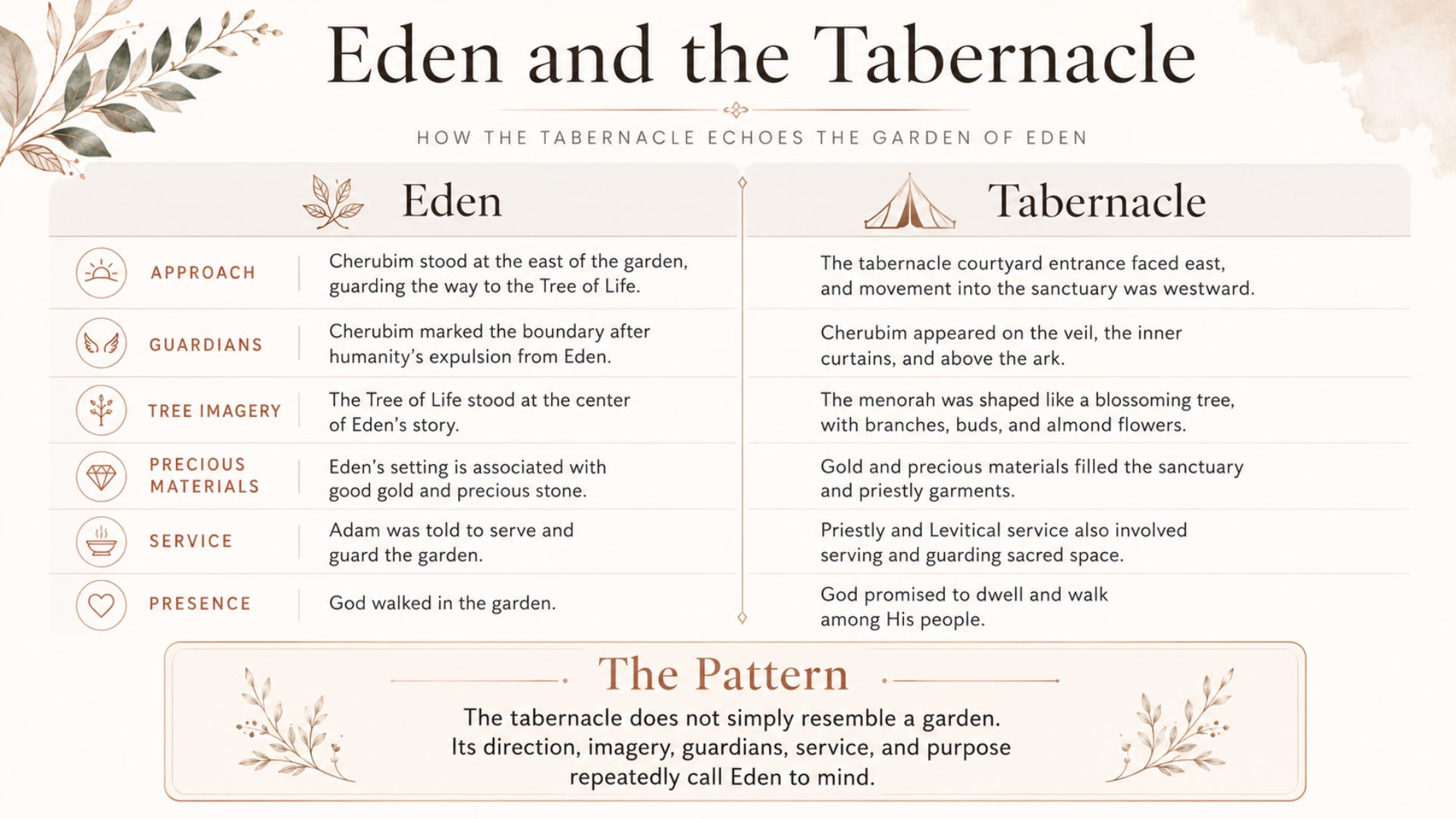
Now look at the tabernacle. The gate of its courtyard stood on the east (Exodus 27:13-16), and Numbers 3:38 places Moses, Aaron, and his sons camped on the east side, in front of the tent, toward the sunrise, guarding the entrance.1 An Israelite bringing an offering entered from the east and moved west, toward the sanctuary, toward the ark, toward the presence.
And deep inside the tent itself hung a veil separating the Holy Place from the Holy of Holies. Exodus 26:31 says that veil was woven with cherubim. 2
The last time anyone stood in unbroken fellowship with God, cherubim were stationed at an east-facing entrance to keep humanity out. Now God commands a tent entered from the east, with the imagery of those same guards worked into the way to the innermost room. Under the priestly order God established, one man went beyond that veil, the high priest, on one day each year, Yom Kippur, with sacrificial blood.
Symbolically, someone was being allowed back toward the presence humanity had lost. Barely, carefully, under blood… but back in.
A Tree Made of Gold
Eden’s neighborhood had gold. Genesis 2:11-12 traces one of the garden’s rivers around the land of Havilah, “where there is gold,” and adds that “the gold of that land is good,” along with precious stone. 3 The text doesn’t put Havilah inside the garden itself, but it surrounds Eden’s story with gleaming materials, and those same materials later fill Israel’s sanctuary and priestly garments.
Gold overlaid the ark, the table, the boards, the fixtures. When the priest stepped inside, he stepped into a golden room.
But the piece of furniture that makes the pattern almost impossible to miss is the menorah.
“There are to be six branches coming out of the sides, three branches of the menorah out of one side, and three branches out of the other. There are to be three cups shaped like almond blossoms in one branch, each with a bulb and flower, then three cups made like almond blossoms in the next branch, each with a bulb and flower, and so forth for the six branches coming out of the menorah. Within the menorah will be four cups made like almond blossoms, with bulbs and flowers.” (Exodus 25:32-34, TLV)
Check out the vocabulary. Branches. Blossoms. Bulbs. Flowers. That’s not lamp language… that’s orchard language. God didn’t commission an ordinary light fixture. He commissioned something that looked remarkably like a tree, hammered from pure gold, blooming with almond blossoms and holding fire in its branches.
Exodus 26:35 places it on the south side of the Holy Place, opposite the table of the bread of the Presence, its lamps tended to burn from evening until morning (Exodus 27:20-21). So picture it: a stylized, radiant tree standing inside God's dwelling, shining through the dark hours, in the same tent as the veil worked with cherubim.
Scholars have noticed for a long time what that seems to echo, and I think they’re right. 4 The Tree of Life stood in the middle of the garden. The menorah stood inside the sanctuary, shaped like the thing Israel had lost.
I sat with my Hebrew lexicon open next to Exodus 25 the first time this clicked, and I remember thinking… it seems like God missed the garden too.
That’s my inference, not a verse. But I’ll stand by it.
The Gardener Was a Priest
Here’s where the English translations kind of rob us.
“Then Adonai Elohim took the man and gave him rest in the Garden of Eden in order to cultivate and watch over it.” (Genesis 2:15, TLV) 5
Two jobs: cultivate and watch over. In Hebrew, that’s avad and shamar. Ordinary enough words. Avad means to work or to serve. Shamar means to keep, to guard, to watch over. A gardener’s job description, on the surface.
Now listen to the job description God gives the Levites for the tabernacle:
“They are to keep watch over duties for him and the entire community before the Tent of Meeting while performing the service of the Tabernacle. They are to tend to all the implements of the Tent of Meeting and the service of Bnei-Yisrael while performing the service of the Tabernacle.” (Numbers 3:7-8, TLV)
In the Hebrew underneath that English, the Levites are assigned forms of shamar and avad. The same two roots. Serve and guard. The two verbs describing Adam’s work in the garden became characteristic vocabulary for Levitical service in God’s sanctuary (see also Numbers 18:5-6, where the pairing repeats). 6
Now, I want to be really careful here, because this is the kind of place where teachers get ahead of the text. Genesis never calls Adam a priest. What the text does give us is the vocabulary: the first man was placed in sacred space and assigned the two verbs that later marked the men who kept God’s house.
Plenty of scholars, Jewish and Christian both, read that as deliberate. Adam serving in Eden the way a priest serves in the sanctuary, because Eden was the first sanctuary. I find the case persuasive. But I’d rather show you the verbs and let you weigh it than announce it like it’s printed in red letters.
One more small thing, because you just know I can't resist. The TLV translates the beginning of Genesis 2:15 as God "gave him rest" in the garden. The Hebrew verb there comes from the root nuach, meaning to rest or to settle.
It even sounds like Noah's name, though Genesis 5:29 actually explains Noah's name through a wordplay on a different root, nacham, the word for comfort. Either way, before Adam ever worked, he was set down into rest. That'll preach, but I'll leave it in the margin where I found it (for now anyway).
The God Who Walks
After the fruit, after the fig leaves, comes one of the saddest sentences in Scripture:
“And they heard the sound of Adonai Elohim going to and fro in the garden in the wind of the day. So the man and his wife hid themselves from the presence of Adonai Elohim in the midst of the Tree of the garden.” (Genesis 3:8, TLV)
That phrase “going to and fro” translates a particular form of the Hebrew verb for walking, mithalekh, a form that in passages like this conveys walking about, moving to and fro. 7 The wording presents God moving within His garden, and the human pair recognize the sound of Him approaching. I read that and I picture a God at home there. The heartbreak of verse 8 is that the sound of Him made someone hide.
Centuries later, God describes what the tabernacle will mean for Israel:
“I will set My Tabernacle among you, and My soul will not abhor you. I will walk among you and will be your God, and you will be My people.” (Leviticus 26:11-12, TLV)
“I will walk among you.” Same verb, in the same Hebrew stem, the walking-about of Genesis 3:8. And when David later offers to build God a permanent house, God answers in 2 Samuel 7:6-7 that He has been moving about in a tent all these years, and the Hebrew uses that word again.
God kept the walking verb. Through the expulsion, through Egypt, through the wilderness, His stated intention doesn’t change: to walk among His people the way He once walked in the garden.
The tabernacle was not just about managing sacrifices. The offerings did real work, atonement and purification and thanksgiving and dedication, all of it sustaining covenant fellowship. And that fellowship served the larger purpose. The point was God dwelling and walking among His people.
The Word Pitched a Tent
So the pattern is set. Eden was God’s dwelling with humanity. The tabernacle wasn't a copy of Eden, but it was full of echoes of Edem: cherubim, an eastern entrance, a tree of light, and priests commissioned to serve and guard the place where God dwelled with His people. Adam's original calling hadn’t been forgotten. Then John sits down to write his Gospel, and chooses his verb with surgical care:
“And the Word became flesh and tabernacled among us. We looked upon His glory, the glory of the one and only from the Father, full of grace and truth.” (John 1:14, TLV)
The Greek verb is skēnoō, related to skēnē, the word for tent or tabernacle. The Septuagint, the ancient Greek translation of the Torah, regularly uses skēnē when translating Hebrew tabernacle language, including the word mishkan. 8 Most English Bibles say "dwelt among us," which is true, but it lets us off the hook too easily. John said He tabernacled. He pitched the tent. Everything the mishkan was, the presence, the glory, the meeting place between God and His people, showed up wearing flesh.
And Yeshua Himself pointed in this direction when He spoke of the temple of His body in John 2:19-21. The dwelling had legs now. The God who walked in the Garden was walking again, on actual roads, in actual dust, among actual people, many of whom hid, resisted, or drew back from Him just as their first parents had.
The Garden Becomes a City
The Bible doesn’t leave the pattern unfinished.
Ezekiel saw water flowing out from under the threshold of a future temple, growing from a trickle to a river, with trees on both banks whose fruit was for food and whose leaves were for healing (Ezekiel 47). A river running out of God’s dwelling, watering the world. Genesis 2 started with one of those.
Then John sees the end:
“I also saw the holy city—the New Jerusalem—coming down out of heaven from God, prepared as a bride adorned for her husband. I also heard a loud voice from the throne, saying, ‘Behold, the dwelling of God is among men, and He shall tabernacle among them. They shall be His people, and God Himself shall be among them and be their God.’” (Revelation 21:2-3, TLV)
There’s the tabernacle verb again, this time forever. And when the angel measures the city in Revelation 21:16, its length, width, and height are equal. The Holy of Holies in Israel’s sanctuary tradition was cubic. Solomon’s temple says so outright, measuring the inner sanctuary at twenty cubits in length, width, and height (1 Kings 6:20), and the tabernacle’s innermost chamber is generally reconstructed as a cube as well. 9
Now an entire city takes that shape. The city has no temple inside it because, as many readers of Revelation have seen, the whole city has become the innermost room. Every square inch is the place behind the veil.
And in that city:
“Then the angel showed me a river of the water of life—bright as crystal, flowing from the throne of God and of the Lamb down the middle of the city’s street. On either side of the river was a tree of life, bearing twelve kinds of fruit, yielding its fruit each month; and the leaves of the tree were for the healing of the nations. No longer will there be any curse.” (Revelation 22:1-3, TLV)
The river is back. The Tree of Life is back, and the text says the curse is gone and the gates are never shut. Hold the whole canon’s imagery in your hands for a minute and watch what it adds up to. There are still angels at the gates of this city. Revelation 21:12 posts twelve of them. But no whirling sword. No guarded inner chamber. And gates that never close.
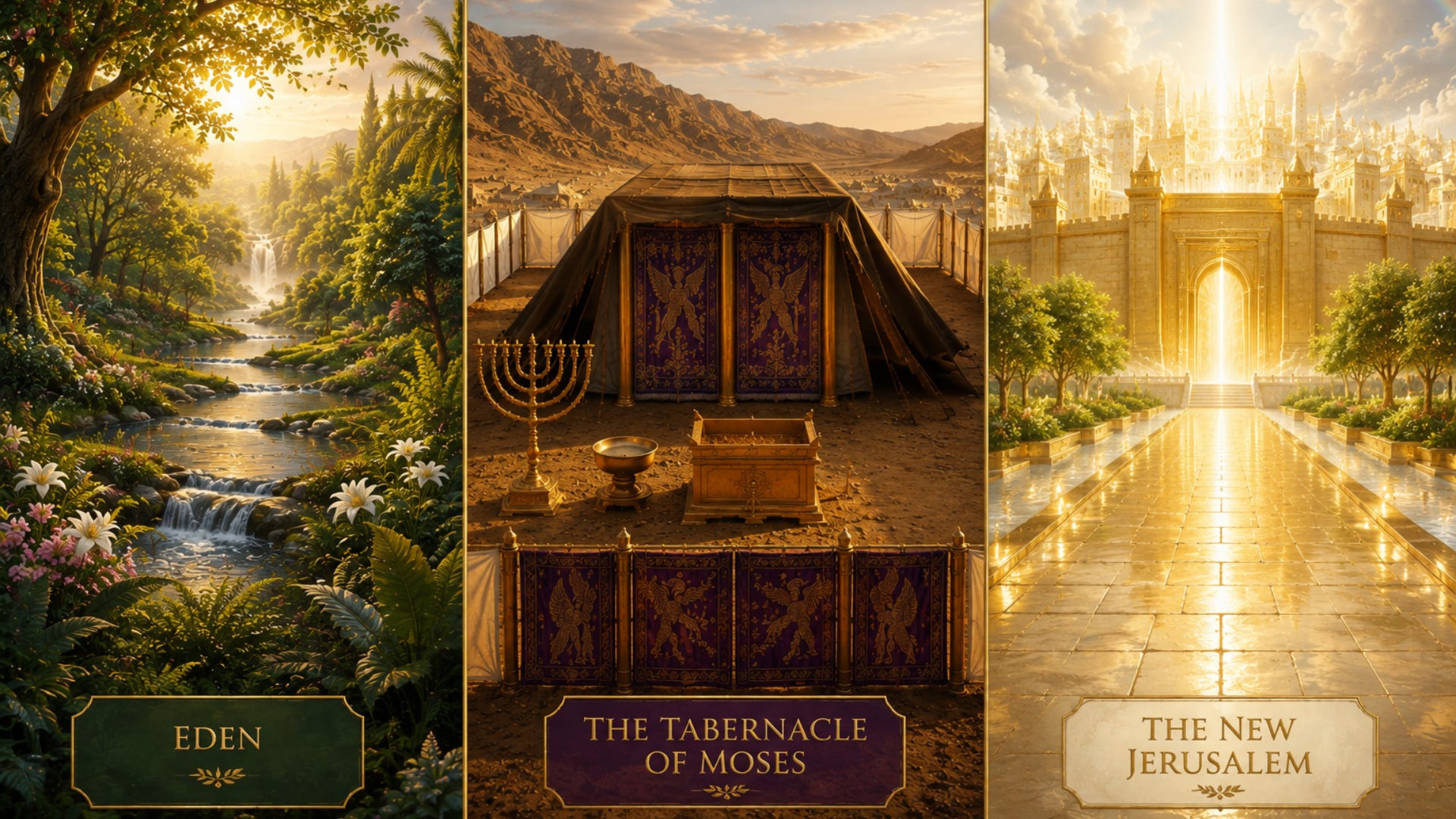
The story that opened with humanity losing a garden through the east closes with humanity walking freely in a garden city, faces unhidden, because the One who tabernacled among us opened the way in.
Genesis 3 stationed a guard to keep us out. Revelation stations angels at gates that never shut.
Verse Mapping Aid
Avad (Hebrew): to work, serve, cultivate. Used of Adam’s task in Genesis 2:15 and of Levitical service in Numbers 3:7-8 and 18:5-6. The related noun avodah becomes the standard term for priestly and worship service.
Shamar (Hebrew): to keep, guard, watch over. The second half of Adam’s Genesis 2:15 assignment, and the standing duty of the Levites who guarded the sanctuary. The pairing of avad and shamar in both settings is the textual hinge of this whole study.
Mithalekh (Hebrew): a form of halakh, “to walk,” that in these contexts conveys walking about or repeated movement. Describes God walking in the garden (Genesis 3:8), God’s promise to walk among Israel (Leviticus 26:12), and God’s self-description as moving about in a tent (2 Samuel 7:6-7).
Skēnoō (Greek): to pitch a tent, to tabernacle. Used in John 1:14 of the Word dwelling among us; Revelation 21:3 uses the same verb of God dwelling with humanity forever. Related to skēnē, the word the Septuagint regularly uses for tent and tabernacle.
My Final Thoughts
Somewhere in my notebook from that year is a scribbled line that just says “the tabernacle is homesickness.” I don’t remember writing it, but I know what I meant.
Every board and blossom of that structure carried echoes of the place where God had walked with humanity in the wind of the day. He didn’t wait for us to find our way back east past the cherubim. He drew up plans. He picked out the gold. He put a tree in the room and kept it lit through the night. And when fabric and furniture weren’t close enough, He came in person and pitched the tent Himself.
You are not reading a Bible about a distant God who reluctantly permits visitation hours. You are reading the story of a God whose purpose to dwell with His people has held steady since page three, and who will not stop until the whole creation is the Holy of Holies and there is no east gate left to guard.
He never got over the garden. Neither did we. That’s the whole Bible.
Dig Deeper
Genesis 2:8-15; Genesis 3:8, 21-24; Exodus 25:31-40; Exodus 26:31, 35; Exodus 27:13-16, 20-21; Exodus 28:9-12; Numbers 3:7-8, 38; Numbers 18:5-6; Leviticus 26:11-12; 2 Samuel 7:5-7; 1 Kings 6:20; Ezekiel 28:13-14; Ezekiel 47:1-12; John 1:14; John 2:19-21; Revelation 21:1-4, 12, 15-22; Revelation 22:1-5
Let’s Talk in the Comments
Which of the Eden echoes in the tabernacle surprised you most: the east entrance, the golden tree, the priestly verbs, or the walking God? Why that one?
Adam’s original assignment was to serve and to guard sacred space. Where do you see that same two-part calling showing up in your own life with God?
Revelation ends with the Tree of Life freely available and the gates never shut. What changes about how you pray or worship this week if you take seriously that the way in is no longer blocked?
If this study stirred something in you, share it with a friend who always skips the tabernacle chapters and deserves to know what she’s been skimming past.
And if it left you wanting to go slower and deeper into the Word, I’ve got you! Paid subscribers get access to live Bible studies, extended studies, devotionals, theological teaching, spiritual formation practices, and a community of people who want depth without pressure or performance. If you’re ready to step further into the Word, you’re welcome inside.
If a paid subscription isn’t feasible right now but this space has blessed you, you can leave a one-time tip here. Every gift helps sustain this work. 💕

About the Author
Diane Ferreira is a Jewish believer in Yeshua, a published author, speaker, seminary student, wife, and proud mom. She is the founder of She’s So Scripture and She Opens Her Bible. She is the author of several books, including The Proverbs 31-ish Woman, which debuted as Amazon’s #1 New Release in Religious Humor, as well as Holy, Hormonal and Holding On.
She is currently pursuing her graduate degree in Jewish Studies in seminary, with her favorite topics being the early church and Biblical Hebrew. Diane writes and teaches from a unique perspective, bridging her Jewish heritage with vibrant faith in the Messiah to bring clarity, depth, and devotion to everyday believers.
When she’s not writing, studying, or teaching, you’ll find her curled up with a good book, crocheting something cozy, traveling, or playing her favorite video games.
Footnotes
Exodus 27:13-16 places the courtyard gate on the east side of the tabernacle complex. Numbers 3:38 places Moses, Aaron, and Aaron’s sons “in front of the Tabernacle to the east, in front of the Tent of Meeting toward the sunrise,” entrusted with guarding the sanctuary on behalf of Israel, and Numbers 2:3 places the camp of Judah on the east side, toward the sunrise.
Cherubim appear throughout the tabernacle’s design: hammered in gold above the ark’s atonement cover (Exodus 25:18-20), worked into the ten inner curtains (Exodus 26:1), and worked into the veil before the Holy of Holies (Exodus 26:31). Their only prior appearance in the Torah is Genesis 3:24, guarding the way to the Tree of Life.
The TLV translates the stones of Havilah in Genesis 2:12 as “bdellium and lapis lazuli.” The Hebrew term behind the second stone, shoham, is of uncertain identification, and translations vary: onyx, lapis lazuli, and others. Whatever the stone was, it reappears in the priesthood: shoham stones were set on the high priest’s ephod, engraved with the names of the sons of Israel (Exodus 28:9-12).
On the menorah’s botanical symbolism, see Carol L. Meyers, The Tabernacle Menorah: A Synthetic Study of a Symbol from the Biblical Cult (Missoula, MT: Scholars Press, 1976; reprint, Piscataway, NJ: Gorgias Press, 2003). The fuller Eden-sanctuary correspondence is developed in Gordon J. Wenham, “Sanctuary Symbolism in the Garden of Eden Story,” in Proceedings of the Ninth World Congress of Jewish Studies, Division A (Jerusalem: World Union of Jewish Studies, 1986), 19-24, reprinted in I Studied Inscriptions from Before the Flood, ed. Richard S. Hess and David Toshio Tsumura (Winona Lake, IN: Eisenbrauns, 1994), 399-404; and G. K. Beale, The Temple and the Church’s Mission: A Biblical Theology of the Dwelling Place of God, New Studies in Biblical Theology 17 (Downers Grove, IL: InterVarsity Press, 2004). This is an interpretive pattern drawn from the text’s imagery, not a claim the text states outright.
Where the TLV reads "gave him rest," many translations read "put him." The Hebrew text of Genesis 2:15 uses a verb from the root nuach, meaning to rest or settle, a different verb from the one translated "put" in Genesis 2:8, and the TLV brings the association with rest into the translation. Noah's name sounds closely related to this root, though Genesis 5:29 explains his name through a wordplay on a different root, nacham, meaning "comfort."
In Genesis 2:15 the Hebrew infinitives are le’avdah and leshamrah, from avad and shamar. Numbers 3:7-8 assigns the Levites forms of these same two roots (shamar in “keep watch,” avad in “service”), and the pairing repeats in Numbers 18:5-6. On the priestly reading of Adam’s role, see Wenham, “Sanctuary Symbolism in the Garden of Eden Story”; Beale, The Temple and the Church’s Mission; and John H. Walton, The Lost World of Adam and Eve: Genesis 2-3 and the Human Origins Debate (Downers Grove, IL: InterVarsity Press, 2015).
The form in Genesis 3:8 is the Hitpael stem of halakh, a form that can convey walking about or repeated movement in these contexts. The same stem appears in God’s promise in Leviticus 26:12, in Deuteronomy 23:14-15 (depending on versification) of God walking in the midst of Israel’s camp, and in 2 Samuel 7:6-7 of God moving about in tent and tabernacle.
The Greek verb in John 1:14 is skēnoō, related to skēnē, “tent.” The Septuagint, the ancient Greek translation of the Torah, regularly uses skēnē when translating Hebrew tabernacle terminology, including mishkan. Revelation 21:3 uses the same verb of God dwelling with humanity.
First Kings 6:20 explicitly gives Solomon’s inner sanctuary equal length, width, and height, twenty cubits each. The tabernacle’s innermost chamber is also generally reconstructed as cubic from the structure’s dimensions and the placement of the veil. Revelation 21:16 presents the entire New Jerusalem with equal length, width, and height, inviting many interpreters to see the whole city as an expanded Holy of Holies; see Beale, The Temple and the Church’s Mission; and Diane Ferreira, The New Jerusalem.
Tree of Life (TLV) – Scripture taken from the Holy Scriptures, Tree of Life Version*. Copyright © 2014,2016 by the Tree of Life Bible Society. Used by permission of the Tree of Life Bible Society.