


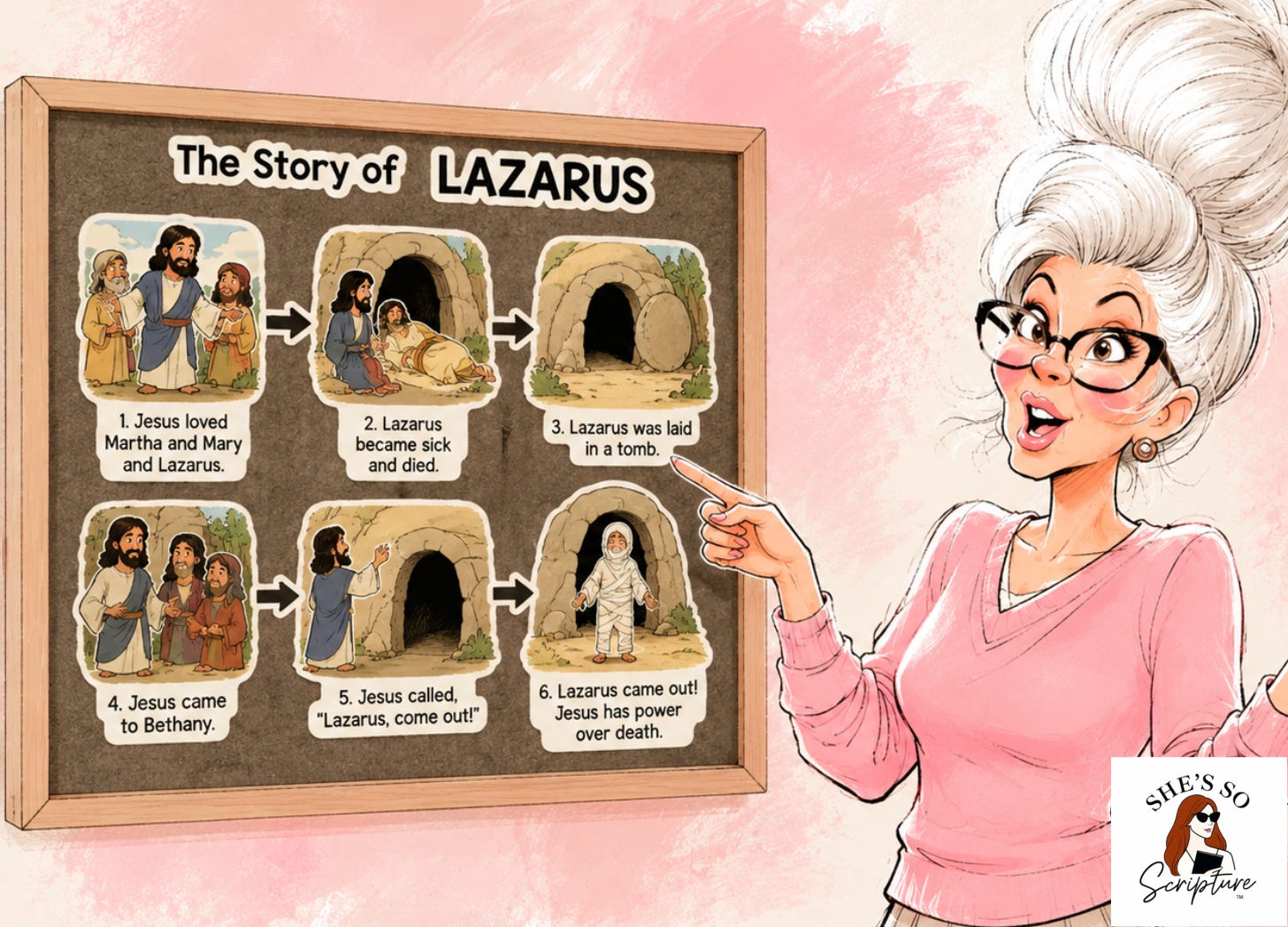
Oh Miss Patty! We love her, don’t we? She taught you the story of Lazarus. You know the version. Yeshua hears his friend is sick, takes his sweet time getting there, and Lazarus ends up dead. But don’t worry! God had a plan! Yeshua shows up, everybody cries, and then boom, Lazarus walks out of the tomb. The end. Go drink your apple juice.
And look, Miss Patty wasn’t wrong that God has a plan. She wasn’t wrong that Jesus has power over death. She just stopped the story approximately forty layers before it got really interesting. And for good reason… it’s not exactly a concept kids can understand.
Because here’s what she never told you: Yeshua didn’t miss it. He didn’t arrive late and have to improvise. He waited on purpose, He arrived on a very specific day, and every Jewish person standing at that graveside knew exactly what that meant. And it wasn’t good news. Not yet at least.
The Four Days Changed Everything
Later Jewish tradition, preserved in sources like Genesis Rabbah and Leviticus Rabbah, describes the soul as lingering near the body for three days, holding out hope for return. By the fourth day, decomposition had visibly set in, and death was understood as irreversible.
Now I want to be clear… whether or not every person in Yeshua’s day held this exact belief I don’t know, but John’s emphasis on the fourth day clearly removes any possibility that Lazarus was merely unconscious or only recently dead.
So when Martha runs out to meet Yeshua and says:
“Master, if You had been here, my brother wouldn’t have died”
(John 11:21 TLV)
She’s not just grieving. She’s saying what everyone in that crowd was thinking. The window has closed. He’s too far gone. You’re too late.
And Yeshua, who knew exactly when Lazarus died, looked at her and said:
“Your brother will rise again.”
(John 11:23 TLV)
Martha, being a good Jewish woman who knew her Scripture, replied:
“I know, he will rise again in the resurrection on the last day.”
(John 11:24 TLV)
She believed in future resurrection. Most Pharisaic Jews did (Sadducees did not). What she could not have imagined was that the resurrection was standing right in front of her face having a conversation.
He Made Them Wait for a Reason
John tells us plainly: Yeshua loved Martha and her sister and Lazarus. And then, almost in the same breath, he tells us that when Yeshua heard Lazarus was sick, He stayed where He was two more days (John 11:5-6 TLV). Read those two sentences together and you get something that feels almost unkind until you understand what day four means.
Yeshua didn’t wait because He was busy. He waited because a resuscitation on day two would have looked like a miracle. What He had in mind for day four was a miracle AND a declaration. He was going to walk into the land of the officially, unquestionably dead, and call a man back to life by name.
This wasn’t a close call. There was no “well he might have just been mostly dead.” Martha herself says it at the tomb:
“Master, by this time he stinks! He’s been dead for four days!”
(John 11:39 TLV)
She was NOT being dramatic. She was stating a reality that everyone in earshot understood. Day four meant gone. Day four meant this conversation about rolling away the stone made no sense.
And Yeshua looked her in the eye and said,
“Didn’t I tell you that if you believed, you would see the glory of God?”
(John 11:40 TLV)
The Word That Was Already in Their Bones
When Yeshua told Martha her brother would rise again, she reached for the word her whole tradition had been built on. In Hebrew, the verb is qum (קוּם), and it means to rise, to stand up, to be established. It’s not a gentle word. It’s a word with weight and momentum. It shows up hundreds of times across the Hebrew Scriptures because it’s doing real work throughout the whole biblical story.
When God told Abraham to arise and walk through the land, that’s qum. When the Psalms describe who may stand in God’s holy place, that’s qum. When Isaiah declares that the dead will rise and their bodies will stand again, that’s qum too.
We even see it elsewhere in the New Testament. “Talitha koum” / “Talitha qumi”
(“Little girl, arise”) in Mark 5:41.
Martha knew this word. She had prayed it, sung it, lived inside its promises her entire life.
But the resurrection she had in mind was future. Distant. Something that happened at the end of all things, not at the entrance of a tomb in Bethany on a Tuesday.
What Yeshua was about to do was collapse the future into the present, right in front of a crowd of mourners who were about to become witnesses.

Verse Mapping Aid: Qum (קוּם)
Pronounced: koom
Qum is a primitive Hebrew root verb meaning to arise, to stand up, to be established. It appears across the Hebrew Scriptures in both physical and theological contexts and became one of the key verbs associated with resurrection hope in the Hebrew Scriptures.
In its most straightforward use, qum describes physical movement: rising from sleep, getting up from a seat, standing to attention before someone of authority. But from its earliest uses in Genesis, it carries something larger underneath it. When God uses qum language with the patriarchs, He’s calling them into forward movement, into covenant action, into something that requires them to be fully upright and present.
The word stretches across the Psalms and the prophets into the territory of eschatological hope. Isaiah 26:19 uses the verbal root to declare that the dead will rise and their bodies will awaken. Daniel 12:2 announces that many who sleep in the dust will rise to everlasting life. This was the framework Martha and every first-century Jewish person carried when they thought about resurrection. The dead would qum at the last day. It was certain. It was promised. It was coming.
What they were not prepared for was a qum that happened right now, today, at the mouth of a cave on the outskirts of Jerusalem.
When Yeshua said,
“I am the resurrection and the life”
(John 11:25 TLV)
He wasn’t offering a theological position. He was announcing an identity. The one who brings the qum of the last day was standing in real time, in sandals, in front of a dead man’s tomb. And then He proved it.
He cried out with a loud voice,
“Lazarus, come out!”
(John 11:43 TLV)
The man who had been dead four days walked out, still wrapped in burial clothes, blinking into the light.
Qum. Right now. Not at the end of time. Here.
The Place We Call “Too Late”
I think most of us believe God still works on days one through three.
When the situation still feels salvageable. When the relationship might still recover. When the diagnosis is still uncertain. When the grief is still fresh enough that people are bringing casseroles and checking in. We know how to pray in those moments because hope still feels reasonable.
But day four is different.
Day four is when the prayer starts feeling awkward. Day four is when people stop expecting resurrection because decomposition has already started. Day four is when Martha says:
“Master, by this time he stinks.”
That’s not lack of faith. That’s honesty. That’s a woman standing in front of irreversible reality as she understands it.
And that is exactly where Yeshua chose to stand.
Not at the edge of inconvenience. Not during the crisis while there was still time to prevent it. He arrived at the place everyone else had already labeled beyond repair.
That’s what makes this story so personal.
Because eventually everyone has a day four.
The marriage that already collapsed. The child who already walked away. The addiction that already cost too much. The dream that already died. The grief that settled in so deeply you stopped expecting relief. The prayer you quietly stopped praying because too much time had passed and now it just hurts to hope.
John 11 is not pretending death is easy. The story is soaked in grief. Yeshua weeps at the tomb before He ever calls Lazarus out of it.
But the story does insist on something uncomfortable and beautiful at the same time: Yeshua is not limited by our definition of “too late.”
Martha thought resurrection belonged safely in the future. Someday. The last day. A distant promise for the end of the age. And Yeshua stood in front of her and moved resurrection into the present tense.
That’s the invitation sitting underneath this whole story. Not optimism. Not denial. Not pretending the tomb doesn’t smell like death.
The invitation is to believe that even in the place where you have stopped expecting God to move, the voice of Messiah can still call something back to life.
My Final Thoughts
There’s a version of this story that gets preached as a comfort text. God is never late, He’s always on time, trust the process, your breakthrough is coming. And I’m not saying that’s wrong, exactly. But I think we’ve made the story seem smaller than it is.
Yeshua didn’t arrive at Lazarus’ tomb to comfort a grieving family with a miracle. He arrived on day four, deliberately, to make a declaration in language that his entire culture already understood. He walked into the space of official, beyond-any-question death and said: I am the resurrection and the life. I am the standing up of everything that has fallen.
That’s not a comfort text. That’s an announcement that changes the entire shape of reality.
Martha believed in a future resurrection, and she was right to. But she was about to find out that the resurrection isn’t just a future event on a divine calendar. It’s a person, and He was standing at her door asking her if she believed.
That question wasn’t just for Martha. It’s still the question.
Do you believe this?
Bible Study Questions
John tells us Yeshua loved Lazarus, Martha, and Miriam, and then immediately tells us He stayed two more days when he heard Lazarus was sick. What does that sequence reveal about how God’s love and God’s timing can look from the outside?
Martha says, “I know, he will rise again in the resurrection on the last day.” What did she understand about resurrection from her Jewish tradition, and what was she missing in that moment?
Why do you think Yeshua asked for the stone to be rolled away before He raised Lazarus, rather than just commanding it to move? What role do human participation and obedience play throughout this story?
Reflection Questions
Have you ever been in a “day four” situation, something that felt past the point of hope? How did you experience God’s presence or absence in that place?
When Yeshua says “I am the resurrection and the life,” He’s making a claim not just about what He can do but about who He is. How does that distinction change the way you bring your grief, your losses, or your dead hopes to him?
Martha’s faith was real and biblically grounded, yet it still had a ceiling on it. What “ceilings” might you have on your own understanding of what God can do right now, in real time, in your actual life?
Action Challenges
Read John 11:1-44 in one sitting this week as a complete narrative. Notice every detail about timing, every word Yeshua speaks before the miracle. Write down one thing you’ve never noticed before.
Find a “last day” promise in the Hebrew Scriptures (try Isaiah 26:19 or Daniel 12:2) and sit with the fact that the one who makes that promise is the same one who stood at Lazarus’ tomb. Spend five minutes in prayer letting that connection speak into something you’re currently waiting on.
This week, when you encounter something that feels finished, over, or beyond hope, practice naming it out loud: “Yeshua is the resurrection. He is the qum. He is not limited by my day four.” Say it like you mean it, even if you have to work up to meaning it.
If this study stirred something in you, share it with a friend who’s living in a day four season and needs to be reminded that God’s timing isn’t carelessness.
And if it left you wanting to go slower and deeper into the Word, I’ve got you! Paid subscribers get access to live Bible studies, extended studies, devotionals, theological teaching, spiritual formation practices, and a community of women who want depth without pressure or performance. If you’re ready to step further into the Word, you’re welcome inside.
👉🏻 Join The Vault.
If a paid subscription isn’t feasible right now but this space has blessed you, you can leave a one-time tip here. Every gift helps sustain this work. 💕

About the Author
Diane Ferreira is a Jewish believer in Yeshua, a published author, speaker, seminary student, wife, and proud mom. She is the founder of She’s So Scripture and She Opens Her Bible. She is the author of several books, including The Proverbs 31-ish Woman, which debuted as Amazon’s #1 New Release in Religious Humor, as well as Holy, Hormonal and Holding On.
She is currently pursuing her graduate degree in Jewish Studies in seminary, with her favorite topics being the early church and Biblical Hebrew. Diane writes and teaches from a unique perspective, bridging her Jewish heritage with vibrant faith in the Messiah to bring clarity, depth, and devotion to everyday believers.
When she’s not writing, studying, or teaching, you’ll find her curled up with a good book, crocheting something cozy, traveling, or playing her favorite video games.
Tree of Life (TLV) – Scripture taken from the Holy Scriptures, Tree of Life Version*. Copyright © 2014,2016 by the Tree of Life Bible Society. Used by permission of the Tree of Life Bible Society.
Gen. Rab. 100:7; Lev. Rab. 18:1.
I'll be honest, as I sit here in week four of my son's absence from this world, I was struggling with seeing just how my current reality is any different than Martha's was. Her brother was dead. My son is dead. Jesus raised Lazarus to life on day four. My son is still dead at week four. I can't touch him, or talk to him, or hear him call me Momma in this life ever again.
But then...context. I think. Correct me if I'm wrong. In Martha's world Lazarus died and was in Sheol -- the pre resurrection reality for all who died. But I've been blessed to live in a post resurrection world where Christ has defeated death and my son entered Paradise and is present alongside Christ, right now. So, Martha (before Lazarus was resurrected) and I both have our current hope set on the horizon of a future reunion with our loved ones. But her definition of resurrection means something that's difficult to understand coming from a post-Jesus world? To Martha, resurrection meant something different than it does to me? When I think resurrection, I think of a bodily resurrection in the future. To her, what did it mean? It's like we're living in the halfway point. Souls are now present with Christ, but the complete resurrection is still coming? Am I making sense?
I happen to love this story. Thanks for bringing out more of its fullness. There’s another part that tends to get neglected, I think. Jesus weeping. Most seem to put it as Him being moved at witnessing the grieving of others, and I definitely think that’s a part of it, but I think there’s a part of it that might be rooted in some disappointment. Hear me out. The story is dripping in faith language and where that faith is placed. Mary and Martha both tell Jesus “if you had been here.” Even verse 11 comments on some other people saying the same. Jesus could have done something. They believed in the God of the past. When Jesus flat out tells Martha that Lazarus would rise again, she immediately assumes He’s talking about the future resurrection. The God of the future. No one anywhere in the story gives regard to the God of the present who stood right in front of them. Faith in the God of the present wasn’t on anyone’s radar. And once Martha objects to Jesus asking the stone to be rolled away, there a subtle rebuke, “Did I not tell you that IF you believed you would see the glory of God.” She believed He could have done something in the past. She believed that He could do something in the future. No one believed even at this late point in His ministry, that He could do something right now. Maybe I’m barking up the wrong tree here, but I think there’s a sense where He’s moved not just by the grieving of others, especially since He knew that He was gonna raise Lazarus up, but by that grieving in the context of their hopelessness and unbelief in Him to be able to do anything in the present circumstance. Really enjoyed this piece. Thanks again!