


Hi Friends,
Okay. Here we are. Acharei Mot-Kedoshim. Two portions, one scroll, and more theological weight than I can carry in a single sitting. So fair warning: this one runs long, because I refuse to skim it.
Acharei Mot means “after the death.” The portion opens in the shadow of Aaron’s two sons, Nadab and Abihu, who walked into the Sanctuary with unauthorized fire and didn’t walk back out. That’s the context. Death at the threshold of the holy. And then God turns to Moses and says: here is exactly how Aaron may enter the Holy of Holies and not die.
The whole Yom Kippur ritual gets built in the shadow of what happens when you approach God carelessly.
And then Kedoshim opens with Leviticus 19:2:
“Speak to all the congregation of Bnei-Yisrael and tell them: You shall be holy, for I, Adonai your God, am holy.” — Leviticus 19:2 TLV
These are not two separate conversations. Acharei Mot shows us what it costs for a holy God to draw near to a sinful people. Kedoshim shows us what that nearness is supposed to produce in the daily lives of people who’ve experienced it. The blood comes first. Then the life that follows from it.
Let’s get into it.
Torah: Leviticus 16:1–20:27
Leviticus 16 is Yom Kippur. If you’ve ever wondered where the concept of atonement comes from, this is the chapter. This is the architecture.
God gives Aaron highly specific instructions. Not suggestions. Instructions. What to wear. What animals to bring. How to enter. When to enter. What to do with the incense. What to do with the blood. In what sequence. And the specificity is not bureaucratic fussiness. It’s mercy. Because Aaron needs to know exactly what will keep him alive in the presence of a holy God, and God provides that information in exhaustive detail.
Aaron has to bathe first. Then he dresses in plain white linen, not his ornate high priestly garments. This detail matters more than it looks. On the holiest day of the year, Aaron doesn’t enter the Holy of Holies dressed in grandeur. He enters stripped of all the symbols of his office. Plain. Unadorned. The white linen is a picture of purity and frailty at the same time. He’s not coming in with credentials. He’s coming in as a representative of a people who need atoning for.
Then come the two goats.
The Two Goats
Two goats are brought to the entrance of the Tabernacle. They’re presented together before Aaron casts lots over them. One lot for the Lord. One lot for Azazel. And here’s where it gets theologically interesting, because for centuries people have debated what Azazel means.
The Hebrew is azazel (עֲזָאזֵל). Some read it as a place, the wilderness destination. Some read it as a descriptor, something like “complete removal.” Whatever the exact etymology, the function is unambiguous: the Azazel goat carries the sins of Israel away from the camp and into uninhabited wilderness, never to return.
But before any of that happens, one goat is slaughtered. Its blood is brought into the Holy of Holies and sprinkled on the kapporet, the mercy seat, the cover of the Ark of the Covenant. Then Aaron comes back out, slaughters the bull that was his own sin offering, goes back in with that blood, and sprinkles it as well.
Two entries into the Holy of Holies. Blood both times.
Then Aaron comes back out to the living goat, lays both hands on its head, and confesses over it all the sins of Bnei-Yisrael, all their transgressions in regard to all their sins. The weight of an entire nation’s accumulated sin gets transferred through the hands of one man onto the head of one animal. And then that animal is led out into the wilderness by a designated person and released.
A Little Nugget
The two goats together portray the fullness of atonement. Through the sacrificed goat, atonement is made and purification is accomplished. Through the live goat, the sins of Israel are carried away into the wilderness. The ritual shows that sin is not only dealt with before God, but also removed from the people. As Psalm 103:12 says, “As far as the east is from the west, so far has He removed our transgressions from us.” The Azazel goat powerfully illustrates that removal.
If you were reading the Torah carefully last week when we were in Tazria-Metzora, you saw a similar two-bird structure in the restoration ceremony for the metzora in Leviticus 14. One bird slaughtered over fresh water. One bird dipped in that water and released alive. The pattern is not accidental. The Torah is teaching something through repetition: atonement costs a life, AND removal is part of the transaction. Sin has to go somewhere. Both elements belong to the complete picture.
The Holy of Holies
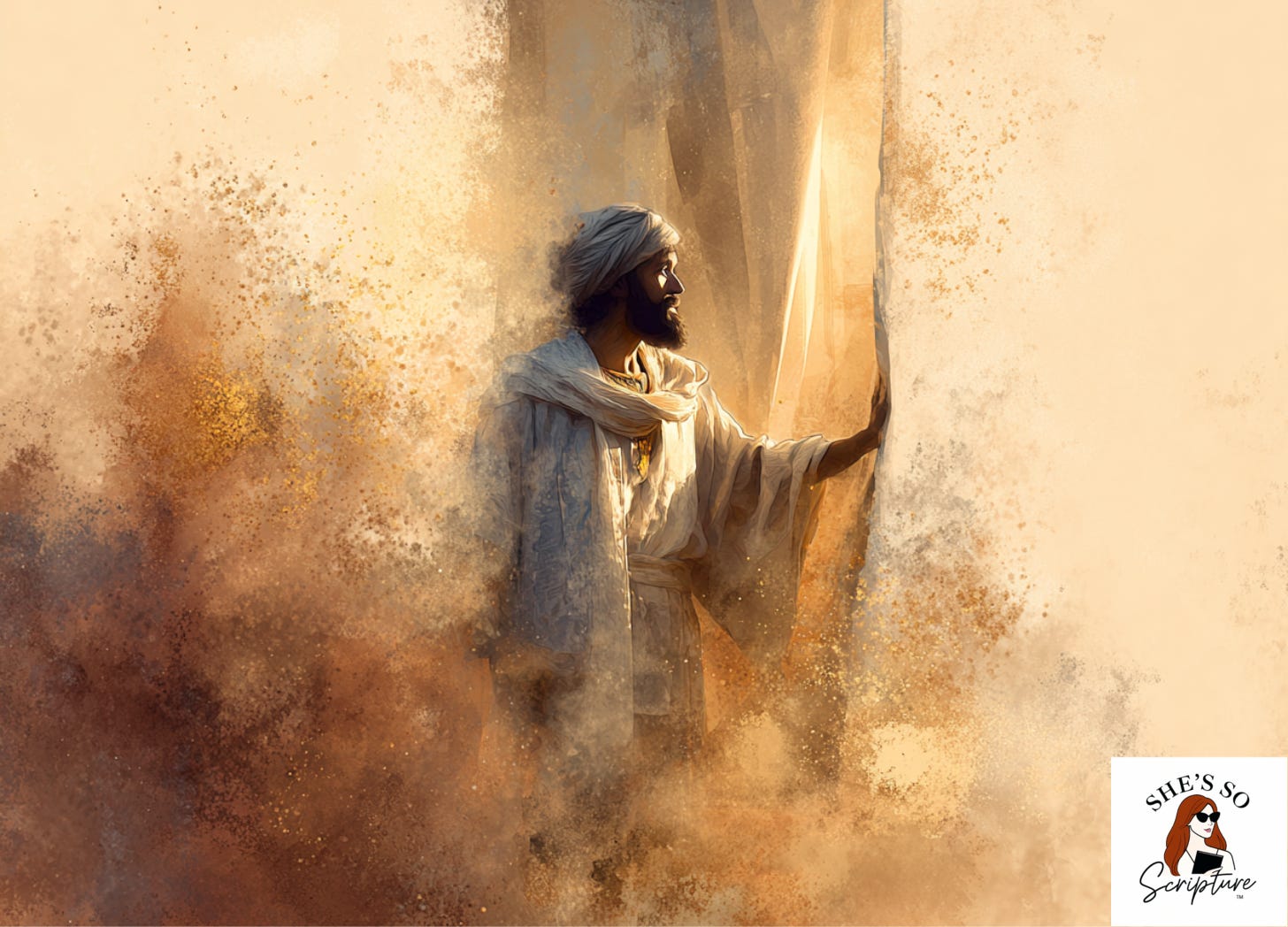
I want to stay here for a minute because I don’t think we fully grasp what Aaron was doing when he walked past the veil.
The Tabernacle was organized in zones of increasing holiness. The outer court, open to all Israel. The Holy Place, accessible only to priests. And then the Holy of Holies, the innermost chamber, where the Ark of the Covenant sat under the wings of two golden cherubim. The presence of God, what the rabbis would later call the Shekinah, dwelt there.
One man. One day a year. With blood. That was the access protocol.
Aaron entered with a cloud of incense smoke so thick it covered the mercy seat, because Leviticus 16:13 says the cloud of incense will cover the kapporet so that he will not die. The smoke is protective. Aaron could not look directly at the presence of God and survive. The incense cloud is the buffer between human fragility and divine holiness.
This is the God we’re talking about. Not a therapeutic concept or a warm abstract force. A holy God whose presence required layers of ritual protection, blood atonement, and a thick cloud of incense just for one man to survive standing in the same room.
And then, once a year, that room was cleaned. The blood of the sacrifice made atonement for the Holy Place itself, because Israel’s sin had contaminated even the Sanctuary. Leviticus 16:16 says:
“So he is to make atonement for the Holy Place because of the uncleanness of Bnei-Yisrael and because of their transgressions in all their sins. So he is to do for the Tent of Meeting that dwells with them in the midst of their uncleanness.” — Leviticus 16:16 TLV
God was dwelling among His people while they were sinning. And the Yom Kippur ritual wasn’t just about the people. It was about purifying the very place where God dwelled in their midst. That is an amazing thing.
Yeshua and the High Priest Typology
I need you to hold on to everything I just said and walk with me into the book of Hebrews for a moment, because the New Covenant writers saw all of this.
Hebrews 9 describes Yeshua as the Kohen Gadol… the High Priest of the good things that have come. And then it says something that should reframe the entire Yom Kippur ritual for you:
“But when Messiah appeared as Kohen Gadol of the good things that have come, He passed through the greater and more perfect Tabernacle not made with hands, that is to say not of this creation. And not through the blood of goats and calves but through His own blood, He entered the Holy of Holies once for all, having obtained eternal redemption.” — Hebrews 9:11-12 TLV
Once for all. That phrase is doing a ton of work right there. Aaron went in once a year, every year, for centuries. The ritual had to be repeated because the atonement it provided was real but it was temporary. It covered but it didn’t permanently remove. It had to be repeated. Yeshua enters the heavenly Holy of Holies once, with His own blood, and what He secures is permanent.
Look at the High Priest parallels line by line:
Aaron bathed and dressed in plain white linen before entering the Holy of Holies. Yeshua took on flesh, became fully human, and entered the world unadorned. He came not in the grandeur of heavenly majesty but in the humility of Jewish flesh. The white linen of Aaron’s Yom Kippur garments is a type of the incarnation.
Aaron offered blood for his own sins before he could intercede for Israel’s. Yeshua had no sins of His own to atone for, which is why His priesthood is categorically different. He enters as the sinless one, offering blood that doesn’t just cover but removes. Hebrews 7:26-27 says He is holy, innocent, undefiled, separated from sinners, and because of that, He doesn’t need to offer sacrifices daily as the Levitical priests did.
Now watch this! Aaron entered the Holy of Holies and came back out. The people waited outside, and his return was confirmation that the atonement had been accepted. Yeshua ascends to the Father and the promise is that He is coming back out. The second coming is the High Priest emerging from the Holy of Holies. And when He appears, it is not to deal with sin a second time but to bring salvation to those who are waiting for Him (Hebrews 9:28).
This is not supersessionism. We don’t do that here. The author of Hebrews isn’t throwing the Levitical system away. The author is reading it correctly. The whole apparatus was designed to point somewhere. The annual repetition of Yom Kippur wasn’t a failure. It was a promise and a foreshadowing. It kept saying: something permanent is coming. Something that won’t need to be repeated next year.
The Scapegoat and the Cross
Now come back to the two goats and watch what happens when you read them as a single typological unit pointing to Yeshua. Because, as you know, your girl loves some typology!
The first goat, the one slaughtered and whose blood enters the Holy of Holies, is the atonement sacrifice. Yeshua’s blood shed at the cross is the fulfillment of this goat. His death provides the covering. His blood enters the true Holy of Holies and makes permanent what the animal blood could only accomplish temporarily.
But the second goat. The Azazel goat. That’s the one I want us to sit with for a hot second.
Aaron confesses all the sins of Israel over this goat. The full accumulated weight of everything. And then the goat is sent away, bearing what was confessed, into territory from which it will not return. Isaiah 53 is reading from the same theological library when it says:
“All of us like sheep have gone astray. Each of us turned to his own way. So Adonai has laid on Him the iniquity of us all.” — Isaiah 53:6 TLV
The iniquity laid on Him. Not metaphorically. Not symbolically in the sense of meaning nothing. Literally, in the same way Aaron literally laid hands on the Azazel goat and literally confessed Israel’s sins over it, the prophet is saying that all of it gets transferred. Carried away. Removed.
Yeshua is both goats. He is the blood sacrifice that atones and the one who carries the weight of sin away into removal. Both truths belong to a complete understanding of what happened at the cross. The cross is not only an altar. It’s also the wilderness into which the sin-bearer was sent.
And John the Baptist, standing at the Jordan, sees Yeshua coming and says:
“”Behold, the Lamb of God who takes away the sin of the world!”“ — John 1:29 TLV
Takes away. Not just covers. Takes away. John is describing an Azazel goat theology in the language of a sacrifice. He sees both functions in one person.
Wow. Just. Wow.
Kedoshim: And Then You Live
After all of that, after the blood, after the Holy of Holies, after the scapegoat led out into the wilderness, the Torah turns the page and says: now here’s how you live.
Kedoshim is the holiness code. It’s Leviticus 19 and 20 and it’s relentlessly, almost bewilderingly practical. Honor your father and mother. Keep my Sabbaths. Don’t turn to idols. When you harvest your field, leave the edges and the fallen gleanings for the poor and the outsider. Don’t steal. Don’t lie. Don’t swear falsely by God’s name. Don’t oppress your neighbor or rob them. Pay your worker the same day you hire them. Don’t curse a deaf person or put a stumbling block before a blind person.
And right in the middle of all of it, in Leviticus 19:18:
“You are to love your neighbor as yourself—I am Adonai.” — Leviticus 19:18 TLV
That verse is 3,500 years old. When Yeshua quotes it as one of the two greatest commands in Matthew 22, He is not introducing some new theology. He is pointing back to Leviticus and saying: this was always the whole point. Love your neighbor as yourself has been sitting in the Torah the entire time.
Here’s what I want you to see: Kedoshim doesn’t exist in isolation from Acharei Mot. The holiness commands come immediately after the atonement ritual. That structure is deliberate. You don’t get a chapter on the Yom Kippur ritual and then a separate, unrelated chapter on how to treat your neighbor. The commands of Kedoshim are the outworking of the atonement. A people whose sins have been covered and removed by blood are now called to live in a way that reflects the character of the God who covered them.
Kedoshim grounds holiness in the grocery store and the courtroom and the workplace and the field. Not just in the Sanctuary. And the reason the command is possible at all is everything that happened in chapter 16.
Haftarah: Amos 9:7–15
Amos is the prophet nobody wanted to hear from. Sorry Amos… but it’s true. He’s a shepherd from Tekoa, and God sends him north to Bethel with words that are deeply unwelcome. By chapter 9, he’s been methodically dismantling every false comfort Israel had built around their covenant status.
Amos 9:7 opens with a question that should have stopped Israel cold:
“”Are you not like the sons of Ethiopia to Me, O children of Israel?” declares Adonai. “Did I not bring up Israel from the land of Egypt, the Philistines from Caphtor and Aram from Kir?”“ — Amos 9:7 TLV
What Amos is doing here is dismantling the assumption that the Exodus guarantees protection regardless of how Israel lives. God governs the movements of other nations too. The Exodus was not a one-time transaction that Israel could leverage forever while ignoring everything else God required of them.
This is the prophetic commentary on a nation that maintained the ritual structure of Yom Kippur while abandoning the ethics of Kedoshim. They were performing the atonement liturgy. They were not loving their neighbor as themselves. They were not leaving the edges of the field. They were not paying their workers. And Amos says: God sees all of it.
But then Amos 9:11. And this is the thing about the Hebrew prophets… they can land in the most devastating place and then pivot to a restoration promise that takes your breath away.
“”In that day I will raise up the fallen booth of David, repair its breaches, raise up its ruins, and rebuild it as in the days of old.”“ — Amos 9:11 TLV
The fallen booth of David. The Sukkah of David, some translations render it. The royal house that has collapsed. And God says: I will raise it up.
James quotes this exact passage in Acts 15 when the Jerusalem council is wrestling with the question of Gentile inclusion in the community of Yeshua-followers. James sees the ingathering of the nations as the fulfillment of Amos 9:11-12. The rebuilt booth of David becomes the space into which all peoples are welcome. Amos was describing a larger restoration than even his original audience could have imagined.
The trajectory of this Haftarah is important: Yom Kippur atonement without transformed living is not what God designed. Amos exposes the gap. And then the promise of restoration at the end of Amos 9 says: the atonement is still real, the future is still being written, and the booth of David is coming back up.
Besorah: Matthew 19:1–12
The Pharisees come to Yeshua with a test question about divorce. Specifically, whether it’s lawful to divorce one’s wife for any reason. This is not some pastoral inquiry. It’s a halakhic (legal) debate between the schools of Shammai and Hillel, and they’re trying to get Yeshua to stake out a position that either alienates part of His following or puts Him at odds with Mosaic law.
Watch what He does.
He doesn’t answer by citing Shammai. He doesn’t answer by citing Hillel. He goes all the way back to Genesis 1 and 2. “Have you not read that from the beginning the Creator made them male and female?” He’s pointing past the Mosaic concession to the original design. Past what was permitted to what was intended.
This is a theological move that connects directly to what Kedoshim is doing. Kedoshim doesn’t say “here’s the minimum standard of holiness you can get away with.” It says: be holy, because I am holy. The direction is always upward toward the character of God, not toward the floor of what’s technically permissible.
The disciples’ response in verse 10 is actually kind of funny. “If that’s the case between a man and his wife, it’s better not to marry.” They hear Yeshua push the standard higher and their reaction is to wonder if opting out entirely is easier. Yeshua doesn’t validate that. He says some are given the capacity for that and some aren’t, and not everyone can receive this teaching.
What’s happening here is the same thing that happens in the movement from Acharei Mot to Kedoshim. The atonement makes something possible. The commands then ask you to live out of what’s been made possible. The High Priest emerges from the Holy of Holies having completed the atonement, and then Kedoshim opens and says: now love your neighbor. Now leave the corners of the field. Now live like someone who’s been touched by that.
Yeshua in Matthew 19 is saying: you’ve been pointing to Genesis 2 as your standard, not to the concession in Deuteronomy 24. Go back to the original. Go back to what the design actually was. Because the person who has been atoned for is not stuck living at the level of what’s merely permitted. They’re invited into the level of what was always intended.
Thematic Threads
The thread that runs through all of this is access. Who gets in. What it costs. What it produces.
Leviticus 16 answers the access question with blood. There is no entry into the presence of a holy God without atonement. Aaron doesn’t wander into the Holy of Holies on a good day because he’s feeling particularly spiritual. He goes in one time a year, with blood, in prescribed garments, with incense, following exact instructions. The access is real, and it costs something.
Kedoshim answers what that access produces in the everyday. A people who have been brought near to a holy God are supposed to look like Him in the market and the field and the courtroom. The commands of Kedoshim are not arbitrary ethical guidelines. They are the shape of a holy life lived from the inside out.
Amos stands in the prophetic tradition and says: don’t confuse the ritual with the result. The Yom Kippur liturgy is not some magic transaction that absolves you of responsibility for how you treat people, so keep on treating them badly. The ritual was designed to produce a transformed life. When it doesn’t, something has gone wrong.
And Yeshua in Matthew 19 pushes in the same direction. He’s not lowering the standard. He’s revealing that the standard was always higher than the concession. The goal was always the original design, and the atonement He came to provide is the thing that actually makes reaching toward it possible.
The two goats are the whole story. One dies so there’s access. One carries the weight away so the access is permanent. Both matter. And what comes next, the life after the Day of Atonement, is supposed to look different because of what happened in that room.
My Final Thoughts
I keep thinking about Aaron walking into the Holy of Holies.
He goes in alone. The congregation of Israel is outside. Everyone is waiting. He has the blood of the sacrifice. He has the incense cloud. He has the white linen. And he steps through the veil into the place where the presence of God actually dwells, and he doesn’t die. Because God designed the ritual. God made the access possible. God specified exactly what would keep Aaron alive in that room.
That’s mercy. That’s what mercy looks like in the architecture of Torah. Not the absence of standards, but the provision of a way through them.
And then the Azazel goat is led out, and the congregation watches it disappear into the wilderness carrying everything. Every failure. Every breach. Everything confessed over its head in the courtyard of the Tabernacle. Gone. Not covered in the sense of papered over. Gone in the sense of taken away.
Yeshua is both. He enters the true Holy of Holies with His own blood and secures permanent atonement. And He is the sin-bearer sent out, despised and rejected, carrying what was laid on Him. Isaiah 53 is not a coincidence. It’s the Azazel theology written in prophetic language, centuries before the cross.
The veil of the Temple tore when He died. From top to bottom. Matthew 27:51. The tearing matters because it’s directional. God tore it from the top down, not from the bottom up. The access was opened from His side, not ours. What the High Priest could only enter once a year through precise ritual and blood, the torn veil now makes available to everyone who approaches through Yeshua.
And then we arrive at Kedoshim. You shall be holy, for I am holy.
Not as an entry requirement. As a response. Because a people who have been this close to that kind of mercy, a people whose sins have been both covered and carried away, should look different. They should leave the corners of the field. They should pay their workers. They should love their neighbor as themselves. Not to earn access but ecause of what the access already cost.
Hebrew Letter Lesson: Yod (י)
י
The Basics Yod is the tenth letter of the Hebrew aleph-bet, and it is the smallest. Its numerical value is ten and its name means hand, specifically the hand extended in action. It is also the first letter of the divine name, the Tetragrammaton: YHVH. And if you want to understand why this letter falls on this portion, I think you’ll see it by the time we’re done.
How It’s Written Yod is written as a single small suspended stroke, a floating mark that hovers just above the baseline. It takes up less space than any other letter in the aleph-bet. And yet it is embedded in the structure of almost every other letter in the Hebrew alphabet. The yod is never absent. It’s just sometimes invisible until you know to look.
Yeshua references this in Matthew 5:18 when He says not one yod and not one stroke of a letter will pass from the Torah until all is accomplished. He picked the smallest, most overlooked mark in the entire written language to make His point about the permanence of the Word.
Spiritual Meaning Yod represents the hand of God in action. It is the letter of divine initiation, the seed from which all other letters grow, the point at which heaven touches earth. In Hebrew, the word for hand is yad (yod-dalet), and it begins with yod. The word for thanksgiving, hodah, contains yod. The divine name begins with yod.
I want you to think on that in the context of this portion.
The Yom Kippur ritual was not invented by Aaron. It was not developed by committee among the priests. God designed it. God specified it. God provided every element of it, down to the incense formula and the linen garments and the sequence of the blood applications. The entire structure of atonement in Leviticus 16 is an act of the divine hand making a way where there was no way.
And Kedoshim, the holiness code, is the same. Israel is not left to figure out what holy living looks like on their own. The hand of God reaches into the ordinary texture of daily life and says: here. This is what it looks like in the field. This is what it looks like in the courtroom. This is what it looks like when your neighbor needs you.
The yod of God is all over both portions. The hand that designed the atonement is the same hand that shaped the ethics.
A Little Nugget
The first letter of the divine name is yod. The last letter of the divine name, the heh, is also found inside the yod when you write out the full name of the letter in Hebrew: yod-vav-dalet. The name of the smallest letter contains within it the letters of the divine name. The smallest thing carries the largest name. That is very, very Torah.
Application Here is what Yod asks of us in the week of this portion:
Where have you been waiting for a dramatic moment of divine intervention when the hand of God might already be at work in the small and overlooked things? The yod is never absent. It’s just sometimes invisible until you know to look.
The atonement provided through Yeshua is a complete act of the divine hand, both the sacrifice and the removal. Have you actually received both? Not just the covering, but the removal? The Azazel theology is part of your inheritance.
Kedoshim is God’s hand reaching into your Tuesday. Into your workplace. Into your field, whatever your field is. One command from Leviticus 19. One specific, concrete, ordinary act of holy living this week. Not performance. Response.
Weekly Practice
Read Leviticus 16:20-22 and Isaiah 53:4-6 side by side this week. Let the two texts speak to each other. Then write down, in your own words, what you understand the connection between the Azazel goat and Yeshua to be. Not what you’ve been taught. What you see when you put those two passages next to each other.
Then choose one command from Leviticus 19:9-18 and practice it in a specific way this week. Name the command. Name the action. Name what it has to do with the God who says “I am Adonai” at the end of nearly every instruction in that chapter. He keeps signing His name to these commands. He wants you to know whose character you’re practicing.
Download This Portion
Download a printable version of this Torah portion along with the study and reflection questions for your study binder!
Bible Study Questions
1.Read Leviticus 16:3-5. What does Aaron bring with him into the Holy of Holies, and what is he explicitly not wearing? Why do you think God specified plain linen rather than the ornate high priestly garments for this particular entry?
2.Leviticus 16:16 says Aaron makes atonement for the Holy Place itself because of the uncleanness of Bnei-Yisrael. What does it tell you about God’s character that He continued to dwell among His people while they were sinning, and that He provided a means to purify even the space of His own dwelling?
3.Look at the two goats together as a single unit in Leviticus 16:7-22. What does each goat accomplish that the other does not? What would be missing from the picture of atonement if only one goat were used?
4.Read Hebrews 9:11-14 alongside Leviticus 16:11-16. Where do you see specific correspondences between the Levitical ritual and what the author says Yeshua accomplished? What does the author mean by “once for all” in contrast to the annual repetition of Yom Kippur?
5.Leviticus 19:2 grounds the holiness commands in God’s own character: “You shall be holy, for I, Adonai your God, am holy.” How does placing this verse immediately after the Yom Kippur chapter change how you read the commands that follow it?
6.In Amos 9:7, God challenges Israel’s assumption of automatic covenantal protection. What does this tell us about the purpose of the Yom Kippur ritual? Was it ever designed to substitute for transformed daily living?
7.In Matthew 19, Yeshua takes a question about what is permitted and redirects it to what was originally designed. Where in your own thinking about holiness do you tend to reason from the floor of “what’s allowed” rather than the direction of “what was intended”?
Reflection Questions
8.The veil of the Temple tore from top to bottom when Yeshua died. What does it mean to you personally that the access to the Holy of Holies, which was available to one man once a year, is now available to you?
9.The Azazel goat carried Israel’s sins into uninhabited wilderness, to a place from which the sins would not return. Have you received the “removal” dimension of atonement as fully as the “covering” dimension? What would it look like to actually live as someone whose sins have been taken away, not just covered?
10.Kedoshim contains some of the most relational and economic commands in the Torah, including leaving grain for the poor, paying workers on time, and not putting a stumbling block before the blind. Which of these commands challenges you most when you apply it to your actual daily life?
11.The letter Yod is the smallest letter in the aleph-bet and present in nearly every other letter. Where in your life right now might God’s hand be working in something that appears too small to notice?
12.Amos confronted a community maintaining religious practice while abandoning justice. Is there a place in your own life where the ritual form is intact but the relational or ethical substance of Kedoshim is missing?
Action Challenges
13.Read Leviticus 16 and Hebrews 9 in the same sitting. Write down every parallel you notice between the Yom Kippur ritual and what Hebrews says Yeshua accomplished. Come back and share what surprised you most in the comments.
14.Look up Psalm 103:12 and John 1:29 and Isaiah 53:6 together. Write a paragraph in your own words describing what each one is saying about the removal of sin, and how they connect to the Azazel goat in Leviticus 16. You don’t need to have the perfect answer. Just sit with the texts and write what you see.
15.Choose one specific person in your life and identify one way you can practice Leviticus 19:18 toward them this week. Not in a general “be nicer” sense. One specific, tangible act of loving them as you would want to be loved. Do it, and then note what it felt like to practice ancient covenant faithfulness in your actual week.
Before You Go
If this study opened something up for you, send it to the friend who has never connected the cross to the Yom Kippur ritual, the one who doesn’t know yet that the theology they love in the New Covenant has been sitting in Leviticus the whole time. She needs this.
And if you want to study like this every week, with live Sunday evening and Tuesday evening Bible studies on Zoom with me, extended Torah portion studies, audio teaching, devotionals, and a community of women who take the whole counsel of Scripture seriously, The Vault is built for exactly that. You’re welcome inside.
👉🏻 Join The Vault. If a paid subscription isn’t feasible right now but this space has blessed you, you can leave a one-time tip here. Every gift helps sustain this work. 🤍
Vault & Founding Members: Want to go deeper into Biblical Hebrew? Use your exclusive discount at sheopensherbible.net/products/3186766
About the Author
Diane Ferreira is a Jewish believer in Yeshua, a published author, speaker, seminary student, wife, and proud mom. She is the founder of She’s So Scripture and She Opens Her Bible. She is the author of several books, including The Proverbs 31-ish Woman, which debuted as Amazon’s #1 New Release in Religious Humor, as well as Holy, Hormonal and Holding On.
She is currently pursuing her graduate degree in Jewish Studies in seminary, with her favorite topics being the early church and Biblical Hebrew. Diane writes and teaches from a unique perspective, bridging her Jewish heritage with vibrant faith in the Messiah to bring clarity, depth, and devotion to everyday believers.
When she’s not writing, studying, or teaching, you’ll find her curled up with a good book, crocheting something cozy, traveling, or playing her favorite video games.
Tree of Life (TLV) – Scripture taken from the Holy Scriptures, Tree of Life Version*. Copyright © 2014,2016 by the Tree of Life Bible Society. Used by permission of the Tree of Life Bible Society.
Whenever I read your posts, I get so excited! The revelation that comes from understanding the language is so revelatory! I truly love following you!
Wow, this is so rich! It helps me understand scripture I have skimmed past before. Everything is significant to our Heavenly Father, even the smallest letter. Everything points to Yeshua. We cannot really understand the NT without understanding the Old. Thank you for taking the time to help gentiles like me to understand the Torah. Today I have learned something that changes the way I see everything.