


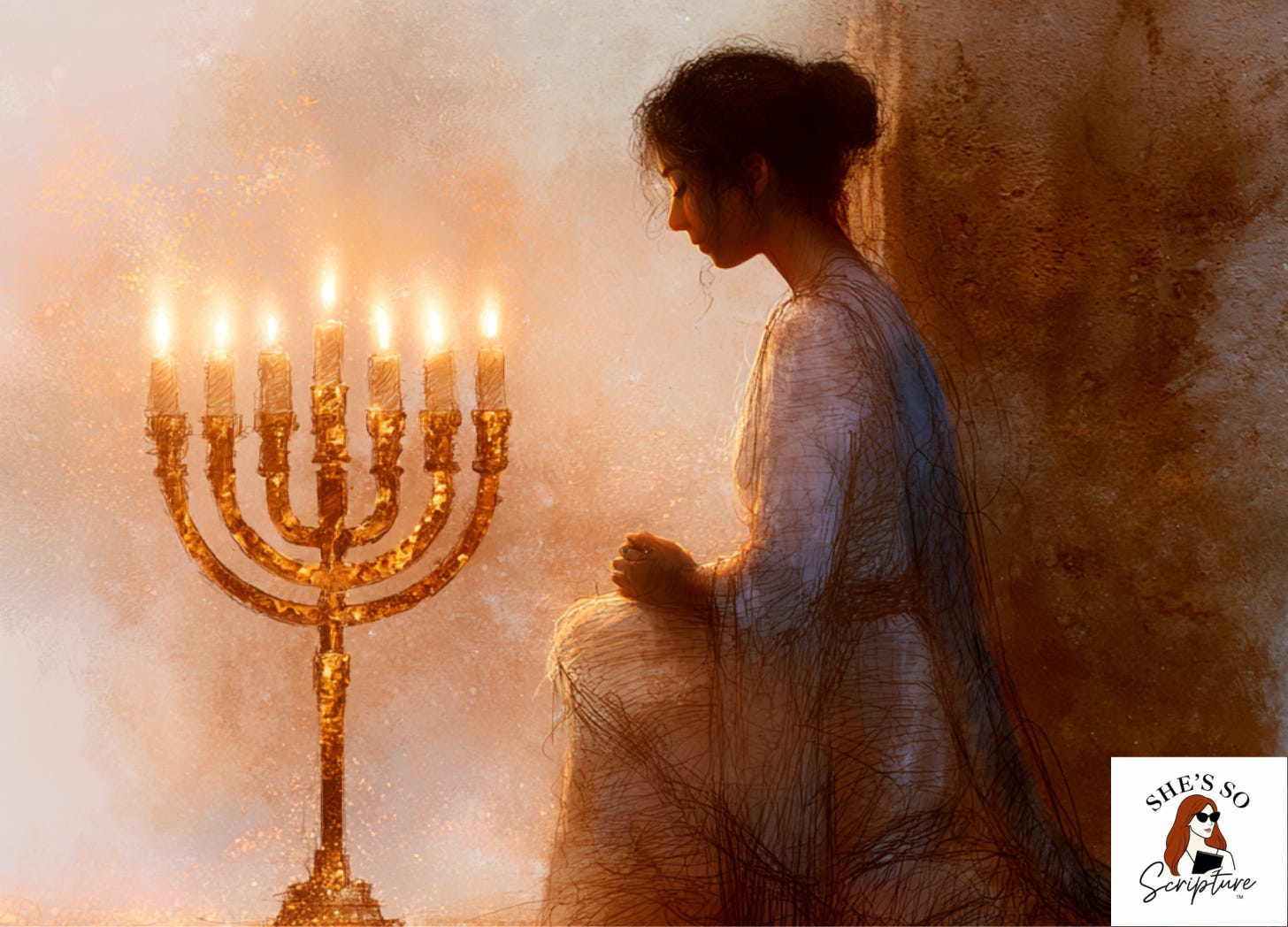
There’s a certain kind of spiritual vertigo that sets in when everything is working and you still find yourself complaining.
The tabernacle is up. The cloud is hovering. The Levites have been consecrated. The menorah is lit. God is present in a way that should silence every doubt you ever had. And then, somehow, within just a few chapters, Israel is weeping at the door of their tents over onions.
Onions. Egyptian onions they ate while enslaved.
This is Beha’alotecha, the thirty-sixth Torah portion, and it is one of the most jarringly human passages in all of Scripture. The name means “when you raise up,” which comes from the Hiphil form of the root alah (עָלָה), to go up or ascend. God tells Aaron to raise the flames of the menorah until they burn on their own. Until the light stands by itself. Until it rises.
The irony of this portion is that it opens with the light going up and ends with almost everything else coming down. Complaints. Grief. Kvetching. Leadership stretched past its breaking point. A prophetess struck with disease. And right in the middle of it all, a woman in Bethany no one thought to name pours out something irreplaceable.
Salvation on trial. From Numbers to Zechariah to a house two days before Passover. Same question, every time: who is the Lord, and can He actually be trusted to see this through?
Torah: Numbers 8:1–12:16
The Menorah: Light That Has to Rise on Its Own
The portion opens with a command that sounds simple until you really think about it a while..
“Speak to Aaron and say to him: When you erect the lamps, the seven lamps are to illuminate the area in front of the menorah.” Numbers 8:2, TLV
Rashi, commenting on the unusual verb beha’alotecha, points out that God did not simply say “when you light” the lamps. He said “when you raise them up.” The flame had to be kindled and held until it rose me’eileha, which means on its own, independently.
Aaron’s job was not to maintain the flame but to release it. To coax it upward until it could stand without him.
This is the opening image of a portion that will immediately be tested by its opposite.
The cloud moves. The trumpets sound. Israel marches. And then the grumbling starts. First a general murmuring, then a specific and detailed craving for Egyptian food that amounts to a rehearsed rejection of the God who just freed them.
The Hebrew word for the instigators is ha’asafsuf, the grumblers or the rabble, and their discontent is infectious. Within verses, the whole camp is weeping like a bunch of kids at summer camp wanting to go home.
Moses is so undone by it that he asks God to kill him rather than make him carry these people one more day (Numbers 11:15). He’s over it. That is next level “Oy gevalt!”
We should probably sit with that for a moment. Moses. The man who stood before Pharaoh. The man whose face shone after standing in the presence of God. He is done! He would rather die than keep going.
That’s not weakness on his part. That’s what it looks like when a leader’s flame has been worn down to the wick.
God’s response is worth noting. He doesn’t rebuke Moses. He also doesn’t take away the burden. What He does is distribute it.
“Then I will come down and speak with you there, and I will take some of the Ruach that is on you and will place it on them. They will carry with you the burden of the people, so you will not be carrying it alone.” Numbers 11:17, TLV
This isn’t delegation for the sake of efficiency. This is a theology of shared fire. The Ruach that was on Moses didn’t diminish when it was given to seventy others. A flame doesn’t lose anything by lighting another candle. We would do well to remember that! Lighting someone else’s candle doesn’t diminish the light from our own.
The Question at the Center
By the time we reach Numbers 12, the complaint has moved from the general population to Moses’ own family. Miriam and Aaron question his leadership. And beneath that, they’re really questioning the exclusive nature of his relationship with God.
“Has Adonai spoken only through Moses? Hasn’t He also spoken through us?” Adonai heard it. Numbers 12:2, TLV
The text pauses to tell us something remarkable: Moses was the most humble person on the face of the earth (Numbers 12:3). And then God shows up to defend him.
God distinguishes between prophets (to whom He speaks in visions and dreams) and Moses, with whom He speaks face to face, plainly, without riddles. Moses sees the form of God. There is no one else like him.
And then, when the cloud lifts, Miriam has tza’arat, the skin condition that in Torah signifies a broken relationship with holiness.
Aaron immediately intercedes. Moses immediately prays.
“O God, heal her now!” Numbers 12:13, TLV
One line. No oratory. Just a desperate, direct plea for someone who had just spoken against him. The one who had just been challenged asks for restoration. The one who was just vindicated does not gloat. He prays.
Haftarah: Zechariah 2:14–4:7
The Haftarah for Beha’alotecha comes from Zechariah, and the visual connection to the Torah portion is immediate. Zechariah sees a menorah: a solid gold lampstand with a bowl at the top and seven lamps, two olive trees flanking it on either side. The angel has to explain the vision to him because he genuinely cannot figure out what he’s looking at.
What he’s looking at is the answer to Israel’s real question: can God bring this back?
The Temple is in ruins. The exile is recent. Zerubbabel is trying to rebuild and the opposition is enormous and the task looks impossible. And the word that comes is this:
“Not by might nor by power, but by My Spirit, says the Lord of Hosts.” Zechariah 4:6, TLV
The menorah in Zechariah’s vision is not maintained by human effort. The olive trees feed it directly. The oil flows without anyone carrying a jar. This is what it looks like when salvation is not on trial anymore. The verdict has already been rendered, and the flame is fed by something that does not run out.
The two olive trees flanking the menorah are “the two anointed ones, who are standing by the Lord of the whole earth” (Zechariah 4:14, TLV). The image is enough even standing alone: there is an oil that never runs out, and it flows from the presence of God.
Zechariah’s word to Zerubbabel is that he will finish what he started. Not by strategy or by force. By Spirit.. The mountain will become a plain. The capstone will be set in place with shouts of grace. The hands that laid the foundation will finish the work.
This is a direct word to everyone who feels like they have run out of whatever they started with.
Besorah: Mark 14:1–11
Mark 14 opens two days before Passover. The ruling kohanim and Torah scholars are plotting to kill Yeshua. The gears of institutional religion are turning against its own Messiah. And in Bethany, in the house of Simon ha-Metzora, a man who knows something about restoration because he himself was healed of a skin condition, a woman walks in with an alabaster jar.
She breaks it over Yeshua’s head.
The disciples are furious. Three hundred denarii. More than a year’s wages. Wasted. But Yeshua stops them.
“Leave her alone. Why do you cause trouble for her? She’s done Me a mitzvah. For you always have the poor with you, and you can do good for them whenever you want; but you won’t always have Me. She did what she could; she came beforehand to anoint My body for burial.” Mark 14:6–8, TLV
A mitzvah. A commandment. A righteous act. Not sentiment, not excess, not waste. She anointed the One who was about to be put on trial. She poured out what was irreplaceable on the One who was about to pour Himself out for the world.
And then Judah (Judas) leaves the room and goes to the kohanim to sell Him.
Two people. Same story. Same room. Same Yeshua. One pouring out. One cashing out.
Thematic Threads
The thread running through Torah, Haftarah, and Besorah is the same question asked three ways: Can the fire be sustained? Can the work be finished? Can salvation hold up under pressure?
In Numbers, the answer is yes, but not the way anyone expected. The Ruach is distributed, not depleted. Leadership is shared, not surrendered. And Moses’ prayer for the one who accused him is answered in seven days.
In Zechariah, the answer is yes, but not by human effort. The oil flows from a source no one controls. The capstone goes in place with shouts of grace, not triumph.
In Mark, the answer is yes, and a woman no one thought to name already knew it. She did what she could. The rest was not her problem to manage.
Salvation on trial always ends the same way. The One on trial is also the Judge. And He does not lose cases.
Verse Mapping Aid
Hebrew Word Study: Alah (עָלָה)
The name of this Torah portion is built on a single Hebrew root: alah (עָלָה), in the Hiphil causative form, beha’alotecha (בְּהַעֲלֹתך). The Hiphil means to cause to go up, to raise, to elevate.
In Numbers 8:2, Aaron is instructed to cause the flames to rise, not just to ignite them but to ensure they ascend, that they achieve their own independent upward movement.
Alah appears across Scripture in ways that illuminate the weight of this moment:
It is the root of olah (עֹלָה), the burnt offering that goes entirely up. Nothing stays down. Nothing is held back.
It is the root of Shir HaMaalot (שִׁיר הַמַּעֲלוֹת), the Psalms of Ascent, the songs Israel sang while going up to Jerusalem for the pilgrim festivals.
It appears in Isaiah 40:31 for those who “soar on wings as eagles,” which means literally they will go up, they will mount up.
Rashi’s insight about the menorah: Aaron held the flame to the wick until the flame rose me’eileha, by itself, from itself. The priest’s job was to initiate the ascent. Then release.
That same pattern runs through this entire portion. God does not fix Israel’s complaining through force. He distributes the Ruach. He validates Moses without humiliating Aaron. He lets Miriam’s restoration unfold over seven days. He initiates. Then He releases the process to do its work.
Salvation is not managed from above with a tight grip. It rises.
My Final Thoughts
This portion is uncomfortable in the best possible way. It refuses to let you pretend that the presence of God eliminates the struggle of walking with God.
The Israelites had the cloud. They had the fire. They had the menorah lit in the tabernacle and the trumpets calling them to march and the God who brought them out of Egypt marching with them in the ark. And they still wept at the doors of their tents over what they had left behind.
Miriam, a prophetess and Moses’ own sister, the woman who led Israel in song at the sea, still let jealousy and grievance run unchecked until it cost her.
Judah watched Yeshua for three years, was one of the Twelve, carried the money bag, heard the teaching, saw the miracles. And walked out of a room where someone was being extravagantly faithful and went to sell Him.
None of this is an argument that faith does not work. It’s an argument that fire has to be tended. The flame does not maintain itself by accident. Aaron held it until it rose. Zechariah watched the oil flow from trees that neither he nor Zerubbabel planted. The woman in Bethany brought what she had and broke the container so the oil could not be recaptured.
The question this portion keeps asking is not whether God can be trusted to finish what He started. Zechariah already answered that: the hands that laid the foundation will also finish the work.
The question is whether you will pour out what is irreplaceable in service of the One who is about to pour Himself out for you. Or walk out of the room.
Not by might. Not by power. By His Ruach.
The fire is not yours to generate. It’s yours to raise.
Hebrew Letter Lesson: Peh (פ)
פ
Peh: The Mouth
The Letter
The letter Peh (פ) is the seventeenth letter of the Hebrew aleph-bet. Its name means mouth. Its numerical value is eighty.
The ancient pictographic form of peh depicts an open mouth. And the rabbis note something remarkable about how the letter is written: inside the peh (פ) is a smaller bet (ב). A mouth containing a house. Some read this as a reminder that what comes out of the mouth either builds a dwelling or tears one down.
The Connection
Everything in this Torah portion turns on what people say.
The grumblers open their mouths and the whole camp catches the complaint. Moses opens his mouth in despair and God reorganizes leadership around him. Miriam and Aaron open their mouths against Moses and the cloud withdraws. And then Moses opens his mouth in the shortest prayer in Torah:
“O God, heal her now!” Numbers 12:13, TLV
El na refa na lah. And heaven responds.
The Ark formula in Numbers 10:35–36 is spoken aloud by Moses every time the Ark sets out and every time it comes to rest. Israel moves and returns by the spoken word of a man whose relationship with God was face to face. The rabbis bracketed those two verses with special marks in the Torah scroll, inverted letters that signal a holy pause, a break in the narrative where the presence of God is moving and everything else has to account for it.
And in the Besorah, Yeshua says that wherever the Good News is proclaimed, wherever the peh of the body of Messiah opens and speaks, the story of the woman who poured out everything will be told as a memorial to her.
A Little Nugget
The Talmud teaches that the world was created by ten utterances: ten times God said something in Genesis 1. Speech is not incidental to creation; it is the instrument of it. The mouth that speaks in covenant, in prayer, in intercession, is never just expressing. It is participating in something God started with His own word.
Application
Where have words from your own mouth, or someone else’s, been doing the work of the grumblers in this portion? Spreading discontent that started small and became communal?
Moses’ intercession for Miriam was four words. Sometimes the most powerful prayers are the ones that do not perform. What would it look like to bring something before God this week without oratory?
The woman in Bethany will be spoken about until the end of the age. What do you want your life to say?
Weekly Practice
This week, find a moment to sit quietly with Numbers 10:35–36, the verses the rabbis mark as a book unto themselves:
“Whenever the Ark set out, Moses said: Arise, Adonai! May Your enemies be scattered, and those who hate You flee before You! And whenever it came to rest, he said: Return, Adonai, to the ten thousands of the thousands of Israel.” Numbers 10:35–36
Pray those verses out loud as an act of trust: that the presence of God still moves, still scatters what needs to be scattered, still returns to rest with His people.
And then notice what rises.
Bible Study Questions
Numbers 8:2 tells Aaron to raise the lamps until the flames burn on their own. What does that image suggest about how spiritual disciplines work: what is our part and what is not?
The grumblers in Numbers 11 start the complaint and the rest of Israel joins in. How do you see this dynamic (one person’s discontent becoming communal) play out in communities you have been part of?
Moses tells God he would rather die than keep carrying these people alone (Numbers 11:15). What does God’s response (distributing the Ruach to seventy elders) reveal about how God responds to leaders at their breaking point?
God makes a distinction between how He spoke to ordinary prophets and how He spoke to Moses, face to face, plainly and not in riddles. What does that distinction tell you about Moses’ relationship with God? And what does it tell you about what is available to us through Yeshua?
Reflection Questions
Miriam raised a legitimate concern wrapped in a sinful motive. Have you ever had a real grievance that you expressed in a way that made the grievance the lesser problem? What happened?
Moses’ first response after God vindicates him is to pray for Miriam. What does that prayer reveal about what vindication actually produces in a humble person?
Zechariah 4:6 says the work will be accomplished “not by might nor by power, but by My Spirit.” Where are you currently trying to accomplish something by force that might need to be released to a different kind of energy?
The unnamed woman in Mark 14 is remembered everywhere the Good News is preached. Judah is also remembered everywhere the Good News is preached. Same story, same room, same Yeshua, completely opposite legacies. What made the difference, in your reading?
Action Challenges
This week, identify one place in your life where you have been carrying a flame alone in a way that was never meant to be a solo task. Take one concrete step toward sharing that weight: whether that is asking for help, inviting someone into the work, or simply telling God you cannot do it alone.
The woman in Bethany did what she could. Not what was expected, not what was practical, just what she could. Write down one thing you have that feels irreplaceable, and ask God whether He is asking you to pour it out.
Download This Portion
Download a printable version of this Torah portion along with the study and reflection questions for your study binder!
If this study stirred something in you, share it with a friend who’s been carrying a flame alone and running low on oil.
And if it left you wanting to go slower and deeper into the Word, I’ve got you! Paid subscribers get access to live Bible studies, extended studies, devotionals, theological teaching, spiritual formation practices, and a community of women who want depth without pressure or performance. If you’re ready to step further into the Word, you’re welcome inside.
Join The Vault. If a paid subscription isn’t feasible right now but this space has blessed you, you can leave a one-time tip. Every gift helps sustain this work. 💕

About the Author
Diane Ferreira is a Jewish believer in Yeshua, a published author, speaker, seminary student, wife, and proud mom. She is the founder of She’s So Scripture and She Opens Her Bible. She is the author of several books, including The Proverbs 31-ish Woman, which debuted as Amazon’s #1 New Release in Religious Humor, as well as Holy, Hormonal and Holding On.
She is currently pursuing her graduate degree in Jewish Studies in seminary, with her favorite topics being the early church and Biblical Hebrew. Diane writes and teaches from a unique perspective, bridging her Jewish heritage with vibrant faith in the Messiah to bring clarity, depth, and devotion to everyday believers.
When she’s not writing, studying, or teaching, you’ll find her curled up with a good book, crocheting something cozy, traveling, or playing her favorite video games.
Tree of Life (TLV) – Scripture taken from the Holy Scriptures, Tree of Life Version*. Copyright © 2014,2016 by the Tree of Life Bible Society. Used by permission of the Tree of Life Bible Society.
The end of Numbers 11 tells the name of the place where Israel complained - Kibroth Hata'avvah - the "graves of craving", for those whom God struck down for not being satisfied with his provision. Very instructive.