

Torah Portion: Beshalach | From Panic to Praise
Exodus 13:17–17:16; Haftarah: Judges 4:4–5:31; Besorah: Mark 2:1–12

Shalom friends,
Beshalach is one of those portions we think we know.
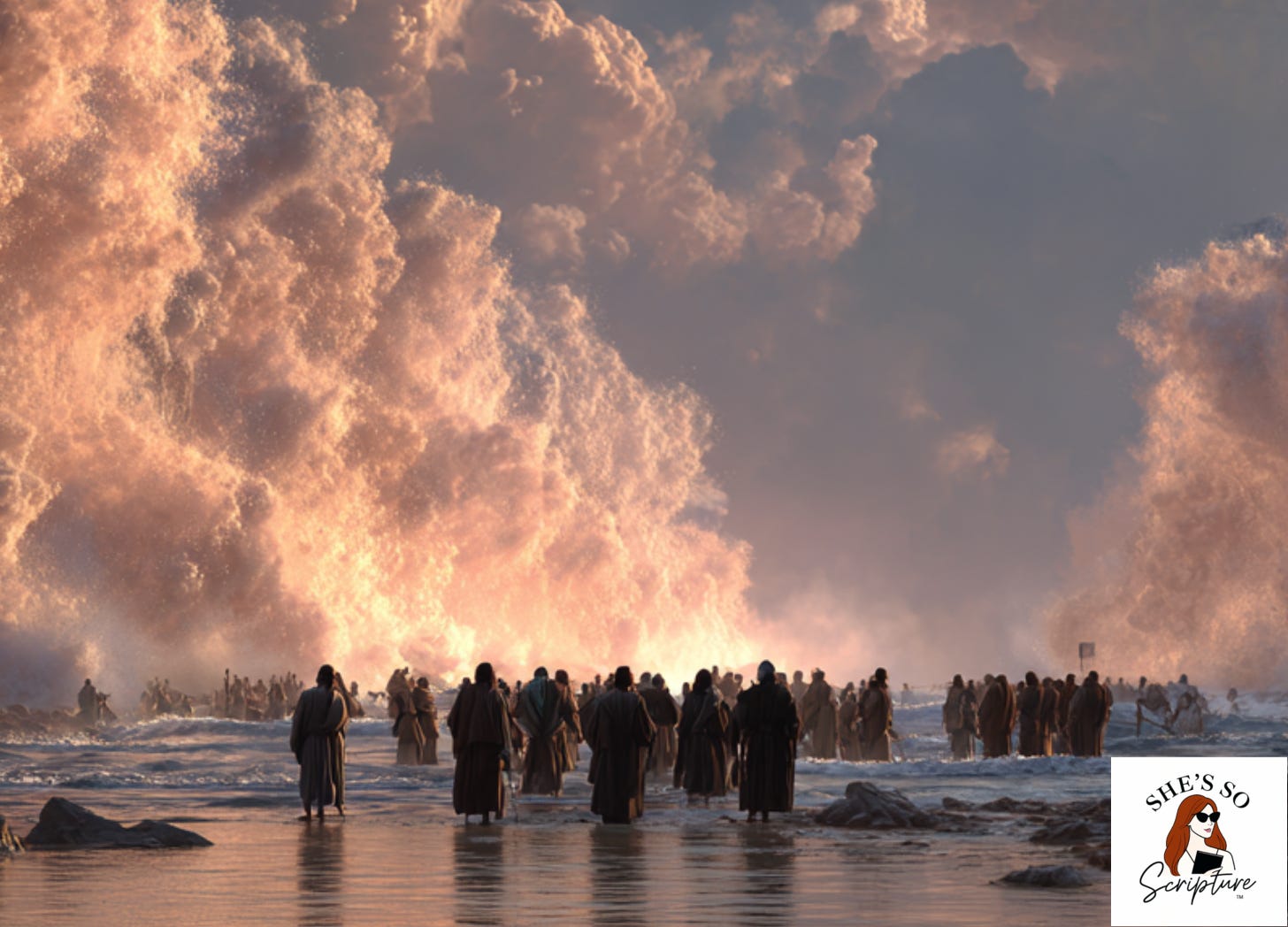
Red Sea. Parting waters. Victory song. Manna from heaven. Amalek shows up to ruin everyone’s mood.
It’s dramatic. It’s memorable. It’s also deeply misunderstood.
Because Beshalach is not a victory story. It’s a formation story. It’s about what happens when God frees people physically before they’re free internally.
And spoiler alert. Freedom is louder on the outside than it is on the inside.
Torah: Exodus 13:17–17:16
When God Leads You the Long Way on Purpose
The portion opens with what feels like an odd routing choice.
God does not lead Israel by the shortest path. Scripture is explicit about why. The people just aren’t ready for war. If they see it too soon, they’ll panic and run back to Egypt.
The Hebrew here is pretty telling. God is described as leading them, וַיַּנְחֵם (vayanchem), guiding them intentionally, not wandering aimlessly.
Then comes the moment everyone remembers.
The sea.
Israel is seemingly trapped. Pharaoh is closing in behind them. Panic sets in immediately (not for the first OR the last time). The people cry out to God, and then, without missing a beat, turn on Moses (again, not for the last time).
Weren’t there enough graves in Egypt?
That question is more revealing than it sounds. Egypt may have been brutal, but it was familiar. Slavery with predictability still feels safer than freedom with uncertainty.
Moses responds with one of the most quoted lines in Torah.
“Stand still and see the salvation of the Lord.”
And then God does something unexpected. He tells Moses to stop whining and start moving.
“Then Adonai said to Moses, “Why are you crying to Me? Tell Bnei-Yisrael to go forward.” Exodus 14:15
The sea doesn’t part while Israel watches from a safe distance. It parts when they step forward. The miracle requires participation.
After they cross, something shifts.
They sing.
The Song of the Sea is not their typical worship. It’s loud, poetic, defiant praise. Miriam leads the women with timbrels and dancing. This is joy with muscle memory still shaking from trauma.
And then, almost immediately, reality returns.
Water is bitter. Food is uncertain. Complaints resume.
Beshalach refuses to let us romanticize redemption. God provides manna daily, not in bulk. He teaches Israel to trust one day at a time. When they try to hoard, it rots. Dependence is the lesson.
Then Amalek attacks.
This isn’t just a military moment. Amalek strikes the weak and the weary from behind. It’s opportunistic, cruel, and it’s symbolic of opposition that targets people mid-transition. Ooh, does that feel familiar?
Moses stands with arms raised. When they drop, Israel begins to lose. Victory comes through interdependence. Moses needs support and Israel needs leadership. No one does this alone.
Beshalach shows us that freedom isn’t a straight line. It’s a process. And it’s messy. Sometimes REAL messy.
Haftarah: Judges 4:4–5:31
When Deliverance Comes from an Unexpected Direction
The Haftarah continues the theme of God delivering His people in ways that disrupt expectations. This is one of my favorite narratives in scripture.
Deborah is introduced not with fanfare, but authority. She is prophet, judge, and leader. Barak is the general, but he refuses to move without her. He knows where the real authority rests.
Deborah tells Barak the victory will come, but not in the way he expects. The honor will go to a woman.
Right away, we think it will be through Deborah. I am sure Barak thought that too.
Enter Jael.
Jael is not a warrior. She is not on the battlefield. And yet she becomes the instrument through which Israel’s enemy is defeated. The song in Judges 5 makes it clear. God used courage, timing, and decisiveness where brute force failed.
And then comes the song.
Like the Song of the Sea, this is not gentle worship. It’s bold, theological, and unapologetic. It names God’s power, Israel’s failures, and the cost of hesitation.
The parallels to Beshalach are strong. God delivers. The people sing. And the song becomes a way of remembering what God has done so fear doesn’t rewrite the story later.
Besorah: Mark 2:1–12
When Healing Challenges More Than Bodies
In Mark’s Gospel, Yeshua is teaching in a crowded house when four men bring a paralyzed friend. They can’t get through the door, so they tear open the roof.
Already, that’s worth sitting with.
These 4 crazy friends don’t ask permission. They don’t wait for a better moment. They are determined.
Yeshua sees their faith and does something unexpected.
He forgives sins.
The scribes are scandalized. Healing is one thing. Authority to forgive sins is another. Yeshua knows what they’re thinking and presses the issue.
Which is harder? To say your sins are forgiven or to tell a paralyzed man to walk?
Then He tells the man to get up.
And he does.
This story fits Beshalach beautifully. God doesn’t just address surface problems. He goes deeper. Physical healing matters. Spiritual restoration matters more.
Just like Israel needed freedom from Egypt and healing from what Egypt did to them, this man needed restoration beyond mobility.
Yeshua doesn’t just part seas. He restores people completely.
And everyone needs a crazy friend to carry them to Jesus!
I actually have two blog posts on this topic if you want to read more.
Jesus Heals the Paralytic Man: A Story of Faith, Forgiveness, and Divine Authority
The 5 Qualities of the Four Friends of the Paralytic Man
My Final Thoughts
Beshalach is about what happens AFTER the miracle.
After the chains fall off, the sea closes behind you, and the song fades.
God leads His people into uncertainty on purpose. He is teaching them to trust daily. He provides what they need, not what they want to store up “just in case”. He allows opposition to expose weakness so dependence can grow.
And when they forget, He reminds them again.
Freedom is not a moment. It’s a way of learning to walk forward without running back.
Beshalach invites us to ask an uncomfortable question. Do we want freedom, or do we want familiarity?
Because God will part seas for His people. But He will also teach them how to live on the other side.
If you want to study the portions more deeply, I’ll be hosting weekly Torah studies beginning February 14th for Vault and Founding members. These will be interactive studies where we slow down, ask questions, share insights, and wrestle with the text together in community.
Hebrew Letter of the Week: ס (Samekh)
Sound: S
Numeric Value: 60
Meaning: Support, protection, sustaining, being upheld
Samekh is one of the most comforting letters in the Hebrew alphabet. Its shape is a complete circle, closed on all sides. Unlike letters that lean or reach upward, Samekh surrounds.
The root סמך (samakh) means to support, uphold, or lean upon. You see it in verses about God sustaining His people when they cannot stand on their own.
That makes Samekh a perfect match for Beshalach.
Israel has just crossed the sea, but they are not suddenly confident or strong. They panic. They complain. They forget quickly. And yet, God surrounds them. He goes before them as a pillar of cloud and fire. He provides manna daily. He brings water from a rock. He gives victory over Amalek while Moses’ arms are being physically held up.
Beshalach teaches us that freedom does not mean self-sufficiency. It means learning who actually holds you up.
How to Write Samekh
ס
Samekh is written as a closed circle.
Start at the top, curve down the right side, continue across the bottom, and come back up the left until the letter closes.
Visually, Samekh reminds us that God’s support is not partial. It is surrounding. When Israel feels exposed and vulnerable, God is already encircling them with provision and protection.
Study Questions
Torah: Exodus 13:17–17:16
Why does God intentionally lead Israel away from the shortest route to the Promised Land?
What does Israel’s reaction at the sea reveal about fear and familiarity?
Why does God tell Moses to move forward instead of simply standing still?
What role does song play after the crossing of the sea?
Why does God provide manna daily instead of in abundance?
How does the battle with Amalek reveal Israel’s need for interdependence?
Haftarah: Judges 4:4–5:31
What stands out about Deborah’s leadership in contrast to Barak’s hesitation?
Why do you think God chooses Jael as the instrument of deliverance?
How does the Song of Deborah function similarly to the Song of the Sea?
What warnings does this passage give about hesitation when God calls for action?
Besorah: Mark 2:1–12
What does the determination of the four friends reveal about faith in action?
Why does Yeshua address forgiveness before physical healing?
How does this passage challenge assumptions about authority and power?
In what ways does this healing mirror Israel’s need for restoration beyond freedom?
Reflection Questions
Where in your life do you still feel tempted to run back to what is familiar instead of trusting God forward? What is your Egypt?
How do you respond when God provides daily instead of all at once?
What does Samekh teach you about being supported even when you feel unsure?
Where might fear be disguising itself as practicality or caution?
How has God upheld you in seasons when you felt exposed or overwhelmed?
Action Challenges
This week, intentionally thank God for one way He has sustained you daily rather than dramatically.
Read Exodus 16 and note how often Israel complains even while being provided for.
Practice trusting God with one area where you normally try to stay in control.
Encourage someone who may feel weary or vulnerable, becoming a source of support rather than criticism.
Meditate on Psalm 3:6 and reflect on what it means to be surrounded by God’s presence.
Download the Portion
Download a printable version of this Torah portion along with the study and reflection questions for your study binder!
And, if you have littles at home, here is a song for them about this portion on our YouTube Channel. We have a playlist just for kids!
If this study stirred something in you, share it with a friend who might need it too.
And if it left you wanting to go slower and deeper into the Word, I’ve got you!
Paid subscribers get access to extended studies, devotionals. theological teaching, spiritual formation practices, and a community of women who want depth without pressure or performance.
If you’re ready to step further into the Word, you’re welcome inside.
If a paid subscription isn’t feasible right now but this space has blessed you, you can leave a one-time tip here. Every gift helps sustain this work. 🤍

About Our Author
Diane Ferreira is a Jewish believer in Yeshua, a published author, speaker, seminary student, wife, and proud mom. She is the author of several books, including The Proverbs 31-ish Woman, which debuted as Amazon’s #1 New Release in Religious Humor.
She is currently pursuing her graduate degree in Jewish Studies in seminary, with her favorite topics being the early church and Biblical Hebrew. Diane writes and teaches from a unique perspective, bridging her Jewish heritage with vibrant faith in the Messiah to bring clarity, depth, and devotion to everyday believers.
When she’s not writing, studying, or teaching, you’ll find her curled up with a good book, crocheting something cozy, or playing her favorite video games.
Tree of Life (TLV) – Scripture taken from the Holy Scriptures, Tree of Life Version*. Copyright © 2014,2016 by the Tree of Life Bible Society. Used by permission of the Tree of Life Bible Society.
Brilliant!
Trusting in daily provision when we can't see what's coming next really is one of the most challenging parts of faith for many of us.
Thank you for the reminder!
I haven't been here long, but so far I'm loving your take on Scripture.
I only was able to read portions of the posts available to free subscribers but I am LOVING your content 💜 I think I may need to add a paid subscription again