Parashat Devarim | Shabbat Chazon | Torah Study
Deuteronomy 1:1–3:22 | Isaiah 1:1–27 | John 19:17–41
Shalom, friends!
This week we begin the Book of Deuteronomy, and it’s no ordinary Shabbat; it’s Shabbat Chazon (“The Sabbath of Vision”), named after the powerful prophetic vision in Isaiah. We’re standing at the threshold: a new book, a new voice, a new challenge. Moses is about to speak his final words to Israel before they cross into the Promised Land. At the same time, the Haftarah calls us to look honestly at our hearts and our history. There’s deep urgency, but also deep hope.
You can download a printable version of this portion with a study guide at the end of this post.
TL;DR – Parashat Devarim / Chazon
Theme: The words you listen to and the words you speak can shape your destiny and legacy—for you, your family, and your nation.
Torah: Moses retells the story of Israel’s journey, warning them to remember, obey, and not repeat past failures.
Haftarah: Isaiah calls Israel to see their spiritual state, repent from empty ritual, and seek justice and restoration.
Besorah: Yeshua’s crucifixion reveals the ultimate fulfillment of both judgment and hope, as He gives His life for the world.
Unified Drash: This week is about vision, memory, and the courage to choose a different future. Will we listen, repent, and rise—or repeat the wilderness?
Hebrew Nugget: Devarim means “words”—reminding us that speech has the power to create or destroy destinies.
TORAH PORTION: Deuteronomy 1:1–3:22
🔍 Understanding the Portion
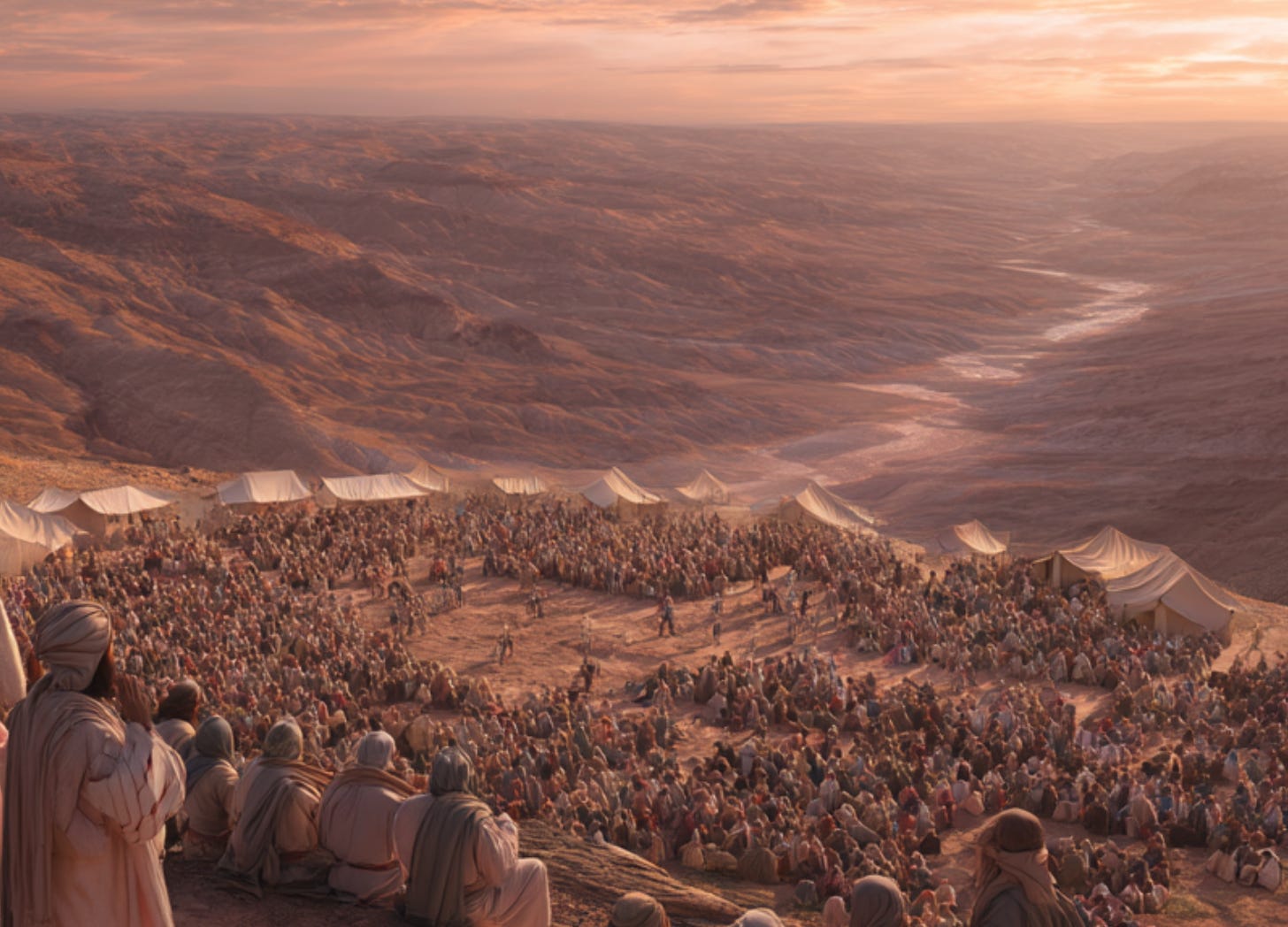
Devarim launches with Moses gathering all Israel on the edge of the Promised Land, his voice trembling with both tenderness and urgency. The journey is almost over; the wilderness dust is nearly behind them. But before Israel can step into their future, Moses insists they remember their past… truthfully.
This is not a mere history lesson. Moses is like a loving parent who knows he won’t be there for the next chapter, so he pours out everything he’s learned. He recounts the stations and stumblings; how God called them from Sinai, told them to advance, but fear led them to send spies, and rebellion turned an 11-day trip into 40 years of wandering. He admits the pain of judgment, the frustration of bearing the nation’s burdens, and the weight of leadership.
“How can I bear your troubles, your burdens, and your disputes all by myself?” (Deut 1:12).
Moses details God’s faithfulness: appointing wise leaders, judging with fairness, winning battles against Sihon and Og, and providing for every need, even in their complaining. He urges Israel not to forget who they are, what God has done, and where things went wrong. This review is Moses’ way of arming the next generation with honest memory, so they can avoid old pitfalls and step into promise with humility and courage.
There’s deep tension: the land is before them, but old wounds and patterns threaten to follow. Moses pleads: Don’t let your past disqualify your future. Learn from it, grow from it, and then go forward.
💡 A Little Nugget:
Hebrew: דְּבָרִים (Devarim) – “Words”
“Devarim” means words, but in Hebrew, “davar” can also mean “thing” or “matter.” In the Bible, words have creative power… they bring things into being. Moses’ words aren’t just history, they are meant to shape identity and destiny.
🧭 Application
Where do I need to stop minimizing or rewriting my past and start learning from it honestly?
How am I using my words—to remember, to bless, to shape the faith of the next generation?
🧠 Drash: Speak Life, Remember Well
Moses teaches us that entering promise isn’t about ignoring failure, but redeeming it. Leadership is not control, but wisdom passed on. Godly words are tools of healing, boundaries, and blessing. What we refuse to remember, we will inevitably repeat.
HAFTARAH: Isaiah 1:1–27 (Chazon)
🔍 Understanding the Portion
Shabbat Chazon’s prophetic vision comes in a time of national prosperity but spiritual crisis. Judah is rich in ritual—sacrifices, prayers, feasts—but poor in justice, compassion, and humility. Isaiah’s words slice through the noise: “Why this multitude of sacrifices? … I have had enough.” God sees beyond outward worship to the heart, and what He finds is a nation sick with pride, injustice, and pretense.
Isaiah compares Israel to a rebellious child and a battered body… wounded but yet refusing care. The nation’s leaders are corrupt, and the courts favor the rich over the widow. The people are “whitewashed” on the outside but scarlet with sin inside. God warns that this spiritual sickness will lead to ruin, exile, and loss… unless they repent.
And yet, even as He rebukes, God’s voice is full of longing: “Come now, let us reason together… though your sins are like scarlet, they shall be as white as snow.” Restoration is always possible, but only through truth-telling and a return to justice and mercy.
Historically, this haftarah is read just before Tisha B’Av, the day mourning the destruction of both Temples. It’s a reminder: the collapse of what’s sacred doesn’t begin with foreign armies, but with hearts that drift from God.
💡 A Little Nugget:
Hebrew: חָזוֹן (Chazon) – “Vision”
“Chazon” isn’t just sight… it’s prophetic, Spirit-filled perception. It’s the ability to see things not just as they seem, but as God sees them. Chazon calls us out of denial and into destiny.
🧭 Application
Is my worship genuine, or am I just going through the motions?
Where do I need to “plead the case” for someone vulnerable, stepping up for justice and mercy in my world?
🧠 Drash: Vision That Transforms
God doesn’t want our rituals if they’re empty of relationship. Real vision sees the mess, repents, and leans on God’s promise to restore. It’s not enough to mourn what’s lost; we must seek the healing only God can bring. Sin can be scarlet, but God’s mercy can still make it snow-white.
BESORAH: John 19:17–41
🔍 Understanding the Portion
In this week’s Besorah, we walk to Golgotha, the Place of the Skull. Yeshua, beaten and bloodied, carries His own cross through jeering crowds. Every detail echoes prophecy: the sign over His head, the soldiers casting lots for His robe, the words spoken in agony.
But beneath the brutality, John wants us to see something deeper: this is the moment when heaven and earth meet. Yeshua cries, “I thirst”—a reminder of both His humanity and the world’s spiritual dryness. “It is finished”—the declaration that everything God promised through Moses and the prophets is accomplished. The spear in His side releases blood and water—symbols of cleansing, Spirit, and new life.
Yeshua is buried not in shame, but in dignity and royal care… wrapped in linen, anointed with spices, and laid in a new tomb. For John, the cross is not just defeat, but the beginning of redemption. The old story of exile and loss finds its answer here: the Temple of Yeshua’s body is torn down, but will rise again.
Spiritually, this passage declares: God’s vision for restoration is costly, but unstoppable. Where sin brought ruin, Messiah brings hope.
💡 A Little Nugget:
Hebrew: מִשְׁחָה (Mishcha) – “Anointing/Ointment”
Mishcha (from the same root as Messiah) is used for the burial spices. Even in death, Yeshua is honored as King and Redeemer, fulfilling the role of the Anointed One.
🧭 Application
Where do I need to accept Yeshua’s finished work instead of striving to earn God’s love?
Who needs my compassion and dignity… even in their lowest, most “hopeless” places?
🧠 Drash: Redemption Is Not the End—It’s the Doorway
The cross is not the end of the story. It’s the place where everything lost can be found, where every exile can come home. In the darkest place, the deepest hope is born. Redemption means letting God turn even the ugliest moments into the first line of a new story.
🌟 My Drash: Speak Life, See Clearly, Cross Over
As we open Deuteronomy this week—on Shabbat Chazon, the Sabbath of Vision—we find ourselves standing on the edge of everything God has promised. While this is Israel’s story; it’s our story in ways as well. We are all standing somewhere between what God has done and what He still wants to do, with our memories and our mistakes trailing behind us, and the unknown future stretching out ahead.
Moses gathers the people, young and old, and before they take a single step forward, he insists on looking back. Why? Because a people who do not remember will always repeat. Moses isn’t just reciting history; he’s performing spiritual heart surgery. He’s showing us that healing and breakthrough start with truth. “Here is what happened. Here’s what hurt. Here’s how we missed it. And here’s how God met us anyway.” It is a radical act of humility and love.
The power of devarim—words—is everywhere in this portion. In the wilderness, the people’s words created fear and rebellion: “We can’t do it. The giants are too big. Why did God bring us here?” But Moses now uses words as tools of healing, legacy, and blessing. He models what it means to speak life over pain, to confess, to recall God’s faithfulness in the face of every failure. This is the gift of a leader who loves more than he wants to be right.
And then, just as Israel is called to remember, Isaiah calls us to see. Shabbat Chazon is about more than history… it’s about vision. God says, “Stop the sacrifices. Stop the noise. I don’t want your rituals. I want your heart.” It’s so easy to settle into routines, to hide behind “church” or “ministry,” to let habits take the place of relationship. But God wants a people who not only do the right things but love the right way. Isaiah cries out: “Seek justice! Defend the oppressed! Plead for the widow!” This is what God sees as worship.
But vision isn’t just about seeing sin; it’s about seeing hope. Isaiah’s vision ends with invitation: “Come, let us reason together… though your sins are like scarlet, they shall be white as snow.” God never confronts to condemn; He confronts to restore.
And then we reach the Besorah, the Gospel, where words and vision and sacrifice converge at the cross. Here is Yeshua, the true and better Moses, the truer and greater Isaiah… the Word made flesh, lifted up for the healing of the nations. He carries every failure, every scar, every exile in His body. “It is finished,” He declares—not as a sigh of defeat, but a roar of victory. The curtain is torn, the way home is opened, and the waters of cleansing and Spirit flow out for all who are thirsty.
So, what does this mean for you?
It means you cannot cross over into promise if you are still hiding from your past. You cannot walk in new vision if you cling to old blindness. You cannot live out legacy if your words tear down instead of build up.
This is your invitation:
Tell the truth.
Own your story, every wild wandering, every hard place, every small victory.
Speak life.
Let your words become prayers, blessings, instructions, and encouragements, especially for those coming up behind you.
See clearly.
Let God show you where you’ve gone through the motions without letting Him have your heart.
Cross over.
Don’t stay in regret or nostalgia. Let the cross be your starting place, not your finish line.
God is calling you out of cycles and into destiny. He’s calling you to be a woman who remembers deeply, speaks wisely, sees clearly, and steps boldly into the land He’s prepared for you.
May your words this week be seeds of blessing.
May your vision be sharpened by truth and softened by mercy.
And may your story be living proof that God still brings His people home.
✡️ Hebrew Letter of the Week: מ (Mem)
Sound: “M”
Numerical Value: 40
Meaning: Water, womb, flow, hiddenness, revelation
Mem is the letter of mayim (מים), “water.” It’s about the flow of God’s Word, wisdom, and mercy. Mem is also shaped like a womb, symbolizing new beginnings, deep mysteries, and the power to bring forth life. There are two forms: open (מ) for the beginning/middle of a word, and closed (ם) for the end, hinting that some things are revealed, and some remain hidden until the right time.
✍🏽 How to Write Mem
Standard Mem (מ):
Draw a vertical line down.
Add a short horizontal line to the left at the bottom (like the base of a “7”).
From the top, draw a line curving to the right, connecting back to the middle, forming a closed but not sealed box.
Final Mem (ם):
Draw a tall vertical line.
Make a square or rectangle, fully closed on all sides.
Practice:
As you write Mem, pray, “Lord, let Your Word flow in me like living water. Reveal what’s hidden and bring new beginnings from my story.”
🧠 Mem Reflection
Mem reminds us that what is hidden in the heart will eventually flow out into life. Let God’s living water fill you, heal you, and overflow into every word, every vision, every act of love.
If this Hebrew letter stirred something in you… like, “I want to read the Word the way it was first written”, then loves, it’s time to take that next step.
👉🏽 Enroll now in my Basic Beginner’s Biblical Hebrew I Course and start learning the language of Scripture at your own pace. No overwhelm. No fluff. Just a beautiful, spirit-led foundation for reading the Bible in its original form.
💻 Click here to join the course
✨ Vault Members: Get 30% off
👑 Founders Circle: Get 50% off
Because unlocking the Word in Hebrew? That’s a legacy move.
Download the Portion With Study Guide