


I once made a New Year’s resolution out loud, in front of witnesses, at a dinner table, with cheese involved. You know the kind. The kind where somebody says “ooh say it again so we all heard it” and suddenly you’re not just thinking a thought anymore, you’re accountable to it in front of God and the cheese board.
That’s basically the energy of this week’s double portion, except instead of a resolution about going to the gym, it’s a binding vow before the God of the universe, and instead of your cousin holding you to it, it’s Torah itself, which does not accept “I meant it in my heart” as a legal defense.
Here’s the question Matot and Masei keep circling back to, and I want you to really consider it before we go any further: does it actually matter, what you say and where you’ve been, or is most of your life just filler before the real story finally starts?
We treat huge swaths of our own lives that way. The years between the big moments. The promises we made and quietly stopped mentioning, hoping nobody would bring them up ever again.
Torah spends this entire double portion building a case that none of it’s filler. Not one word. Not one unremarkable mile. Not even the mile where nothing happened and you were just tired and hungry and vaguely lost, which, if you’ve read Numbers, describes most of it.
Word Study
מַסָּע
Masa comes from the Hebrew root nasa’ (נסע), meaning to set out, to pull up camp, to journey. It’s a different root from nasa (נשא), which means to lift or carry, though the two get confused easily in transliteration, and I will die on this hill because I have watched too many well-meaning teachers mix them up.
Scholars note the root behind our word most likely originally pictured the literal act of pulling up tent pegs. Not a poetic metaphor I’m layering on for effect, an actual agricultural, tent-dwelling, nomadic reality. In this wilderness setting, the word carries the feel of uprooting camp again, trusting there’s another patch of ground worth walking to. No Yelp reviews. No street view. Just go.
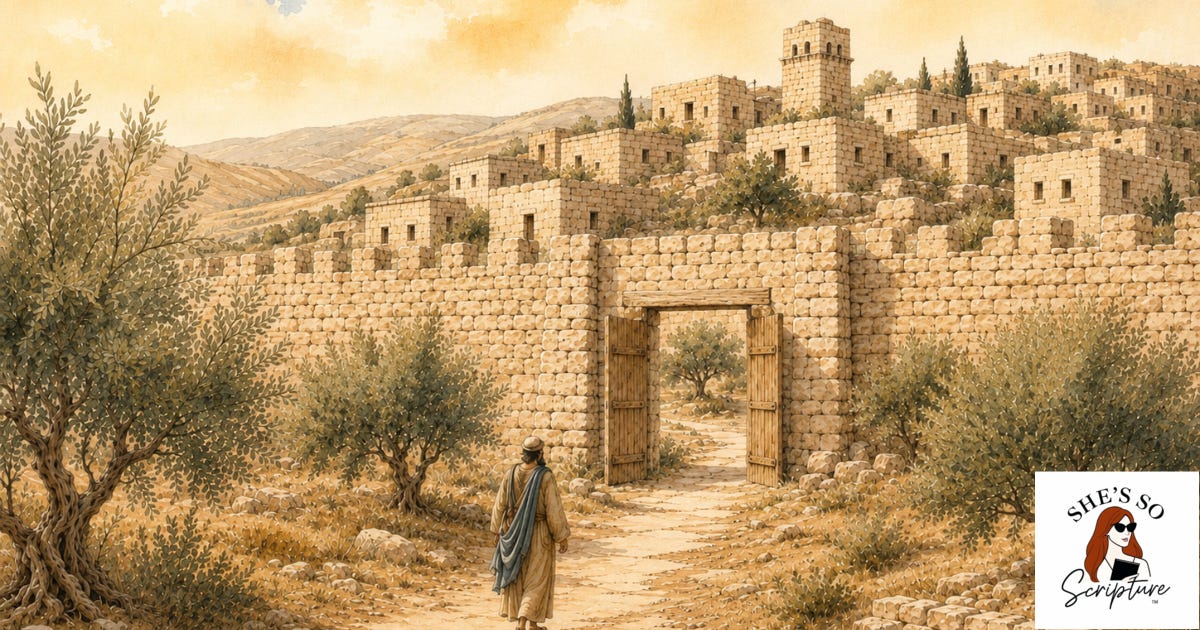
The parasha Masei opens with the plural of this word: “these are the masei of Bnei-Yisrael” (the children of Israel), the journeys, the stages, the pulled-up-and-moved-again record of forty years. Moses doesn’t summarize. He names all forty-two stops. Many of them are otherwise obscure or unattested anywhere else in Scripture. Torah wrote them down, otherwise they’d probably be wherever my favorite sweater from 1987 ended up.
Numbers 33:1-2 :
“These are the journeys of Bnei-Yisrael when they came out of Egypt by their divisions under the hand of Moses and Aaron. Moses recorded the stages of their journeys at Adonai’s command.” (TLV)
Numbers 33 doesn’t present Moses nostalgically journaling by candlelight. It presents him recording Israel’s departure-points and journeys at the LORD’s command. Not Moses being sentimental. God told him to write it down, so he wrote it down. That’s it. That’s the whole vibe of the chapter.
Torah Section
Matot opens with vows, and Masei opens with a forty-two-stop travel log, and I used to read those as two unrelated sections that happened to land in the same double portion because the reading calendar needed to keep moving. But they’re not unrelated. They’re the same argument made twice, once about your mouth and once about your feet: God doesn’t deal in filler. He’s present and paying attention to the parts of your life you’d never think to record, including the parts you’d honestly rather He didn’t.
Exhibit one: your word is a legal event, not a feeling
Numbers 30:2:
“Whenever a man makes a vow to Adonai or swears an oath to obligate himself by a pledge, he is not to violate his word but do everything coming out of his mouth.” (TLV)
Notice what this verse doesn’t say. It doesn’t say a vow’s a nice intention you should try to honor if life cooperates. It treats the words themselves as an event that already happened, binding, the second they left your mouth. No grace period. No “I was speaking hypothetically.”
Torah actually distinguishes two related but different things here: a vow, which dedicates or forbids something, and an oath, which binds the person more directly. Both get treated as real, which is more than I can say for half the group texts I have been part of.
The chapter goes on to describe how a father or a husband has a narrow same-day window to nullify a young woman’s vow, and if he says nothing, it stands permanently. This passage assumes a patriarchal household structure, and I’m not going to pretend for a second that a modern reader shouldn’t notice that.
But within that structure, the text still treats a woman’s vow as consequential enough to require a formal, same-day response, not a shrug and not an indefinite veto whenever it becomes convenient.
In other words, the passage doesn’t treat her words as vapor. It regulates them, limits who may intervene and for how long, and takes them seriously enough to legislate. In a culture that tosses around “I promise” the way we toss around “I’m starving,” this chapter is a cold splash of water: what you say isn’t vapor. It’s a record.
Exhibit two: your steps are a legal event too
Masei opens with the same insistence, aimed now at the feet instead of the mouth.
Numbers 33:1-2:
“These are the journeys of Bnei-Yisrael when they came out of Egypt by their divisions under the hand of Moses and Aaron. Moses recorded the stages of their journeys at Adonai’s command.” (TLV)
Forty-two stops, named, in order, and by the time you get down the list you realize many of them are otherwise obscure or unattested anywhere else in the Bible. No plague at that stop. No miracle. No pillar of fire doing anything dramatic.
Just a name and the fact that Israel was there, and then they weren’t there anymore, and God told Moses to write it down anyway. Some of these forty-two are remembered because something happened there. Most of them are remembered only because God chose to remember them.
If your life’s felt like a string of stops nobody would think to name, you’re in excellent company. Torah’s position is that the unremarkable middle of a journey is exactly as worth recording as the parts that make it into the highlight reel, which is frankly a relief, because most of my life would not make a very good highlight reel.
Exhibit three: God doesn’t deal in vague
The rest of the portion is really this same argument with a costume change. Reuben, Gad, and half of Manasseh don’t just get waved off with a general blessing when they ask for land east of the Jordan. Moses extracts a specific, testable vow from them, that they’ll cross armed and fight before they settle, and holds them to the actual wording of it, not the vibe of it.
The boundaries of the land in chapter 34 aren’t sketched with a vague gesture toward “over there somewhere.” They’re drawn point to point, tribe to tribe. The six cities of refuge in chapter 35 exist because Torah refuses to let “it was an accident” stay a vague, unverifiable claim.
There’s a defined process, a defined place to run, a defined hearing. And the whole book ends with Zelophehad’s daughters, the women who already won the right to inherit their father’s land back in chapter 27, now facing tribal leaders worried that a marriage outside the tribe would blur exactly whose land was whose.
Numbers 36 doesn’t cancel the daughters’ inheritance. It preserves that inheritance within the tribal allotment, defining the boundary precisely enough that the land and the daughters both stay exactly where they belong.
Put the word law next to the boundary law next to the travel log and you get one unified claim: nothing in this relationship is left to vibes. Not what you said. Not where you walked. Not what belongs to you. God’s a details God, because the details are where faithfulness actually happens, one named stop and one kept word at a time. He’s not a vague-blessing-and-good-vibes kind of God. Never has been.
Haftarah
Jeremiah 2:4-28 and 3:4 is the second of what Jewish tradition calls the Three Haftarot of Rebuke (haftarah being the prophetic reading paired with each week’s Torah portion), read in the weeks leading up to Tisha B’Av, the fast that mourns the destruction of both Temples. And rebuke’s exactly the right word.
Jeremiah isn’t asking a gentle, reflective question here. He’s speaking in the mode of a covenant lawsuit, conducting an interrogation, with the marriage imagery that runs through chapters 2 and 3 sharpening the accusation of Israel’s unfaithfulness rather than softening it.
Jeremiah 2:5:
“What fault did your fathers find in Me that they strayed so far from Me? They walked after worthless things, becoming worthless themselves.” (TLV)
This isn’t an angry God looking for an excuse. This is God conducting a courtroom interrogation with no defense available, because there isn’t one. He kept every vow He ever made to this people, and they still wandered.
A few verses later comes one of the most devastating lines in the whole book, God saying His people forsook Him, the spring of living water, and dug their own cisterns instead, cracked ones that can’t even hold water. They traded a spring for a hole in the ground and called it an upgrade. I would like to speak to whoever approved that renovation.
And yet even inside the accusation, the language of relationship hasn’t disappeared. The haftarah ends at 3:4, with God noting that Israel still, even now, calls out to Him, “My Father, You are the friend of my youth.”
That’s still part of the rebuke, not a warm reconciliation moment, so I don’t want to soften Jeremiah’s rhetoric more than the text allows. But the fact that covenant language survives even inside a lawsuit says something. That’s the whole tension of these three weeks of rebuke readings: real grief over real unfaithfulness, held next to a relationship that hasn’t been fully severed.
And notice what makes the grief so sharp in the first place. It’s not that God demanded something unreasonable and Israel failed to deliver. It’s that He kept every single word of His own covenant, the way Numbers 30 says a vow must be kept, and they treated theirs as disposable.
The same God who requires an entire legal chapter on how seriously to take a vow is shown here keeping His, generation after generation, while the other party in the covenant walked.
Besorah
Matthew 27:33-44 puts us at Golgotha.
Matthew 27:33-37:
“And when they came to a place called Golgotha (that is to say, Place of a Skull), they offered Him wine mixed with gall to drink; but after tasting, He was unwilling to drink it. And when they had crucified Him, they divided His clothing among themselves by casting lots. And they sat down and kept guard over Him there. Over His head they put the charge against Him, which read: THIS IS YESHUA, THE KING OF THE JEWS.” (TLV)
The crowd throws back at Yeshua an accusation twisting something He once said about the Temple. Sound familiar? It should. Words matter enough in this parasha cycle to build a legal chapter around them, and here the mockers weaponize an echo of His own words against Him, which is a genuinely wild move considering how this whole double portion has just spent two chapters explaining why words matter.
Matthew 27:40:
“You who are going to destroy the Temple and rebuild it in three days, save Yourself! If you are Ben-Elohim, come down from the stake!” (TLV)
TLV renders the Greek stauros as “stake” rather than the more familiar “cross,” a translation choice consistent with the version’s aim of staying close to the text’s first-century setting.
Matthew presents this as the mockers repeating a garbled version of a charge; it’s John, not Matthew, who later makes explicit that Yeshua had spoken of the temple of His body (John 2:19).
I want to keep those two Gospels distinct rather than blend them into one seamless quotation, because I promised you precision this week and I intend to keep that promise, unlike SOME people in Numbers 30.
Ask Jeremiah’s question here. What fault did your fathers find in Me. Ask it of Yeshua at Golgotha and the honest answer’s the same as it was in Jeremiah. None. And this is where the whole parasha’s argument lands with its full weight.
If a vow spoken with a human mouth binds a person under Numbers 30, and if an entire nation’s held accountable in Jeremiah for breaking a covenant word they spoke, then the words Yeshua actually said were never just vapor either. The crowd twisted an echo of them into a taunt. He kept every word that was actually His anyway, all the way to the very last stop of His own journey.
Thematic Threads
A Refuge Outside the Boundary
Numbers 35 sets aside cities of refuge, a defined place to run when you caused harm you never intended, so the accused wouldn’t be left to vague mercy or vague vengeance. Its own legal category is specifically accidental killing, not deliberate guilt, and I want to be clear about that before I say the next part.
Christian readers have sometimes read these refuge laws as a pattern that later deepens in Messiah, since Golgotha also sits outside Jerusalem’s boundary and also becomes a place people run to for safety. That’s a typological reading, not the plain sense of Numbers 35 itself, and it’s worth naming as one layer of reflection laid over the text rather than something the text’s already saying on its own.
An Inheritance Kept Intact
Numbers ends by protecting Zelophehad’s daughters’ inheritance so it stays exactly where it belongs. I’ll state this one gently and simply name the shape of it without overclaiming a direct line: an inheritance secured at the cross, one Scripture elsewhere describes as imperishable and kept for us, sits in that same family of ideas. Something’s defined. Something’s protected. Nothing gets lost in the wandering, no matter how the road bends to get there.
My Final Thoughts
So, back to the question I opened with. Does it actually matter, what you say and where you’ve been, or is most of your life filler before the real story starts? Matot-Masei’s answer is a flat no, none of it’s filler. Not the vow you made that nobody but God ever heard. Not the stretch of your life you can’t even name, the one with no plague and no miracle and no verse written about it, just a starting point and an ending point and God somewhere in between, still watching, still recording.
Your word and your walk aren’t two separate categories of faithfulness. They’re the same category examined from two angles. What you say you’ll do, and what you actually do, mile after unremarkable, unrecorded-feeling mile. God was writing down every stop the whole time. He’s writing down yours too, and He kept every word of His own covenant while He did it, all the way to a hill outside the city called the Place of a Skull.

Hebrew Letter Lesson
ת — Tav
Tav is the last letter of the Hebrew alphabet. In Ezekiel 9:4, God instructs an angel to put a mark, identified with tav, on the foreheads of those who grieve over the sins happening in Jerusalem, setting them apart from coming judgment. In older scripts that mark could be written in a form that looked different from the square Hebrew letters we use today, sometimes resembling an X or cross-like shape. I want to be careful here: that’s a note about ancient script forms, not a claim that Ezekiel was forecasting the cross of Christian faith.
I know, I know, it’s right there, it’s very tempting, I felt it too. But feeling it doesn’t make it so. The point of Ezekiel’s vision isn’t hidden code. It’s moral clarity. God knows who still mourns what’s wicked, and He marks that grief, that allegiance, that discernment.
Tav also sits at the very end of the Hebrew word emet, truth: aleph, the first letter, mem, a middle letter, and tav, the last letter. Later Jewish teaching reads that spelling devotionally, truth reaching from the beginning of the alphabet clear through to the end, nothing left out.
I want to flag that as a devotional reading of the word, not a claim about the linguistics of how emet was actually formed. It’s a beautiful teaching tool. It’s not a grammar lesson, and I will not be taking questions from anyone who wants to turn it into one.
✨ A Little Nugget
Ezekiel’s mark isn’t a secret symbol waiting to be decoded. It’s closer to a designation of loyalty, the way you might recognize your own people in a crowd by something only they’d carry. What marks a person as still grieving over what grieves God, still facing the right direction, even while everything around them’s falling apart?
Landing on tav in the same week we read about vows that can’t be broken and a journey recorded stop by stop feels less like a coincidence and more like the alphabet agreeing with the parasha. After all the vows, journeys, boundaries, and inheritances in Matot-Masei, the question gets simple: what marks us as people who still belong to the LORD?
Application
Tav marks completion. Where in your life is God asking you to trust that the current unfinished chapter’s still being recorded toward a real ending, not lost?
Ezekiel’s mark set apart those who grieved what grieved God. Is there something in your own life or community you’ve stopped letting yourself grieve, because it felt easier to look away?
Emet, truth, only holds together with a beginning, a middle, and an end. Is there an area where you’re living out the beginning and middle of your faith but avoiding the follow-through that makes it whole?
Weekly Practice
Take ten quiet minutes this week and write your own masei list. Not forty-two stops, just the honest ones you can name from this past year: a move, a loss, a job, a diagnosis, a wedding, a wilderness season with no name at all. Next to each one, write a single sentence about what you now know about God that you didn’t know before that stop. You’re not journaling for yourself. You’re doing what Moses did. You’re recording it because it was worth recording, even the parts you’d rather forget you survived.
Bible Study Questions
1. In Numbers 30, why do you think Torah treats a spoken vow with this much legal weight?
2. Numbers 33 records all forty-two stops of Israel’s wilderness years, including the ones where nothing else in Scripture tells us what happened there. What does that tell you about how God views the seasons of your life that felt uneventful at the time?
3. Why did the tribal leaders push back on Zelophehad’s daughters’ marriages in Numbers 36, and why do you think Torah resolves it by preserving the inheritance within the tribe rather than taking it back?
Reflection Questions
4. Jeremiah 2:5 asks what fault the fathrs found in God. If you’re honest, is there a vow, a commitment, or a season of walking away in your own story where the fault was never actually His?
5. At Golgotha, Yeshua’s own words were twisted and used to mock Him, yet He kept every one of them anyway. Where in your life have your words cost you something, and did you keep them anyway?
6. Cities of refuge existed for people who caused harm without meaning to, but the need for refuge still presses on all of us. Where have you been hiding behind vague excuses when what you really need is honest repentance and the mercy of God?
Action Challenges
7. Name one vow, promise, or commitment you’ve let quietly lapse. This week, either keep it or have the honest conversation that formally releases it. No more letting it just fade.
8. Write down five stops on your own wilderness journey, the way Moses recorded Israel’s. Thank God specifically for what each one taught you, even the ones you wouldn’t have chosen.
9. Find one boundary in your life, a relationship, a habit, a commitment, that needs to be drawn with the same specificity Numbers 34 draws the borders of the Land. Write down exactly where that line needs to be, in plain words.
A gentle note on Action Challenge seven: if you’ve made a reckless promise, this isn’t legal counsel drawn straight from Numbers 30. Take it instead as a prompt toward honesty, repentance where it’s needed, and wise counsel from people who know your actual situation.
Let’s Talk
If this study resonated with you, share it with a friend who’s got a vow she’s been meaning to keep, or a season of her life she’s never once thought was worth recording.
And if it left you wanting to go slower and deeper into the Word, I’ve got you!
Paid subscribers get access to live Bible studies, extended studies, devotionals. theological teaching, spiritual formation practices, and a community of women who want depth without pressure or performance.
If you’re ready to step further into the Word, you’re welcome inside.
If a paid subscription isn’t feasible right now but this space has blessed you, you can leave a one-time tip here. Every gift helps sustain this work. 💕
Download This Portion
Download a printable version of this Torah portion along with the study and reflection questions for your study binder!

About the Author
Diane Ferreira is a Jewish believer in Yeshua, a published author, speaker, seminary student, wife, and proud mom. She is the founder of She’s So Scripture and She Opens Her Bible. She is the author of several books, including The Proverbs 31-ish Woman, which debuted as Amazon’s #1 New Release in Religious Humor, as well as Holy, Hormonal and Holding On.
She is currently pursuing her graduate degree in Jewish Studies in seminary, with her favorite topics being the early church and Biblical Hebrew. Diane writes and teaches from a unique perspective, bridging her Jewish heritage with vibrant faith in the Messiah to bring clarity, depth, and devotion to everyday believers.
When she’s not writing, studying, or teaching, you’ll find her curled up with a good book, crocheting something cozy, traveling, or playing her favorite video games.
Tree of Life (TLV) – Scripture taken from the Holy Scriptures, Tree of Life Version*. Copyright © 2014,2016 by the Tree of Life Bible Society. Used by permission of the Tree of Life Bible Society.
I'm increasingly in awe of His character… grieving for statements of intent that I know I made, but I cannot remember at all. How can I not love a God like He is.
Im a recent follower. I’m loving your work. When I read your Ruth study, I wanted to share it with everyone. A friend encouraged me to lead a ladies Bible Study. (Way out of my comfort zone.) Well…I did! I cannot say that I was nervous or scared. It felt very comfortable. I finished the study with an average of 6 ladies. Another 3 ladies who couldn’t attend studied on their own. Everyone loved it!! And they are asking “What are we doing next?!!”
I’m here to thank you and ask if you have done a study on Esther. If so, can you guide me in the right direction with a link or something.
❤️