


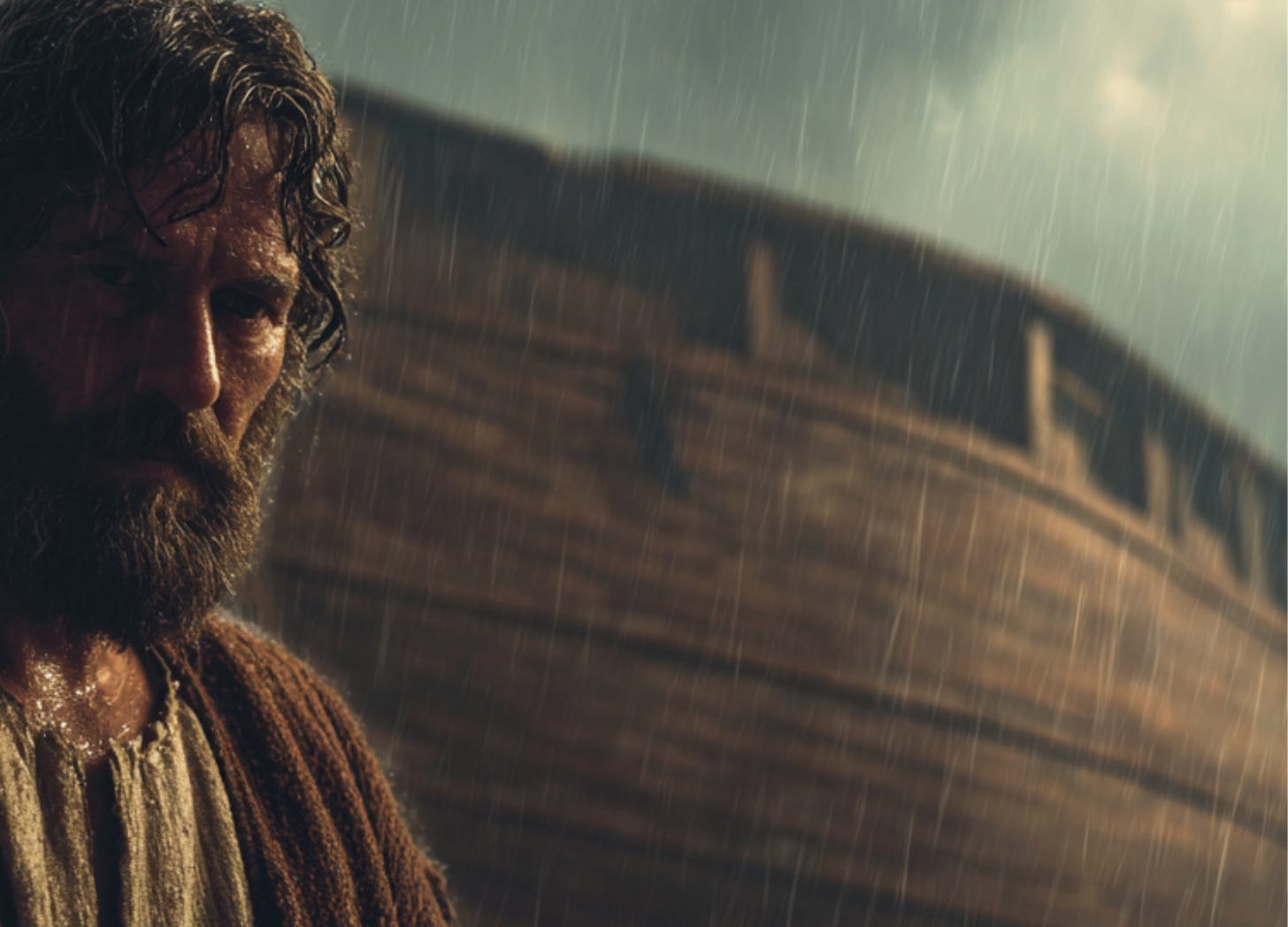
Noah’s Righteousness in Context
The story of Noah begins with one of the most misunderstood verses in the Torah:
“These are the generations of Noah: Noah was a righteous man, blameless in his generation. Noah walked with God.” (Genesis 6:9)
Many people read this as though Noah’s righteousness had something to do with his ancestry… that he was pure in his lineage or somehow separate by birth. But the text itself doesn’t support that. The Hebrew phrase tzaddik tamim b’dorotav means “righteous and blameless in his generation.” It’s about moral character, not genealogy.
Rashi and the sages make this clear. Rashi taught that Noah’s righteousness was relative; that compared to the corrupt and violent people of his generation, Noah stood apart. But had he lived in another time, among the truly righteous like Abraham, he might not have been remarkable at all.
Others, like Ramban, argue that righteousness in a wicked generation is far more difficult, and that Noah’s faithfulness shines brighter because he stood alone. Both are true in their own way, but neither has anything to do with lineage.
Noah’s righteousness wasn’t inherited; it was chosen. It wasn’t about where he came from but about how he lived in the midst of moral collapse.
Genesis 6:11–12 describes the world around him:
“Now the earth was corrupt before God, and the earth was filled with violence.”
The Hebrew word chamas used here doesn’t only mean physical violence. It also refers to injustice, deceit, and moral decay… a society consumed by selfishness.
Noah lived counter to the culture. He wasn’t flawless, but he was faithful. He wasn’t sinless, but he stood firm when everyone else compromised.
That’s what it means to be righteous in your generation; not to be perfect, but to walk with God when the world has forgotten Him.
Building When It Makes No Sense
God told Noah to build an ark at a time when there was no rain, no flood, and no visible reason to do such a thing. It was a massive project, and the world around him likely thought he had lost it.
What stands out is that Noah did not argue. He did not question. Genesis 6:22 says:
“Noah did this; he did all that God commanded him.”
One verse says everything. Noah built without seeing what was coming. Each plank and each layer of pitch was a physical act of trust. It took decades to complete. That is what faith looks like. It is not always glamorous. It is steady and often quiet.
When the flood came, the same waters that brought destruction lifted Noah and his family to safety. His obedience became the line between judgment and deliverance.
A Covenant of Grace
When Noah stepped out of the ark, he built an altar before he built a house. Worship came before comfort.
God responded with the first covenant recorded in Scripture. And this covenant was not only with Noah. It was with all creation:
“I establish My covenant with you, and with your descendants after you, and with every living creature.” (Genesis 9:9–10)
The sign of that covenant was the rainbow. In Hebrew, keshet also means “bow,” like a weapon. The sages taught that God hung His bow in the sky, pointing it away from the earth. It was a sign that His wrath had ceased.
The rainbow is not just a beautiful sky moment or some sort of arrow pointing to a pot of gold at the end. It is a reminder of mercy. God made this covenant because He chose grace over judgment. His promise was never about human perfection. It was about His faithfulness.
The Haftarah: The Waters of Noah
In Isaiah 54, God points back to Noah’s story:
“For this is like the waters of Noah to Me: as I swore that the waters of Noah should no more go over the earth, so have I sworn that I would not be angry with you nor rebuke you.” (Isaiah 54:9)
Isaiah calls this a brit shalom, a covenant of peace. God tells His people that His mercy is stronger than their rebellion. Even if the mountains crumble and the hills are removed, His love does not leave. His covenant remains.
God is not a covenant breaker!
The mercy that carried Noah’s ark is the same mercy that carries us when everything around us falls apart.
The Besorah: The Genealogy of Grace
Matthew opens with a genealogy. It is a long list of names, and many people skip over it. But I encourage you to really dig into genealogies when you come across them in scripture.
Genealogies in Scripture aren’t just long lists of names. They act like bookends, framing the story of redemption. One of my teachers, Rabbi Joshua Brumbach, says that they mark turning points in God’s plan, connecting one covenant moment to the next.
In Genesis, genealogies move the story from creation to Noah to Abraham. In Matthew, the genealogy roots Yeshua in the line of promise, linking Him to Abraham and David. It’s the other bookend, showing that the story that began in Genesis is finding its fulfillment in Messiah.
Every name tells a part of God’s bigger story. The genealogy isn’t background. It’s the bridge between promise and fulfillment.
That list is a testimony of God’s covenant faithfulness through generations.
From Abraham through David to Yeshua, each name tells a story. Noah. Abraham. Ruth. David. All of them were flawed people whom God wove into His redemptive plan.
The ark that carried Noah through the flood points forward to the cross that carries us through sin. Both are vessels of mercy built on obedience.
Righteous in Our Generation
Rashi’s words about Noah have weight for us today. He did not change the world. He refused to be shaped by it.
Our generation is filled with its own kind of chamas. Injustice. Confusion. Self-interest. The details look different, but the brokenness is familiar. God’s call remains the same. Walk with Him.
God is not looking for perfect people. He is looking for faithful ones. Noah’s quiet obedience did not make him famous. It made him ready. And when the storm came, that faith preserved the promise for what came next.
If your obedience feels small or unseen, remember Noah. He was not trying to be extraordinary. He was simply walking with God. That was enough.
My Final Thoughts
Noah was not righteous because the times were easy. He was righteous because he walked with God when the world was falling apart.
Faith does not have to make sense to anyone else. It just needs to be rooted in obedience. And obedience has a way of carrying promises forward.
When the world walks one way, walk with God. When your obedience looks small or even strange, keep going. God uses steady faith to build extraordinary things.
Hebrew Letter of the Week: בּ (Bet) / ב (Vet)
Sound: “B” as in blessing (with a dot, called a dagesh), or a softer, breathier “V” which sounds somewhere between a V and an F
Numerical Value: 2
Meaning: House, dwelling, beginning
How to Write Bet and Vet
ב בּ
Draw a horizontal line from right to left.
Add a vertical line descending from the right side.
Leave the left side open — symbolizing a home open to the presence of God.
Add the dot inside for Bet and leave the dot out for Vet
Understanding the Dagesh
When you see a small dot inside the letter ב, that dot is called a dagesh.
With the dagesh, it’s pronounced “B” as in blessing — Bet (ב).
Without the dagesh, it’s pronounced “V” as in vine but much softer— Vet (בֿ).
It’s a subtle shift, but it changes both the sound and the sense.
In Hebrew, the difference between Bet and Vet can also remind us of the power of what enters and exits the “house”'; what we let in through hearing, and what we release through speech.
Spiritual Meaning
Bet is the first letter of the Torah, beginning the word B’reishit — “In the beginning.” The sages taught that the Torah starts with Bet because it represents a bayit, a house, a dwelling.
Creation itself begins with God building a dwelling for His presence… a world where He would walk with humanity. Bet reminds us that relationship with God is meant to be lived within His dwelling, under His covering, and through His Word.
Bet also teaches that beginnings and belonging are inseparable. To begin again with God is to come home.
Download the Portion and Study Questions
Get your printable copy of this portion along with study and reflection questions plus action challenges.

Did you know we have music for both kids and adults? Subscribe to our YouTube channel and check out our music on Spotify or iTunes!
🔥 Want to go deeper?
Step beyond the surface and into the Word with our paid subscriber community. When you upgrade, you unlock The Vault — and if you’re ready to go all in, Founders Level brings even more.
🔐 Inside The Vault:
💛 Weekly devotionals with depth and application
🌿 Monthly teachings on the Jewishness of Jesus
💬 Private community chats
🎁 30% off all digital products
🚨 Access to our Peppery Bible Study Group in Signal
👑 Founders Level includes everything in The Vault, plus:
🎧 Weekly audio teachings
💻 Monthly Bible Study Q&A Calls
📓 Printable studies and reflection tools
⏰ Early access to studies and new digital products
🖊️ Exclusive journal
💸 50% off all digital products + 10% off physical merch
👉🏽 Join now to unlock your access and walk deeper in truth, boldness, and biblical beauty.
“My final thoughts “ brings encouragement. I find the biggest obstacles come from other believers. G-d’s message was joyful and yet perplexing. Faith and patience are necessary while His will for the future slowly unfolds.
I love this deep dive and wisdom. Thank you.