Shalom, friends!
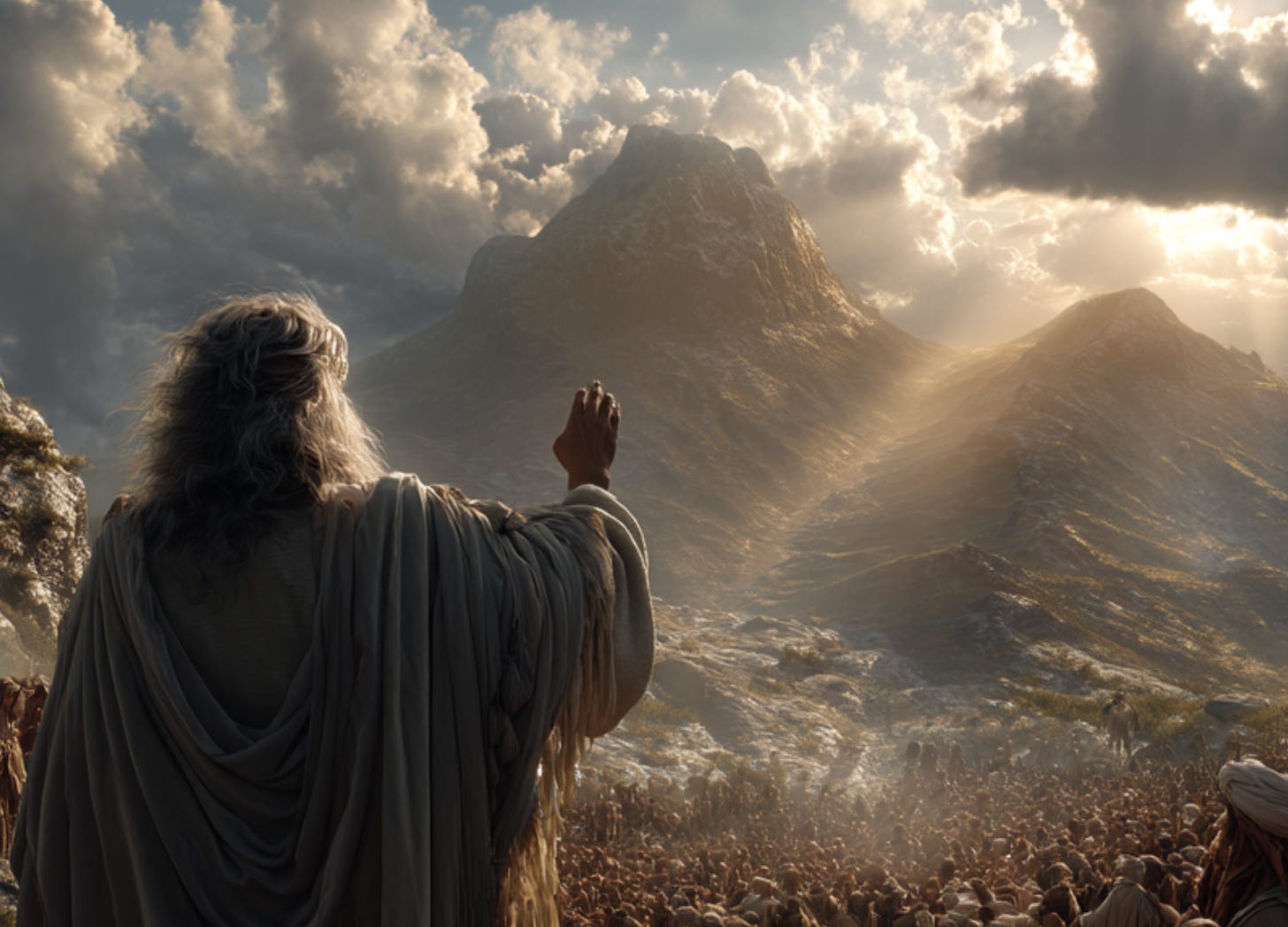
This week’s Torah portion, Re’eh (“See”), begins with a choice: blessing or curse. God sets before Israel two paths and calls them to choose life by obedience. These chapters cover worship, justice, idolatry, false prophets, dietary laws, tithing, care for the poor, and the appointed festivals. Moses is preparing the people not just for the land, but for life in covenant with the God who will dwell among them.
The Haftarah shines with hope: Zion, once afflicted and storm-tossed, will be rebuilt with jewels, her children taught by the Lord, and her covenant secure. Isaiah offers living water without cost, reminding us that true satisfaction comes only from God. From 1 Samuel we hear the covenant bond between David and Jonathan, a friendship grounded in loyalty and divine faithfulness.
In the Besorah, Yeshua appears to His disciples after the resurrection, opening their minds to understand the Scriptures and commissioning them as witnesses.
The message of Re’eh is clear: See what God has set before you. Choose rightly. Live faithfully. Testify boldly.
Be sure to download your free copy of our printable Torah Portion with Study Questions at the end of this post!
TL;DR — Re’eh
Torah (Deut. 11:26–16:17): Blessing and curse, centralization of worship, warnings against idolatry, justice in community life, care for the poor, tithes, and festivals.
Haftarah (Isa. 54:11–55:5; 1 Sam. 20:18, 42): God rebuilds His people with everlasting love; true covenant loyalty in friendship; the call to receive living water freely.
Besorah (Luke 24:33–49): The risen Messiah reveals Himself, explains the Scriptures, and sends out His disciples as witnesses.
Hebrew Letter: Quf (ק) — holiness, separation, “the back of the head,” reminding us of what we cannot see but must trust.
📜 TORAH PORTION: Deuteronomy 11:26–16:17
🔍 Understanding the Portion
Moses lays before Israel the choice of blessing or curse, tied directly to obedience or disobedience. The blessing comes if they carefully follow God’s commandments; the curse if they turn aside to idolatry. This binary choice frames all of covenant life… God is not vague: life, order, and blessing flow from obedience; disorder, exile, and destruction from rebellion.
He stresses the importance of centralized worship: Israel is not to serve God “as each sees fit,” but only in the place He chooses to put His Name. This guards them against syncretism: mixing the worship of Yahweh with pagan practices.
False prophets, dreamers, or even close relatives who entice to idolatry must be resisted, even punished severely. This underscores the seriousness of loyalty to God above all human ties. Dietary laws (clean/unclean animals, prohibition of blood) are reiterated as a sign of holiness.
Moses expands on tithing; first for the Levites, then for community feasts, then for the poor in the third year. He insists on care for the vulnerable: debts must be released in the Sabbatical year, slaves freed with generosity, and the poor never neglected.
Finally, he reviews the festivals: Passover, Shavuot, and Sukkot… times of remembering deliverance, celebrating harvest, and rejoicing before the Lord. These mo’edim are not empty rituals but covenant rhythms that form Israel into God’s people.
💡 A Little Nugget
The word Re’eh (רְאֵה) means See!… in the singular. Moses addresses the whole community as one, but he speaks in the singular form, as if each person must see for themselves. Covenant is corporate, but obedience is personal.
🧭 Application
Am I “seeing” God’s ways clearly, or blinded by culture’s alternatives?
Do I treat obedience as optional, or as the path of life?
How am I ensuring the poor, the marginalized, and the vulnerable are remembered in my own walk of faith?
🧠 Drash: The Choice Before Us
Moses doesn’t sugarcoat covenant life. There’s no neutral ground… only blessing or curse. Re’eh teaches us that compromise is not a small slip; it’s a path. Israel’s survival depends on their ability to see clearly and choose rightly.
The festivals remind us that faith isn’t just about private morality, it’s about rhythm, memory, and community. To feast before the Lord is to remember salvation, generosity, and joy. Worship, justice, and celebration all intertwine.
Re’eh confronts us today: What voices am I entertaining that entice me to idolatry? What rhythms shape my life; God’s appointed ones, or the frantic calendar of culture? Blessing follows obedience because obedience keeps us close to God, the true source of life.
📖 HAFTARAH: Isaiah 54:11–55:5; 1 Samuel 20:18, 42
🔍 Understanding the Portion
Isaiah paints a picture of Zion, once storm-tossed, now adorned with precious stones… foundations of sapphires, gates of jewels. Her children will be taught by the Lord, and her peace will be great. No weapon formed against her will prevail, for God’s covenant love is everlasting.
In chapter 55, the invitation is universal:
“Come, everyone who thirsts, come to the waters.”
Bread, wine, and milk are offered without money. God calls His people not to spend their labor on what does not satisfy, but to listen and live. His covenant is sure, as certain as His promises to David.
From 1 Samuel, we hear the covenantal loyalty between Jonathan and David… Jonathan declaring:
“‘May Adonai be between me and you, and between my offspring and your offspring, forever.’” (TLV)
This picture of friendship mirrors God’s unbreakable covenant.
💡 A Little Nugget
Isaiah 40 begins with “Comfort, comfort My people.” Here in Isaiah 54–55, that double comfort deepens. The repetition shows not only consolation for the wound but empowerment for the future. God doesn’t just soothe; He restores, rebuilds, and sends.
🧭 Application
Do I drink deeply from what truly satisfies, or waste my labor on empty pursuits?
How does God’s “double comfort” equip me not only to heal but also to comfort others?
Am I building relationships with covenantal loyalty, like David and Jonathan?
🧠 Drash: The Covenant That Cannot Break
Isaiah lifts the eyes of the discouraged: storms do not define the end. God rebuilds, and not with rubble… with jewels. His covenant is stronger than affliction, stronger than exile, stronger even than our doubts.
Jonathan’s covenant with David reminds us that loyalty rooted in God is eternal. In a world of disposable commitments, covenant friendship shines as prophetic. Together, these passages tell us that God’s love isn’t fragile. His covenant isn’t breakable. His comfort isn’t shallow.
✝️ Besorah: Luke 24:33–49
🔍 Understanding the Portion
The two Emmaus disciples rush back to Jerusalem to tell their story, and Yeshua appears to the gathered disciples. At first they are startled, thinking they see a spirit. He shows His hands and feet, eats with them, and proves He is risen in the flesh.
He then “opens their minds” to understand the Scriptures, showing that the Messiah had to suffer and rise, and that repentance and forgiveness should be proclaimed in His name to all nations. Finally, He commissions them: “You are witnesses of these things.”
💡 A Little Nugget
The phrase “opened their minds” (Luke 24:45) uses the Greek dianoigo, meaning to “thoroughly open, unlock.” It is the same word used when Yeshua “opened” the Scriptures to the Emmaus disciples. The Word unlocks both text and heart.
🧭 Application
Do I live as a “witness” of the resurrection, or just as a consumer of religious truth?
What areas of my mind still need to be “opened” by Yeshua to understand His Word?
How am I proclaiming repentance and forgiveness in His name?
🧠 Drash: Witnesses of the Word Made Flesh
Luke shows us that resurrection is not an abstract doctrine… it is embodied reality. Yeshua ate fish, spoke peace, and then unlocked their minds. Resurrection is both physical and spiritual, truth and transformation.
The disciples were not just comforted, they were commissioned. Resurrection always moves us outward. We do not just receive peace; we become proclaimers of it. Re’eh ties this together: See what is before you. Choose life. Proclaim life.
🌟 My Drash: See and Choose
Re’eh is about vision. “See, I set before you today blessing and curse.” It is a sermon that insists: you can’t walk blindly. You must see.
Isaiah echoes: See your affliction transformed into jewels. See the water that flows freely for the thirsty. Jonathan and David add: See the loyalty of covenant friendship that outlasts hardship. And Yeshua declares: See My hands, My feet, My Word fulfilled—now go and testify.
The blessing comes not from vague optimism but from clear-eyed obedience. Seeing is the first step; choosing is the next. Re’eh challenges us to look at the world honestly and still choose God.
Today, what do you see? Do you see scarcity or promise? Do you see exile or restoration? Do you see a crucified hope or a risen Messiah? What you see will shape what you choose. And what you choose will shape the blessing or curse that follows.
✡️ Hebrew Letter of the Week: ק (Quf)
Sound: “Q” or hard “K” from the back of the throat
Numerical Value: 100
Meaning: Holiness, separation, that which is “behind” or “beyond”
✍🏽 How to Write Quf
ק
Start with a long vertical line (like a pole).
Add a small circle or curve to the right, near the top, slightly detached.
The two parts together form the “back of the head”… something you cannot see directly.
Spiritual Meaning
Quf teaches us holiness… the call to be set apart. It also symbolizes the unseen dimension of God’s reality, what is “behind” us or beyond human sight. In Re’eh, we are asked to “see” clearly, yet Quf reminds us that true vision requires trust in what we cannot see.
If this Hebrew letter stirred something in you… like, “I want to read the Word the way it was first written”, then loves, it’s time to take that next step.
👉🏽 Enroll now in my Basic Beginner’s Biblical Hebrew I Course and start learning the language of Scripture at your own pace. No overwhelm. No fluff. Just a beautiful, spirit-led foundation for reading the Bible in its original form.
💻 Click here to join the course
✨ Vault Members: Get 30% off
👑 Founders Circle: Get 50% off
Because unlocking the Word in Hebrew? That’s a legacy move.
Download Your Printable Version Along With Study Questions