There’s something about Sukkot that slows you down. The world outside might still be racing, but in that little booth under the open sky, you can’t rush. The roof leaks light. The wind slips through the walls. You’re reminded that what we call “security” is mostly an illusion.
And maybe that’s the point.
Sukkot, the Feast of Tabernacles, comes at the end of the High Holy Days as a kind of exhale… a celebration after repentance. But it’s not just about joy; it’s about presence. Joy in the Bible is never disconnected from presence; it’s what happens when God draws near.
And this week’s readings are all about that nearness and how costly, fragile, and glorious it is.
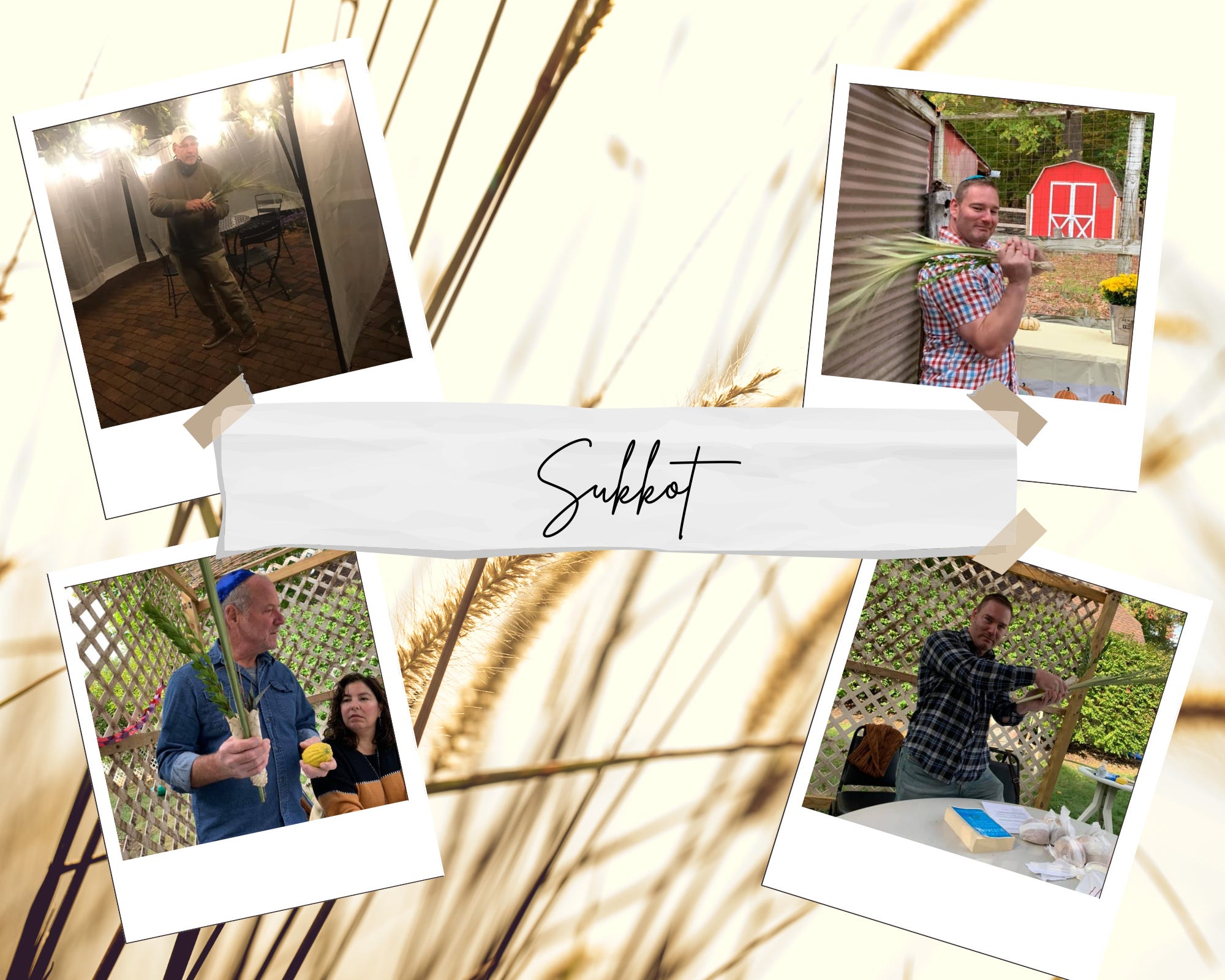
First, here’s some photos from our Sukkot celebrations. The first is my Rabbi, the second is my husband inside our Sukkah being all dramatic. The third is our friend Dave (who was our cantor) about to do the blessing and shake the lulav and etrog. The last is, once again, my husband at our Rabbi’s house being dramatic.
Moses stands before God in Exodus 33, exhausted by the people’s rebellion. They’ve worshiped a golden calf. They’ve broken covenant before the ink on the tablets was even dry. And now God says He’ll send an angel to go with them, but His own Presence will not.
That’s when Moses says something that stops me every time I read it:
“If Your Presence does not go with us, do not send us up from here.” (Exodus 33:15)
Moses isn’t asking for success. He isn’t asking for safety. He isn’t asking for Canaan. He’s asking for God.
And the Lord answers him:
“My Presence will go with you, and I will give you rest.”
But Moses isn’t done. He says, “Show me Your glory.”
Wow… what a request! It’s not just for help, but for God Himself.
And God answers: “I will make all My goodness pass before you.”
When Moses finally stands in the cleft of the rock and God’s glory passes by, what he sees isn’t blinding light, it’s character. It’s mercy. It’s compassion. God reveals His Name:
“The Lord, the Lord, compassionate and gracious, slow to anger, abounding in lovingkindness and truth.” (Exodus 34:6)
That’s what glory looks like. Not fire, not thunder… faithfulness.
And that’s the heart of Sukkot.
For millenia, the Jewish people dwell in frail shelters for seven days, but we are covered by a faithful God. We remember the wilderness, but more than that, we remember the Presence that never left us there. We celebrate the God who pitched His tent among His people… who dwells not in temples made with hands but in hearts made willing.
That same glory that passed before Moses in a cloud of compassion now rests upon us through the Spirit. The Presence that once hovered above the mercy seat now abides in those who love Him.
Ezekiel takes that same Presence and projects it forward. In chapters 38 and 39, he sees the day when the nations will rise against Israel…Gog and Magog…and God Himself will fight for His people. The imagery is fierce: earthquakes, fire, judgment, restoration. But the outcome is clear:
“I will make My holy name known in the midst of My people Israel, and the nations shall know that I am the Lord.” (Ezekiel 39:7)
It’s Sukkot on a global scale: God’s Presence dwelling among His people, the nations drawn in awe. What began in a desert tent will one day fill the whole earth.
And then comes the Gospel reading from John 7.
It’s the Feast of Tabernacles in Jerusalem. The Temple courts are packed. The golden menorahs are lit. Every morning, the priests draw water from the Pool of Siloam and pour it out at the altar, praying for rain and blessing.
In the middle of it all, Yeshua stands up and begins to teach. People are stunned. “How does He know all this?” they whisper. He answers:
“My teaching is not My own. It comes from the One who sent Me.” (John 7:16)
In the middle of the Feast that celebrates God dwelling with His people, Yeshua declares that He is that dwelling.
He is the glory Moses longed to see, walking among them in flesh and blood.
Later, He’ll cry out, “If anyone is thirsty, let him come to Me and drink.” The One who spoke to Moses from the cloud now stands in human form, offering the same Presence that once filled the Tabernacle.
Sukkot was always a rehearsal for this moment; when the Word would become flesh and “tabernacle” among us (John 1:14).
That’s why this feast still matters. It reminds us that glory doesn’t live in perfect walls — it lives in surrendered hearts. It reminds us that God doesn’t ask for performance — He asks for presence.
And it challenges us to live open-roofed lives: exposed, dependent, aware that everything we build will fade, but His Presence endures forever.
So as you think about what it means to dwell with Him, ask yourself:
Am I content with comfort, or am I desperate for Presence?
Do I want blessings, or do I want the One who blesses?
Because the same God who said to Moses, “My Presence will go with you,” still says it now to those willing to dwell with Him.
And if Sukkot teaches us anything, it’s that the Presence of God is not found in permanence; it’s found in dependence.
Hebrew Letter of the Week: ת (Tav)
Sound: “T” as in truth
Numerical Value: 400
Meaning: Mark, covenant, completion, seal
✍️ How to Write Tav
ת
Begin with a horizontal line across the top (right to left).
Draw a vertical line descending from the right side, forming a corner (like a reversed “L”).
In modern Hebrew script, the bottom is slightly curved or joined — simple, balanced, and steady.
In ancient Paleo-Hebrew, the Tav was shaped like a cross or an “X”, representing a sign or mark. It symbolized ownership… the seal that something (or someone) belonged to God.
Spiritual Meaning
Tav is the final letter of the Hebrew alphabet. It represents completion, truth, and covenant fulfillment.
In Ezekiel 9:4, God marks the faithful with a Tav: the sign of protection. It’s not just an ending, but a seal of divine purpose.
When Yeshua said, “It is finished” (John 19:30), He spoke the heart of Tav; the covenant completed, redemption sealed, the Presence of God now dwelling permanently with His people.
A Little Nugget
During Sukkot, when we remember God’s Presence “tabernacling” among His people, Tav reminds us of the final shelter: Messiah Himself.
He is the mark that cannot be erased, the covenant that cannot be broken, and the Presence that cannot be driven away.
Download Your Portion & Study Questions
If you would like to have this portion in a printable format, along with study and reflection questions, you can download it here.