


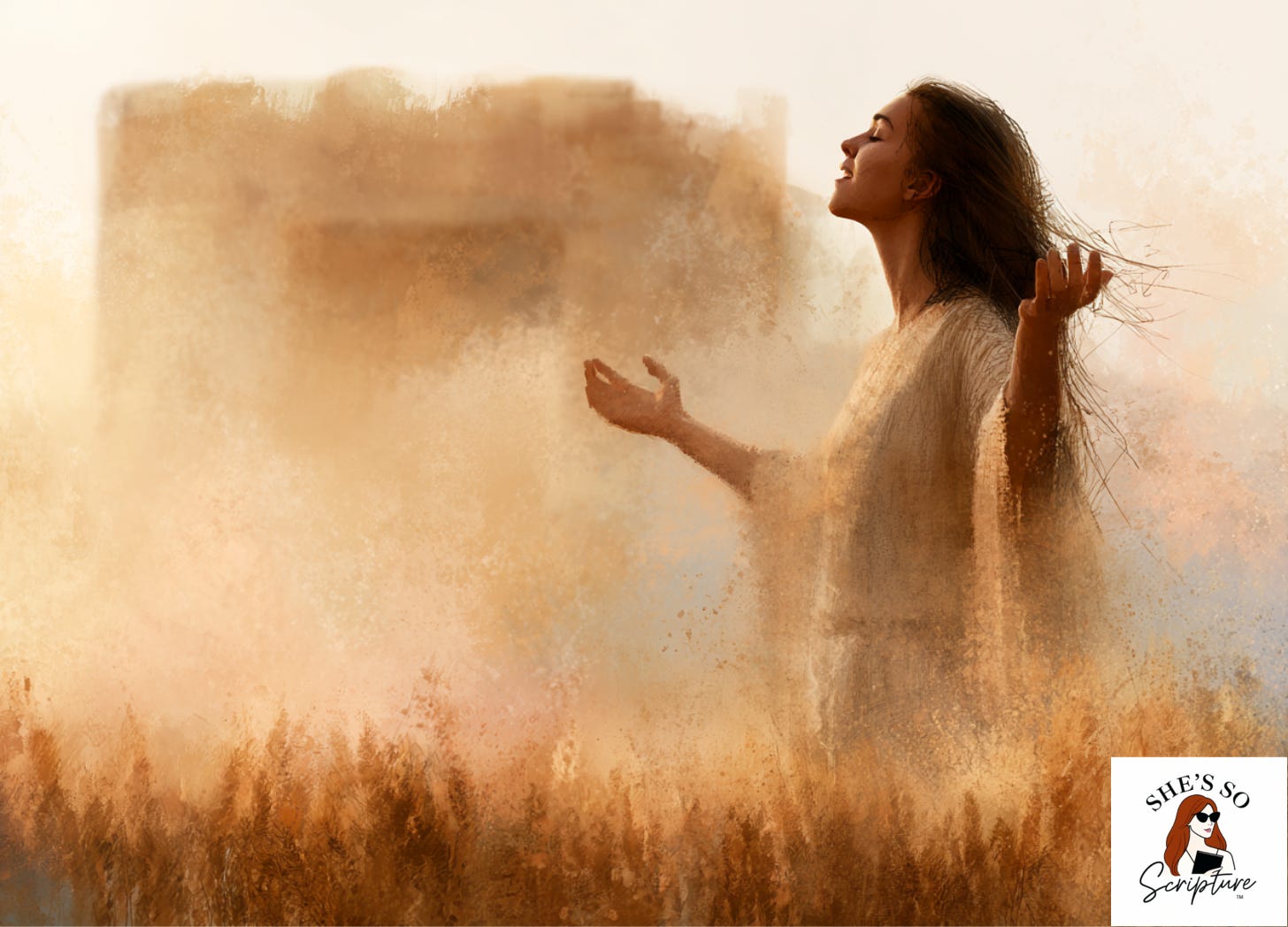
I have a confession to make. For most of my life, Shavuot was the holiday I explained to people by saying, “Oh, that’s basically Pentecost,” and then moving on as fast as possible. Like I’d satisfied the curiosity. Like that answered anything.
It didn’t.
Pentecost is the Greek name. Shavuot is the Hebrew name. And they’re pointing at the same moment from completely different angles. One is counting backward from a miracle. The other has been counting forward to one for fifty days. The whole festival is built on anticipation, on movement, on the space between Passover and here. Seven weeks of counting. Seven weeks of leaning toward something you can’t quite see yet but know is coming.
That’s Shavuot. And it lands on Shabbat, which means we get an extra reading. Which means more Torah. And honestly? Good. There’s a lot to dig into here.
Wait—What Is a Maftir, and Why Two Readings?
If you’re newer to following along with the Torah portion cycle, you may have noticed we have an extra section this week called the Maftir. Here’s what that is.
In synagogue practice, the Torah is divided into weekly portions and read through over the course of a year. On a normal Shabbat, the Torah portion is read in full. But when Shabbat coincides with a Jewish festival, the synagogue faces a kind of liturgical overlap: do you read the regular weekly portion, or the special holiday portion? The answer is that we do nothing small so… both!
The word Maftir (pronounced maf-TEER) literally means “the one who concludes.” It refers to the final reader called up to the Torah, and on festival Shabbatot, that concluding reader reads a short special section designated for the holiday.
This week, the Maftir is from Numbers 28:26–31, which lists the specific sacrificial offerings commanded for Shavuot. It’s brief, it’s specific, and it grounds the celebration in the Temple’s ritual life.
So this week, we’re putting the main Deuteronomy reading alongside the Maftir alongside the Haftarah alongside the Besorah. Four readings, one Shabbat, one festival, and a whole lot of the same theme converging from every direction.
That’s not an accident. The Jewish reading calendar layers these texts together because they belong together. And once you see what they’re all saying, you’re going to feel it.
Torah: Deuteronomy 14:22–16:17
Tithe, Release, and the Open Hand
At first glance, this Torah reading looks like a collection of laws that don’t obviously connect. Tithes. Debt cancellation. Generosity to the poor. The release of Hebrew servants. Firstborn animals. Then the three pilgrimage festivals. What do any of these have to do with Shavuot?
Everything, actually.
The portion opens with the practice of tithing your harvest, bringing a tenth of what the land has produced to “the place He will choose to make His Name dwell.” This is centralized worship in motion. You’ve grown something. It belongs to God first. You bring it, you eat before God, you celebrate.
And if the distance is too far to carry the physical produce, you convert it to silver and use that to buy “whatever your soul desires” once you’re there. God is not forbidding joy at the feast. He’s funding it.
Deuteronomy 14:22–23 (TLV)
“You will surely set aside a tenth of all the yield of your seed that comes from the field year by year. You are to eat the tithe of your grain, your new wine, your oil, and the firstborn of your herd and flock, before Adonai your God in the place He chooses to make His Name dwell, so that you may learn to fear Adonai your God always.”
Notice the purpose stated here: “so that you may learn to fear Adonai your God always.” The tithe isn’t just some economic arrangement. It’s a posture. It’s regular, structured acknowledgment that everything you’ve produced came from a God who made the rain fall and the seed germinate. Generosity begins with that recognition.
Then in chapter 15, the text turns to shmitah, the seventh-year cancellation of debts, and the call to generosity toward the poor.
Deuteronomy 15:7–8 (TLV)
“If there is a poor man among you—any of your brothers within any of your gates in your land that Adonai your God is giving you—you are not to harden your heart or shut your hand against your poor brother. Rather, you must surely open your hand to him and you must surely lend him enough for his need—whatever he is lacking.”
The repetition in the Hebrew here is explicit. “You must surely open your hand” is the same root word appearing twice, the Hebrew way of making something unambiguous. This isn’t a suggestion. It’s not a best practice. It’s the standard of covenant community. You have received. Now you give. Closed fists have no place in a people whose God opened His hand to them.
Deuteronomy 15:11 (TLV)
“For there will never cease to be poor people in the land. Therefore I am commanding you, saying, ‘You must surely open your hand to your brother—to your needy and poor in your land.’”
This verse is often treated as a concession. A shrug. “There will always be poor people, so fine, give.” But that’s not what it’s doing. The presence of need in the community is not a failure of the system. It’s the perpetual occasion for faithfulness. The community that continually opens its hand is the community shaped by the God who continually opens His.
By the time we get to chapter 16 and the actual Feast of Shavuot instructions, the language of open-handedness has already been established. Look at how the feast is described.
Deuteronomy 16:9–12 (TLV)
“Seven weeks you are to count for yourself—from the time you begin to put the sickle to the standing grain you will begin to count seven weeks. Then you will keep the Feast of Shavuot to Adonai your God with a measure of a freewill offering from your hand, which you are to give according to how Adonai your God blesses you. So you will rejoice before Adonai your God in the place Adonai your God chooses to make His Name dwell—you, your son and daughter, slave and maid, Levite and outsider, orphan and widow in your midst. You will remember that you were a slave in Egypt, and you are to take care and do these statutes.”
Every category of vulnerability is on that guest list: the Levite, the outsider, the orphan, the widow. The feast is not a private family celebration. It’s a community table, and it’s only complete when the margins are included. The joy of Shavuot is a shared joy or it isn’t really the feast God intended.
And then the command to remember Egypt. This appears again and again in Deuteronomy, and it’s never incidental. You were the outsider once. You were the one without land, without inheritance, without power. Someone—God himself—opened His hand to you. Now you are that hand for someone else.
Maftir: Numbers 28:26–31
The Offerings of the Day
The Maftir reading for Shavuot is short and easy to pass over. It’s a list of offerings: bulls, rams, lambs, a goat. The specific combinations required when the community brings the holiday sacrifice. Not exactly the most inspiring reading on the surface.
But it matters, for a reason that might surprise you.
This is the only place in the Torah where Shavuot is explicitly called Yom HaBikkurim, the Day of Firstfruits. The word bikkurim refers to the first ripe grain of the wheat harvest, the very first yield of the season offered back to God before anything else is used.
Firstfruits is not about giving your leftovers. Firstfruits is about the sequence of trust. You give the first thing, the one you haven’t yet seen multiply, and you give it before you know whether the rest of the harvest will come. That’s faith as an agricultural practice. That’s what Shavuot is built on.
The offerings in Numbers 28 are also clearly more elaborate than a normal Shabbat. Two young bulls, one ram, seven lambs, a goat for a sin offering, grain offerings alongside each. This is a major festival. The language of the portion says the community is to have a sacred assembly; no ordinary work is to be done. It’s set apart. The calendar itself stops to mark what God has given and what He is about to give.
There’s something worth taking in here. In the first century, Shavuot was one of the three pilgrimage festivals, meaning Jewish men from across the diaspora traveled to Jerusalem to be present at the Temple on this day. That’s why, when the Acts 2 account describes the outpouring of the Spirit, it specifies that devout Jews from every nation under heaven were there.
They were following the Torah. They were where they were supposed to be. Messianic believers have long found deep significance in the Spirit falling on that particular day, on the festival of firstfruits, among people who were gathered in covenant obedience.
Haftarah: Habakkuk 3:1–19
The God Who Shakes the Earth and Makes the Feet Like Deer
Habakkuk 3 is one of the most stunning pieces of poetry in the entire Tanakh, and it’s read on Shavuot for a reason that runs pretty deep.
The chapter is labeled “a prayer of Habakkuk the prophet, in the style of a lament.” And it starts exactly there, in lament. Habakkuk has already spent two chapters arguing with God about injustice and violence, about the Babylonian threat and the apparent silence of heaven. God answered. Habakkuk didn’t exactly like the answer. Now, in chapter 3, he pivots.
He asks God to revive His work. To make it live again. And then he begins to remember.
Habakkuk 3:3–4 (TLV)
“Elohim came from Teman, the Holy One from Mount Paran. Selah His splendor covered the heavens, and the earth was full of His praise. His radiance was like the sunlight; rays of light flashed from His hand—there His power was hidden.”
Habakkuk is doing something very specific here. Teman and Mount Paran are the regions associated with the Sinai peninsula, the direction from which God appeared when He gave the Torah.
Habakkuk is invoking the theophany at Sinai, the moment when God descended on the mountain in fire and thunder and spoke the Ten Words (Ten Commandments) to Israel. He’s asking God to do that again. To show up with the same terrifying, glorious presence He showed up with the first time.
This is why the rabbis chose Habakkuk 3 for Shavuot. Shavuot, in rabbinic tradition, is understood as the anniversary of matan Torah, the giving of the Torah. The agricultural festival had its meaning deepened over time to include the covenant itself. And Habakkuk’s vision of God coming from Teman, shaking mountains, routing nations, is a vision of the God who came to Sinai.
But then Habakkuk does something unexpected. He describes devastating loss. The fig tree isn’t blooming. The vines are empty. The olive crop has failed. The fields have no food. The flocks are gone. The stalls are empty. This is complete agricultural devastation, the exact opposite of what Shavuot is supposed to celebrate.
Habakkuk 3:17–19 (TLV)
“Though the fig tree does not blossom, and there is no yield on the vines, though the olive crop fail, and the fields produce no food, the flock is cut off from the fold, and there is no cattle in the stalls—yet I will rejoice in Adonai! I will take joy in the God of my salvation. Adonai my Lord is my strength. He makes my feet like deer’s feet. He enables me to walk on my high places.”
And there it is. The theological spine of the whole haftarah. The harvest might fail. The fields might empty. The signs of God’s blessing might disappear entirely. And the prophet says: yet. Yet I will rejoice. Not because the circumstances have changed. Because the God behind the circumstances has not. Wow!
Shavuot is a harvest festival. You celebrate what came in. But Habakkuk preaches the Shavuot that remains when nothing came in. The joy that doesn’t require the produce to show up.
This isn’t “positive thinking.” This is a man who has watched devastation coming, argued with God about it, received an answer that troubled him, and then arrived at the same God on the other side of all of it. That’s trust that has been tested.
The deer’s feet image at the end is worth noting. Deer navigate terrain that would break human ankles. They move through instability with solid footing not because the terrain is smooth, but because of what they are. Habakkuk is asking God to make him that. Not to flatten the mountain, but to make him able to walk on it.
How often do we ask God to flatten our mountains rather than making us able to cross them?
Besorah: John 15:26–27; 16:12–15
The Helper Who Has Come
Now, this is where all this lands.
These verses come from Yeshua’s farewell discourse, spoken the night before His crucifixion. He is preparing His disciples for what is about to happen and for what will come after. And He keeps returning to the same promise.
John 15:26–27 (TLV)
“When the Helper comes—whom I will send to you from the Father, the Spirit of truth who goes out from the Father—He will testify about Me. And you also testify, because you have been with Me from the beginning.”
John 16:12–15 (TLV)
“I still have many things to tell you, but you cannot bear them now. But when the Spirit of truth comes, He will guide you into all the truth. He will not speak on His own; but whatever He hears, He will tell you. And He will declare to you the things that are to come. He will glorify Me, because He will take from what is Mine and declare it to you. Everything that the Father has is Mine. For this reason I said the Ruach will take from what is Mine and declare it to you.”
Yeshua is describing what the disciples couldn’t yet understand: that the Ruach HaKodesh (Holy Spirit) is the ongoing presence of Yeshua among His disciples. Not a consolation prize for His absence. Not a lesser experience. The Spirit takes what belongs to Yeshua and makes it known. He guides into truth. He declares what is coming.
Fifty days after Passover, when the disciples were gathered in Jerusalem for Shavuot as the Torah commanded, this promise was fulfilled. The Spirit fell. Messianic believers have long seen profound symbolism in the Spirit being poured out on Shavuot, the festival of firstfruits. The community of Yeshua was gathered in obedience to the appointed time and something entirely new was given in it.
The word Helper in the Greek is Parakletos. A helper, an advocate, one called alongside to support. The root idea is standing next to someone, leaning toward them. It evokes the image of a hand extended, a presence that upholds.
And here is where the letter Samech comes in, which we’ll get to in the Hebrew Letter Lesson below.
What Yeshua is describing in these verses is not primarily information. It’s a relationship. The Spirit who testifies, who guides, who takes what belongs to Yeshua and declares it to us. This is the gift of Shavuot. Not a doctrine… a presence.

Thematic Threads: What Is Shavuot Actually Saying?
These four readings don’t just share a calendar date. They share a theological argument, and it runs like this.
Shavuot is a feast about receiving. You counted fifty days from the barley offering at Passover. Every day of the Omer count is a day of preparation, of expectation, of moving toward something. The rabbis have long taught that the counting is the journey from Egypt to Sinai, from rescue to covenant. The people were freed from slavery so that we could stand at the mountain and receive something. Not just commandments. An identity. A people. A God who descends.
The Torah portion teaches you how to hold what you’ve received: with an open hand. Tithe. Release debts. Feed the outsider and the widow. Don’t close your fist around the harvest. The closed hand reflects the scarcity mindset Israel learned in Egypt. The open hand is the posture of a people who know who their Provider is.
Habakkuk tells you what to do when the harvest fails: still rejoice. The joy of Shavuot is not conditional on the crop. It’s rooted in the God who gives the crop, who remains when the crop is gone, who makes the feet steady on the high places.
And the Besorah tells you what was always coming at the end of the fifty days, though the first disciples couldn’t see it yet. The Ruach. The Parakletos. The One who comes alongside, who takes from what belongs to Yeshua and makes it yours.
The theme is leaning. Leaning on God in obedience. Leaning on God in loss. Leaning into the Presence that doesn’t leave.
Verse Mapping Aid
The Hebrew: Samach (סמך) — To Lean, To Support, To Uphold
Pronunciation: SAH-makh (Strong’s H5564)
The verb samach appears forty-eight times in the Hebrew Bible. Its range of meaning includes to lean upon, to lay, to rest, to support, to sustain, to uphold, to prop. It’s the verb used when Aaron and his sons “laid their hands” on the head of the sacrificial bull at the Tabernacle. It’s the verb behind the entire concept of semikhah, the laying on of hands in consecration and blessing.
When you laid your hand on the head of the sacrifice, you were doing something with physical weight behind it. You were leaning. Transferring. Connecting yourself to what was happening. Semikhah isn’t a casual touch. It’s a deliberate, weighted act of identification and support.
The same root is behind the practice of rabbinic ordination, still called semikhah today. When one rabbi ordains another, there is a laying of hands, a transmission of authority and blessing through the gesture of leaning upon.
Samach is also the verb behind several stunning passages in the Psalms.
Psalm 37:17 (TLV)
“For the arms of the wicked will be broken, but Adonai upholds [samach] the righteous.”
Psalm 54:4 (TLV)
“Behold, God is my helper. Adonai is the one who upholds [samach] my soul.”
God upholds, props, supports, sustains. He doesn’t stand at a distance managing things. He leans in. The image is intimate and weight-bearing.
And the letter Samech (ס) is the shape of that action made visible. It’s one of the enclosed Hebrew letters, forming a complete circle with no opening in its standard middle-letter form. Later Jewish tradition, particularly mystical interpretation, has often read the circular shape of Samech as a picture of God encircling His people, a surrounding without a break. Whatever is inside the Samech is held.
On Shavuot, the festival when the Spirit is poured out and the Helper comes alongside, the Samech is not incidental. The Ruach HaKodesh described in John 16 as the One who guides into all truth, who takes from what is Yeshua’s and makes it yours, is the living, personal expression of samach. He upholds. He sustains. He leans in.
When Habakkuk says “Adonai my Lord is my strength” and describes feet made like deer’s feet on high places, he’s describing what it feels like to have samach underneath you. Not smooth terrain but support on rough terrain. The difference between standing on something stable and being held by Someone stable.
My Final Thoughts
Shavuot is the feast where you come with an open hand.
That’s what the Torah portion is about: not gripping the harvest, not hardening your heart toward the need in front of you, not calculating whether the year of release is too close to make generosity worth it. The open hand is the lived theology of a people who know they didn’t produce the harvest alone.
And then the Ruach comes, and fills the open hand.
This is how Shavuot works, and has always worked. You count. You arrive. You bring what you have, with open hands. And God shows up with something more than you brought. At Sinai it was the Torah, written by His own finger. In Acts 2 it was the Spirit poured out on everyone in the room, devout Jews from every nation who had made the pilgrimage as the Torah commanded. Today it’s the same Ruach, the same Parakletos, the same samach underneath your life.
Habakkuk got it right. The harvest might fail. The flock might disappear. The fig tree might not bloom. The joy of Shavuot is not the produce. The joy is the God who gives the produce, the God who comes from Teman, the God who makes feet like deer’s feet on the high places.
Open your hand. Count your fifty days. Lean in. He’s leaning in toward you.
Hebrew Letter Lesson: Samech (ס)
ס
The Letter Samech
Pronunciation: SAH-mekh (the “s” sound, as in “son”)
Numerical value: 60
Ancient pictograph: A shield, or a support, or a trellis
Root meaning: To lean upon, to prop, to support, to uphold, to surround
Samech is one of the enclosed Hebrew letters. In its standard middle-letter form it is a complete circle, closed on all sides. Final Mem (ם) shares this quality, and both appear together in a striking piece of Talmudic tradition we’ll get to in a moment.
Some Jewish interpreters, particularly in later mystical tradition, have read the circular shape of Samech as a picture of God’s surrounding protection. The perimeter is God; the interior is His people. Nothing inside the Samech is exposed. Whether or not that was the original intent of the letter’s scribes, the image carries genuine theological weight.
The ancient pictograph associated with Samech in some paleo-Hebrew analyses resembles a shield or a trellis. These interpretations are speculative rather than settled linguistics, but they’re suggestive: a shield is what stands between you and what’s coming at you, and a trellis is what holds the vine up so it can grow. Both images are about support in the face of something the vine or the person couldn’t bear alone.
Samech also gives us the root verb samach: to lean, to lay hands on, to support. The laying on of hands in the Levitical offerings, in priestly ordination, in the consecration of Joshua by Moses, all of it uses this root. It’s a gesture of weight and intention, not a light touch. When you samach on something, you are genuinely resting your weight on it.
On Shavuot, when we celebrate the giving of the Torah at Sinai and the outpouring of the Ruach, the letter Samech is the shape of what both of those events accomplished: God encircling His people. The Torah as the covenant that surrounds and holds the community. The Spirit as the Presence that surrounds and upholds the believer.
There are exactly fifty days between Passover and Shavuot. The numerical value of Samech is sixty, not fifty, so the counting itself doesn’t hit the letter exactly. But fifty is the number of Jubilee, and Samech is the letter of the full circle, the completed cycle, the surrounding that holds. The thematic connection between Samech and Shavuot runs through what they both describe: God as the One who comes around, who sustains, who doesn’t leave a gap.

A Little Nugget
The Talmud (b. Shabbat 104a) records a tradition that when the Ten Commandments were engraved completely through the sapphire stone tablets, two enclosed letters posed a problem: the Samech and the final Mem. Because their centers were completely surrounded by stone with no connection to the outer surface, their inner pieces should have fallen out. The rabbis taught that those centers were miraculously suspended in mid-air, held up by God in the very act of giving the Torah. The letter whose name means support had to be supernaturally upheld by the One it represents. That’s worth having a think on, on Shavuot.
Application
What are you leaning on right now that is not God? The Samech shape is a circle, which means the question isn’t whether you’re inside something. Everyone is. The question is what the perimeter is made of.
Habakkuk’s fig tree failed. His flocks disappeared. The harvest was gone. He still had the Samech. He still had the surrounding. And his response wasn’t denial, it was declaration: Adonai my Lord is my strength.
Shavuot is an invitation to lean. To open your hand instead of gripping. To count your days toward the God who is already counting toward you.
Weekly Practice
Find one concrete way this week to open your hand toward someone in need. It doesn’t have to be dramatic. Deuteronomy 15 is very specific: don’t calculate whether it’s convenient. Don’t harden your heart. Just open your hand. Let the act be practice in the theology of Shavuot.
Also: take a few minutes this week to read the Acts 2 account in light of what you now know about Shavuot. They were there because the Torah commanded it. Read it with that context and notice what changes.
Bible Study Questions
1. Deuteronomy 15 describes the practice of shmitah, the seven-year debt cancellation, alongside the command to give generously to the poor. What is the relationship between these two practices? How do they work together to form a vision of community?
2. The Torah portion repeatedly commands Israel to “remember that you were a slave in Egypt.” Why is this memory supposed to produce generosity? What does your own memory of God’s rescue do to the way you hold what you have?
3. The Shavuot feast in Deuteronomy 16 includes the Levite, the outsider, the orphan, and the widow. Who are the equivalent categories of marginalized people in your community today, and what would it mean for them to be genuinely included in the table?
4. Habakkuk 3 moves from lament and argument to theophany and then to praise in the absence of harvest. Trace that movement through the chapter. Where does the pivot happen, and what makes it possible?
5. In John 16:12–15, Yeshua says the Spirit will “guide you into all truth” and “take from what is Mine and declare it to you.” What does this mean practically? How do you experience this in your own engagement with Scripture?
Reflection Questions
6. Where in your life right now are you holding something tightly that God may be asking you to hold with an open hand? What is the fear underneath the grip?
7. Habakkuk’s joy in chapter 3 is explicitly not based on circumstances. Have you ever experienced that kind of joy? What was the occasion, and what did it feel like to be held by something larger than what was happening around you?
8. The letter Samech is a complete circle, fully enclosed. Do you experience the presence of God more as surrounding or as distant? What has shaped that experience?
9. The disciples in Acts 2 were in Jerusalem for Shavuot because the Torah commanded them to be. They were following the rhythm of the covenant calendar when the Spirit fell. What does it mean to you that the outpouring happened inside obedient participation in the appointed times?
Action Challenges
10. Between now and next Shabbat, practice the open hand. Give something you were holding back. It can be money, time, attention, a word of acknowledgment. Track what comes up in you as you do it.
11. Read Acts 2:1–21 this week with fresh eyes, knowing that the disciples were gathered for Shavuot as the Torah required. Write a few sentences about what changes in your reading when you understand the festival context.
12. Find one person in your life who might be in the “Levite, outsider, orphan, or widow” category for this season. How can you specifically include them at your table, literal or metaphorical, this week?
Want to Go Deeper?
If this study stirred something in you, share it with a friend who is learning to read the Bible through its Jewish foundation. These readings belong to all of us, and the more people who encounter them in context, the richer the conversation gets.
And if this left you wanting to go slower and deeper into the Word, I’ve got you! Paid subscribers get access to live Bible studies, extended Torah portion studies, audio lessons, devotionals, theological teaching, spiritual formation practices, and a community of people who want depth without pressure or performance. If you’re ready to step further into the Word, you’re welcome inside.
If a paid subscription isn’t feasible right now but this space has blessed you, you can leave a one-time tip. Every gift helps sustain this work. 💕
Download This Portion
Download a printable version of this Torah portion along with the study and reflection questions for your study binder!
About the Author
Diane Ferreira is a Jewish believer in Yeshua, a published author, speaker, seminary student, wife, and proud mom. She is the founder of She’s So Scripture and She Opens Her Bible. She is the author of several books, including The Proverbs 31-ish Woman, which debuted as Amazon’s #1 New Release in Religious Humor, as well as Holy, Hormonal and Holding On.
She is currently pursuing her graduate degree in Jewish Studies in seminary, with her favorite topics being the early church and Biblical Hebrew. Diane writes and teaches from a unique perspective, bridging her Jewish heritage with vibrant faith in the Messiah to bring clarity, depth, and devotion to everyday believers.
When she’s not writing, studying, or teaching, you’ll find her curled up with a good book, crocheting something cozy, traveling, or playing her favorite video games.
Tree of Life (TLV) – Scripture taken from the Holy Scriptures, Tree of Life Version*. Copyright © 2014,2016 by the Tree of Life Bible Society. Used by permission of the Tree of Life Bible Society.