


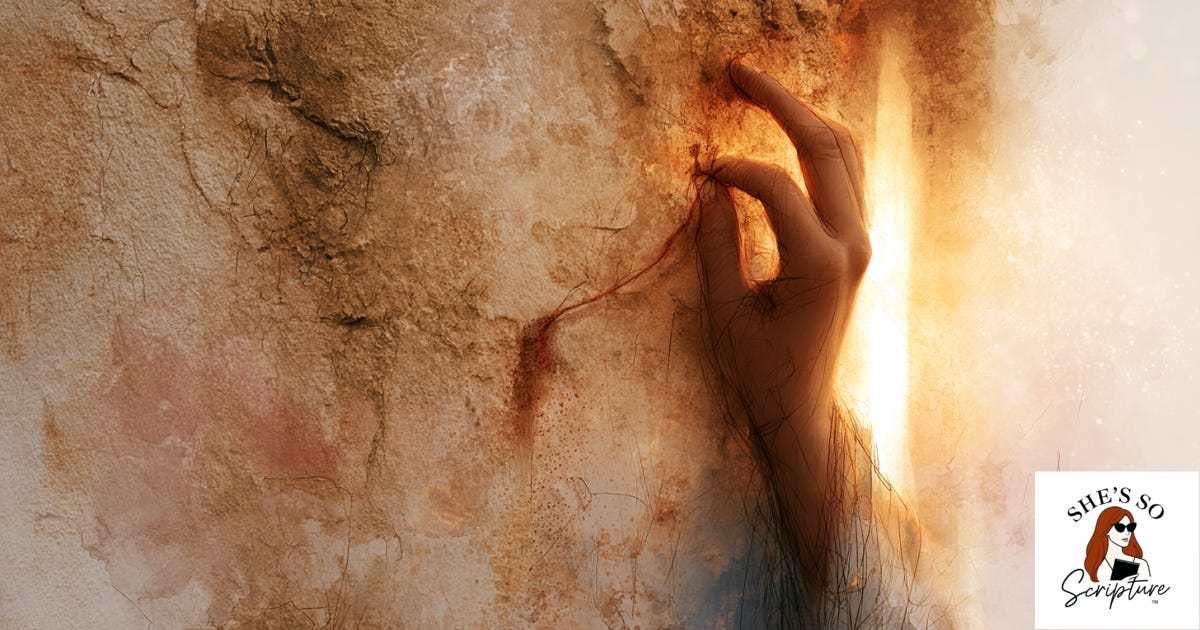
“The land through which we passed to explore devours its residents. All the people we saw there are men of great size!” Numbers 13:32, TLV
There’s a phrase in this portion that caught me the first time I really saw it. Not the giants. Not the forty years. Not even the fruit cluster so big it had to be carried on a pole between two men, which is its own thing.
It’s this:
“We seemed like grasshoppers in our own eyes, and we looked the same to them.”
(Numbers 13:33, TLV)
Ten trained spies. Men chosen by name from every tribe of Israel. They went into the land, they saw what was there, and they came back with an actual cluster of grapes from the Valley of Eshcol as evidence. Real data. And yet what shaped their report wasn’t what they saw in the land. It was what they saw when they looked in the mirror.
The grasshopper problem wasn’t a size problem. It was a sight problem. And God has a lot to say about what we look at.
This week’s readings take us from a paralyzed people staring at giants, to a foreign woman with a scarlet cord and more faith than all twelve spies combined, to an upper room in Jerusalem where Yeshua transforms the oldest memorial meal in Israel’s history into something the world would still be participating in two thousand years later. Stick with me here. There’s a thread running straight through.
Word Study: Shelach Lecha
The portion gets its name from the first notable words of Numbers 13:2. God says to Moses: shelach lecha, literally ‘send for yourself.’
The word shelach (shin-lamed-chet) means to send or dispatch. But the lecha part is where it gets interesting. Lecha is the second-person singular pronominal form: ‘for you’ or ‘on your behalf.’ We saw this when we studied Torah portion Lech Lecha. God is making clear that this mission is commissioned at Moses’ initiative, not as a divine command.
Rashi picks up on this immediately. He notes that the Deuteronomy account (1:22–23) makes clear what Numbers implies: the people requested the spies. God permitted it. The lecha signals something like: ‘This is on you. I’m not commanding it, but you may do it.’
This is not the first time we see this construction. God uses the same lecha in Genesis 12:1 when He tells Abraham: Lech lecha, ‘go for yourself.’ There, the phrase launches the greatest act of covenant faithfulness in the patriarchal narratives. Here, it precedes one of Israel’s most catastrophic moments of unbelief. Same grammar, opposite outcome. The difference wasn’t the command. It was the heart that received it.
Torah: Numbers 13:1–15:41
The Reconnaissance Mission
Twelve men. One from each tribe, all described as princes or leaders. Moses gives them a detailed assignment: go up through the Negev, into the hill country, and report back. What’s the land like? What are the people like? Are there trees? Are there fortifications? And while you’re at it, bring back some fruit.
They’re gone forty days. When they return to Kadesh, they have the fruit. They have their report. And the report divides the room.
Ten of the twelve agree on the facts and disagree on the conclusion. Yes, the land flows with milk and honey. Yes, there is fruit. And also: the people are powerful, the cities are fortified, and the Anakites are there.
Caleb sees what they see and arrives at the opposite conclusion:
Then Caleb quieted the people before Moses, and said, “We should definitely go up and capture the land, for we can certainly do it!” Numbers 13:30 (TLV)
The Hebrew behind ‘quieted’ is the same root used to describe a sea that has been stilled. Caleb didn’t politely raise his hand. He stood in front of a room full of panic and made it stop.
Grasshoppers and the Weight of Self-Perception
But the ten have the numbers. And their counter-report isn’t just tactical analysis. It’s theological collapse:
They spread among Bnei-Yisrael a bad report about the land they had explored, saying, “The land through which we passed to explore devours its residents. All the people we saw there are men of great size! We also saw there the Nephilim. (The sons of Anak are from the Nephilim.) We seemed like grasshoppers in our eyes as well as theirs!” Numbers 13:32–33 (TLV)
The bad report travels, as bad reports tend to do. By morning the entire assembly is weeping and threatening to elect a new leader and return to Egypt… again. Moses and Aaron fall on their faces. Joshua and Caleb tear their clothes.
And God says: how long will they despise me? How long will they refuse to trust me, despite all the signs I’ve shown?
This is the verdict that costs an entire generation the promised land. Not the presence of the Nephilim. Not the fortifications. The inability to see what God sees when He looks at them.
Notice what the spies say: we seemed like grasshoppers in our own eyes, and so we were in their sight. Their self-assessment is the premise for their assumption of how the Canaanites saw them. They weren’t reporting what the Anakites actually said. They were reporting their own internal narrative, then treating it as objective reality. That’s not a military failure. That’s a theological one.
Caleb and Joshua: The Counter-Narrative
Joshua and Caleb are not naive. They saw the same fortified cities. They scouted the same Anakites. Their confidence is grounded in the same God who split the sea, brought down fire and cloud, and swore an oath to their ancestors.
“If Adonai is pleased with us, He will lead us into that land and will give it to us—a land flowing with milk and honey. Only don’t rebel against Adonai, and don’t be afraid of the people of the land. They will be food for us. The protection over them is gone. Adonai is with us! Do not fear them.” Numbers 14:8–9 (TLV)
The protection over them is gone. What a line. While the ten spies saw impenetrable cities, Caleb and Joshua saw a people whose God had already abandoned them.
Numbers 15: After the Verdict
Chapter 15 is often overlooked because it follows one of the most heartbreaking scenes in the entire Torah. But that’s exactly why it matters. Immediately after the decree of forty years of wilderness wandering, God pivots to: when you come into the land...
Not if. When. The promise to the next generation is still intact. The laws about offerings, firstfruits, and tzitzit aren’t cruel irony. They’re covenant continuity. God is already preparing them for what He’s still committed to giving them.
The tzitzit command at the end of chapter 15 closes the portion with a visual reminder: look at these fringes and remember all the commands of Adonai. The remedy for a grasshopper complex is not better intelligence or stronger soldiers. It’s a regular practice of looking somewhere other than the mirror.
Haftarah: Joshua 2:1–24
Forty Years Later, a Different Scouting Report
By Joshua 2, the generation of unbelief is dead. The wilderness years are over. Joshua sends two spies into Jericho quietly, without all the fanfare of the Numbers 13 mission, and the contrast is remarkable from the first verse.
They arrive at the house of a woman named Rahab. The Hebrew text describes her as an ishah zonah, which most translations render as prostitute. Rashi, citing Targum Jonathan, suggests zonah here might mean pundekita, an Aramaic word for innkeeper or seller of food.
Given that the spies come to her house to lodge, the innkeeper reading has practical logic. Most commentators maintain she was indeed a prostitute, and possibly both: a woman running a lodging establishment who also engaged in prostitution, occupying a marginal social position that made her house accessible and overlooked by authorities.
Whatever her occupation, what happens next is one of the most theologically stunning scenes in the entire Hebrew Bible.
Rahab’s Confession
When the king’s men come looking for the spies, Rahab hides them under stalks of flax on her roof and sends the soldiers off in the wrong direction. Then she goes to the men and makes her case:
“I know that Adonai has given you the land—dread of you has fallen on us and all the inhabitants of the land are melting in fear before you. For we have heard how Adonai dried up the water of the Sea of Reeds before you when you came out of Egypt, and what you did to the two kings of the Amorites that were beyond the Jordan, to Sihon and Og, whom you utterly destroyed. When we heard about it, our hearts melted, and no spirit remained any more in anyone because of you. For Adonai your God, He is God, in heaven above and on earth beneath.” Joshua 2:9–11 (TLV)
Read that slowly. A Canaanite woman, in a city about to be destroyed, has arrived at the same theological conclusion it took Moses years in the wilderness to communicate to Israel. She heard the same reports the ten spies heard about what God did at the Sea of Reeds (or Red Sea). The spies went back to camp and said: we’re grasshoppers. Rahab heard the same stories and said: your God is the only God in heaven and on earth. And she staked her life on it.
My rabbi drew my attention to what theologian Walter Brueggemann calls the ‘counter-narrative’ embedded here. The conquest of Canaan begins not just with judgment, but with mercy. Before the walls come down, grace has already entered the city. Rahab is inside the scarlet cord while the armies are still being mustered.
Rahab as Firstfruits of the Nations
Rahab isn’t just a sympathetic character who made a smart survival decision. She’s a theological statement.
Before Israel’s conquest has officially begun, a woman from the nations has already identified with the God of Israel and sought refuge among His people. She embodies the prophetic hope before the prophets articulated it: that God’s purposes were never limited to ethnic Israel alone but always pointed toward a future in which people from every nation would find their place among His covenant people.
She ends up in the lineage of Yeshua the Messiah (Matthew 1:5) and in the Hebrews 11 hall of faith alongside Abraham and Moses. The woman on the wall with the scarlet cord outlasted the walls themselves.
“Surely Adonai has given all the land into our hands,” they said to Joshua. “Indeed, all the inhabitants of the land have melted in fear before us.” Joshua 2:24 (TLV)
Same news. Forty years earlier, that same fear in Jericho was reported by the ten spies as confirmation that Israel couldn’t win. Now Joshua’s scouts bring it back as confirmation that God has already won. The facts didn’t change. The perspective did.

Besorah: Matthew 26:17–30
The Last Passover, the First Covenant Meal
The Besorah brings us to an upper room in Jerusalem. It’s the first night of matzah, the beginning of the Passover season, and Yeshua is reclining at table with His disciples. Many scholars view this as a Passover meal, and some would even see it as an early form of what later developed into the Passover seder, though the chronology remains debated.
A real Passover meal with real matzah, a real cup of wine, real reclining at table as free people do. The same covenant meal Israel had been observing since the night before the Exodus.
Yeshua knows what He’s doing. He’s been talking about His death for chapters. He tells them:
“Now while they were eating, Yeshua took matzah; and after He offered the bracha, He broke and gave to the disciples and said, ‘Take, eat; this is My body.’ And He took a cup; and after giving thanks, He gave to them, saying, ‘Drink from it, all of you; for this is My blood of the covenant, which is poured out for many for the removal of sins. But I say to you, I will never drink of this fruit of the vine from now on, until that day when I drink it anew with you in My Father’s kingdom.’” Matthew 26:26–29 (TLV)
Yeshua doesn’t abandon the Passover meal. He inhabits it. He takes the elements Israel has been using for over a thousand years to remember the first exodus and redefines them around Himself. The matzah broken is His body. The cup poured out is His blood, the blood of the covenant. This isn’t the replacement of Passover. This is Passover read in full.
Singing on the Way to Gethsemane
Matthew 26:30 says something that is SO easy to miss if you’re not familiar with the structure of a Passover meal:
‘After singing the Hallel, they went out to the Mount of Olives.’
The Hallel. Psalms 113–118, traditionally associated with Passover and sung as part of the festival celebration. If the meal followed the customary Passover pattern, these may well have been the psalms on Yeshua’s lips as He walked toward Gethsemane. Psalm 116 includes the line:
‘I will lift up the cup of salvation and call on the name of Adonai.’
Psalm 118 ends with:
‘This is the day that Adonai has made; we will rejoice and be glad in it.’
He walked into the hardest night of His life singing about the salvation He was about to provide. That’s the connection point with our Torah portion. The ten spies looked at the Nephilim and saw the end. Yeshua looked at the cross and sang Hallel. What you see depends entirely on what you’re standing in.
Thematic Threads
Faith is not the absence of accurate intelligence. The ten spies weren’t lying. The cities were fortified. The Anakites were large. Caleb and Joshua saw the same data. Faith engages reality honestly; it just doesn’t treat present circumstances as the final word.
Self-perception is a theological issue. The grasshopper problem in Numbers 13 isn’t just psychological. It’s a failure to remember what God says about who they are. The same failure surfaces in every generation that prioritizes the mirror over the covenant.
God’s redemptive purposes have always been wider than ethnic boundaries. Rahab is not an exception to the story of Israel’s God. She is evidence of where that story was always heading. Her faith in Joshua 2 anticipates the nations streaming to Zion that the prophets would later envision.
The new covenant is not a departure from the Passover covenant. Yeshua doesn’t cancel the meal; He fulfills it. Every Passover since Sinai was a signpost. Matthew 26 is where the signpost gives way to the destination.
Verse Mapping Aid
Key Word: Dibbah (Bad Report)
The Hebrew word at the center of the Numbers 13–14 drama is dibbah, which the TLV translates as ‘bad report’ in verse 32. It appears three times in the narrative (13:32; 14:36–37), which is the Torah’s way of flagging that this word is load-bearing.
Dibbah means a report, but with a particular shade: it implies a defamatory or slanderous account. It’s not just a negative report. It’s a false framing of reality. The ten spies weren’t technically lying about the fortifications, but they were slandering the land. They were reporting on God’s gift as though it were a trap.
The same root appears in Proverbs 10:18 in the phrase ‘one who spreads slander is a fool.’ The connection the Hebrew reader would make isn’t subtle: spreading dibbah about the land God promised is treated as the same category of sin as spreading false reports about your neighbor. Both reject God’s word in favor of your own assessment.
The remedy in chapter 15 is not an argument but a practice: the tzitzit, the fringes on the garment, are meant to interrupt the cycle of dibbah by constantly redirecting the eyes toward the commandments of God. When you’re about to report what you see instead of what God has said, the fringe is supposed to stop you mid-sentence.
My Final Thoughts
The thing that gets me about Rahab is that she had less information than the Israelites did and more faith than any of them. She hadn’t seen the cloud or the fire. She hadn’t stood at Sinai. She wasn’t part of the covenant. She heard rumors about what God had done for Israel at the sea, and she bet her entire family on it.
Meanwhile, twelve spies had watched God do miracles in real time, and ten of them looked at a fortified city and said: No Sir… not today! There’s something deeply convicting about that contrast. Faith isn’t proportional to proximity to the miraculous. It has something to do with the posture you bring to what you see.
I think about that when I’m tempted to interpret my own circumstances as a bad report. When I look at what’s in front of me and start talking about how the cities are fortified and the people are large. When I start to sound like the ten. The grasshopper problem is not a biblical-era problem. It is a this-morning problem.
But then there’s the upper room. There’s Yeshua taking the bread that His people have broken over this story for centuries and saying: this is My body. The cup of the covenant poured out for the removal of sins, including the sin of dibbah, including the sin of looking at what God has given and calling it a threat.
He walks out of that room singing. That’s the final image I want to carry from this week’s readings. Not the grasshoppers. Not even Rahab, fabulous as she is. Yeshua walking toward Gethsemane singing the Hallel, because He knows what the Passover means, because He knows what is about to happen, and He sings anyway.
You can do that too. Not because the walls aren’t real. Because the God who brought Israel out of Egypt and the God who raised Yeshua from the dead is the same God who is with you in whatever fortified city you’re staring at this week.
Hebrew Letter Lesson
צ Tsade / Tsadi | Righteousness · Humility · The Righteous One
Letter: Tsade (צ) Numerical Value: 90
The tsade is the letter of the tzaddik, the righteous one. Its name is connected to the Hebrew root tzedek, meaning righteousness or justice, which we see through the entire Hebrew Bible as one of God’s core attributes. To be a tzaddik is not about perfection; it means to be properly aligned, to live in right relationship with God and others.
The classic pictographic tradition associates tsade with a man bent in posture, which the rabbis connect to the idea of humility as the foundation of righteousness. You cannot stand before God upright if you are full of yourself. The bent posture of the tsade is not weakness. It’s the form righteousness takes in a creature who knows who God is.
Now look at this portion through that lens. The ten spies failed not because they stood before giants but because they stood too tall in their own self-assessment and too small in their assessment of God. They were not tsaddikim in that moment. They were men who had not yet learned to bend.
Caleb and Rahab both demonstrate what tsade looks like in practice. Caleb bends his assessment to what God has said rather than what his eyes report. Rahab bends her allegiance away from Jericho and toward the God she has never formally met. Both of them are, in the deepest sense, living in alignment with tzedek, even when the numbers are against them.
A Little Nugget
The word tzniut, often translated as modesty or humility in Jewish ethical teaching, comes from the same root as tsade.
Micah 6:8 famously closes with the call to ‘walk humbly with your God.’ The Hebrew for ‘humbly’ is tzne’a, from tsade-nun-ayin.
The Talmud (Makkot 24a) teaches that Micah reduced all of Torah to three things: do justice, love kindness, and walk humbly with your God. The tsade is the letter at the center of that third command. You cannot do the first two without the posture of the third.
The ten spies lacked tzniut. They measured themselves against the Anakites instead of measuring themselves against the word of God. Humility, in the Hebrew sense, is not self-deprecation. It’s right-sizing: seeing yourself accurately in relation to who God is and what He has said.
Application
Where in your life are you measuring yourself against the Anakites instead of against the covenant? Write out the comparison you’ve been making and then write out what God has actually said.
The tzaddik in Jewish tradition is not a perfect person. It’s a person who is properly aligned. What would it look like to walk in alignment this week, even when the fortified cities are visible?
Tsade is the letter of both righteousness and humility. In your spiritual life right now, which feels more like a stretch: acting in righteousness or walking in humility? Why?
Weekly Practice
This week, choose one area of your life where you’ve been giving a dibbah report. Maybe it’s a relationship, a financial situation, a health issue, a ministry assignment you feel unqualified for. Write it down.
Then do three things:
Audit the report. What are the facts? What are the interpretations? Where are you letting your self-assessment become the authoritative voice instead of the covenant?
Find the Rahab evidence. Where is God already at work in your situation in ways the dominant narrative has overlooked? Look for the scarlet cord. It’s usually there.
Sing the Hallel. Not as denial, but as declaration. Identify one psalm that speaks directly to your situation and read it out loud this week as a counter-report to the dibbah.
Bible Study Questions
Numbers 13:2 says each spy was a ‘prince’ of his tribe. What does it mean that these were the most qualified, most respected men Israel had? How does that change how you read their failure?
Compare the language of Numbers 13:31–33 with the language of Joshua 2:9–11. The inhabitants of Canaan are described as ‘melting in fear’ in both passages. How does Rahab’s response to the same news differ from the ten spies’ response? What explains the difference?
In Numbers 14:8–9, Caleb and Joshua say ‘the protection over them is gone.’ What theological claim are they making? How does this reframe the fortified cities and large people?
Rahab’s confession in Joshua 2:11 is described by scholars as echoing Deuteronomy 4:39, which says Adonai is God in heaven and on earth. What does it tell you about the God of Israel that this confession comes from a Canaanite woman rather than an Israelite?
Matthew 26:30 says Yeshua and the disciples sang the Hallel before going to Gethsemane. The Hallel psalms (113–118) are declarations of God’s faithfulness and salvation. Why is it significant that Yeshua sang these psalms knowing what was about to happen?
Reflection Questions
The ten spies experienced real fear in the presence of real obstacles. When has your fear produced a dibbah report, a framing of reality that was technically accurate but spiritually false? What was the cost of that framing?
Rahab had every reason to stay loyal to Jericho. She had no covenant with Israel, no history with the God of Israel, no guarantee except the spies’ word backed by their God’s reputation. What made her bet her life on it? What does her choice reveal about the nature of faith?
The tzitzit command in Numbers 15:38–40 says to look at the fringes and ‘remember all the commandments of Adonai.’ What visual or physical practices in your own life function as tzitzit? Where do you look when you’re tempted to give a bad report?
Yeshua takes the Passover meal, a memorial of the first exodus, and reinterprets it around His own body and blood. How does this reshape your understanding of what you’re doing when you participate in communion or a Passover seder?
Action Challenges
Write a Caleb report this week. Choose one situation in your life where you’ve been repeating the ten-spies narrative and write out what the same situation looks like through the lens of covenant faithfulness. Keep it somewhere visible.
Study Psalm 118 this week as the final Hallel psalm Yeshua would have sung at the Passover table. Read it out loud. Pay attention to verses 5–6, 17, and 22–23. Journal one connection between the psalm and where you are right now.
Identify someone in your community who, like Rahab, is outside the obvious circle of ‘covenant people’ but is showing genuine faith. What would it look like to honor that faith the way Israel honored Rahab?
Download This Portion
Download a printable version of this Torah portion along with the study and reflection questions for your study binder!
A Note from Diane
If this study put some language around something you’ve been living but couldn’t name, share it with a friend who’s been looking at their own giants and whispering grasshopper.
And if it left you wanting to go slower and deeper into the Word, I’ve got you! Paid subscribers get access to live Bible studies, extended Torah portion studies, audio teachings, devotionals, theological teaching, spiritual formation practices, and a community that wants depth without pressure or performance. If you’re ready to step further into the Word, you’re welcome inside.
If a paid subscription isn’t feasible right now but this space has blessed you, you can leave a one-time tip. Every gift helps sustain this work. 💕

About the Author
Diane Ferreira is a Jewish believer in Yeshua, a published author, speaker, seminary student, wife, and proud mom. She is the founder of She’s So Scripture and She Opens Her Bible. She is the author of several books, including The Proverbs 31-ish Woman, which debuted as Amazon’s #1 New Release in Religious Humor, as well as Holy, Hormonal and Holding On.
She is currently pursuing her graduate degree in Jewish Studies in seminary, with her favorite topics being the early church and Biblical Hebrew. Diane writes and teaches from a unique perspective, bridging her Jewish heritage with vibrant faith in the Messiah to bring clarity, depth, and devotion to everyday believers.
When she’s not writing, studying, or teaching, you’ll find her curled up with a good book, crocheting something cozy, traveling, or playing her favorite video games.
Tree of Life (TLV) – Scripture taken from the Holy Scriptures, Tree of Life Version*. Copyright © 2014,2016 by the Tree of Life Bible Society. Used by permission of the Tree of Life Bible Society.
"Self-perception is a theological issue." ❤️ But anyway, it should not be any wonder that Rahab appears in Hebrews 11 😊 Her faith was off the charts, I loved how you phrased it though "she had less information and more faith... And staked her life on a God she had never met." ⚔️
“The grasshopper problem is not a biblical problem?” I need to remember that next time fellow parishes say things to diminish spiritual gifts that are rare or different from theirs.