


Shalom friends,
After the cinematic fire of Sinai and the heavy legal lifting of Mishpatim, Terumah feels a bit like God handed Moses an IKEA catalog. We’ve got measurements, specific fabrics, acacia wood, and enough gold leaf to make a New Yorker’s head spin. It reads like a blueprint because, well, it is… but don’t let the assembly instructions distract you from the miracle.
This portion isn’t just about interior design; it’s about a question far more provocative than “does this curtain match the rug?”
Torah: Exodus 25:1–27:19
The “Lifted” Offering: No Coercion Allowed
God tells Moses to receive a terumah. The word comes from a root meaning to lift or raise up. It’s an elevated offering, something brought forward with actual intention.
One of the most striking things about this request is that it was entirely optional. God says to take the offering from everyone “whose heart moves him.” Why? Because the Creator of the Universe doesn’t need our gold… He already owns the mines.
He wanted a dwelling place built only from that which was given freely. Love that is forced isn’t love; it’s a transaction. God wasn’t looking for a tax; He was looking for a partner. He wanted materials that carried the “scent” of a willing heart.
Then God speaks the line that shapes everything that follows:
וְשָׁכַנְתִּי בְּתוֹכָם
V’shachanti betocham
“I will dwell among them.”
Among them. In their midst.
Notice He does not say “I will dwell in it”. He says among the people.
The sanctuary becomes a center of gravity for a people learning how to live with divine presence. The wilderness remains wild. The nations remain hostile. Yet in the middle of tents and uncertainty, a dwelling rises.
The Hebrew root ש־כ־נ gives us the word Mishkan, dwelling place. From that same root comes the later rabbinic term Shekhinah, referring to the manifest presence of God. That language itself carries proximity.
God provides the pattern. Israel provides the materials. Craftsmanship turns obedience into beauty.
The Ark, the Testimony, and the Witness
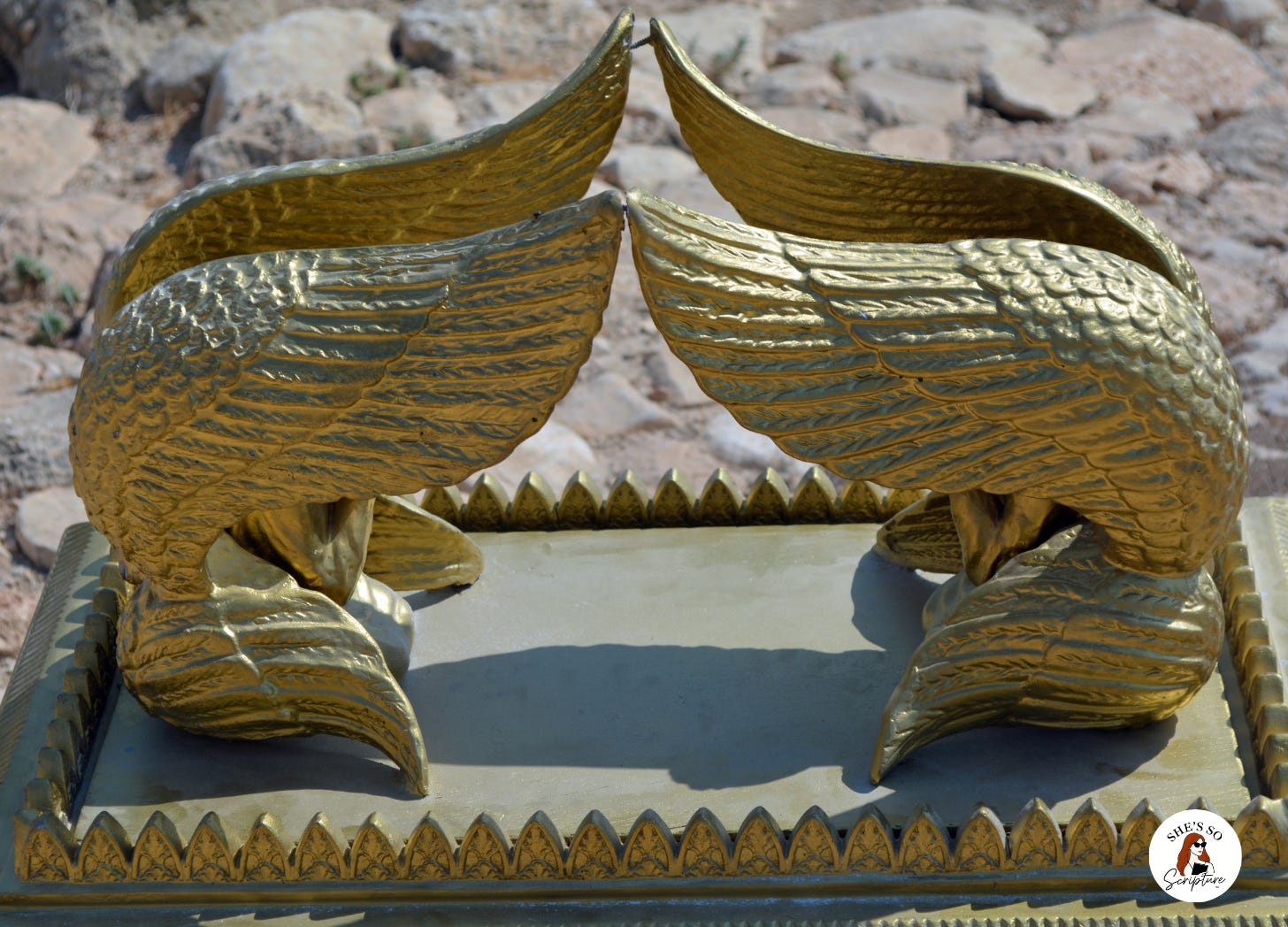
At the heart of the Mishkan (Tabernacle) sits the Ark. Inside, it holds the Edut—the Testimony. In Judaism, it is sometimes referred to to as the Witness.
Why the double naming? Because the tablets of the Ten Commandments weren’t just a set of house rules; they were a legal witness to the covenant made at Sinai. Think of it like a marriage certificate kept in a safe. It stands as a “witness” to the fact that God and Israel are in a binding, exclusive relationship. It testifies to the terms of the engagement.
Above the Ark is the kapporet (mercy seat), with two cherubim facing each other. God says He’ll meet Moses in that tiny, invsible space between the wings. It’s a profound thought: holiness doesn’t just sit on the furniture; it gathers in the gap between the covenant (the Witness) and the covering (Mercy).
Haftarah: From Tent to Temple (1 Kings 5:26–6:13)
The Haftarah picks up generations later with Solomon, who is ready to upgrade the “mobile home” to a permanent estate. The scale is bigger and the cedar is fancier, but the theology remains identical.
Solomon’s construction was a marvel of logistics. There’s a striking detail: no hammers or iron tools were heard on site. The stones were fully prepared at the quarry so the Temple could rise in total silence. It’s a powerful “vibe”… building something for the Prince of Peace shouldn’t sound like a war zone.
However, mid-construction, God interrupts the floor plan with a reality check. He tells Solomon that if the people don’t walk in His statutes, the building is just expensive real estate. The stones are silent, but our lives have to speak. A permanent house doesn’t mean a permanent presence if the heart isn’t right.
Besorah: Soil and Soul (Matthew 13:1–23)
In the Besorah, Yeshua takes the “building” concept inward. He’s by the sea, doing a masterclass on spiritual gardening. He speaks of seed hitting different types of ground: the hard path, the shallow rocks, the thorny weeds, and the receptive soil.
The Mishkan required materials lifted willingly. The Temple required quiet, ordered labor. But the heart? That requires cultivation. The seed (the Word) is perfect; the soil (us) is usually the problem.
Understanding only happens when roots can actually get some traction. Sacred space is external in Exodus, but it’s internal in Matthew. Both require us to actually pay attention to what we’re cultivating.
On Saturdays at 1PM Eastern, we have our live Torah Portion Community Study on Zoom exclusively for Vault and Founding members. This won’t be a lecture. It’s a conversation. We’ll study the text together, ask questions, wrestle with difficult passages, share insights, and grow in understanding as a community. I will also share some commentary from sages so we can dig further into the portion. If you’ve been wanting a space to go deeper than just reading on your own, this is it. Bring your Bible, bring your thoughts, and come ready to engage.
If you’re not yet a member of the Word Girl Vault and would like to join us for these live studies, you can become a member here:
My Final Thoughts
Terumah takes its sweet time. It lingers over textures and colors because sacred space isn’t built in a rush. It’s the result of steady obedience.
The gold that once represented survival in Egypt now shapes the sanctuary. Whether it’s a tent in the desert, a silent stone temple, or the soil of your own soul, the question is the same: are you making room?
Depth doesn’t happen by accident, and neither does fruitfulness. God wants to dwell in the middle of our lives, but only if we invite Him in with a heart that’s actually “moved.”
Hebrew Letter of the Week: צ (Tsade)
Sound: “Ts” as in cats
Numeric Value: 90
Meaning: Righteousness, justice, the righteous one
Tsade is connected to the word צֶדֶק (tzedek), meaning righteousness or justice. It also connects to צַדִּיק (tzaddik), a righteous person.
That connection feels fitting in Terumah.
The Tabernacle does not begin with spectacle. It begins with ordered obedience. Measurements. Proportions. Intentionality. Righteousness in Scripture is rarely abstract. It takes shape in actions aligned with God’s will.
The sages often associate Tsade with humility. In its traditional script, the letter bends slightly, as though leaning forward. The tzaddik is not self-elevating. Righteousness stands upright before God and bowed in posture at the same time.
There are two forms of Tsade:
צ – regular form
ץ – final form (used at the end of a word)
The final form extends downward, reaching lower than the line. Jewish tradition sometimes sees in this a picture of righteousness that reaches into the lower places, lifting what has fallen.
Terumah describes a holy structure built in the middle of a wilderness. Righteousness often looks like that. It does not wait for ideal surroundings. It establishes alignment in the midst of dust and journey.
How to Write Tsade
צ
Begin with a small vertical stroke on the right side.
Then attach a curved line from the top, slanting down and left, forming a shape that leans slightly forward.
The letter should feel balanced yet gently angled, not rigid.
For the final form:
ץ
Start with the same upper shape, but extend the vertical stroke straight downward below the line, giving it a longer descent.
Tsade carries the sound of righteousness lived out. Terumah reminds us that holiness takes form when obedience becomes visible.
Want to learn more Hebrew? We have a Basic Beginner’s Biblical Hebrew self-paced course! Right now, it is on sale! And, if you are a Vault or Founding Member you get a discount!
Next Week’s Portion
The reading for next week, so you can get a head start, is:
First Torah: Tetzaveh: Exodus 27:20 - 30:10
Second Torah: Parshat Zachor: Deuteronomy 25:17-19
Haftarah: Samuel I 15:1-34
Besorah: Revelation 6:9–7:8
Study & Reflection
The Willing Heart: If God only accepts what is given freely, what does that say about the “vibe” of your current service or giving?
The Witness: How does viewing the Commandments as a “Marriage Witness” change how you feel about “obeying” them?
The Silence: Solomon built without the sound of a hammer. Where can you cut out the noise to let something holy rise?
Study Questions
Torah: Exodus 25:1–27:19
How does the concept of terumah shape your understanding of generosity?
What does “V’shachanti betocham” suggest about divine presence?
Why is the Ark placed at the center of the Mishkan?
How does portability influence Israel’s theology of dwelling?
Haftarah: 1 Kings 5:26–6:13
In what ways does Solomon’s Temple reflect continuity with the Mishkan?
What role does covenant obedience play in sustaining sacred space?
How does silence during construction contribute to the narrative?
Besorah: Matthew 13:1–23
Which type of soil do you most often observe in your own life?
What practices cultivate depth and endurance?
How does distraction affect spiritual growth?
Reflection Questions
Where in your life is sacred space currently being shaped?
What materials are you bringing forward in service to God?
How is your heart being cultivated for deeper roots?
What patterns need adjustment to create room for presence?
Action Challenges
Set aside time this week for intentional study or prayer without interruption.
Offer a tangible act of generosity that reflects lifted intention.
Evaluate one distraction and reduce its hold on your schedule.
Read Exodus 25 slowly and consider how precision reflects devotion.
Download the Portion
Download a printable version of this Torah portion along with the study and reflection questions for your study binder!
Share with a Friend
If this study stirred something in you, share it with a friend who might need it too.
And if it left you wanting to go slower and deeper into the Word, I’ve got you!
Paid subscribers get access to extended studies, devotionals. theological teaching, spiritual formation practices, and a community of women who want depth without pressure or performance.
If you’re ready to step further into the Word, you’re welcome inside.
If a paid subscription isn’t feasible right now but this space has blessed you, you can leave a one-time tip here. Every gift helps sustain this work. 🤍

About the Founder
Diane Ferreira is a Jewish believer in Yeshua, a published author, speaker, seminary student, wife, and proud mom. She is the founder of She’s So Scripture and She Opens Her Bible. She is the author of several books, including The Proverbs 31-ish Woman, which debuted as Amazon’s #1 New Release in Religious Humor, as well as Holy, Hormonal and Holding On.
She is currently pursuing her graduate degree in Jewish Studies in seminary, with her favorite topics being the early church and Biblical Hebrew. Diane writes and teaches from a unique perspective, bridging her Jewish heritage with vibrant faith in the Messiah to bring clarity, depth, and devotion to everyday believers.
When she’s not writing, studying, or teaching, you’ll find her curled up with a good book, crocheting something cozy, or playing her favorite video games.
I just really joined substack. I found the article interesting and thought provoking. Thank you. I love to learn more about how the Hebrew mindset is different from the western mindset. Learning about it brings depth and richness that we don't get.
I’m so glad to find your Substack!!!!!!!!!! I’m praying for income to be a Vault member!!! 🙏🏻👏💜