


When the Struggle Starts Before Birth
Toldot means “generations” or “family history.” In this portion, we move into the next chapter of the covenant story. Abraham and Sarah have passed from the scene, and now Scripture turns to Isaac and Rebekah and the sons who will carry the promise forward.
Right away, we are pulled into a struggle.
Rebekah, like Sarah before her, is barren. Isaac prays for her, and God answers. She conceives, but something is happening inside her that she cannot ignore.
“But the children struggled with one another inside her, and she said, “If it’s like this, why is this happening to me?” So she went to inquire of Adonai.” (Genesis 25:22 TLV)
The Hebrew verb for “struggled” here is vayitrotzetzu.
וַיִּתְרֹֽצְצ֤וּ הַבָּנִים֙ בְּקִרְבָּ֔הּ וַתֹּ֣אמֶר אִם־כֵּ֔ן לָ֥מָּה זֶּ֖ה אָנֹ֑כִי וַתֵּ֖לֶךְ לִדְרֹ֥שׁ אֶת־יְהֹוָֽה׃
It carries the idea of intense pushing, collision, pressure. Rebekah feels more than normal movement. She feels conflict. She discerns that this is not just physical discomfort. Something spiritual is taking place.
Her response is important. She does not make assumptions. She does not rush to fix the situation herself. She takes her question straight to the Lord.
“If it is so, why am I like this?”
That is such an honest, relatable prayer. It is the prayer of someone who trusts God enough to bring Him her confusion.
God answers with a prophecy that shapes the entire story that follows:
“Two nations are in your womb,
and two peoples from your body
will be separated.
One people will be stronger
than the other people,
but the older will serve the younger” (Genesis 25:23 TLV)
God is not just describing a pregnancy. He is announcing destiny. He is making it clear that His choice will not follow the expected pattern. The older will not lead. The younger will carry the line.
From the beginning, Toldot teaches us that conflict is not always a sign of failure. Sometimes it is the first sign that God’s purpose is at work.
Jacob and Esau – Appetite and Birthright
When the boys are born, the differences are obvious.
Esau comes out red and covered with hair, already looking wild and rugged. Jacob comes out grasping his brother’s heel. Even their names point to something deeper.
As they grow, the contrast continues:
“When the boys grew up, Esau became a man knowledgeable in hunting, an outdoorsman, while Jacob was a mild man, remaining in tents.” (Genesis 25:27 TLV)
Esau lives outside, in movement and impulse. Jacob stays close to home, in the tents, in the quieter spaces of life.
The turning point comes in a very human moment.
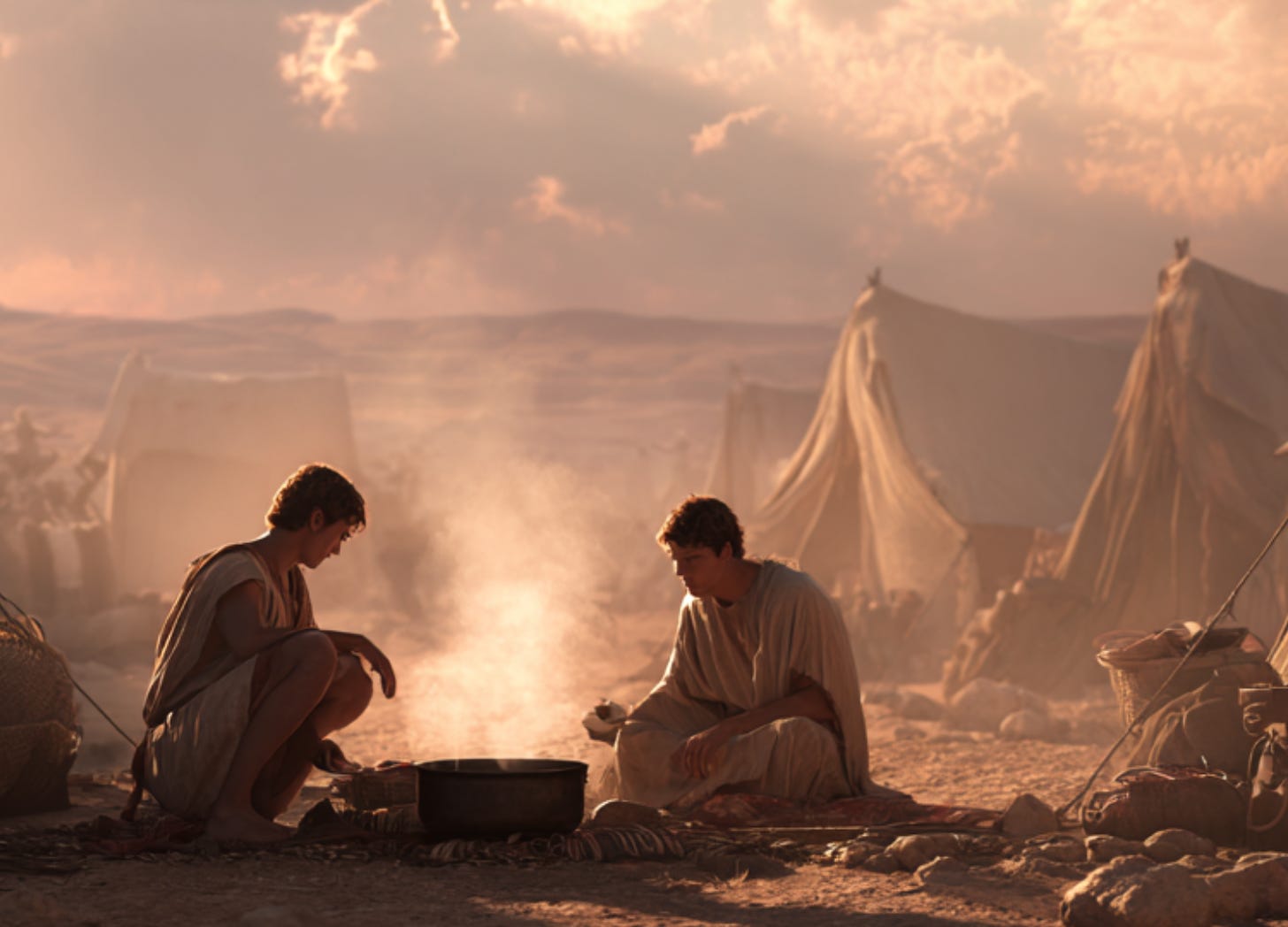
Esau comes in from the field exhausted and hungry. Jacob is cooking stew. Esau demands food. Jacob responds with a shocking proposal.
“Sell me your birthright.”
Esau answers, “Look, I am about to die. Of what use is a birthright to me?”
He eats, he drinks, he gets up, and Scripture says:
“Then Jacob gave Esau bread and lentil stew, and he ate and drank, then got up and left. So Esau despised his birthright.” (Genesis 25:34)
The key word here is “despised.” The Hebrew is vayivez, which means to treat something lightly, to regard it as insignificant.
Now I admit… I have been hangry at times. I get it. But Esau’s problem is not that he was hungry. The issue is that he could not see the value of what he carried.
The birthright was not just about material inheritance, but spiritual responsibility. It meant carrying the covenant, being a representative of God’s purposes in the earth.
Esau preferred a full stomach to a future. He traded calling for convenience.
Jacob, for all his immaturity and manipulation, at least wanted the birthright. He saw value where Esau saw inconvenience.
Toldot confronts us with a hard question. Where do we act like Esau, trading long term spiritual inheritance for immediate relief or comfort?
Isaac’s Blindness and the Blessing
Later in the portion, Isaac is old and his eyes are dim. He calls Esau and tells him to hunt and prepare a meal so that he can bless him.
We already know from God’s word to Rebekah that the older will serve the younger. Isaac seems to favor Esau anyway. We are not told why, but the tension is clear. The father’s preference is not aligned with the revealed will of God.
Rebekah overhears and acts. She devises a plan, and Jacob goes along with it. He dresses in Esau’s garments, covers his arms and neck with goat skins, and brings food to Isaac.
The scene is full of detail. Isaac questions the speed of the meal, the sound of the voice, the feel of the hands. In the end, he blesses Jacob, believing him to be Esau.
Most of us struggle with this story because it involves deception. The text does not excuse that. Jacob’s methods are not righteous. Yet the larger context reminds us of something else. God had already declared that Jacob would carry the line.
God’s purpose does not depend on human perfection. Scripture often holds both realities at once in this sacred tension. Human sin and divine sovereignty move together, but God’s plan stands.
When Esau returns and the truth comes out, Isaac trembles violently. That reaction is telling. He realizes not only that he has been deceived, but that he has been pushing against God’s revealed word.
After that, Isaac does not reverse the blessing. He confirms it. He blesses Jacob again before sending him away.
He finally steps into agreement with what God had spoken over these boys before they were born.
Esau’s Cry and Jacob’s Journey
Esau’s reaction is not something we should just gloss over. His pain is real.
“Esau said to his father, “Do you just have one blessing, my father? Bless me too, my father!” And Esau lifted up his voice and wept.” (Genesis 27:38 TLV)
His anger is also real. He resolves in his heart to kill Jacob. Rebekah hears and urges Jacob to flee to her brother Laban.
Isaac, now aligned with God’s purposes, calls Jacob and blesses him again, this time clearly and intentionally:
“Now may El Shaddai bless you, and make you fruitful and multiply you so that you will become an assembly of peoples.” (Genesis 28:3 TLV)
Jacob leaves home under the shadow of family conflict, but he does not leave under a curse. He goes out with the covenant blessing over his life.
Sometimes walking into what God has for us means leaving familiar ground in less than ideal circumstances. That does not cancel the calling. Jacob’s story is full of complexity, but it is not outside God’s hand.
Haftarah – Loved, Chosen, and Called Back
Malachi 1:1–2:7
The Haftarah portion in Malachi speaks directly into the Jacob and Esau narrative.
“I loved you,” says Adonai.
But you say: “How have you loved us?”
“Was Esau not Jacob’s brother?”
—it is the declaration of Adonai—
“Yet I loved Jacob 3 and Esau I hated.
I made his hills a wasteland
and gave his inheritance to jackals of the wilderness.” (Malachi 1:2–3 TLV)
That phrase can be jarring. But in Hebrew, “hated” (sane) often has a covenantal meaning. It does not mean emotional hatred in the way we usually think of it, but to a choice between two paths, two lines, two purposes.
God chose Jacob to carry the covenant. Esau treated what was holy as light and forgettable. Malachi uses this history to confront Israel, who, like Esau, has treated holy things casually.
The priests are offering blind, sick, and blemished animals. They are serving without reverence. Malachi calls them back to honor, to weightiness, to the fear of the Lord.
The same theme from Toldot runs through Malachi. What do we do with what God has placed in our hands? Do we bless Him with our best, or do we treat His things as optional?
Besorah – Tested Son, Faithful Son
Matthew 3:13–4:11
In the Besorah, we see Yeshua enter the waters of the Jordan to be baptized by John. The heavens open, the Spirit descends, and a voice from heaven speaks.
“And behold, a voice from the heavens said, “This is My Son, whom I love; with Him I am well pleased!” (Matthew 3:17)
Immediately after this public affirmation of His identity, the Spirit leads Him into the wilderness. There He is tested.
The enemy tries to appeal to appetite, identity, and power.
“Turn these stones to bread.”
“Throw Yourself down.”
“Bow to me, and I will give You the kingdoms.”
In each temptation, Yeshua responds with Scripture and with trust. He does not grasp for power. He does not trade His calling for comfort. He does not put God to the test.
Where Esau yielded to appetite, Yeshua refuses to compromise.
Where Jacob grasped and schemed, Yeshua rests in the Father’s word.
He is the faithful Son who holds the birthright rightly and fully.
What Do You Do With the Birthright
Toldot is not a simple portion. It is full of conflict, confusion, hurt, and deeply human choices. It is also full of calling, blessing, and divine faithfulness.
Rebekah shows us what it looks like to take our questions straight to God.
Esau shows us what happens when we treat spiritual things lightly.
Jacob shows us how messy it can be when we desire the right thing, but try to get it the wrong way.
Isaac shows us what it means to finally align with God’s word even after resisting it.
The deeper question Toldot asks is this:
What do you do with the birthright?
In Messiah, we have been given an inheritance. We are called children of God. We are brought into covenant by grace. The question is not whether the birthright exists. The question is how we handle it.
Do we treat it as normal and forgettable, like Esau?
Do we reach for it in our own strength, like Jacob at his worst?
Or do we value it, guard it, and let God shape us to carry it well?
This portion invites you to examine what God has entrusted to you. Your calling, your gifts, your influence, your relationships, your place in the body of Messiah.
It asks:
Where have I been casual with what is holy?
Where have I reached instead of received?
And where is God inviting me to hunger again for the things of His kingdom?
Hebrew Letter of the Week: ג (Gimel)
Sound: “G” as in “good”
Numeric Value: 3
Meaning: Movement, giving, pursuit
In Jewish thought, Gimel is often pictured as a person in motion. It is associated with the word gomeil, which refers to one who deals generously or shows kindness. In some traditions, Gimel is seen as the one who runs toward the Dalet, the “poor” one, to give.
Gimel reminds us of movement toward others and toward God. It is the letter of going, of responding, of not staying still when there is a call to answer.
How to Write Gimel
ג
Draw a vertical line from top to bottom.
Add a short stroke extending left from the middle or lower part of the line, like a small foot stepping forward.
In printed form, it often looks like a figure leaning and walking.
Gimel fits Toldot well. We see Jacob moving toward the blessing, for better and for worse. We see Esau moving away from what is holy. We see God always moving toward His people, even in their brokenness.
Gimel invites us to ask, “In which direction am I moving?”
If walking through the Hebrew letters is stirring a deeper hunger to understand the language of Scripture, I also have a self-paced Basic Beginner’s Biblical Hebrew course you can take at your own speed. You can find it here. Vault and Founding members receive a special discount on the course as part of their membership benefits.
Study and Reflection Questions
Torah – Genesis 25:19–28:9
What does Rebekah’s response to the struggle in her womb teach you about bringing confusion and tension to God?
How does God’s word to her about the older serving the younger shape the rest of this story?
In what ways does Esau’s attitude toward the birthright resemble ways believers sometimes treat spiritual things today?
Where do you see hints of Isaac’s spiritual “blindness” before the blessing incident, not just his physical blindness?
Why do you think Scripture shows us all the messy details of Jacob’s behavior instead of presenting him as clean and perfect?
How does this portion help you understand that God’s purposes are not dependent on human perfection?
Where can you identify tendencies of Esau in your own life, and where can you identify Jacob’s hunger for spiritual things?
How does Isaac’s final blessing over Jacob in Genesis 28 show his surrender to the will of God?
Haftarah – Malachi 1:1–2:7
How does Malachi use the history of Jacob and Esau to confront Israel’s spiritual carelessness?
In what ways were the priests “despising” God’s name in Malachi’s time?
How might believers today be tempted to offer God what is blemished instead of our best?
What does true covenant faithfulness look like in the everyday decisions of your life?
Besorah – Matthew 3:13–4:11
Why is it significant that Yeshua hears the Father’s affirmation before going into the wilderness to be tested?
Which of the three temptations in the wilderness feels most familiar in your own life: appetite, pride, or power?
How does Yeshua’s use of Scripture in each temptation model how we should fight spiritual battles?
How does this passage help you see Yeshua as the faithful Son who handles the “birthright” perfectly?
Reflection Questions
What “birthright” has God placed in your life that you may have treated lightly?
Where have you been frustrated by struggle, and how might God be inviting you to bring that struggle to Him as Rebekah did?
Are there places where you have tried to accomplish God’s purposes by your own methods rather than His?
How does this portion challenge the way you think about blessing, responsibility, and spiritual appetite?
Action Challenges
Read Genesis 25 and 27 slowly this week. Pay attention to every mention of desire, weariness, or blessing, and note what you see about the heart behind the actions.
Ask the Lord to show you one area where you have taken spiritual things for granted. Repent and ask Him to renew your hunger.
Choose one discipline to lean into more intentionally this week, such as prayer, time in the Word, or silence before God.
Spend time thanking God for the inheritance you have in Messiah, and ask Him to teach you how to carry it with reverence instead of casualness.
Download the Portion
Download a printable copy of this portion to add to your study binder!

Because you asked… If a monthly subscription isn’t feasible but you’ve been blessed by this space and want to support the work, you can leave a one-time tip here. Every gift is appreciated and helps us keep serving this community with love.
🔥 Want to go deeper?
Step further into the Word with our paid subscriber community. When you upgrade, you unlock The Vault — and if you’re ready to go all in, Founders Level brings even more.
🔐 Inside The Vault:
💛 Weekly devotionals with depth and application
🌿 Monthly teachings on the Jewishness of Jesus
💬 Private community chats
✨ Our weekly spiritual disciplines program (Mussar)
🎁 30% off all digital products
🚨 Access to our Peppery Bible Study Group in Signal
👑 Founders Level includes everything in The Vault, plus:
🎧 Weekly audio teachings
💻 Monthly Bible Study Q&A Calls
📓 Printable studies and reflection tools
⏰ Early access to studies and new digital products
🖊️ Exclusive journal
💸 50% off all digital products + 10% off physical merch
👉🏽 Join now to unlock your access and walk deeper in truth, boldness, and biblical beauty.
Tree of Life (TLV) – Scripture taken from the Holy Scriptures, Tree of Life Version*. Copyright © 2014,2016 by the Tree of Life Bible Society. Used by permission of the Tree of Life Bible Society.