

Torah Portion Tzav | Shabbat Hagadol
Leviticus 6:1–8:36; Torah: Leviticus 6:1–8:36; Haftarah: Malachi 3:4–24; Besorah: Luke 1:5–22

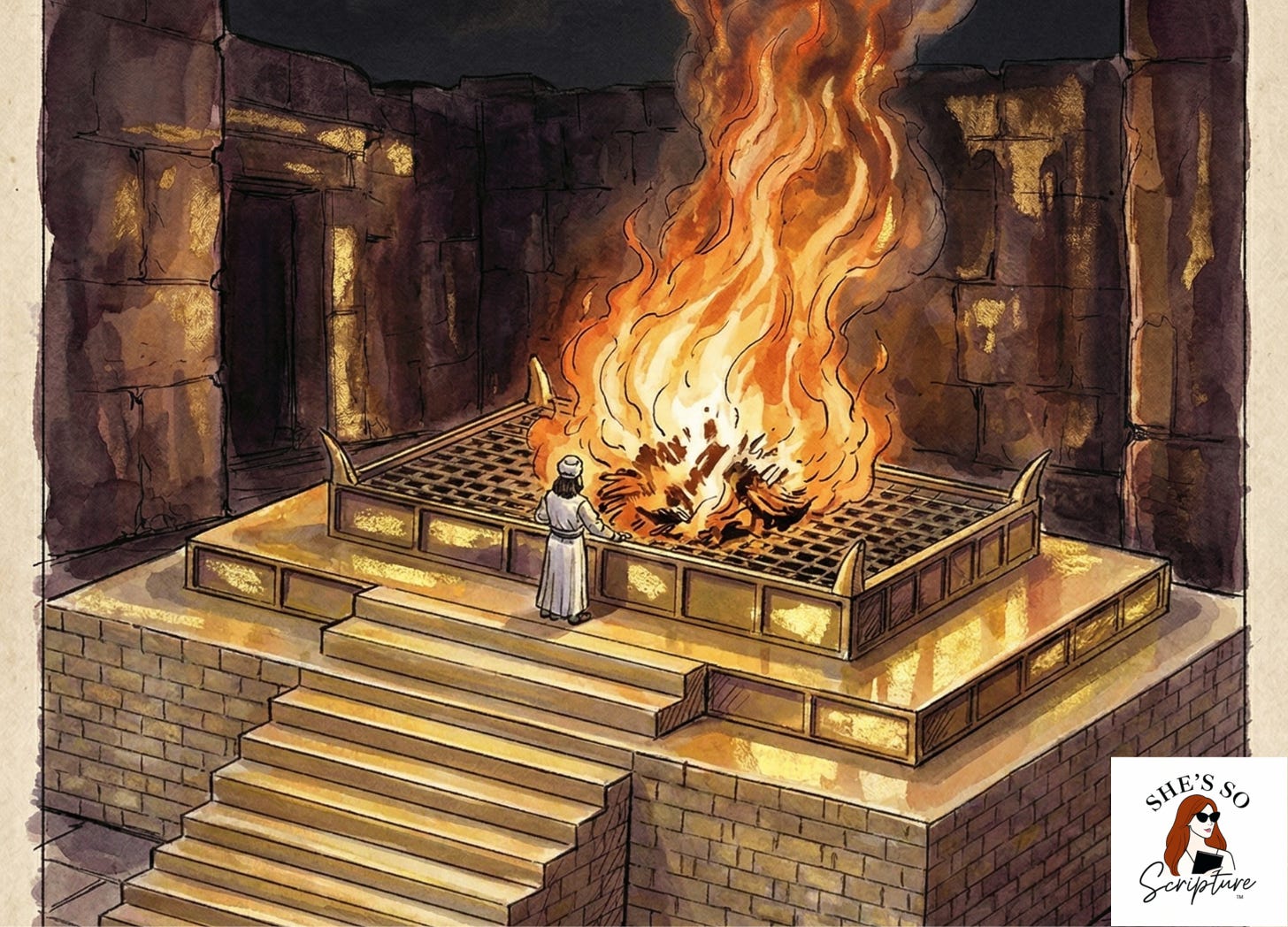
There is a fire in Tzav that is never allowed to go out.
The Torah says it six times in the opening verses of this portion. Six times. Which, in a text that does not repeat itself casually, is essentially God tapping the table and saying: are you hearing me? The fire on the altar shall be kept burning. It shall not be put out. A fire shall always be burning. It shall never go out.
That repeated command is the theological heartbeat of Tzav. And if you came to this portion expecting a dry procedural manual for ancient priests who no longer exist, I have good news: you walked into the wrong assumption entirely.
This is Shabbat HaGadol, the Great Shabbat, the Shabbat before Passover. It is the Shabbat where the whole calendar leans forward, where the air smells like redemption that has not quite arrived yet but is unmistakably coming. And the texts we read today are not background music. They are a conversation that has been running for three thousand years, and we are stepping into the middle of it.
The fire on the altar. The messenger coming before the great day. A priest alone at the incense altar when heaven tears open.
Pay attention because every bit of this lands somewhere.
The Word: צו | Tzav
The word tzav (צו) means command. Not suggestion. Not recommendation. Not gently encourage. Command. The same verb used when God issues the foundational instructions of the Torah, the same word Malachi will use at the very end of his prophecy when he says:
“Remember the Torah of Moses My servant, which I commanded (tziviti) him”
(Malachi 3:22, TLV).
The word tzav bookends the entire prophetic canon from Moses to Malachi and shows up at the opening of this portion with intention.
God is not making a polite request about the fire. He is commanding it. Which raises the question that sits underneath the whole portion: if God is commanding the fire to be kept burning, who is responsible for keeping it lit?
The answer is the kohanim. The priests. Every morning, fresh wood laid on. Every morning, the ashes removed. Every morning, the fire tended before anything else happens in the day. The fire did not sustain itself. It required the daily, unglamorous, behind-the-scenes faithfulness of human hands.
The Sefat Emet, a nineteenth-century Chassidic master, wrote that the fire on the altar represents the Torah burning within the heart of every person. The divine fire is kindled from above. But the wood that feeds it? That comes from us. God lights it. We tend it. This is the covenant of Tzav.
And as we step into Shabbat HaGadol, that framing matters. Because the question Malachi is about to ask, and the question Zechariah is about to encounter in a way he did not see coming, is exactly this: is the fire still burning? Are you still tending it? Or has it quietly gone out while you were busy doing other things?
Torah: Leviticus 6:1–8:36 — The Priests, the Fire, and the Ashes
If Vayikra last week was the Torah’s introduction to the offerings from the worshipper’s perspective, Tzav is the same material from the priest’s side of the altar. Same offerings, different vantage point. Now we are inside the sacred service, watching what the kohanim actually do, step by step, morning by morning.
The Perpetual Fire (Leviticus 6:1–13)
The portion opens with the olah, the ascending offering, and immediately goes to the fire. The priest is to tend it every morning. He removes yesterday’s ashes in his linen garments, changes into different clothes, and carries the ashes outside the camp to a clean place. Then he comes back, lays fresh wood on the altar, and the fire continues.
Two things to hold here. First, the ashes are not discarded carelessly. They are carried to a clean place outside the camp. Even what has been consumed by the holy fire is treated with dignity. There is a theology of sacred remainders in this text. God does not throw away what has been given to Him, even after it has been spent.
Second, the priest changes clothes to carry the ashes. He wears his sacred linen to tend the altar, then changes to his ordinary garments to carry the ash out. The rabbis debated why, but the plain meaning is pretty striking: some work is sacred in its context and ordinary in its execution. Ooh, hold that one for a second. The priest does the holy thing in the holy garments, and the practical labor of clearing away what has burned gets done in work clothes. Holiness and practicality are not opponents. They take turns.
And then the fire is fed again. Every morning. Day after day. The whole sacrificial system of Israel depends on this: someone showing up before sunrise to lay wood on an altar so the fire does not go out.
If you have ever wondered what faithfulness looks like as a spiritual practice, here it is. It looks like lo tichbeh, it shall not be extinguished. It looks like tending something every morning before the day has a chance to get complicated.
The Priestly Portions (Leviticus 6:14–7:38)
Tzav then works through each of the five offerings from last week, this time describing what the priests receive from each one. The grain offering: the priests eat the remainder after the memorial portion is burned. The sin offering: the priests eat from it. The guilt offering: the priests receive their portion. Peace offerings: shared between the worshipper, the priest, and God.
This is meaningful. The priests had no land inheritance in Israel. God Himself was their inheritance, and the portions of the altar were how they were sustained. The ministry was not separate from the provision. Serving at the altar was how the priests were fed. God built the economic structure of the priesthood directly into the sacrificial system.
There is something worth sitting in here for anyone who has ever felt the tension between doing sacred work and being practically sustained. God did not ask the priests to serve for free and trust that something would show up. He built their livelihood into the structure of what He was already doing.
One significant note: the chatat offering eaten by the priests had to be eaten in the court of the Tabernacle. It was most holy. And any vessel it touched absorbed holiness and had to be dealt with accordingly. The holy was not casual. Contact with what God designated as most holy changed the thing that came into contact with it. That principle does not disappear with the Temple.
The Ordination of Aaron and His Sons (Leviticus 8)
Chapter 8 is one of the most liturgically dense chapters in all of Torah. The ordination of Aaron and his sons into the priesthood takes seven days. Moses washes them, dresses them in the priestly garments, anoints the Tabernacle and everything in it with oil, anoints Aaron’s head, offers the sin offering, the burnt offering, the ram of ordination.
And then the blood of the ordination ram is applied to Aaron’s right ear, right thumb, and right big toe. Then the same for each of his sons. Everything they hear. Everything they do. Everywhere they walk. The whole person consecrated. Nothing of the priest held back from the service.
We covered this in the Tetzaveh context already, but it lands differently in Tzav because here we watch it actually happen. It’s not instructions anymore. It’s the moment. Moses anoints. The blood is applied. The seven days begin. The ordination is not a ceremony that takes an afternoon. It takes a week. God was making a point about how long consecration takes.
Nobody walks into a holy calling on a Tuesday and walks out ordained by Wednesday. The process is the point.

Haftarah: Malachi 3:4–24 — The Last Word Before the Silence
Here is something to hold before we read a single verse of Malachi: he is the last prophet. After Malachi closes his scroll, the prophetic voice goes silent for four hundred years. No prophet. No word from heaven. Four centuries of waiting.
And his last word is the one we read on Shabbat HaGadol, the Shabbat before Passover, every single year.
The Haftarah opens with a promise so beautiful it’s almost painful given what comes next:
“Then the offering of Judah and Jerusalem will be pleasing to Adonai, as in days of old and as in former years.”
(Malachi 3:4, TLV).
The word then is doing a lot of work in that sentence. Not now. Not yet. Then. The offerings are not pleasing right now. The priests are corrupt, the tithes are withheld, the people are playing games with God’s calendar and covenant. But then... they will be. There is a future in which everything is made right.
God proceeds to list what is wrong. Sorcerers. Adulterers. Those who swear falsely. Those who exploit workers and the vulnerable and the stranger. People who do not fear Him. This is not abstract sin. It is the specific, practical, relational failure of a community that has let the fire go out while maintaining the external structure of religion.
And then, in one of the most striking verses in all of prophetic literature:
“I am Adonai, I do not change. Therefore you, O sons of Jacob, are not consumed.”
(Malachi 3:6, TLV)
God’s faithfulness is the only reason the covenant survives Israel’s unfaithfulness. His unchanging character is the firewall between the people and their own destruction. They didn’t earn preservation. He is simply who He is, and that is enough.
Then comes the call that has echoed through Jewish liturgy for centuries:
“Return to Me and I will return to you,” says Adonai-Tzva’ot.
(Malachi 3:7, TLV)
The distance isn’t fixed. It’s not permanent. It is reversible. The very next step toward God, He will meet. This is the same theology as the korban from Vayikra. The mechanism has changed across history. The invitation has not.
Then the tithe challenge in 3:10. God actually tells Israel to test Him. Bring the whole tithe and see if I do not open the windows of heaven for you. It is one of the only places in Scripture where God extends this kind of direct challenge: try Me and see. The fire on the altar requires wood from human hands. The provision from heaven requires faithfulness from human practice. Both relationships are participatory.
And then, at the very end of the Haftarah, at the very end of the Hebrew prophetic canon, the final word:
“Behold, I will send you Elijah the prophet before the coming of the great and awesome day of Adonai. He will turn the hearts of fathers to the children and the hearts of children to their fathers.”
(Malachi 3:23–24, TLV)
Four hundred years of silence begin after this sentence. And the promise hanging in the air during all of it is: before the day comes, Elijah will come first.
Every year at the Passover Seder, a cup is poured for Elijah and the door is opened. The gesture isn’t naive. It is theological. It is the community saying: we have not forgotten the promise. We are still watching.
The Haftarah is read on Shabbat HaGadol because this Shabbat stands at the threshold of Passover, which is the annual rehearsal of the redemption that is still coming in its fullness. And Malachi is saying: before the final redemption, there will be a forerunner. There will be a voice that prepares hearts. And the preparation will look like reconciliation, the turning of generations back toward each other, the repair of what has broken between parents and children, teachers and students, the old covenant and the new.
Besorah: Luke 1:5–22 — The Fire Is Still on the Altar
Four hundred years after Malachi goes silent, Luke opens his Gospel by walking us straight into the Temple.
Zechariah is a priest of the division of Abijah. His wife Elizabeth is also of Aaronic descent. Both of them are described as righteous, blameless in their observance of the Torah’s commandments. They are the kind of people the whole covenant was designed to produce. And they are old. And they have no child. And they have been carrying that grief quietly for as long as anyone can remember.
The priests served in rotating divisions, two weeks per year. Out of the thousands of priests eligible, lots were drawn each day for specific duties. Being chosen to enter the Holy Place and burn incense was a once-in-a-lifetime honor. No priest was permitted to offer incense more than once. The Mishnah records this. You got one chance, and then you yielded the privilege to someone else for the rest of your priestly career.
Zechariah’s lot falls on this day. This particular day. Which is not an accident.
He goes in. The whole assembly is outside praying. This was the model for how observant Jews all over the world pray three times each day at the time of the sacrifice.
The incense rises. And then the angel of the Lord appears at the right side of the altar of incense, the side of favor, the side of blessing.
Zechariah is terrified. The angel says: do not be afraid. Your prayer has been heard. Elizabeth will bear a son. You will call him Yochanan (John). He will be great before the Lord. He will be filled with the Ruach HaKodesh (Holy Spirit) from his mother’s womb. And he will go before the Lord in the spirit and power of Elijah, to turn the hearts of the fathers to the children.
Zechariah is standing at the incense altar in the Temple, inside the most sacred space a non-high-priest could enter, and an angel is quoting Malachi at him.
The four hundred years of silence have ended. And they ended at the altar. At the place of prayer rising. At the place where the fire is kept burning. In the holy place where one priest shows up faithfully and tends what God commanded to never go out.
Zechariah’s response is clearly not his finest moment. He asks how he can be sure of this, because he is old and his wife is old. The angel introduces himself.
“I am Gabriel. I stand in the presence of God.”
And because Zechariah did not believe, he will be silent until the promise is fulfilled.
He walks out of the Temple unable to speak. The people outside realize he has seen a vision. He makes signs to them and remains mute. The benediction the community was waiting for doesn’t come.
Here is what I want you to really sit with: Zechariah believed in the promise abstractly. He had prayed for a son. He had read Malachi. He served at the altar all his life. But when the answer to his own prayer appeared in front of him, flesh and blood got in the way. He did the math on his wife’s age and his age and decided the answer was not possible.
God didn’t ask him to do the math. God asked him to believe what Gabriel said.
The fire on the altar requires wood from human hands. But the ignition, the miracle, the thing that makes any of this possible, always comes from above. Zechariah could tend the altar faithfully for a lifetime and still be caught off guard when heaven answered in a way that exceeded his calculations.
Sometimes the fire doesn’t go out because God keeps it burning in spite of us.
Threads Across All Three Readings
The fire that must not go out. Tzav commands it on the altar. Malachi mourns that the hearts of the people have grown cold. Zechariah tends the incense altar faithfully even when he cannot see what it is building toward. The whole week’s readings are asking: is the fire still burning in you? And if it’s barely a coal, who do you trust to lay wood on it?
God’s faithfulness sustains what human faithfulness cannot maintain on its own. Malachi 3:6 says it plainly: I do not change, therefore you are not consumed. The priests’ morning faithfulness keeps the altar fire burning. But the original flame came from God. The four hundred years of silence did not extinguish the promise. The silence ended at an altar.
The forerunner principle. Malachi promises an Elijah who prepares the way. Gabriel quotes that promise to Zechariah in the Temple. John will come in the spirit and power of Elijah. What Malachi saw from the end of the prophetic age, Zechariah encounters from inside it. The same word, three thousand years running.
Consecration takes time. Aaron’s ordination is seven days. Zechariah’s silence lasts until his son’s birth. The four-hundred-year silence between the testaments. God is not in a hurry, and He tends to do His deepest work in the people who have been faithfully tending small things for a long time.
My Final Thoughts
This is Shabbat HaGadol. The Great Shabbat. And I want to tell you what makes it great, because it is not what you might think.
It is not great because everything is already good. Malachi describes a community that has let things slip. Zechariah is an old man who did not get the miracle he prayed for on the timeline he hoped for. The priests in Tzav are doing their jobs before sunrise in the dark, tending an altar that most of Israel will never see the inside of.
What makes this Shabbat great is the promise that stands on the other side of all of it. Before the great day comes, Elijah will come. Before the redemption arrives, there will be a forerunner. Before the silence ends, the fire has to still be burning on the altar. And in Luke 1, we find out that it was.
Zechariah tended the altar faithfully for his entire priestly life and probably had no idea what that faithfulness was making room for. He served in a system that pointed to something he could not fully see. He prayed prayers that had not been answered on the timeline he expected. And on the one day out of his entire life that he got to enter the Holy Place, heaven showed up.
God does not waste faithfulness. Not even the faithfulness that happens in the dark, before sunrise, when nobody is watching and the ash from yesterday still has to be carried outside before the new wood can be laid.
Malachi’s final word to Israel was not condemnation. It was return. Come back. The door is still open. The fire is still burning. And someone is coming before the great day to turn hearts back toward each other and toward God.
We are standing in Nisan, the first month, the month of beginnings. Passover is days away. The Seder table is being prepared. The cup of Elijah will be poured and the door will be opened.
The question Tzav is putting to you this week is the same question it put to those priests before sunrise: are you still tending what God gave you to tend? Is the fire still burning? Not the performance, not the outward structure, not the religious routine. The actual fire. The love. The prayer. The faithful daily showing up.
Lo tichbeh.
It shall not go out.
Hebrew Letter Lesson for the Week: Samech (ס)
The Basics of Samech
Sound: “S” as in samach (to support, to uphold)
Numerical Value: 60
Appearance: Samech is a closed circle. No beginning. No end. No opening. It encircles completely, like arms around something that would otherwise fall.
How Samech Is Written
ס
The shape of samech is its entire message. A perfect circle. Closed on all sides. Nothing getting in that should not be there, and nothing falling out. The rabbis said that samech is the letter of the surrounding light of God, the light that holds creation from the outside, the presence that encircles what it sustains.
Spiritual Meaning of Samech
Samech means somech, to support, to lean upon, to uphold. The Psalms use this word in one of the most tender verses in all of Scripture:
“Adonai somech noflim — Adonai supports all who fall and raises all who are bowed down.” (Psalm 145:14, TLV).
This is the daily prayer. This is the verse every observant Jewish person recites every morning. God is the one who catches what falls.
The letter samech follows directly after nun. And in Hebrew letter theology, that sequence is intentional. Nun is the letter of the falling, the fish that has left its water, the soul that has been pressed down. And samech is what comes next. The circle that catches the fallen nun. God does not skip the falling. He positions Himself underneath it.
Together, nun and samech form the word nes, which means miracle. The fallen thing caught by the encircling support of God is, by definition, a miracle. This is not the kind of miracle that bypasses suffering. It’s the kind that meets it on the way down and holds it.
Samech also carries an acronym hidden in its root letters: samach (to support), salach (to forgive), mechal (to pardon), and kaper (to atone). The letter of support is built from forgiveness, pardon, and atonement. You cannot be fully supported by God while carrying what He has already offered to remove. The encircling only works when you stop holding yourself up by the wrong things.
Samech has a numerical value of sixty, and sixty is the number of the Mishnah’s principle of bitul beshishim, the ratio at which something that falls into a larger substance is completely nullified. In other words, if one drop of something not “Kosher” falls into something “Kosher”, as long as the “Kosher” thing is 60 parts more, it’s still “Kosher”.
One drop of the wrong thing in sixty parts of the right thing is rendered as nothing. God’s surrounding grace is the sixty. Your mess is the one drop. Samech is the letter that says your failure does not have the final proportion.
A Little Nugget The connection between samech and the fire in Tzav is not subtle once you see it. Leviticus 6:12-13 commands that the fire shall never go out, that God’s holy fire must be continuously sustained. But who sustains the sustainer? Psalm 145:14 answers: God somech noflim, God upholds those who fall. Even the priests who tend the altar are themselves held up by the One whose fire they tend. The circle of samech is the answer to every priest, every prayer-er, every person who has ever wondered whether they are doing enough to keep the holy fire going. The fire is not ultimately in your hands. You bring the wood. He keeps it burning.
Application
Malachi’s great word on this Shabbat is return. And what samech teaches us is that the God we are returning to is already encircling us. We are not navigating our way back from outside the circle. We are turning around inside it.
Zechariah was surrounded by the presence of God his entire priestly life. The altar he tended, the fire he kept burning, the incense he offered, all of it was samech in practice. God holding the structure in which Zechariah’s faithfulness could mean something. And then on one specific morning, God held him so close that an angel appeared right next to the altar.
Ask yourself this week:
Where do I most need to feel the encircling support of God right now, not just His help from a distance, but His arms around the thing that is falling?
Is there something I am trying to sustain in my own strength that was only ever meant to be held in His?
What would it mean to truly believe that the fire is not going out on my watch because He is the one who lights it and I am simply the one who brings the wood?
Samech comes after nun. The circle comes after the fall. The support comes after the falling. The miracle is always the next letter.
If you want to learn basic beginner’s Biblical Hebrew, we’ve got you! We have a course that is self-paced and will teach you the basics of reading Hebrew.
Weekly Practice
This week, as we move toward Passover, identify one thing in your life where you have been trying to keep the fire going entirely on your own. Name it. Bring it to God specifically and ask Him to be the samech underneath it. Then do your part: lay the wood on the altar this week. The one small, faithful, unglamorous act that keeps the fire alive. Show up before sunrise, so to speak. Trust that He is the one keeping it lit.
Bible Study Questions for Your Study Binder
Leviticus 6:12-13 commands that the fire on the altar shall never go out. The priests were responsible for tending it daily with fresh wood. What does this dual reality, God’s holy fire sustained by human daily faithfulness, teach you about how spiritual life actually works?
The ashes from the altar were carried to a clean place outside the camp with dignity. What does God’s treatment of what has been spent and consumed say about how He views the things we have given Him, even when nothing visible remains?
Aaron’s ordination took seven full days. Blood was applied to his ear, thumb, and toe, consecrating what he hears, what he does, and where he walks. What would full-body consecration look like in your actual daily life?
Malachi 3:6 says God does not change, and that is exactly why Israel has not been consumed. What does it mean that human survival under covenant depends entirely on the consistency of God’s character rather than the consistency of human faithfulness?
God tells Israel to test Him by bringing the full tithe and watching what He does (Malachi 3:10). How do you reconcile the warning not to test God in Deuteronomy 6:16 with God’s explicit invitation to test Him in Malachi? What is the difference?
The incense offering was a once-in-a-lifetime privilege for most priests, chosen by lot. What does it say about God’s sovereignty that this particular lot fell to Zechariah on this particular day?
Gabriel quotes Malachi 3:23-24 directly to Zechariah, saying John will come in the spirit and power of Elijah to turn the hearts of fathers to children. What does it mean that the forerunner’s primary mission is relational reconciliation rather than doctrinal correction?
Reflection Questions for Your Journal
The priests tended the fire before sunrise, before the public arrived, before anyone was watching. What does your spiritual life look like when no one is watching? Is the fire still being tended in private?
Malachi says the people have wearied God with their words and robbed Him with their withholding. Have you ever gone through a season where you maintained the external structure of faith while the internal fire had quietly gone out? What brought you back?
Zechariah believed in God’s promise in principle but doubted it when it showed up personally. Where have you experienced the gap between believing something theologically and actually trusting it for your own life?
Malachi’s final word is the promise of Elijah turning hearts. Where in your own family or community is there a breach between generations that needs that kind of healing? What is your role in that repair?
Samech is the encircling support of God, the circle that catches what falls. Where do you most need to experience God’s arms around something in your life right now rather than just His hand in it?
Action Challenges for Your Life
Commit to one daily spiritual practice this week that you do before anything else, before checking your phone, before the day gets complicated. Make it small. Make it non-negotiable. Lay the wood on the altar before sunrise.
Read Malachi 3:6-12 slowly and write down every specific area where God identifies unfaithfulness in the text. Then honestly consider which of those areas, if any, show up in your own life. Not to condemn yourself but to name what needs tending.
As Passover approaches, do a personal “chametz audit” of your heart. What has been quietly fermenting in you, what puffed-up thing or slow corruption, that needs to be removed before you sit at the Seder table? Write it down and bring it to God specifically.
Reach out this week to one person in your family or community with whom there has been distance or disconnection. You do not have to resolve everything. Just open the door. Malachi says Elijah’s work is turning hearts toward each other. You can start that work.
Pray Psalm 145:14 out loud every morning this week: “Adonai supports all who fall and raises all who are bowed down.” Then name one specific thing you are trusting God to hold that you cannot hold yourself. Do this every morning. Let samech become a practice.
If this study stirred something in you, share it with a friend who needs to be reminded that their fire is still worth tending.
And if it left you wanting to go slower and deeper into the Word, I’ve got a whole room for that.
Paid subscribers get access to two weekly live Bible studies, extended Torah portion studies, audio lessons, devotionals, theological teaching, and a community of women who want depth without the pressure to perform it.
If you’re ready to go further in, you’re welcome inside.
If a paid subscription isn’t feasible right now but this space has blessed you, you can leave a one-time tip here. Every gift helps keep this work going. 🤍
About the Author
Diane Ferreira is a Jewish believer in Yeshua, a published author, speaker, seminary student, wife, and proud mom. She is the founder of She’s So Scripture and She Opens Her Bible. She is the author of several books, including The Proverbs 31-ish Woman, which debuted as Amazon’s #1 New Release in Religious Humor, as well as Holy, Hormonal and Holding On.
She is currently pursuing her graduate degree in Jewish Studies in seminary, with her favorite topics being the early church and Biblical Hebrew. Diane writes and teaches from a unique perspective, bridging her Jewish heritage with vibrant faith in the Messiah to bring clarity, depth, and devotion to everyday believers.
When she’s not writing, studying, or teaching, you’ll find her curled up with a good book, crocheting something cozy, or playing her favorite video games.
Tree of Life (TLV) – Scripture taken from the Holy Scriptures, Tree of Life Version*. Copyright © 2014,2016 by the Tree of Life Bible Society. Used by permission of the Tree of Life Bible Society.
This is just fabulous! Thank you for writing this! I can hardly wait to get to my journal to write how I can apply what you taught me!
My mama died 2 years ago. I’ve been keeping my 93 year old father company every afternoon for coffee and dessert and every evening for dinner so he doesn’t eat alone. Balancing my time between an understanding husband and 7 grandchildren has been a struggle. I don”t need anyone else to see what I’m doing but in reading this beautiful post I’m reminded that God sees my faithfulness. I’m doing a Holy work in jeans and a t-shirt. Thank you so much for encouraging me in this season of my life as I keep the fires burning.