


Shalom friends,
Vayechi is one of those portions that sneaks up on you.
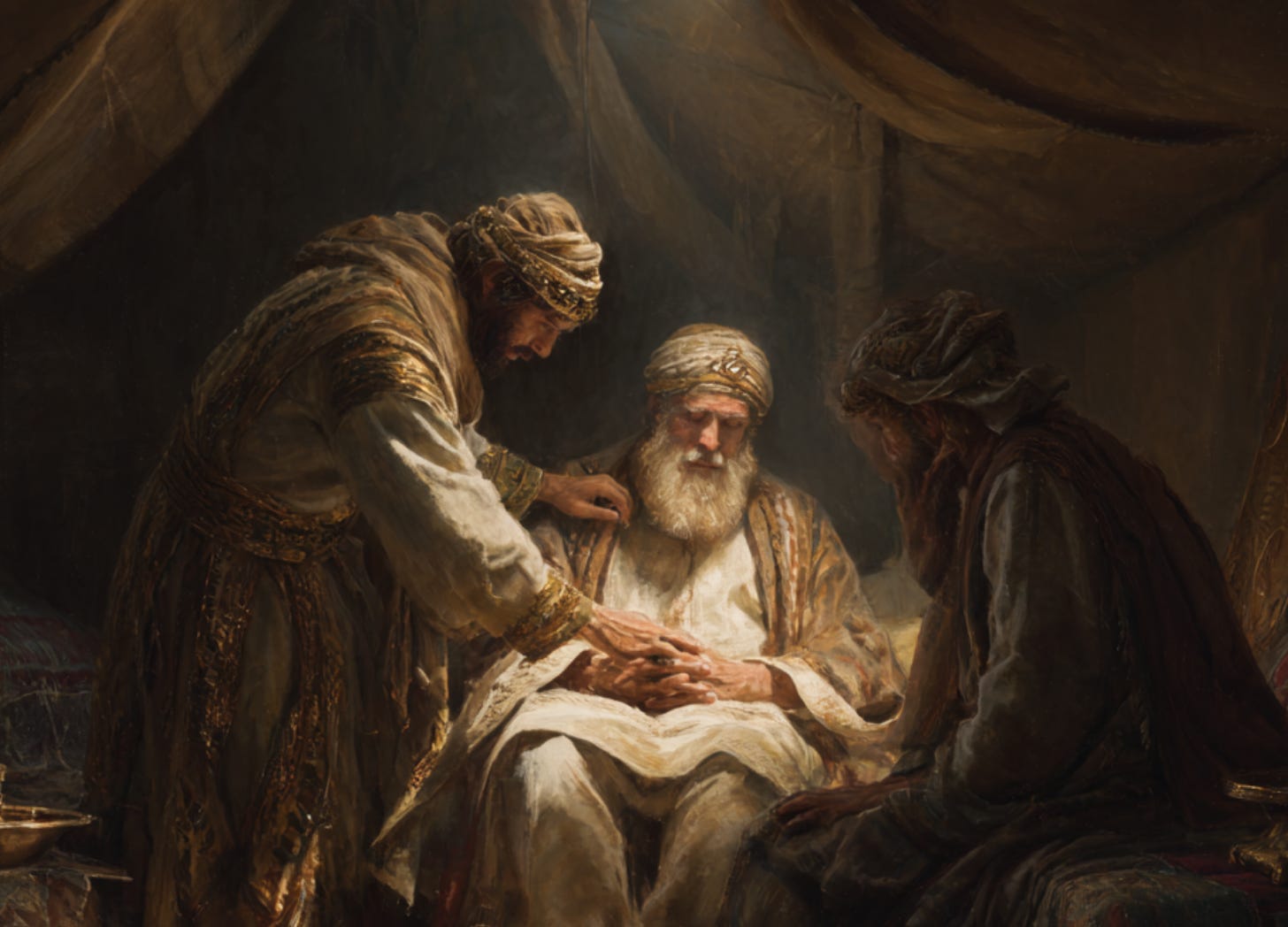
There’s no big plot twist. No sudden rescue. No dramatic confrontation. Genesis doesn’t end with fireworks. It ends with a family gathered around a dying patriarch, listening carefully because they know these words matter.
Vayechi reminds us that endings are rarely flashy, but they are revealing.
How someone finishes tells you what actually shaped them. Legacy has a way of cutting through the noise and getting right to the point.
Torah: Genesis 47:28–50:26
Final Words Have a Way of Telling the Truth
Jacob knows his time is short, and he doesn’t waste it on small talk.
The first thing he asks Joseph to do is promise not to bury him in Egypt. That might seem odd at first, considering Egypt has kept the family alive through famine. But Jacob isn’t being ungrateful. He’s being clear-eyed.
Provision is not the same thing as promise.
Egypt is where they survived. Canaan is where God called them. Jacob refuses to let comfort blur covenant, even at the end of his life.
When Joseph brings Ephraim and Manasseh to be blessed, Jacob crosses his hands and gives the greater blessing to the younger son. Joseph tries to correct him, but Jacob isn’t confused. He’s experienced.
Jacob has lived long enough to know that God doesn’t follow birth order charts or human expectations. If Genesis has taught us anything, it’s that God has a habit of blessing the unexpected.
Then Jacob gathers all twelve sons and speaks over them one by one. These are called blessings, but some of them feel more like spiritual performance reviews.
Reuben is reminded of his instability. Simeon and Levi are confronted with their violence. No one gets a participation trophy here.
Judah, however, is spoken to differently.
Leadership is named and authority is affirmed. The promise of kingship is spoken out loud. Judah’s earlier repentance and responsibility were not a one-time moment. They reshaped his future.
After Jacob dies, the brothers immediately spiral with a bit of paranoia. They assume Joseph’s forgiveness was temporary. Surely now that their father is gone, payback is coming.
Joseph’s response is one of the most grounding statements in all of Scripture.
“You intended evil against me, but God intended it for good.”
Joseph doesn’t rewrite history. What happened was wrong, but he refuses to let sin have the final word. God has been at work the entire time, even through betrayal and loss.
Genesis ends with Joseph’s death, but it doesn’t end in despair. Joseph makes one final request. When God brings Israel out of Egypt, they are to take his bones with them.
The book closes in Egypt, but the story keeps pointing forward.
Haftarah: 1 Kings 2:1–12
What Leaders Say When They’re Almost Out of Time
The Haftarah mirrors the Torah portion in a way that feels almost too perfect.
King David is dying, and like Jacob, he uses his final moments to speak carefully. He doesn’t talk about his victories. He talks about faithfulness.
David reminds Solomon that leadership isn’t sustained by charisma or strength. It’s sustained by obedience. By walking in God’s ways when no one is watching and when the decisions are complicated.
Some of David’s instructions feel spiritual. Others feel political. The text doesn’t clean that up, and that honesty matters. Leadership in Scripture is never tidy. It carries weight and consequences.
What stands out most is that David understands his role is shifting. He can’t rule forever. What he can do is prepare the next generation to walk wisely.
Like Jacob, David knows that legacy isn’t about control. It’s about stewardship.
Besorah: Matthew 6:1–18
Faithfulness That Doesn’t Need an Audience
In Matthew 6, Yeshua addresses giving, prayer, and fasting. Practices that sound deeply spiritual, but He adds a warning that cuts straight through religious noise.
Don’t do them to be seen.
Yeshua isn’t scolding people for being faithful. He’s calling out performative spirituality. Faith that needs applause has already received its reward.
This connects beautifully with Vayechi. Jacob’s legacy wasn’t built in public moments. Joseph’s character wasn’t shaped on a stage. The deepest work in their lives happened quietly, over time, often when no one was paying attention.
Yeshua reminds us that God sees what happens in secret, and that’s what actually shapes who we become.
My Final Thoughts
Vayechi teaches us that the end of a story has a way of telling the truth about the whole thing.
Jacob blesses based on character, not convenience. Joseph forgives without conditions. David prepares rather than clings. Yeshua points us toward faithfulness that doesn’t need validation.
None of these people were perfect, and Scripture doesn’t pretend they were. But they all understood something essential.
Life isn’t measured by how impressive it looks in the middle. It’s measured by what remains when everything else is stripped away.
Vayechi leaves us with a quiet but uncomfortable question.
What will your life be remembered for once the noise dies down?
Because how you finish matters more than most of us want to admit.
Hebrew Letter of the Week: כ (Kaf)
Sound: “K” (or soft “Kh” when without the dagesh)
Numeric Value: 20
Meaning: Palm of the hand, capacity, containment, potential
Kaf literally means palm. Not a clenched fist. An open hand.
In Hebrew thought, the palm represents both the ability to receive and the ability to give. It speaks of capacity. How much something can hold. How much weight it can carry. How much responsibility it is able to steward.
That makes Kaf a deeply appropriate letter for Vayechi.
This portion is about what a life has been able to hold. Jacob’s life held promise, struggle, failure, growth, and finally clarity. Joseph’s life held betrayal, suffering, restraint, forgiveness, and wisdom. None of that happened by accident. Capacity was built over time.
Kaf reminds us that God often expands our capacity long before we understand why. We think we’re just surviving. God is forming hands strong enough to carry blessing without dropping it.
The number twenty is also significant. In Scripture, it often marks maturity and readiness. A person reaches full responsibility at twenty. Kaf carries the idea of someone who is no longer forming in theory, but ready to act with discernment.
That fits Vayechi beautifully. This is not a portion about beginnings. It’s about maturity. About lives that have been shaped enough to bless others intentionally.
How to Write Kaf
כ
(final form: ך)
Kaf is written with a curved stroke that opens toward the left, like a cupped hand.
Begin at the top and draw the line downward with a gentle curve inward.
The final form, ך, extends downward when the letter appears at the end of a word.
Visually, Kaf looks like a vessel. Something shaped to hold what is placed inside it.
That image matters.
Vayechi asks us to consider what our lives are becoming capable of holding. Blessing. Responsibility. Truth. Legacy.
Kaf reminds us that God does not just give blessing. He shapes the hands that will carry it.
Study Questions
Torah: Genesis 47:28–50:26
Why is Jacob so insistent on being buried in the land of promise rather than Egypt?
What does the crossing of Jacob’s hands when blessing Ephraim and Manasseh reveal about his understanding of God?
How do Jacob’s words to his sons differ from modern ideas of blessing?
Why do you think Judah receives such a distinct affirmation of leadership?
What does the brothers’ fear after Jacob’s death reveal about their understanding of forgiveness?
How does Joseph’s statement about God’s intentions shape a biblical view of suffering?
Haftarah: 1 Kings 2:1–12
What similarities do you notice between David’s final instructions and Jacob’s blessings?
How does David frame leadership for Solomon?
Why does Scripture preserve the complexity of David’s final words rather than smoothing them out?
What does this passage teach about preparing the next generation?
Besorah: Matthew 6:1–18
Why does Yeshua place such emphasis on motivation rather than behavior?
How do secrecy and faithfulness work together in this passage?
What spiritual practices does Yeshua assume His followers are already doing?
How does this teaching connect with the quiet legacy-building we see in Vayechi?
Reflection Questions
Where might comfort be tempting you to loosen your grip on calling?
What small, faithful actions are shaping your character right now?
Are there any unfinished relationships where fear is still driving your assumptions?
How do you respond when forgiveness feels risky?
What do you hope remains after your season of influence ends?
Action Challenges
Identify one quiet area of obedience God has already placed in front of you and commit to practicing it consistently this week.
Spend time reflecting on the legacy you are actively forming through daily choices, not future plans.
Choose one spiritual practice to do intentionally without telling anyone about it.
Read Genesis 50:20 slowly and sit with it, especially if you are walking through unresolved pain.
Write a prayer asking God to help you finish your current season with faithfulness and clarity.
Download the Portion
Download a printable version of this Torah portion along with the study and reflection questions for your study binder!

If this study stirred something in you, share it with a friend who might need it too.
And if it left you wanting to go slower and deeper into the Word, there’s a place for that.
Inside The Vault, we go slower, deeper, and more intentionally into Scripture… moving from reading the Word to actually living it.
Paid subscribers get access to extended studies, devotionals. theological teaching, spiritual formation practices, and a community of women who want depth without pressure or performance.
If you’re ready to step further into the Word, you’re welcome inside.
If a paid subscription isn’t feasible right now but this space has blessed you, you can leave a one-time tip here. Every gift helps sustain this work. 🤍
