



Shalom friends,
This week we are stepping into one of the most dramatic transitions in the entire Torah. The portion opens with the word Vayeishev, which means “and he settled,” but there is nothing settled about what unfolds next. Jacob may be trying to build stability in Canaan, but inside this family, the foundation is already cracking.
Joseph’s story begins with tension, calling, immaturity, and a whole lot of misunderstanding. And honestly, many of us reading this portion have lived these moments.
When God puts a dream or calling on your life, it rarely unfolds in a straight line. Sometimes it begins with conflict you didn’t expect or pain you didn’t choose. Vayeishev is a portion about how God forms a life long before He fulfills a promise.
Let’s walk through it.
Understanding the Portion
Joseph’s “Bad Report” and Rising Resentment
Before Joseph ever has a dream, before any coat is given, the Torah shows us Joseph bringing a “bad report” about his brothers to Jacob. The Hebrew phrase, dibbatam ra’ah, isn’t innocent. It means a negative report. A slanted accusation. Words spoken in a way that cast someone in a poor light.
Joseph is 17. He is brilliant and gifted, but the boy cannot read a room yet. This only fuels the brothers’ frustration. Joseph isn’t trying to be malicious, but immaturity can be just as damaging as intent.
And the Torah wants us to see that Joseph’s calling doesn’t begin in perfection. It begins with a teenager who has a lot of growing up to do.
Hatred Shifts to Jealousy
The Torah describes the brothers’ emotions very intentionally. At first, it tells us they hate Joseph. That is already bad enough. But after the dreams, their hatred morphs into jealousy.
This is important!
Hatred reacts.
Jealousy plots.
Jealousy sees Joseph as a threat to the stability of the entire family. Now that the drama between Jacob and Esau is behind them, the brothers do not want another power struggle. Jacob’s favoritism, combined with Joseph’s behavior, feels dangerous. And with every dream Joseph shares, their anxiety grows.
Joseph’s Dreams: Prophetic, Yes. Delivered Wisely, No.
Dreams in Scripture often carry prophetic weight, and these dreams absolutely do. But Joseph’s brothers do not see prophecy. They see ego. They assume Joseph’s dreams are nothing more than the nightly overflow of his daytime fantasies.
The sages absolutely debated Joseph’s motives in sharing them.
Some say Joseph was just plain immature.
Others say he believed the dreams were prophetic and, because he was given prophecy he was obligated to tell them.
Honestly, I think both are true. Joseph believed the dreams meant something. But how he shared them revealed his youth. He shared truth without tact. Prophecy without awareness of the people he was talking to. The message was right. The delivery was not.
And let’s be honest. Many of us have done the exact same thing.
Melek vs Moshel: The Brothers’ Real Fear
In Genesis 37:8, Joseph’s brothers ask, “Will you reign over us? Will you rule over us?”
This is not just repetition to drive home a point.
Two different verbs. Two different fears.
A melek is a king you willingly follow.
A moshel is a ruler who dominates you.
They are essentially asking,
Joseph, are you going to lead us with love or crush us with authority?
This is not about the specifics of the dream. It is about the kind of man they think Joseph is becoming. And they fear they will be forced into submission under someone who lacks the maturity to lead well.
Reuben’s Motives: Not Compassion, but Calculation
When the brothers finally snap and plot to kill Joseph, Reuben steps in and says they should not shed blood. It sounds heroic at first. But the context tells another story.
Reuben is not acting out of compassion for Joseph. He is trying to protect his brothers from becoming murderers. As the oldest, Reuben would also carry the weight of responsibility if Joseph was killed. The text says he intended to rescue Joseph and bring him back to Jacob, but this was likely for Reuben’s sake, not Joseph’s.
Reuben tries to mitigate disaster. He is not trying to save Joseph’s life out of brotherly love. His motives are self-protective and rooted in fear of consequences.
The Pit and the Sale into Egypt
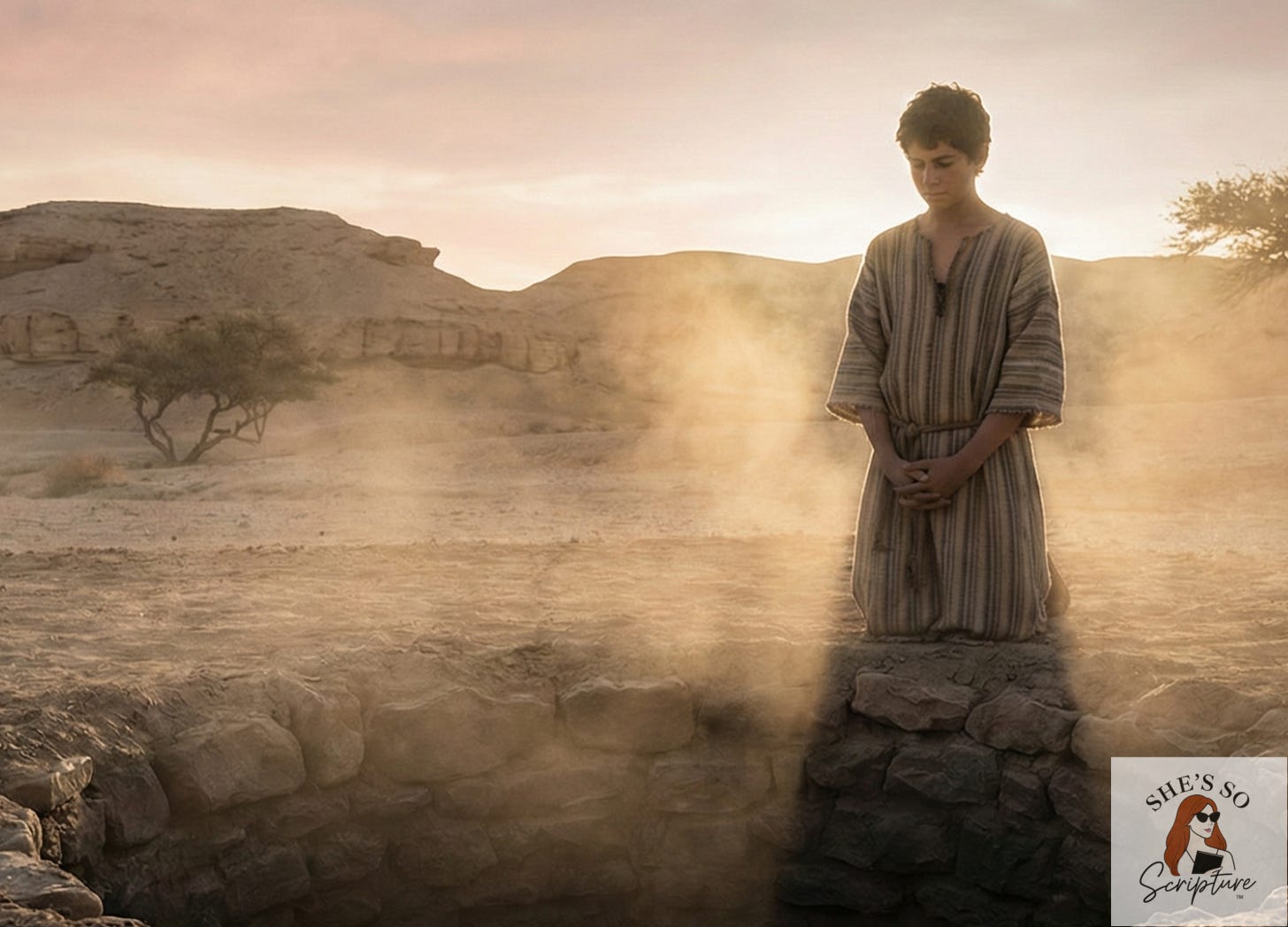
Even after Reuben’s intervention, Joseph is still thrown into a pit. The Torah says it was empty, without water. In other words, hopeless. Lifeless. Well, except for the snakes. And while Joseph is in the pit crying out with vipers around him, the brothers sit down to eat.
They.sat.down.to.eat.
This shows they had no concern for Joseph… only themselves.
Judah then has the brilliant idea about selling him to Ishmaelite traders. And just like that, the chosen son becomes a slave. It is cruel. It is heartbreaking. And it is the doorway to Egypt. Joseph’s path into his destiny begins in a place he never would have chosen.
Judah and Tamar: A Parallel Story of Formation
Genesis 38 might feel like a detour, but it is actually vital. Judah’s failures and Tamar’s courage prepare us for Judah’s future transformation. The brother who sells Joseph will one day offer his life for Benjamin. Judah is being shaped too.
Joseph in Potiphar’s House and in Prison
In Egypt, Joseph ends up in Potiphar’s house, and the text tells us, “The Lord was with Joseph.” Not once. Repeatedly. God’s presence doesn’t show up after Joseph rises. It shows up in the lowest places.
Joseph rises to prominence. Then he is falsely accused. Then he is thrown into prison. And again Scripture says, “The Lord was with Joseph.”
In other words, God’s presence in Joseph’s life is not proven by the comfort of the moment but by the character that is being formed.
Even in prison, Joseph interprets dreams with accuracy and faithfulness. The cupbearer promises to remember him and then forgets. Classic.
And that extra waiting becomes part of Joseph’s preparation to go from the prison to the palace. Sometimes God knows we are ready long before He opens the door. And the waiting is what seals the work He began in us.
Haftarah: Amos and the Roar of God’s Justice
The Haftarah for Vayeishev comes from Amos, a prophet who does not soften anything. Amos was not a trained religious leader or a polished court prophet. He was a shepherd and a dresser of sycamore figs. In other words, he was not shaped by palace politics or religious etiquette. When God sent him, he spoke plainly, clearly, and without apology.
Israel needed that clarity.
Amos names exactly what they had chosen not to see:
They were mistreating the poor.
They were silencing uncomfortable voices.
They were twisting justice until it no longer resembled righteousness.
They were still claiming covenant while living in ways that contradicted everything covenant meant.
Amos interrupts this spiritual drift with a question that stops the reader in their tracks:
“Do two people walk together unless they have agreed to meet?”
Amos 3:3 TLV
It is not a question about whether people and God share similar goals. It is about alignment. Covenant relationship cannot flourish while God moves in one direction and His people insist on walking in another. Amos reminds Israel that walking with God means embodying His heart for justice, compassion, and truth.
Then Amos introduces the image of a roaring lion.
When a lion roars, nothing in the environment stays casual. Nothing keeps scrolling. Nothing assumes safety. The roar demands attention and response.
According to Amos, God’s voice is like that.
It is not background noise.
It is not optional.
It is not a suggestion.
It is a call to return.
This message connects deeply with Joseph’s story. His brothers tried to silence the truth that confronted them. Israel tried to silence the prophets who confronted them. Yet truth has a way of resurfacing no matter how deeply anyone tries to bury it.
The God of Israel will not allow injustice, apathy, or spiritual drift to have the final word. Amos reminds the community that the roar is not anger for anger’s sake. It is a call back to the God who redeemed them, the God who loves them enough to interrupt patterns that would destroy them.
Besorah: Matthew 5:1–16 and the Formation of Kingdom Character
The Besorah brings us into the opening of the Sermon on the Mount, where Yeshua describes the kind of people who embody His kingdom. And this teaching is not sentimental or gentle in the way many imagine it. It is radical. It turns every worldly definition of success upside down.
The blessed ones in Yeshua’s kingdom are not the powerful or the impressive.
They are the poor in spirit.
Those who mourn.
The meek.
Those who hunger for righteousness.
The merciful.
The pure in heart.
The peacemakers.
These qualities do not emerge in easy seasons. They are formed through trial, humility, and dependence on God. Joseph’s story echoes this truth long before Yeshua preaches it. His life in Egypt forms him into a man who carries blessing, not because of status or circumstance, but because of character.
The parallels are striking:
Joseph becomes poor in spirit when stripped of his father’s favor.
He learns meekness as he serves in Potiphar’s house.
He hungers for righteousness while navigating injustice.
He becomes a peacemaker, mediating conflict and bringing wisdom.
He walks in purity and refuses temptation at great personal cost.
By the time Joseph rises to leadership, he has embodied much of what Yeshua later describes.
Yeshua then calls His disciples salt and light.
Salt preserves and protects against decay.
Light reveals truth and gives direction.
Joseph becomes both in the darkest places of his life. He preserves the households he serves. He brings clarity wherever he is placed. His circumstances do not dictate his influence. His character does.
Matthew 5 invites readers to see the kingdom not as a reward for the successful, but as the life of God revealed in people who allow Him to shape them in quiet, hidden places. Joseph is a witness to that long before the Beatitudes ever reached a hillside.
My Thoughts
Vayeishev speaks to every believer who has ever felt caught between what God promised and what life looks like right now. Joseph begins with a coat, a dream, and favor. He ends this portion in a pit, then in a foreign house, then in a prison.
And through every rise and fall the text keeps saying the same thing.
The Lord was with Joseph.
Not because Joseph handled everything perfectly or even understood his situation.
And definitely not because Joseph’s life looked anything like the dream.
God was with Joseph because God had a purpose bigger than Joseph’s circumstances.
Joseph’s immaturity doesn’t disqualify him. It becomes the raw material God begins shaping. His brothers’ betrayal doesn’t stop God’s plan. It becomes the vehicle God uses to get Joseph to the place he needs to be. Egypt doesn’t destroy Joseph. Egypt trains him.
This is the God we serve. The God who holds presence and purpose together when the path makes no sense. The God who does not abandon us in the pit or the prison. The God who forms us long before He fulfills the dream He gave us.
If Vayeishev teaches us anything, it is this:
You are not forgotten.
You are not off track.
And you are not being overlooked.
You are being formed.
Hebrew Letter of the Week: ח (Chet)
Sound: A breathy, guttural “ch” - not “ch” as in “chess”. This is more of a breathy, gutteral “kh” sound
Numeric Value: 8
Meaning: Life, boundary, enclosure
Chet begins the word chai, which means life. The letter looks like a doorway, and it often symbolizes the boundaries God places around us. Not boundaries that restrict us, but boundaries that preserve and protect what He is forming.
Joseph lives inside these boundaries. He cannot go where he wants. He cannot escape his circumstances. But every limit becomes a place where God shapes him. Chet reminds us that God’s boundaries are often the very places life begins.
How to Write Chet
ח
Draw a horizontal line across the top.
Draw two vertical lines down from each end.
Chet looks like an arch or doorway, solid and enclosed.
God uses these enclosed spaces in Joseph’s life to create resilience, humility, leadership, and faithfulness.
Want to Learn Biblical Hebrew More Deeply?
If the Hebrew insights in these studies are stirring something deeper, I offer a self-paced Basic Beginner’s Biblical Hebrew course. It will help you understand Scripture in a richer, more foundational way.
Vault and Founding Members receive discounts on the course.
https://www.sheopensherbible.net/products/3186766
Study Questions
Torah: Genesis 37–40
How does Joseph’s “bad report” reveal his immaturity and contribute to the rising conflict?
What is the significance of the Torah shifting from hatred to jealousy in the brothers?
Why were Joseph’s dreams seen as a threat instead of a blessing?
How do the Hebrew concepts of melek and moshel deepen the brothers’ reaction in Genesis 37:8?
What do Reuben’s motives teach us about intention vs perception?
What does Joseph’s experience in the pit teach us about moments of isolation?
How is God’s presence demonstrated in Joseph’s time in Potiphar’s house and in prison?
Why do you think God allowed the cupbearer to forget Joseph for a time?
What themes emerge in the Judah and Tamar story that help us understand the larger narrative?
Haftarah: Amos 2:6–3:8
What injustices does Amos confront, and how do they parallel Joseph’s family dynamics?
Why does God remind Israel of who He is before pronouncing judgment?
What does Amos mean when he says the lion has roared?
How do we silence uncomfortable truth today, and how can we recognize when we are doing it?
Besorah: Matthew 5:1–16
Which Beatitude stands out to you most in this season, and why?
How does Joseph embody the values of the kingdom Yeshua describes?
What does it look like to be salt and light when life feels restrictive?
How does this passage challenge your view of spiritual success?
Reflection Questions
Where do you see immaturity God may be trying to grow into maturity?
How have you interpreted divine boundaries as punishment instead of protection?
What dream or calling has required more formation than you expected?
Where can you look back and say, “God was with me,” even in the hard places?
Action Challenges
Identify an area where jealousy, comparison, or insecurity has shaped your reactions and surrender it to the Lord.
Read Genesis 39 and note every reference to God’s presence with Joseph.
Choose one Beatitude to intentionally practice this week.
Spend time asking God what He is forming in you right now.
Download the Portion
Download a PDF version of the portion and study questions for your study binder!

If this post hit home for you, send it to a friend who could use a little Bible-study glow-up today.
You’re reading one of Substack’s Bestseller Publications and that’s because of readers like you. Thank you for showing up, sharing, and growing with this community.
If a monthly subscription isn’t feasible but you’ve been blessed by this space and want to support the work, you can always leave a one time tip here. Every gift, big or small, keeps this ministry thriving. 💛
🔥 Want to go deeper?
Step further into the Word with our paid subscriber community. When you upgrade, you unlock The Vault… and if you’re ready to go all in, the Founders Level opens every door.
🔐 Inside The Vault:
💛 Weekly devotionals with depth and application
🌿 Monthly teachings on the Jewishness of Jesus
💬 Private community chats
✨ Our weekly spiritual disciplines program (Mussar)
🎁 30% off all digital products
🚨 Access to our Peppery Bible Study Group in Signal
…and more!
👑 Founders Level includes everything in The Vault, plus:
🎧 Weekly audio teachings
💻 Monthly Bible Study Q&A Calls
📓 Printable studies & reflection tools
⏰ Early access to new releases
🖊️ Exclusive journal
💸 50% off all digital products + 10% off merch
…and more!
👉🏽 Join now to unlock your access and walk deeper in truth, boldness, and biblical beauty.
Tree of Life (TLV) – Scripture taken from the Holy Scriptures, Tree of Life Version*. Copyright © 2014,2016 by the Tree of Life Bible Society. Used by permission of the Tree of Life Bible Society.
So suitable for the modern day church as well. I'll be rereading this portion for the next month.
I love what was said about the prophet:
" Amos, a prophet who does not soften anything. Amos was not a trained religious leader or a polished court prophet. He was a shepherd and a dresser of sycamore figs. In other words, he was not shaped by palace politics or religious etiquette. When God sent him, he spoke plainly, clearly, and without apology.
Adaptation:
People in the church need that clarity.
Amos names exactly what they had chosen not to see:
They were living lives of disobedience.
They were twisting justice until it no longer resembled righteousness.
They were still claiming covenant while living in ways that contradicted everything covenant meant."
Glad to have this reminder.