


When God Appears
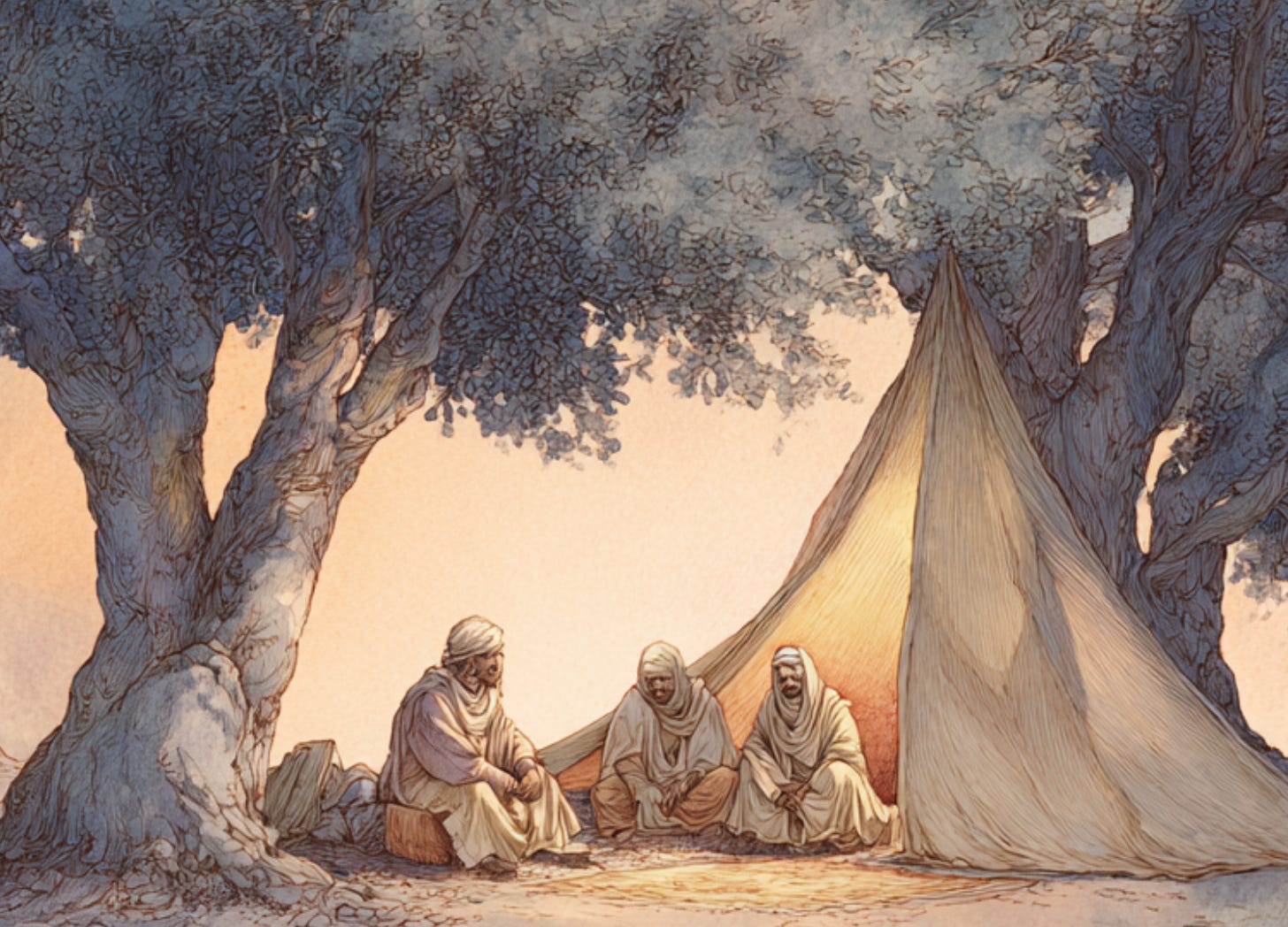
This week’s portion, Vayera, means “And He appeared.” It opens with a scene that’s almost shockingly normal. Abraham is sitting at the entrance of his tent, resting in the heat of the day, when God shows up.
“And the Lord appeared to him by the terebinth trees of Mamre, as he sat at the tent door in the heat of the day.” (Genesis 18:1)
There’s no thunder, no lightning, no dramatic vision… just three men standing nearby. And Abraham doesn’t hesitate. He runs to meet them, bows low, and offers them food, rest, and shade. He doesn’t know exactly who they are yet, but his posture says, “If this moment is sacred, I won’t miss it.”
And it was sacred. The Lord had come.
This moment captures something we often forget: God’s presence doesn’t always arrive with fanfare. Sometimes He shows up in the middle of the ordinary; in a simple conversation, a quiet act of kindness, or a weary afternoon when we think nothing special is happening.
The Hebrew root of Vayera (ra’ah, “to see”) reminds us that revelation is as much about perceiving as it is about receiving. Abraham saw what others might have missed. That’s often the difference between a divine encounter and an ordinary day… whether or not we’re paying attention.
The Promise That Makes You Laugh
When the visitors tell Abraham that Sarah will bear a son, she laughs. And honestly, who wouldn’t? She’s long past childbearing age, and this promise sounds like it’s arriving several decades too late.
But God hears her laugh and asks,
“Is anything too difficult for Adonai?” (Genesis 18:14)
Sarah’s laughter isn’t defiance… it’s disbelief turned into wonder. And that’s why her son’s name, Yitzchak (Isaac), means “he will laugh.” God takes our skeptical chuckles and turns them into songs of joy. What started as, “Yeah, right,” becomes, “Look what the Lord has done.”
A God of Justice and Mercy
Then we come to one of the most powerful moments in the Torah… when Abraham learns that God plans to destroy Sodom and Gomorrah.
Now, most of us, faced with that kind of revelation, would probably back away in silence. But Abraham does the opposite. He steps forward.
“Abraham drew near and said, “Will you really sweep away the righteous with the wicked?” (Genesis 18:23)
We often miss the “Abraham drew near” part. Abraham argues with God. Not rudely, not rebelliously, but boldly. He pleads for mercy. He pushes, questions, negotiates… fifty righteous, forty-five, thirty, twenty, ten.
This is faith in protest. It’s one of the most deeply Jewish things. The sages often say that to argue with God is not a lack of faith, it’s the proof of it. It means you believe He’s just enough, merciful enough, relational enough to be engaged in honest struggle. God is not threatened by our questioning or our arguing.
Abraham’s conversation with God isn’t defiance; it’s relationship. He knows God well enough to know He welcomes dialogue. In that sense, arguing with God becomes a form of worship.
And that’s something we can all take to heart. Faith isn’t blind agreement; it’s sometimes standing before God and saying, “This doesn’t make sense to me, but I still trust You.”
If you want to dive deeper into that tension… the sacred space between trust and wrestling…I wrote more about it here:
👉 Struggling With Faith: Discover the Power of Wrestling with God
Because like Abraham, sometimes the most faithful thing we can do is keep talking when silence would be easier.
The Test on the Mountain
Genesis 22 gives us the story that tests Abraham’s faith to its core… the Akedah, the binding of Isaac. God says, “Take your son, your only son, whom you love…” and Abraham obeys. There’s no arguing this time. No delay.
Every parent reading this feels that weight. It’s unthinkable. And yet Abraham trusts that the same God who gave Isaac can also sustain or restore him. Hebrews 11:19 says Abraham reasoned that God could raise the dead.
At the last moment, God provides a ram caught in the thicket. Abraham names the place Adonai Yireh—“The Lord will provide.” That same phrase can also mean “The Lord will be seen.” Provision and revelation go hand in hand.
On that mountain, Abraham sees God more clearly than ever before. The God who asks for everything is also the One who provides what’s needed.
The Haftarah — God Appears Through Provision
The Haftarah from 2 Kings 4 parallels Abraham’s story in stunning ways. We meet two women—one poor and one prominent—both facing impossible situations.
A widow pours out her last bit of oil, trusting the word of the prophet Elisha. God multiplies it until every vessel is full. Her faith and obedience literally fill her life with provision.
Then a wealthy Shunammite woman shows Elisha hospitality. In return, God gives her a son. Later, that same son dies and through Elisha, God restores his life. Her generosity and trust become the channel through which God moves.
These stories remind us that the God who appeared to Abraham still appears to the faithful today. Sometimes He comes through provision, sometimes through restoration, but always through His presence.
The Besorah — The King Revealed
In the Besorah reading (Matthew 2:1–12), another revelation unfolds. Wise men from the East follow a star to find the newborn Messiah. They arrive, bow down, and offer gifts of gold, frankincense, and myrrh.
Just like Abraham, they recognize the divine in the unexpected.
Just like the Shunammite woman, they respond with generosity.
And just like Sarah, their journey ends in joy, because they’ve seen what God promised.
God’s appearing…His Vayera…isn’t limited to one people or one moment. From Abraham’s tent to Bethlehem’s manger, He keeps showing up for those who are watching.
When the Ordinary Becomes Holy
This week’s portion reminds us that God still appears, often when life feels slow, ordinary, or inconvenient. Abraham was just sitting outside his tent, but his heart was open. That’s where encounter happens; in the open heart.
Sometimes we’re so busy waiting for “big moments” that we miss the small ones where God is quietly present. Maybe the place you feel most unseen is exactly where He’s showing up.
Vayera teaches us to live awake, to look for Him in the everyday details, to recognize the divine in the faces that pass by, to believe that laughter can still come after long waiting.
God is still the One who provides, who restores, who reveals Himself to those who make space for Him.
So maybe this week your “tent door” is a conversation, a quiet prayer, a small act of obedience. Keep it open. He still appears.
Hebrew Letter of the Week: ד (Dalet)
Sound: “D” as in door
Numerical Value: 4
Meaning: Door, pathway, humility
How to Write Dalet
ד
Draw a horizontal line from right to left.
Add a vertical line descending on the right.
Keep the corner open… it’s the letter of invitation.
The name Dalet comes from dal, meaning “poor” or “lowly.” In Jewish thought, the Gimel (the giver) walks toward the Dalet (the humble receiver).
Dalet represents the open door through which grace enters. Abraham’s tent was a Dalet… open on all sides, ready to receive the presence of God. That’s our invitation too: to stay open, humble, and ready for divine encounter.
Study and Reflection Questions
Torah — Genesis 18:1–22:24
Genesis 18:1–8: How does Abraham’s hospitality show us how to recognize God’s presence in ordinary life?
Genesis 18:9–15: What does Sarah’s laughter teach us about faith, doubt, and the patience of God?
Genesis 18:16–33: How does Abraham’s intercession challenge our own prayer life?
Genesis 19: What can we learn from Lot about righteousness in a corrupt culture?
Genesis 21: What does Isaac’s birth teach us about God’s timing?
Genesis 21:8–21: What does God’s care for Hagar and Ishmael reveal about His compassion for the outcast?
Genesis 22: How does the Akedah foreshadow the sacrifice of Messiah, and what does it teach about trust?
Haftarah — 2 Kings 4:1–37
2 Kings 4:1–7: What can the widow’s obedience teach us about acting in faith even when resources are low?
2 Kings 4:8–17: How does the Shunammite woman’s hospitality mirror Abraham’s?
2 Kings 4:18–37: What does her determination show us about perseverance in prayer and faith during loss?
Besorah — Matthew 2:1–12
Matthew 2:1–2: How do the Magi represent the nations being drawn to God’s light?
Matthew 2:3–8: Why do some hearts rejoice at revelation while others resist it?
Matthew 2:9–11: What do the gifts symbolize about Yeshua’s kingship, divinity, and sacrifice?
Matthew 2:12: What does their obedience to divine instruction teach us about spiritual discernment?
Reflection Questions
How can you become more aware of God’s presence in everyday life?
Where do you see God turning your laughter of doubt into laughter of joy?
Who in your life might need you to “stand in the gap” like Abraham did?
What might your “open tent” look like this week? Where can you make room for God’s presence or for others?
How can the story of the Akedah renew your trust in God’s provision even when you don’t understand His plan?
Action Challenges
Read Genesis 18 aloud and reflect on Abraham’s readiness to welcome the divine.
Invite someone into your life this week as an act of spiritual hospitality.
Take time each day to notice one small moment where God “appears.”
Pray Isaiah 40:31 and ask God to renew your strength to trust and wait.
Write down one area where you’ve doubted God’s promise and ask Him to turn that doubt into laughter.
Download the Portion
Use the button below to download a printable copy of this portion and study questions.

Tree of Life (TLV) – Scripture taken from the Holy Scriptures, Tree of Life Version*. Copyright © 2014,2016 by the Tree of Life Bible Society. Used by permission of the Tree of Life Bible Society.
🔥 Want to go deeper?
Step beyond the surface and into the Word with our paid subscriber community. When you upgrade, you unlock The Vault — and if you’re ready to go all in, Founders Level brings even more.
🔐 Inside The Vault:
💛 Weekly devotionals with depth and application
🌿 Monthly teachings on the Jewishness of Jesus
💬 Private community chats
🎁 30% off all digital products
🚨 Access to our Peppery Bible Study Group in Signal
👑 Founders Level includes everything in The Vault, plus:
🎧 Weekly audio teachings
💻 Monthly Bible Study Q&A Calls
📓 Printable studies and reflection tools
⏰ Early access to studies and new digital products
🖊️ Exclusive journal
💸 50% off all digital products + 10% off physical merch
👉🏽 Join now to unlock your access and walk deeper in truth, boldness, and biblical beauty.
I love this! It reminds me to look for God more in my day to day life and to try and focus more on His presence. Thank you! And I love learning the Hebrew words with it!!