

Weekly Deep Dive - What the Garden Was Really Asking and Why We Keep Getting It Wrong
The Two Trees and the Whole Bible Hanging Between Them

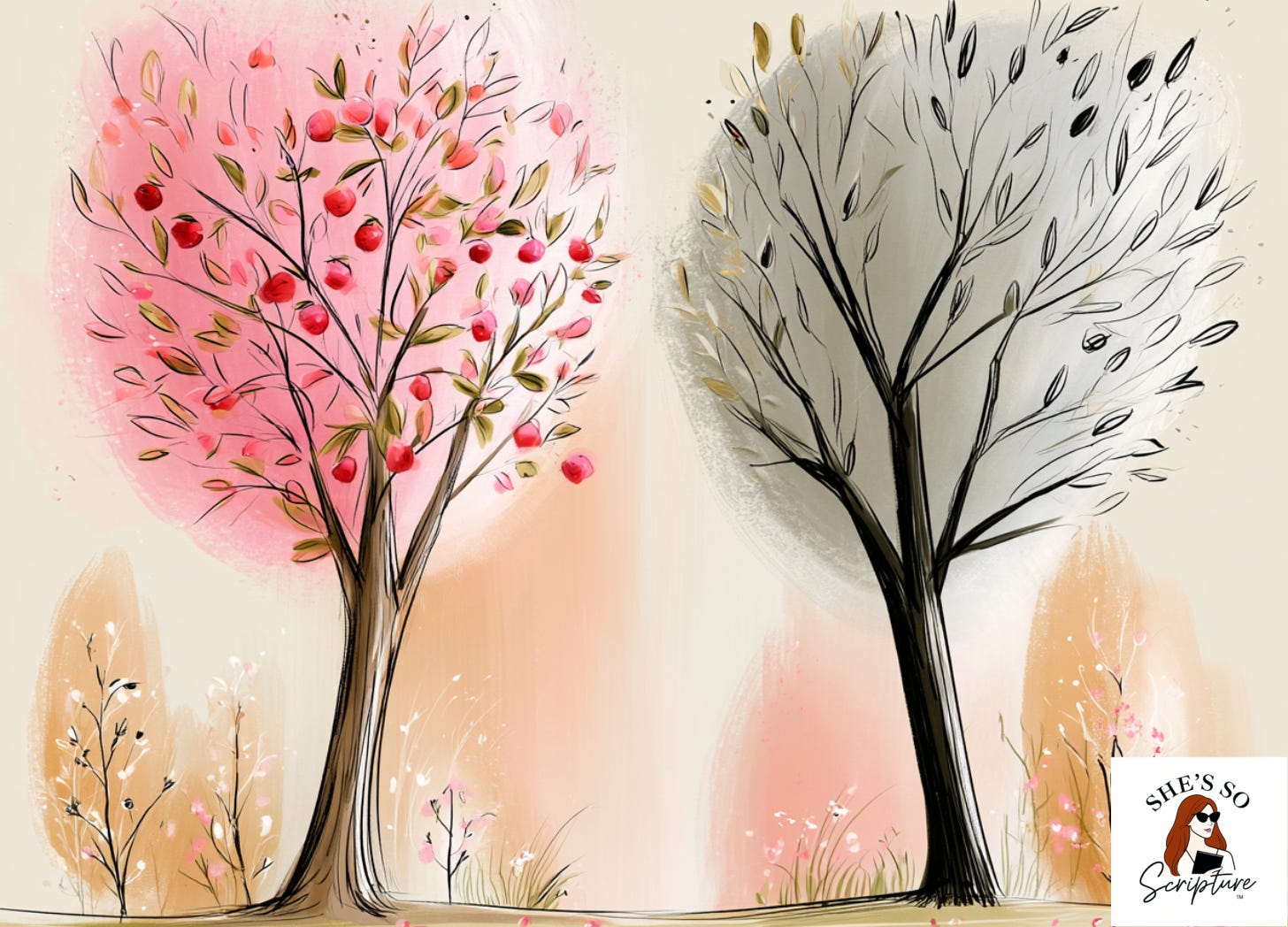
There are two trees in the middle of the garden of Eden, and most of us never pause long enough to understand their role.
Those two trees are doing more theological work than almost anything else in the first three chapters of Genesis. They frame the entire human story. They shape every choice every person has ever made about who gets to define reality. And they show up again in Proverbs, in the Gospels, on a hill outside Jerusalem, and in the very last chapter of the Bible.
Two trees. One garden. The entire arc of redemption running between them like a heartbeat.
Yalla (let’s go)! Lock in and let’s walk through this.
What Genesis Actually Says
Genesis 2:9 in the TLV says:
“Then Adonai Elohim caused to sprout from the ground every tree that was desirable to look at and good for food. Now the Tree of Life was in the middle of the garden, and also the Tree of Knowledge of Good and Evil.”
Notice what God planted. Not just food. Not just beauty. He planted two specific trees with specific names that signal two specific possibilities for the two humans He just made.
The Tree of Life. Eitz HaChayyim. Connected to ongoing fellowship with God, sustained life, dependence, trust.
The Tree of the Knowledge of Good and Evil. Eitz HaDa’at Tov v’Ra. Connected to something FAR bigger than information.
Most of us were taught this story like it was about fruit and rules. Don’t eat the apple. Eve was naughty. Adam was weak. Snake was sneaky. The end.
But that reading misses what was actually being offered, and what was actually being lost.
What That Tree Was Really About
Here’s where the Hebrew opens up the whole thing.
The phrase “knowledge of good and evil” in Hebrew is da’at tov v’ra. Da’at is the word for knowledge, but biblical da’at is not the same as encyclopedia knowledge. It’s not data.
Da’at in Scripture is intimate, experiential, relational knowing. It’s the same word used when the text says Adam knew his wife Eve and she conceived. Da’at is knowledge that comes through participation.
So this isn’t a tree of information. It’s a tree of experience!
Now let’s look at the phrase “good and evil,” tov v’ra. In Hebrew, when you put two opposites together like this, it’s a literary device called a merism. A merism uses two extremes to mean everything in between.
When the Bible says God created the heavens and the earth, that means He created EVERYTHING! When the Bible says from the rising of the sun to its setting, that means all day long. So “good and evil” doesn’t mean two narrow categories. It means the whole spectrum. Everything.
Put it together and you get this. The Tree of the Knowledge of Good and Evil was not offering Adam and Eve a moral education. It was the temptation to seize an authority that was never theirs to hold. The illusion that they could decide for themselves what is good and what is evil. The lie that they could define reality apart from God.
That is not eating an apple. That is a coup!
The first sin underneath the sin was not disobedience to a rule. It was the grasping of an authority that was never theirs to take. The serpent’s pitch was, “You will be like God, knowing good and evil.” Translation. You won’t need Him to tell you what’s true anymore. You can decide for yourself.
And we have been deciding for ourselves ever since.
The Tree They Couldn’t Reach Anymore
After they ate, God did something that so often gets read as punishment but is actually mercy. He blocked access to the Tree of Life.
Genesis 3 tells us cherubim and a flaming sword guarded the way back. Why? Because if humanity could now reach that tree in its fallen state, it would freeze them in that brokenness forever.
Eternal life inside a corrupted nature is not a gift… it’s a horror! So God closed the gate, not to punish, but to protect. To keep the door open for a different kind of return.
But here’s where it gets beautiful. The Tree of Life doesn’t disappear from the Bible. It just goes underground for a while (no pun intended), and when it shows back up, it shows up in some unexpected places.

Wisdom as the Tree of Life
When we get to Proverbs, the Tree of Life resurfaces.
Proverbs 3:18 says of wisdom:
“She is a tree of life to those who embrace her, and blessed will be all who hold firmly to her.” TLV
Did you catch that? Wisdom is described as a Tree of Life. And wisdom in Proverbs has a specific definition. It begins with the fear of the Lord. It’s rooted in trusting God’s design rather than our own assessment. It’s the exact opposite of the move made at that other tree.
Proverbs takes the Tree of the Knowledge of Good and Evil mistake and offers the opposite. Where the first humans grasped at autonomy, wisdom literature says blessed is the one who lets go and trusts. Where they tried to ascend by their own striving, wisdom says she is something you embrace, something you receive.
You can’t climb back to Eden by trying harder. You can’t earn your way past the flaming sword. But you CAN stop reaching for the wrong tree, and you can let wisdom plant a different kind of life in you.
Yeshua and the Cursed Tree
Now here’s where this study gets wild!!
Galatians 3:13 says:
“Messiah liberated us from Torah’s curse, having become a curse for us (for it is written, ‘Cursed is everyone who hangs on a tree’).” TLV
Paul is quoting Deuteronomy 21:23. In the Torah, anyone executed and hung on a tree was considered cursed. So when Yeshua was crucified on a Roman cross, Jewish observers would have understood Him through that lens. He bore the curse. He was, in the language of the law, accursed.
Now get ready for this next part.
The Greek word for “tree” used for the cross in Galatians 3:13, in Acts 5:30, in Acts 10:39, in 1 Peter 2:24, is xulon. The same word used in Revelation 22:2 for the Tree of Life. Same word. Cross and Tree of Life. The New Testament writers weren’t being sloppy with vocabulary. They were driving home a theological point.
The tree where Yeshua bore the curse becomes the means by which the curse is reversed.
He hung on a tree so that the gate to the other tree could be opened. He took on the consequences of our reach for the wrong tree, our grasping, our autonomy, our self-defining, all of it, and absorbed it into Himself. The tree of death in our hands becomes the tree of life in His.
That is not a coincidence in vocabulary. That is the gospel written into the very grain of the wood.
Revelation Closes the Loop
The Bible ends in a garden city. Of course it does. The whole story has been pulling toward this.
Revelation 22:2 in the TLV says:
“On either side of the river was a tree of life, bearing twelve kinds of fruit, yielding its fruit each month; and the leaves of the tree were for the healing of the nations.”
The Tree of Life is back. Not or guarded anymore. Right in the middle of the city, on both sides of the river that flows from the throne of God and of the Lamb. Bearing fruit constantly. Leaves for the healing of the nations.
What got lost in Eden gets returned in the New Jerusalem, except now it’s even better. Now there is no possibility of grasping the wrong tree again, because the One who hung on the cursed tree reigns from the throne, and there is no curse anywhere. Revelation 22:3 says it plainly. “No longer will there be any curse.”
Two trees. The whole Bible. From a garden where humans grasped at being God, to a garden city where God dwells with humans, and the Tree of Life is freely accessible because the Lamb who was slain is on the throne.
Verse Mapping Aid: A Closer Look at Da’at
The Hebrew word da’at, knowledge, is one of the richest words in the Hebrew Bible. It comes from the root yada, to know. But it doesn’t mean what English “knowledge” means.
In Genesis 4:1, the same root is used when the text says Adam knew his wife Eve. That’s intimate knowing. It’s relational… participatory.
In Hosea 6:6, God says He desires “mercy, and not sacrifice; the knowledge of God more than burnt offerings.” That’s not God asking us to memorize facts about Him. That is God asking for relationship.
So when the tree is called the Tree of the Knowledge of Good and Evil, the Hebrew is telling us this is not a tree that hands out information. It’s a tree that draws you into participatory experience of the whole moral spectrum. Eating from it doesn’t teach you about good and evil. It immerses you in the act of being your own arbiter of both.
That distinction changes everything about how we read Genesis 3.
My Final Thoughts
The two trees in the garden are not just an old story. They are a question every single one of us answers every single day.
Whose authority do you trust to define what is good and what is harmful? Whose voice do you listen to when something feels right but Scripture says otherwise? Whose definition of love, of worth, of righteousness, of peace, do you reach for when the moment comes?
That is the Tree of the Knowledge of Good and Evil question, and to this day it’s still on the table.
But so is the Tree of Life. Because Yeshua hung on a tree to reverse the curse, and wisdom calls to us through the pages of Scripture, and one day there will be a city with a river and a tree and leaves for the healing of the nations.
And the people who learn to stop reaching for the wrong tree get to spend their lives drawing nearer to the right one.
That’s the whole Bible. That’s the whole gospel. That’s the whole invitation.
Bible Study Questions
Read Genesis 2:9-17 carefully. What specific instructions does God give about each tree?
In Genesis 3:1-5, how does the serpent reframe what God said? What does that reframing reveal about the real temptation?
Look at Proverbs 3:13-18. How does wisdom literature describe the way back to a Tree of Life experience? What attitudes are required?
Read Galatians 3:10-14. How does Paul connect Yeshua’s death on a tree to the curse, and what does He free us from?
Compare Genesis 3:22-24 with Revelation 22:1-5. What is restored, and what is different about the access this time?
Reflection Questions
Where in your life right now are you most tempted to be the one who decides what is good and what is harmful, instead of trusting what God has said?
The Hebrew word da’at means experiential, participatory knowing. How does that shift your understanding of what was actually being offered at the forbidden tree?
When you think about Yeshua hanging on a tree to reverse the curse of Eden, how does that change the way you see the cross?
Where have you been trying to climb back to God by your own effort instead of receiving wisdom and trust as God’s gift?
What does it mean to you that the Bible ends with a Tree of Life freely accessible in a city where God dwells with His people?
Action Challenges
This week, pick one area where you have been quietly defining “good” and “evil” by your own preferences. Bring it to Scripture and to prayer. Ask God to realign your sense of what is actually good.
Read Genesis 2 and 3 alongside Revelation 21 and 22 in one sitting. Notice the echoes. Notice what is restored. Write down three things you see.
Memorize Proverbs 3:18. Let wisdom be a Tree of Life to you this week, embraced and held firmly.
If this study resonated with you, share it with a friend who has been quietly wrestling with whose voice she’s actually listening to.
And if it left you wanting to go slower and deeper into the Word, I’ve got you! Paid subscribers get access to live Bible studies, extended studies, devotionals, theological teaching, spiritual formation practices, and a community of women who want depth without pressure or performance. If you’re ready to step further into the Word, you’re welcome inside.
👉🏻 Join The Vault.
If a paid subscription isn’t feasible right now but this space has blessed you, you can leave a one-time tip here. Every gift helps sustain this work. 💕

About the Author
Diane Ferreira is a Jewish believer in Yeshua, a published author, speaker, seminary student, wife, and proud mom. She is the founder of She’s So Scripture and She Opens Her Bible. She is the author of several books, including The Proverbs 31-ish Woman, which debuted as Amazon’s #1 New Release in Religious Humor, as well as Holy, Hormonal and Holding On.
She is currently pursuing her graduate degree in Jewish Studies in seminary, with her favorite topics being the early church and Biblical Hebrew. Diane writes and teaches from a unique perspective, bridging her Jewish heritage with vibrant faith in the Messiah to bring clarity, depth, and devotion to everyday believers.
When she’s not writing, studying, or teaching, you’ll find her curled up with a good book, crocheting something cozy, traveling, or playing her favorite video games.
Tree of Life (TLV) – Scripture taken from the Holy Scriptures, Tree of Life Version*. Copyright © 2014,2016 by the Tree of Life Bible Society. Used by permission of the Tree of Life Bible Society.
Excellent! One of the things I’ve noticed about our current western reading of the garden of Eden story is that it sets us up to see God incorrectly. It creates the same doubt that Eve has when the serpent speaks to her: is God good?
So many people tell me that they reject the story of the garden of Eden because God is setting us up to fail, knowing that we’re going to fail.
I tell them that they’re reading the set up wrong. God is not setting us up to fail, he’s setting us up so that whichever way we chose, he would win us in the end! If they had called out for God’s help, he would’ve answered and come to them and rescued them. Since they did not, he still came to them and rescued them. Either way, he won us in the end. That’s the real set up.
What a joy. I just a Gentile taught by the Holy Spirit and recently He has been showing me that what He taught me is backed up by the Hebrew. At 82, I'm not up for learning a language. I'm assuming that will come with my perfect spiritual body. But thank you for your explanation. The core of my teaching has become for a couple decades: The Lord requires that we know Him. I've been looking for it in the creation story—and there it is.