


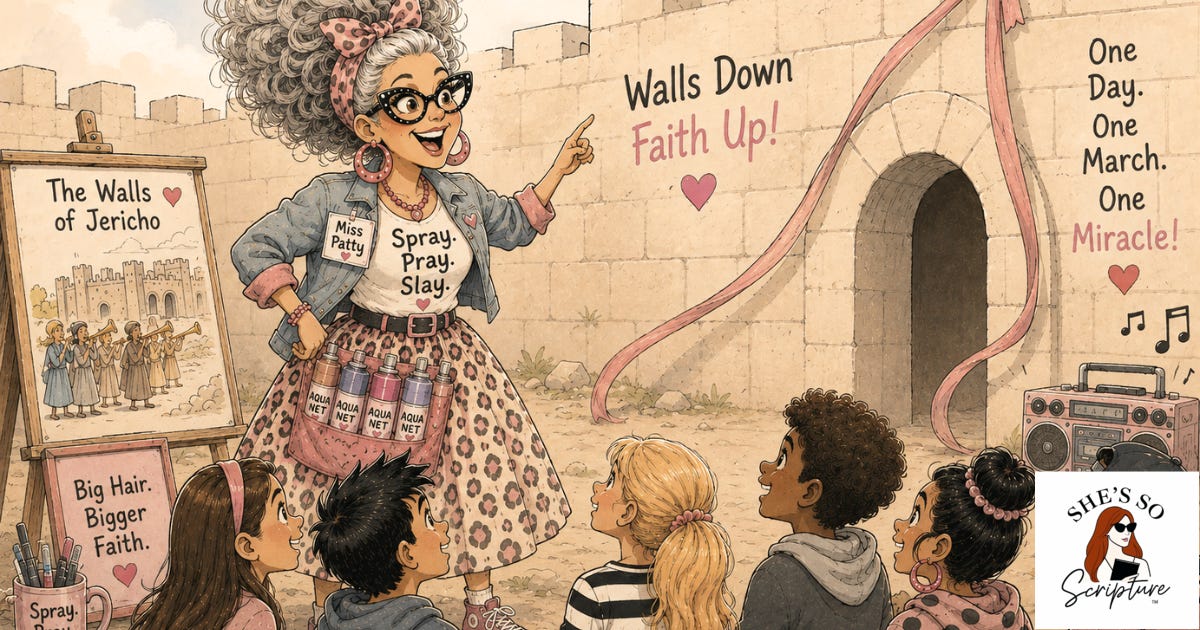
Miss Patty went all out for Jericho. Construction paper bricks taped to a refrigerator box, a plastic kazoo standing in for the trumpet, and twelve of us marching around the fellowship hall while she kept time on her tambourine. On the seventh lap she’d holler “SHOUT!” and we’d scream, the box would tip over, somebody always cried, and we all went home with fruit punch mustaches and a lesson about obedience.
Or she phoned it in and just pressed play on the episode of Veggie Tales and you all sang “Keep Walking”.
March when God says march. Shout when God says shout. Watch the impossible fall over.
Which is true. It just starts about a chapter too late, because the strangest things in this story happen before anyone marches at all.
The Man with the Drawn Sword
Before a single lap around the city, Joshua is out near Jericho, presumably doing what generals do, and he looks up to see a man standing there with a drawn sword. Joshua walks right on up to him and asks: are you for us, or for our enemies?
Now, here’s where my Hebrew notebook earns its keep, and we’re not even to the horns yet. The commander’s answer begins with one word: lo. No. The TLV smooths the fuller reply into “Neither... Rather, I have now come as commander of Adonai’s army” (Joshua 5:14, TLV), 1 which catches the gist of it well enough, but I want you to hear that blunt opening too. Joshua asked for a side, and the answer was “no”.
Then Joshua falls on his face, and the commander tells him to remove his sandals because the ground is holy. If that sounds familiar, it should. The last man told to take off his sandals was standing in front of a burning bush. 2 The text stops short of calling this commander the LORD Himself; all he claims for himself is command of the LORD’s army, which is its own kind of interesting, and I’m going to leave it right there, because the text does.
Miss Patty likely never mentioned this mysterious commander at all. Which is a shame, because everything that follows plays by the rules set in this scene. Israel is about to win a battle through a strategy no general would have devised, with GOD bringing down the city’s defenses before Israel’s army does anything but march and shout.
And while we’re in chapter 5, there’s a reason the flannelgraph skipped the first half. Israel had already crossed the Jordan, stacked twelve memorial stones, and made camp at Gilgal back in chapter 4.
Once they’re settled there, the males born during the wilderness years get circumcised, which is not a lesson you can teach with pipe cleaners or safety scissors. Then Israel observed Passover on the plains of Jericho, ate of the produce of the land, matzot and roasted grain, and the manna ceased (Joshua 5:10-12).
I thought about that order for a while. Israel’s first major covenant acts in the land, once they’ve crossed and camped, are renewing the covenant sign and keeping the covenant meal. The wall can wait.
A Siege That Looks Like a Worship Service
Here’s the entire battle plan as recorded. No siege ramps. No ladders. No battering rams. The only rams at Jericho were the horns… the shofars.
What they had instead was the ark of the covenant at the center of the procession. Seven priests. Seven shofars. Seven days. Seven circuits on the seventh day. Joshua never explains why the number shows up so many times in a row, but it’s the same number GOD stamps on creation and on Sabbath, and it’s hard not to hear that resonate.
And then there’s the silence. Joshua commands the people:
“You must not shout nor let your voice be heard nor let a word proceed out of your mouth, until the day I tell you ‘shout!’” (Joshua 6:10, TLV).
Six days of that. An entire nation circling a city without a word. As a woman who has seen every woman in her family stay quiet for all of about 1.2 seconds, I’d argue this is the real miracle of Jericho.
But picture it. Armed men in front, priests with shofars, the ark, the rear guard, all moving in slow silent laps around a locked city. I don’t know what a military historian would call that. From the top of the wall, though, it must have looked like a worship procession. Jericho’s king was watching for an army, and what he got, six days running, was GOD’s presence taking a walk around his city.

What Kind of Horn Was That?
Joshua 6:4 calls the priests’ instruments shofrot ha-yovelim, and verse 5 says the wall will fall when they make a long blast on the keren ha-yovel. 3 Now, as a Jewish believer, I am familiar with the word yovel. But I know many reading this are not. So let’s go over it.
In Exodus 19 and Joshua 6, yovel refers to the ram’s horn whose blast is heard. In Leviticus 25 the same word becomes the name of a year. Israel is told to count off fifty years, sound the horn across the land, and “proclaim liberty throughout the land to all its inhabitants” (Leviticus 25:10, TLV).
The fiftieth year is called the yovel, the Jubilee, and medieval commentator Ibn Ezra ties the year’s name directly to that horn blast. 4 In the Jubilee, liberty is proclaimed, Israelite servants return to their families, and hereditary land returns to the family GOD assigned it, because the land, He says, belongs to Him. 5
I’ll flag one thing though: the Jubilee doesn’t cancel debts. That’s the seventh year, back in Deuteronomy 15. Jubilee brings people and land home.
One more place that long blast shows up: Sinai. Exodus 19:13 says the people may come up the mountain when the yovel sounds a long note. Same word, same idiom, and these are in fact the only two passages in the Hebrew Bible that pair yovel with that particular phrase. 6 The horn that called Israel to meet GOD at the mountain is the horn sounded when a Canaanite wall comes down.
So the vocabulary lets us hear an echo of Sinai, and maybe of Jubilee, in what happens at Jericho. Joshua never explains the connection himself, and I want to be honest about where the text stops and my reading begins. I’m drawing this from the shared vocabulary; the narrative never says it outright. But I heard it once and now I hear it every time. Liberty proclaimed. Land changing hands. And a horn doing the announcing.
It would also explain something Miss Patty definitely glossed over: why Israel couldn’t keep anything from the city. Jericho was “under the ban of destruction” (Joshua 6:17, TLV), cherem, meaning it belonged to GOD alone and no Israelite could claim it as personal plunder. 7
Commentators often compare the ban on Jericho to a firstfruits offering, the whole city devoted before Israel keeps anything for itself, and I personally find that comparison fitting even though the text itself never uses the phrase. 8 It’s exactly why Achan’s little shopping spree in chapter 7 goes so badly. He didn’t take ordinary spoils. He took what had already been set apart for the LORD.
The Woman Who Lived in the Wall
Joshua 2:15 gives us my favorite detail in the whole narrative, tucked away quietly into the escape scene: “her house was in the wall; she was living in the wall” (TLV).
I feel like Rahab has been all up in my business lately and I don’t hate it. It just seems like alot of what I write and study these days has featured Rahab.
Rahab lived inside the very structure GOD was about to flatten. The scarlet cord hung from a window in it.
And when the moment came,
“the people shouted a loud shout—and the wall fell down flat!” (Joshua 6:20, TLV).
Yet Joshua had already given the order:
“Rahab the harlot will live, she and all who are with her in the house, because she hid the scouts” (Joshua 6:17, TLV).
Can I just pause to say, imagine going through life having your name associated with what you do or a trait you have? Diane the Sarcastic has a nice ring to it though, not gonna lie? Anyway, I digress. Back to the woman in the wall and the wall that is now floor tile.
The text never slows down to explain the physics of that, and I won’t pretend to either. It just sets the woman in the wall on one page and the wall on the ground a few pages later, and lets you feel the size of the rescue.
Hebrews felt it.
“By faith the walls of Jericho fell down after they were circled for seven days. By faith Rahab the prostitute did not perish with those who were disobedient, because she welcomed the spies with shalom” (Hebrews 11:30-31, TLV).
Two verses, side by side. The falling wall and the spared woman, filed together under faith.
Then Matthew gives us the ending nobody in Jericho saw coming:
“Salmon fathered Boaz by Rahab” (Matthew 1:5, TLV). 9
Matthew doesn’t pause to confirm it’s the same Rahab, but the identification is about as close to unanimous as biblical scholarship gets, and it places her in the family line that leads to David, and eventually to Yeshua Himself.
If there really is Jubilee in that horn blast, then Rahab is what the liberty looked like when it landed on an actual person. A condemned outsider, rescued, and given a place among the very people who brought the wall down.
Verse Mapping Aid
The word: יוֹבֵל (yovel, pronounced yoh-VEL). A ram’s horn, and in Leviticus 25 the name of the Jubilee year, tied by tradition to the horn blast that proclaims it.
Where to find it: Exodus 19:13 (the long blast that calls Israel up Mount Sinai), Leviticus 25:8-13 (the Jubilee year), Joshua 6:4-5 (the horns at Jericho).
How to map it: Write out Joshua 6:5 in your notebook and circle “ram’s horn.” Pull up three or four translations and watch how they handle it; some say “trumpets of rams’ horns,” and a few older ones say “jubilee trumpets,” which is your first clue.
Then read Leviticus 25:8-13 beside it and write yovel over both passages. In one column, list what the Jubilee year actually accomplishes: liberty proclaimed, servants returning to their families, land returning to its ancestral holding.
In the other, list what happens at Jericho. Think about that overlap and write down what you see before you read what anyone else says about it.
My Final Thoughts
Somewhere along the way, Jericho became a story about volume. Shout at your walls! Shout louder! But the chapter spends far more time on silence than on shouting. Six days of quiet laps. One shout, and only when GOD said so.
Look at Israel’s first days in the land. Circumcision. Passover. Silent processions behind the ark. A horn blast that sounds like Sinai and maybe like Jubilee. GOD taught His people the rhythms of covenant life before He gave them a single city, as if the order itself were the lesson.
I keep coming back to Rahab’s window, though. All those years in the wall of a doomed city, and when the horn of liberty finally sounded over that land, it turned out the sound was for her too.
Dig Deeper
Read Joshua 5 and 6 in one sitting this week, out loud if you can, and mark every action Israel takes before a single weapon is used. The order will preach all by itself.
Then look at Joshua 6:4-5 next to Leviticus 25:8-13 and work the yovel map from the Verse Mapping Aid. List what the Jubilee year accomplishes in one column and what happens at Jericho in the other, and write down what you see before you open a commentary.
Somewhere during your week, come back to the commander’s flat no. Ask where you’ve been recruiting GOD to your side of a situation instead of asking whether you’re standing on His.
And if you’re feeling brave, practice one day of Jericho silence. Pick the situation you’ve been narrating to everyone who’ll listen, and for one full day say nothing about it except to GOD. The wall fell after the quiet, not before it.
If this study stirred something in you, share it with a friend who can still sing every word of the wall-tumbling song from VBS. And if it left you wanting to go slower and deeper into the Word, I’ve got you! Paid subscribers get access to live Bible studies, extended studies, devotionals, theological teaching, spiritual formation practices, and a community of people who want depth without pressure or performance. If you’re ready to step further into the Word, you’re welcome inside.
If a paid subscription isn’t feasible right now but this space has blessed you, you can leave a one-time tip here. Every gift helps sustain this work. 💕

Represent She’s So Scripture and Your Love of Exegesis!

This is what we’re building here. Women who actually engage the text and don’t apologize for it.
If that’s “extra,” we’re fine with that.
In fact… we put it on a t-shirt.
“She’s not extra. She’s exegetical.”
You can get yours here.
About the Author
Diane Ferreira is a Jewish believer in Yeshua, a published author, speaker, seminary student, wife, and proud mom. She is the founder of She’s So Scripture and She Opens Her Bible. She is the author of several books, including The Proverbs 31-ish Woman, which debuted as Amazon’s #1 New Release in Religious Humor, as well as Holy, Hormonal and Holding On.
She is currently pursuing her graduate degree in Jewish Studies in seminary, with her favorite topics being the early church and Biblical Hebrew. Diane writes and teaches from a unique perspective, bridging her Jewish heritage with vibrant faith in the Messiah to bring clarity, depth, and devotion to everyday believers.
When she’s not writing, studying, or teaching, you’ll find her curled up with a good book, crocheting something cozy, traveling, or playing her favorite video games.
Notes
1 Tree of Life (TLV) – Scripture taken from the Holy Scriptures, Tree of Life Version*. Copyright © 2014,2016 by the Tree of Life Bible Society. Used by permission of the Tree of Life Bible Society.
2 Exodus 3:5. The Hebrew wording of the command in Joshua 5:15 closely parallels the command to Moses, down to the phrase “the place where you are standing is holy.”
3 Hebrew יוֹבֵל (yovel), Strong’s 3104, occurring 27 times in the Hebrew Bible, concentrated in Leviticus 25 (fourteen times), with the remaining uses including Exodus 19:13 and Joshua 6:4, 5, 6, 13. BDB glosses it as the ram’s horn and as the designation of the fiftieth year. Brown, Driver, and Briggs, A Hebrew and English Lexicon of the Old Testament (Oxford: Clarendon, 1906), s.v. יוֹבֵל.
4 Ibn Ezra on Leviticus 25:10 connects the Jubilee year’s name directly to the ram’s-horn blast that proclaims it.
5 On the specific provisions of the Jubilee year, liberty, the return of Israelite servants, and the return of hereditary land, see Jacob Milgrom, Leviticus 23–27, Anchor Bible 3B (New York: Doubleday, 2001), on Leviticus 25:8-13. Debt cancellation is a separate provision tied to the seventh (shmita) year in Deuteronomy 15, not to the Jubilee itself.
6 Exodus 19:13 reads bimshokh ha-yovel, “when the ram’s horn sounds a long blast”; Joshua 6:5 reads bimshokh b’keren ha-yovel. These are the only two passages in the Hebrew Bible that pair yovel with this idiom, built on the verb mashakh, “to draw out” or “prolong.”
7 On ḥerem, the ban or devoted thing, see N. Lohfink, “ḥāram,” in Theological Dictionary of the Old Testament, vol. 5 (Grand Rapids: Eerdmans, 1986). Some devoted items were destroyed; silver, gold, bronze, and iron entered Adonai’s treasury instead (Joshua 6:19, 24).
8 The comparison of Jericho’s cherem to a firstfruits offering is a common interpretive reading rather than the text’s own stated explanation. See, e.g., Richard S. Hess, Joshua: An Introduction and Commentary, Tyndale Old Testament Commentaries (Downers Grove: InterVarsity, 1996), on Joshua 6.
9 Matthew’s genealogy names a Rahab as Salmon’s wife and Boaz’s mother, without independently confirming she is Rahab of Jericho. The identification is nonetheless nearly universal among interpreters, and Hebrews 11:31 and James 2:25 confirm that Rahab of Jericho remained a celebrated figure of faith in the first century.
Thanks for expounding on Jesus confronting Joshua. Jesus confronted Moses and was going to kill Moses. Sunday school doesn't tell the whole story.
Most scholars say that Melchizedek was also Jesus.
I don't think so. I think Rehab was a descent of Melchizedek.
There are many believers out side the bloodline of Abraham. We will see Nebabannezzar since he wrote Daniel 4.
What a legacy for Melchizedek that his distant relative was grafted into the bloodline of Jesus.
Elijah went to Zidon and the widow had a son. May I suggest that the widow's distant decendant is the lady with the sick child that Jesus healed.
Matthew 15:21 KJV — Then Jesus went thence, and departed into the coasts of Tyre and Sidon.
______
Why else would Jesus go from Jerusalem to Lebanon?
Therefore, the gentiles believers that are outside of Israel are grafted into the family of God.
It's prophecy and warning to Israel that they are the only people who are believers.
Therefore, there is a connection between Rahab and Melchizedek, and the widow and mother in Sidon.
_____
Genesis 15:16 KJV — But in the fourth generation they shall come hither again: for the iniquity of the Amorites is not yet full.
_____
After Melchizedek, four hundred years of apostasy before Rahab.