


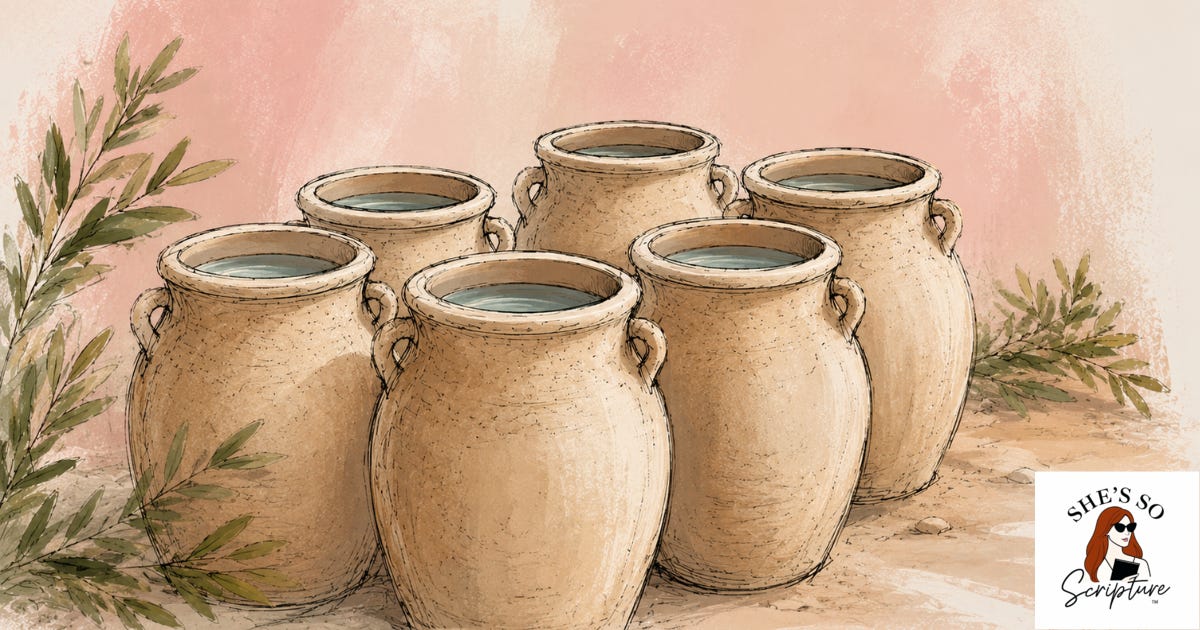
Alot of us learned about the wedding at Cana in Sunday school. Miss Patty, whose bangs had enough Aqua Net in them to survive the Great Tribulation and holding onto her “Spray, Pray, Slay” coffee mug, had cardboard waterjugs and explained that Jesus turned water into wine because He cared about people and wanted to help a family in need.
She wasn’t wrong.
What I never heard was why John opened his Gospel here.
John could have begun with a healing. He could have started with a sermon or an exorcism. But instead, he introduces us to Yeshua at a wedding in an ordinary village where the wine has run out. By the end of the account, John tells us exactly why he recorded it:
“Yeshua did this, the first of the signs, in Cana of the Galilee. He revealed His glory, and His disciples believed in Him.” (John 2:11, TLV)
John isn’t simply writing to tell us about a miracle. He’s introducing the One who has just stepped onto the stage of history.
The Timing Was Deliberate
John begins with a detail most of us would read right past.
“On the third day, there was a wedding at Cana in the Galilee.” (John 2:1, TLV)
At first look, it sounds like a simple time marker. But John rarely includes details without a reason.
During my graduate studies at the Messianic Jewish Theological Institute (MJTI), one of my professors, Dr. Vered Hillel, pointed out something that forever changed the way I read this passage. It’s also in her article on the same topic.⁷
In Exodus 19, the LORD tells Israel to prepare themselves because on the third day He’ll descend upon Mount Sinai. That third day becomes the moment when God’s presence is revealed, the mountain is wrapped in cloud and fire, and Israel enters into covenant as the Torah is given.
John uses that same language as he introduces Yeshua’s first public sign.
John appears to invite readers familiar with Israel’s Scriptures to hear an echo of Sinai. Some scholars also note that John carefully structures the opening of his Gospel as a sequence of days that culminates at Cana, strengthening that literary connection.³
At Sinai, the kavod (glory) of the LORD is revealed as God establishes His covenant with Israel. At Cana, John tells us that Yeshua reveals His glory at a wedding feast.
John isn’t asking us to see two identical events. He’s inviting us to recognize a familiar pattern. He invites readers to recognize in Yeshua the same divine glory that was once associated with Sinai.
John has barely begun his Gospel, and already he’s telling us something meaningful. The One standing at the wedding is doing more than solving some social crisis. He’s revealing the presence of God in a way that brings to mind one of the defining moments in Israel’s history.
The Six Stone Jars
John then directs our attention to another detail that would have meant far more to his original audience than it often does to ours.
“Now there were six stone jars, used for the Jewish ritual of purification, each holding two to three measures.” (John 2:6, TLV)
These weren’t just some decorative containers sitting in the corner for aura and atmosphere. They were part of the ordinary rhythm of Jewish life.
Stone vessels held a unique place within Jewish purity practice because, unlike earthenware, they were understood not to contract ritual impurity. That’s one reason archaeologists continue to uncover so many stone vessels from the late Second Temple period. They belonged to the daily life of observant Jewish families that tried to maintain ritual purity.⁴
Yeshua doesn’t ignore the jars. He doesn’t ask for something entirely different. He tells the servants to fill the very vessels already associated with Israel’s purification.
If that wasn’t awesome enough, what happens next is even more amazing.
The water becomes wine of such incredible quality that the headwaiter assumes the groom has intentionally saved the best for last.
“Everyone brings out the good wine first, and whenever they are drunk, then the worse. But you’ve reserved the good wine until now!” (John 2:10, TLV)
John presents abundance emerging through vessels already associated with Israel’s life under the Torah.
Throughout the prophets, overflowing wine is one of the images associated with God’s coming restoration. Isaiah tells us of a lavish banquet prepared by the LORD for all peoples.¹ Amos has a vision of the mountains dripping with sweet wine when God restores His people.² John’s readers would have recognized those promises beneath this wedding feast immediately.
The miracle is generous, but it’s also incredibly symbolic.
Why Running Out Of Wine Was A Crisis
Modern readers often shrug at this part of the story. They imagine an unfortunate catering mistake and wonder why it mattered so much.
But in the first century a wedding was one of the most significant celebrations a family would ever host. The festivities could, and often did, last for several days, and the responsibility for providing food and wine rested squarely on the groom and his family.
Running out of wine wasn’t just inconvenient. It brought public shame upon the family and could leave a lasting stain on their reputation within the community.⁵
That changes the way we hear Mary’s words.
“Do whatever He tells you.” (John 2:5, TLV)
She doesn’t explain herself. She doesn’t tell the servants what Yeshua’s about to do. She simply entrusts the situation to Him. There’s a quiet confidence in those five words.
Mary brings the need to her Son and then steps aside. The servants don’t yet understand what He’s doing, but they obey anyway.
John has taken us from Sinai to a village wedding, from purification jars to overflowing wine, from public shame to unexpected abundance. And the most important part is still coming.
Glory
John finishes the account with a sentence that’s easy to read quickly and even easier to underestimate.
“Yeshua did this, the first of the signs, in Cana of the Galilee. He revealed His glory, and His disciples believed in Him.” (John 2:11, TLV)
John calls this the first of Yeshua’s signs. He isn’t simply arranging miracles in chronological order. He’s telling us where he wants us to begin if we’re going to understand who Yeshua is.
The miracle, the wine and the wedding all matters. Yet John draws our attention somewhere else entirely: His glory.
That single word opens the door to everything that has come before.
Doxa And Kavod
John writes in Greek, and the word he uses is doxa.
In much of classical Greek usage, doxa referred to opinion, reputation, or how one appeared to others. If that were John’s meaning, the verse would simply tell us that Yeshua’s reputation began to spread.
But John’s a Jewish writer whose imagination has been shaped by Israel’s Scriptures.
When the Hebrew Bible was translated into Greek in the Septuagint, the translators frequently chose doxa to translate the Hebrew word kavod, particularly in contexts describing God’s presence and honor.⁶ That’s an important connection.
The Hebrew word kavod is associated with ideas of weight or heaviness, and when Scripture speaks of the kavod of the LORD, it’s describing His tangible, weighty presence among His people.
The kavod descended upon Mount Sinai. The kavod filled the Tabernacle. The kavod later filled Solomon’s Temple at its dedication.
Again and again, God’s glory marks His dwelling among His people.
John’s already prepared us for this.
“The Word became flesh and tabernacled among us. We looked upon His glory...”
(John 1:14, TLV)
Now, at Cana, that glory begins to reveal itself publicly.
John’s doing much more than telling us people began to think highly of Jesus. He’s presenting Him as the One in whom the glory of God has come to dwell. That’s why this account stands at the beginning of the Gospel.
The first sign isn’t merely about water becoming wine. It’s the first public unveiling of the glory John has already told us dwells in the Word made flesh.
My Final Thoughts
Miss Patty was absolutely right about one thing. Yeshua cared about the people gathered at that wedding. His compassion is never in question.
John, however, wants us to see something even greater.
The first sign in his Gospel is more than an act of kindness. It’s a revelation. The glory associated with God’s presence is now revealed in the person of Yeshua.
The stone jars used in Israel’s purification become the setting for astonishing abundance. A family on the brink of public shame becomes the backdrop for the first public revelation of the Messiah’s glory.
John’s been preparing us for this moment from the opening lines of his Gospel.
“The Word became flesh and tabernacled among us. We looked upon His glory...”
(John 1:14, TLV)
Cana isn’t the beginning of God’s glory. It’s the first public unveiling of the glory John has already told us dwells in the Word made flesh.
That changes the way we read the story.
It is no longer simply about a wedding where the wine ran out. It is about the God who revealed His glory on Sinai now revealing that same glory in His Son.
As it so often does, God’s glory appears in a place no one expected: an ordinary village, an ordinary wedding, and a quiet act of obedience that most of the guests never even knew had taken place.
Dig Deeper
Read these passages alongside John 2 and watch how they begin speaking to one another.
“Go to the people, and sanctify them today and tomorrow. Let them wash their clothing... Be ready for the third day. For on the third day Adonai will come down upon Mount Sinai in the sight of all the people.” (Exodus 19:10-11, TLV)
“The glory of Adonai settled upon Mount Sinai, and the cloud covered it for six days... The appearance of the glory of Adonai was like a consuming fire on the top of the mountain in the sight of Bnei-Yisrael.” (Exodus 24:16-17, TLV)
“Then the cloud covered the Tent of Meeting, and the glory of Adonai filled the Tabernacle.” (Exodus 40:34-35, TLV)
“On this mountain, Adonai-Tzva’ot will prepare a lavish banquet for all peoples...”
(Isaiah 25:6-8, TLV)
“Behold, days are soon coming...when the mountains will drip sweet wine...”
(Amos 9:13-14, TLV)
“The Word became flesh and tabernacled among us. We looked upon His glory...”
(John 1:14, TLV)
As you read, notice how often the themes of God’s presence, covenant, abundance, and glory appear together. John assumes his readers know Israel’s story, and he invites us to hear those echoes as we read his Gospel.
Let’s Talk In The Comments
John rarely includes a detail without a purpose. It’s one of the things I love about him.
What stayed with you most as you read this account?
Was it the reference to the third day? The significance of the six stone jars? The wedding itself? Or the way John’s use of doxa invites us to hear the echo of kavod?
I’d love to hear your thoughts. I read every comment, and I genuinely enjoy seeing what stands out to you as you study the Scriptures.
If this study encouraged you, consider sharing it with someone who loves digging deeper into God’s Word.
And if it left you wanting to spend more time in the historical, literary, and Jewish world of the Bible, I’d love to welcome you into The Chavurah. Paid subscribers receive live Bible studies, extended studies, theological teaching, devotionals, spiritual formation resources, and a community of people committed to reading Scripture carefully and faithfully.
If a paid subscription isn’t feasible right now but this space has blessed you, you can leave a one-time tip here. Every gift helps sustain this work. 💕

About the Author
Diane Ferreira is a Jewish believer in Yeshua, a published author, speaker, seminary student, wife, and proud mom. She is the founder of She’s So Scripture and She Opens Her Bible. She is the author of several books, including The Proverbs 31-ish Woman, which debuted as Amazon’s #1 New Release in Religious Humor, as well as Holy, Hormonal and Holding On.
She is currently pursuing her graduate degree in Jewish Studies in seminary, with her favorite topics being the early church and Biblical Hebrew. Diane writes and teaches from a unique perspective, bridging her Jewish heritage with vibrant faith in the Messiah to bring clarity, depth, and devotion to everyday believers.
When she’s not writing, studying, or teaching, you’ll find her curled up with a good book, crocheting something cozy, traveling, or playing her favorite video games.
Tree of Life (TLV) – Scripture taken from the Holy Scriptures, Tree of Life Version*. Copyright © 2014,2016 by the Tree of Life Bible Society. Used by permission of the Tree of Life Bible Society.
Notes
Isaiah 25:6-8.
Amos 9:13-14.
Craig S. Keener, The Gospel of John: A Commentary, vol. 1 (Grand Rapids: Baker Academic, 2003), on John 1:19–2:1.
Yitzhak Magen, The Stone Vessel Industry in the Second Temple Period (Jerusalem: Israel Exploration Society, 2002), chaps. 1–2; Mishnah Kelim 10:1.
Bruce J. Malina and Richard L. Rohrbaugh, Social-Science Commentary on the Gospel of John (Minneapolis: Fortress Press, 1998), on John 2:1–11.
T. Muraoka, A Greek-English Lexicon of the Septuagint (Leuven: Peeters, 2009), s.v. doxa; Marianne Meye Thompson, John: A Commentary, New Testament Library (Louisville: Westminster John Knox, 2015), on John 1:14 and 2:11.
Vered Hillel, “The Wedding at Cana and the Glory of God,” Kesher Journal, August 11, 2021.
Ok I see the hands raised in the back of class LOL
So John's Gospel uses the phrase "my hour" in a very specific way. It's not just talking about timing. It's eschatological... pointing to the climactic moment of Yeshua's death, resurrection, and glorification.
So when He tells Mary, "My hour has not yet come," He's saying that the full public revelation of who He is still lies ahead. Yet He performs the miracle anyway because Cana is the beginning of that revelation. The hour hasn't fully arrived, but it's beginning to unfold. This first sign low key reveals His glory to the disciples and the servants, and it is a foreshadowing of the muxh greater revelation of His glory that will come through the cross and resurrection. I hope that makes sensw.
“Miss Patty, whose bangs had enough Aqua Net in them to survive the Great Tribulation…” ??!!!!! 😂😆 Dead.