


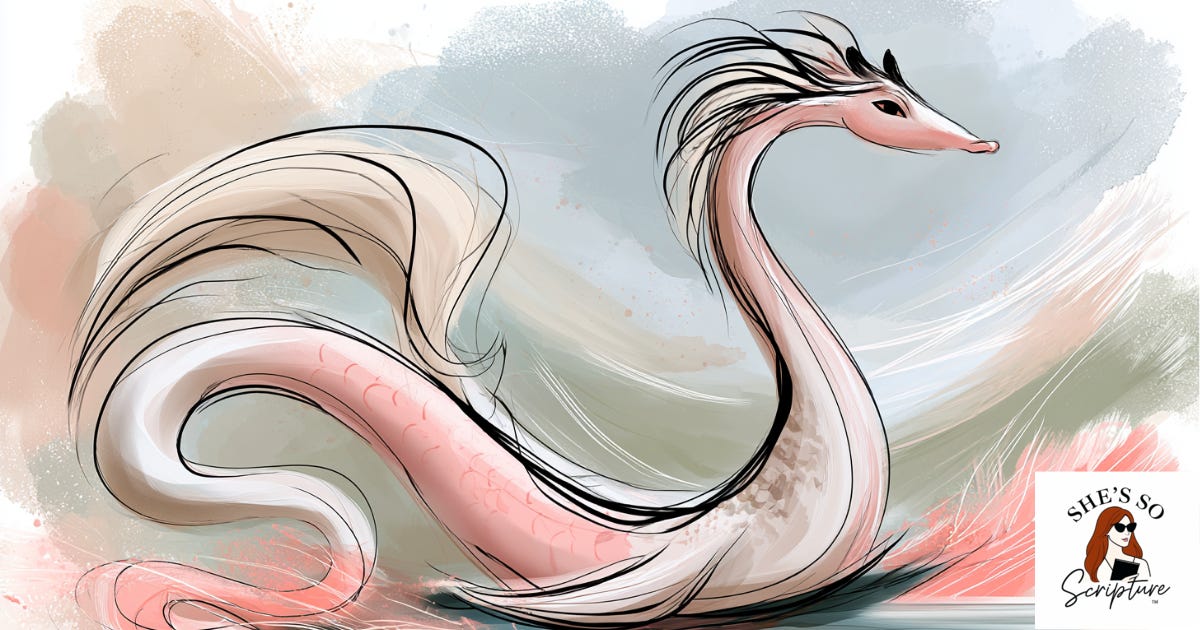
There’s a blessing prayed in observant Jewish homes every fall.
It comes at the end of Sukkot. For a week the family has been eating meals in the sukkah, that three-sided shelter with a roof of branches and natural materials that remembers Israel’s wilderness years, and on the way out for the last time we pray that just as we merited to sit in this sukkah, we would merit, in the coming year, to sit in a sukkah made from the skin of Leviathan.¹


The skin of Leviathan. A shelter for the righteous, in the days of Messiah, made from the hide of a sea monster.
I never thought much about Levianthan before and decided to study it more. I found it at my kitchen table, siddur on one side, concordance on the other, coffee abandoned somewhere around the third cross-reference. And my first reaction wasn’t theological at all. It was closer to indignation. I had spent my whole adult life in Scripture. Where had this been?
If your reaction is, wait, Leviathan, the thing in Job? Yes. Him. His story runs a lot longer than Job, though, and nobody tells Christians the rest of it. So let me.
The Monster You Probably Skimmed Past
Leviathan (לִוְיָתָן) shows up by name in three books of the Hebrew Bible. Always in poetry and most of us slid past every single mention.
I can prove it, at least in my case. My old study Bible has notes crammed into the margins all through Job, questions, highlights, references. Then you hit chapters 40 and 41 and the margins go clean. ‘Past Diane’ apparently read “fire-breathing sea dragon” and had no follow-up questions. I’ve forgiven her, but I do wonder about her sometimes.
Because Job 41 is not a throwaway passage. God spends nearly two chapters on this creature. Interlocking armored scales. Terrifying teeth. Smoke pouring from his nostrils, flame from his mouth. A long line of commentators, Rashi among them, said Nile crocodile, and I understand why; parts of the chapter really do read like a field guide.
But sir… SIR! Crocodiles do not breathe fire, and no commentary can make them.
Robert Alter reads the passage as deliberately mythological, a portrait of the untamable painted at full volume so God’s question lands with its whole weight: ‘you cannot handle this creature, and I made him.’ ²
Psalm 74 remembers God crushing “the heads of Leviathan.” Heads, plural. The plural turns out to matter, and don’t worry… we’ll get there.
Psalm 104 is the one that makes me smile. The psalmist looks out at the great wide sea, the ships going about their business, “and Leviathan, whom You formed to play there.” Formed to play? The terror of the deep is, in this psalm, God’s pet.
Then Isaiah:
In that day Adonai will punish Leviathan the fleeing serpent with His fierce, great, strong sword, Leviathan the twisted serpent! He will slay the dragon in the sea. (Isaiah 27:1, TLV)
Will slay. Not slew. Isaiah puts the monster’s death in the future, on the day of the Lord’s final victory. Which means the Hebrew Bible closes with Leviathan still out there, swimming around with an appointment on the calendar.
What the Rabbis Saw
Jewish tradition noticed the open ending and kept reading.
It set Isaiah’s future tense next to that odd line in Psalm 74 about Leviathan’s flesh being given as food. And by the era of the New Testament, a picture had formed in Jewish writing: when the Messianic age dawns, Leviathan will be slain, and his flesh will become a feast for the righteous.³
The rabbis of the Talmud finished the picture. Tractate Bava Batra teaches that God created Leviathan male and female, then slew the female and preserved her flesh for the banquet of the righteous in the world to come, since a breeding pair of these creatures would have overwhelmed the earth.
The rabbis thought of everything. At that banquet the righteous eat. God builds them a sukkah from Leviathan’s skin. And the leftover hide gets stretched along the walls of Jerusalem, where it shines to the ends of the earth.⁴
Follow the monster through that story. He becomes the meal. His hide becomes the shelter. His scraps become the light of the city. Chaos loses the war and then gets put on the menu at the reception.
The first time I traced all this out in my notebook, I laughed out loud, alone in my kitchen, which is NOT a normal response to the Talmud. Just then, a friend of mine and my Tanakh professor, Rabbi Dr. Joshua Brumbach, mentioned something on Facebook about writing on Leviathan. So I ran to Kesher Journal because I know that is where some of my favorite people publish scholarly articles. And there it was. So I studied it… a lot.
Then I sat thinking about it a while, because underneath the strangeness was a shape I recognized. The enemy of God’s people ending up as party supplies. That sounded like a hope I already knew from somewhere.
Hold that thought, because first I should tell you where the monster came from.
Actually, one more thing before we leave the rabbis. None of this is buried in a manuscript only scholars can reach. It’s in the prayer book. It’s in that Sukkot blessing we started with. My Koren Shalem Siddur says:
“May it be your will, LORD our God and God of our fathers, that as I have fulfilled [Your commandment] and sat in this sukka, so next year may I have the privilege of sitting in the sukka made of the skin of Leviathan.”
It’s in the Akdamut (also from my Siddur), a beloved poem chanted on Shavuot, which sings of the final battle and the banquet after it, the righteous at their tables drinking wine that has been aging since creation.⁵
Cong: “He plays with the Leviathan, with the Behemoth of the high mountain, and when they wrestle one another in their great duel,”
Leader: “the horns of the great Behemoth will gore, and the mighty Leviathan will leap out at him with his fins,”
Cong: “and finally, his Creator will step forward with His great sword, and prepare a meal, a feast, of that meat, for all the righteous.”
Jewish families have been rehearsing this ending, out loud, for over a thousand years. And no, the rabbis were not planning a harpoon expedition. This is symbolic, imaginative language about God’s final victory, the same tune Revelation writes in. They knew what they were doing with these images. So should we.
Yes, About Those Origins
If you go digging, and I did, because this is what happens to a woman with too many Hebrew dictionaries, you’ll find Leviathan has a backstory older than Israel.
Texts from ancient Ugarit, up the coast north of Israel, dating to roughly the fifteenth and fourteenth centuries BCE, describe a twisting sea serpent named Lotan, defeated by the storm god. Lotan has seven heads.⁶
That likely explains why Psalm 74 speaks of Leviathan’s heads in the plural. Chaos-serpent battles like this turn up all over the ancient Near East. Apparently every nation in the neighborhood needed its god to fight the sea and just barely win.
Some Christians get nervous right here, as if pagan fingerprints disqualify the image. I’d wait and watch what the biblical authors do with it before deciding anything.
Open Genesis 1, and notice what it does. While the surrounding cultures told stories of gods struggling against the sea, Israel’s God speaks, and even the great sea creatures come into being as part of His good creation. No battle. No rival. No suspense of any kind.
Fifth day, called good, moving on. Psalm 104 goes further still: He made the thing to play. Michael Fishbane has traced how Israel took the imagery of the nations and conscripted it into the service of the God of Israel.⁷ The neighbors’ gods strained against the dragon and squeaked past him.
Israel’s God keeps him as a goldfish.
The Dragon You Already Know
Which brings us to the part you may have memorized in youth group.
Revelation 12: a great red dragon. Seven heads. Verse 9 names him: that ancient serpent, the devil and the satan, the adversary. Revelation 20: seized, bound, finished forever.
Watch what John is doing here. He’s writing to people who carried this whole inheritance in their bones. The seven heads. The sea. The twisting serpent. The battle Isaiah scheduled for “that day.”
John is basically the friend who waits until everyone else has spoken and then says, "Okay...now let me explain”. The ancient dragon gets a name and a face, the Adversary himself, personal form given to the chaos the older imagery had gestured toward, and his defeat arrives exactly as certain as Isaiah promised.⁸
Read Revelation’s dragon without the Jewish backstory and you’re hearing the melody without the harmony. Those seven heads are a callback thousands of years deep.
The Two Banquets
Remember that shape I said I recognized in my kitchen? Here it is. I’ll label it clearly as my own connection rather than settled scholarship, because that’s how we do things around here.
In Jewish tradition, the death of the dragon ends in a feast. The righteous at the table, eating the defeated monster, sheltered by God Himself.
Now open Revelation 19. Just before the dragon’s final defeat, John shows us a supper. The marriage supper of the Lamb. The redeemed gathered in, and blessed are those invited to the table (Revelation 19:9).
I’m not claiming John copied the rabbis; the Talmud was compiled centuries after Patmos. But the hope of a Messianic banquet on the far side of the monster’s defeat was already alive in Jewish writings of John’s own generation,⁹ and Yeshua Himself spoke of many coming from east and west to recline at table with Abraham, Isaac, and Jacob in the kingdom (Matthew 8:11). The two traditions carried the hope in different directions. They set different menus. But look at what they agree on. The dragon dies, and then somebody passes the bread.
I’ve tried reading that as coincidence and sorry… I can’t make it stick. Two witnesses, one promise.
How to Train Your Dragon
So what do you actually do with a fire-breathing serpent and a dragon-skin sukkah?
Let it stretch your Bible, for one. Leviathan rewards reading Scripture the way its first readers did, with the whole sweep in view, Job to the Psalms to Isaiah to Patmos. The Bible’s images have histories, and those histories show how thoroughly God spoke into the world His people actually lived in, sea monsters and all.
Let it stretch your view of Jewish tradition while you’re at it. The rabbis read the same Scriptures the early followers of Yeshua read, worked them hard, and arrived at a hope that should sound familiar to anyone who loves Revelation 19.
You don’t need to adopt the feast of Leviathan. But something shifts when you learn your Jewish neighbors have been praying toward a Messianic banquet all along. They’ve been rehearsing their hope for God’s promised ending the whole time.
And then there’s the part I keep penciled in my own margin. Whatever chaos is circling you right now, and something usually is, both traditions insist it has an expiration date. They even agree about what’s on the other side.
A table. Set for you.
Tell me in the comments: had you ever heard of the feast of Leviathan before today? And what’s one image from Revelation you now want to trace backward through the Hebrew Bible?

About the Author
Diane Ferreira is a Jewish believer in Yeshua, a published author, speaker, seminary student, wife, and proud mom. She is the founder of She’s So Scripture and She Opens Her Bible. She is the author of several books, including The Proverbs 31-ish Woman, which debuted as Amazon’s #1 New Release in Religious Humor, as well as Holy, Hormonal and Holding On.
She is currently pursuing her graduate degree in Jewish Studies in seminary, with her favorite topics being the early church and Biblical Hebrew. Diane writes and teaches from a unique perspective, bridging her Jewish heritage with vibrant faith in the Messiah to bring clarity, depth, and devotion to everyday believers.
When she’s not writing, studying, or teaching, you’ll find her curled up with a good book, crocheting something cozy, traveling, or playing her favorite video games.
Further Reading
Joshua Brumbach, “Leviathan and Exegetical Imagination,” Kesher: A Journal of Messianic Judaism, kesherjournal.com/article/leviathan-and-exegetical-imagination
Bava Batra 74a-75a, at sefaria.org
Michael Fishbane, The Exegetical Imagination (Harvard University Press, 1998)
Robert Alter, The Wisdom Books: Job, Proverbs and Ecclesiastes (Norton, 2010)
Notes
The blessing upon leaving the sukkah at the festival’s close appears in traditional siddurim; see The Koren Shalem Siddur. For discussion, see Joshua Brumbach, “Leviathan and Exegetical Imagination,” Kesher.
The crocodile identification has a long history, including Rashi, Ibn Ezra, and the Soncino commentary on Job. Robert Alter, The Wisdom Books, 171, reads the description as deliberately mythological; many who favor the crocodile view still acknowledge the passage’s poetic and mythic coloring.
See 2 Baruch 29:3-4, where the revealing of the Messiah is followed by Leviathan and Behemoth becoming food for those who remain; cf. 2 Esdras 6:49-52. Both discussed in Brumbach, “Leviathan.”
b. Bava Batra 74b-75a (William Davidson Talmud, Sefaria).
The Akdamut, recited on Shavuot; text available on Sefaria. See Brumbach, “Leviathan,” for the liturgical discussion.
On Lotan and the Ugaritic parallels, see the sources surveyed in Brumbach, “Leviathan,” including the Dictionary of Deities and Demons in the Bible.
Michael Fishbane, The Exegetical Imagination, 86-92.
On Revelation’s use and transformation of the Leviathan tradition, see Brumbach, “Leviathan.”
2 Baruch is commonly dated to the generation after the Temple’s destruction in 70 CE, roughly contemporary with Revelation; dating is approximate.
Tree of Life (TLV) – Scripture taken from the Holy Scriptures, Tree of Life Version*. Copyright © 2014,2016 by the Tree of Life Bible Society. Used by permission of the Tree of Life Bible Society.
This is soooo good! I have passed over these verses as verses I’ll study “one day.” But one day never comes! Thank you for opening this up for us! I LOVE learning something new and when the thread extends across all of biblical history, it is even more exciting! 🤩
Diane, I have many reasons to love your posts, but I must admit that as a lifelong lover of seafood, this one especially resonated! ☺️❤️☺️