

Why Jesus Cursed the Fig Tree: 5 Lessons for Christians Today
A deeper look at the fig tree story during Passion Week—what it meant then, what it symbolizes now, and how believers can bear true spiritual fruit.

The story of Jesus cursing a fig tree can feel surprising, maybe even unsettling. Why would He curse a tree, especially when Mark tells us it wasn’t fig season? Was He simply tired or hungry? At first glance, it seems unusual, but when we look deeper, this moment becomes a powerful, prophetic lesson.
Matthew 21 and Mark 11 both recount the story, each from a slightly different perspective. Together, they invite us to see more than an odd miracle; they reveal Jesus inspecting His people, exposing hypocrisy, and teaching His disciples what true fruitfulness looks like.
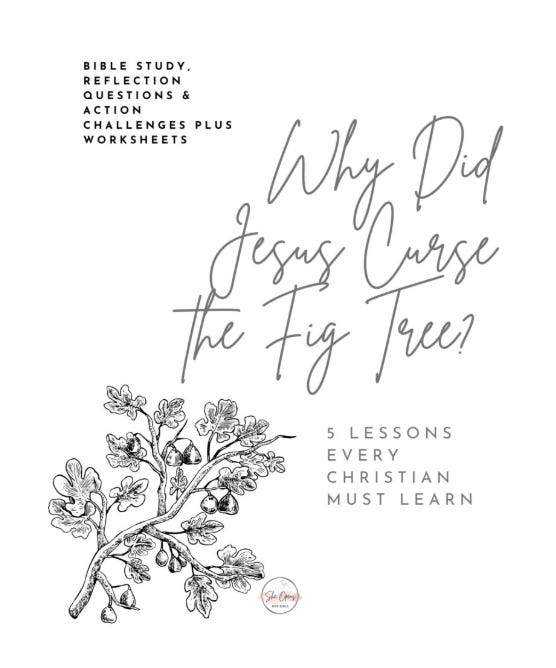
Get a FREE Printable Study Guide with Bible Study and Reflection Questions and Action Challenges at the end of this post!
The Setting: Passion Week
It’s the week leading up to the cross. Jesus has just entered Jerusalem to shouts of “Hosanna!” and now moves between Bethany and the city each day. On His way back into Jerusalem, He notices a fig tree covered in leaves. Hungry, He approaches, expecting fruit, but finds nothing.
Mark writes:
“Seeing at a distance a fig tree in leaf, He went to see if perhaps He would find anything on it; but when He came to it, He found nothing but leaves…”
(Mark 11:13, NASB)
This wasn’t about produce. It was a living parable. Just as He inspected the tree, He would soon inspect the Temple, full of religious activity, but lacking the righteousness God desired.
Why the Fig Tree Matters
A Picture of Hypocrisy
In Israel, fig trees usually produce small, early figs before the leaves. The leaves on this tree signaled that fruit should be there, but it was barren. It was making a promise it didn’t keep.
In the same way, the Temple looked alive with ritual and sacrifice but was missing the heart of obedience, justice, and mercy. Jesus’ actions echoed the prophets who warned God’s people not to settle for appearances.
A Warning for God’s People
Notice that His judgment begins with His own people, not with Rome or the surrounding nations. Like Ezekiel’s vision where judgment starts at the sanctuary, Jesus starts with the household of faith.
Fig Trees in Scripture
The Hebrew Scriptures often use fig trees as symbols of blessing or covenant faithfulness. Micah paints a picture of peace when every person rests under their vine and fig tree (Micah 4:4). Hosea recalls God delighting in Israel as “early fruit on the fig tree” (Hosea 9:10).
To be fruitful was to be faithful. To be barren was to reject God’s covenant. Jesus steps into that tradition declaring through action what the prophets had long spoken in words.
Five Lessons From the Withered Fig Tree
1. God Wants Fruit, Not Just Leaves
The fig tree looked healthy but had nothing to offer. Our lives can look the same when we focus on outward religion instead of inward transformation. God desires genuine love, repentance, and Spirit-filled living, not empty activity.
2. Judgment Begins With Us
The first inspection is not of outsiders but of God’s people. Just as Jesus cleansed the Temple, He examines His Church today. Covenant brings both privilege and accountability.
3. Seasons Don’t Excuse Barrenness
The tree was judged even when it wasn’t harvest time. Why? Because it gave the impression of fruitfulness. In the same way, we can’t excuse spiritual dryness by saying, “It’s just not my season.” The Spirit equips us to bear fruit wherever we are.
4. Faith and Fruit Go Hand in Hand
Right after this event, Jesus teaches about prayer and mountain-moving faith. Faith isn’t just about asking boldly. It’s about abiding in Him (John 15). True faith produces visible fruit.
5. Beware of Empty Religion
Leaves without fruit symbolize the danger of religious show without spiritual reality. God inspects our hearts, not just our habits. This isn’t condemnation, it’s an invitation to authenticity.
The “Markan Sandwich”
Mark weaves the fig tree story around the Temple cleansing—tree → Temple → tree. This storytelling technique makes the point clear: both the tree and the Temple looked alive but were spiritually barren. Both came under judgment.
The message still stands: God isn’t fooled by appearances. He looks for truth “in the inward parts” (Psalm 51:6).
Final Reflection
So, why did Jesus curse the fig tree? Because it was all show, no substance. It promised fruit but produced nothing. The withered tree still warns us today: faith without fruit is empty.
But here’s the hope. Jesus doesn’t leave us stuck. The same Lord who judged the tree is the one who gives us His Spirit so that we can bear lasting fruit. If you feel spiritually dry, He can restore you. If your life feels barren, He can make it bloom again.
Friend, don’t just settle for leaves. Let your life be rooted in Him and bear fruit that remains.
FAQs About the Withered Fig Tree
Why did Jesus speak judgment over the fig tree even though it wasn’t harvest time?
In the land of Israel, a fig tree that already has leaves normally carries small, early figs as well. The leafy appearance signaled fruitfulness, but the tree had none. Mark notes the season detail to remind us this wasn’t about agriculture—it was a living lesson. The tree represented those who project spiritual vitality outwardly but lack genuine faith and obedience.
What does the fig tree represent in Scripture?
Throughout the Bible, fig trees often picture Israel’s spiritual state. A flourishing tree symbolized covenant blessing, peace, and God’s favor, while a fruitless tree pointed to decline, judgment, or unfaithfulness. The imagery called God’s people to bear true fruit, not just display outward form.
How is the cursed tree tied to Jesus cleansing the Temple?
Mark weaves the two events together—the fig tree before and after the Temple scene. This storytelling frame links them thematically: both the tree and the Temple seemed alive at first glance, yet both were barren where it mattered. Jesus was exposing the danger of surface-level religion without substance.
What kind of fruit does God look for in our lives?
The Lord desires fruit that reflects His character—love, joy, peace, patience, kindness, faithfulness, humility, and self-control. These qualities are the Spirit’s work in us, not external performance. True fruit grows out of abiding in Christ, not striving in our own strength.
Was the fig tree incident symbolic or an actual miracle?
It was both. The tree physically withered, but the act itself carried prophetic meaning. Just as Old Testament prophets used symbolic actions to deliver God’s message, Jesus used this real moment as a visible parable, warning against hollow faith that looks vibrant but has no depth.

Download Your Free Printable Study Guide
🔥 Want to go deeper?
Step beyond the surface and into the Word with our paid subscriber community. When you upgrade, you unlock The Vault — and if you're ready to go all in, Founders Level brings even more.
🔐 Inside The Vault:
💛 Weekly devotionals with depth and application
🌿 Monthly teachings on the Jewishness of Jesus
💬 Private community chats
🎁 30% off all digital products
🚨 Access to our Peppery Bible Study Group in Signal
👑 Founders Level includes everything in The Vault, plus:
🎧 Weekly audio teachings
💻 Monthly Bible Study Q&A Calls
📓 Printable studies and reflection tools
⏰ Early access to studies and new digital products
🖊️ Exclusive journal
💸 50% off all digital products + 10% off physical merch
👉🏽 Join now to unlock your access and walk deeper in truth, boldness, and biblical beauty.
You’re currently a free subscriber to She's So Scripture. For the full experience, upgrade your subscription.
🛍️ Shop resources crafted for believers who build bold confidence, gratitude, and Bible intimacy. Click here to visit the She’s So Scripture Shop!
Tree of Life (TLV) – Scripture taken from the Holy Scriptures, Tree of Life Version*. Copyright © 2014,2016 by the Tree of Life Bible Society. Used by permission of the Tree of Life Bible Society.
NASB - “Scripture quotations taken from the NASB. Copyright by The Lockman Foundation“