


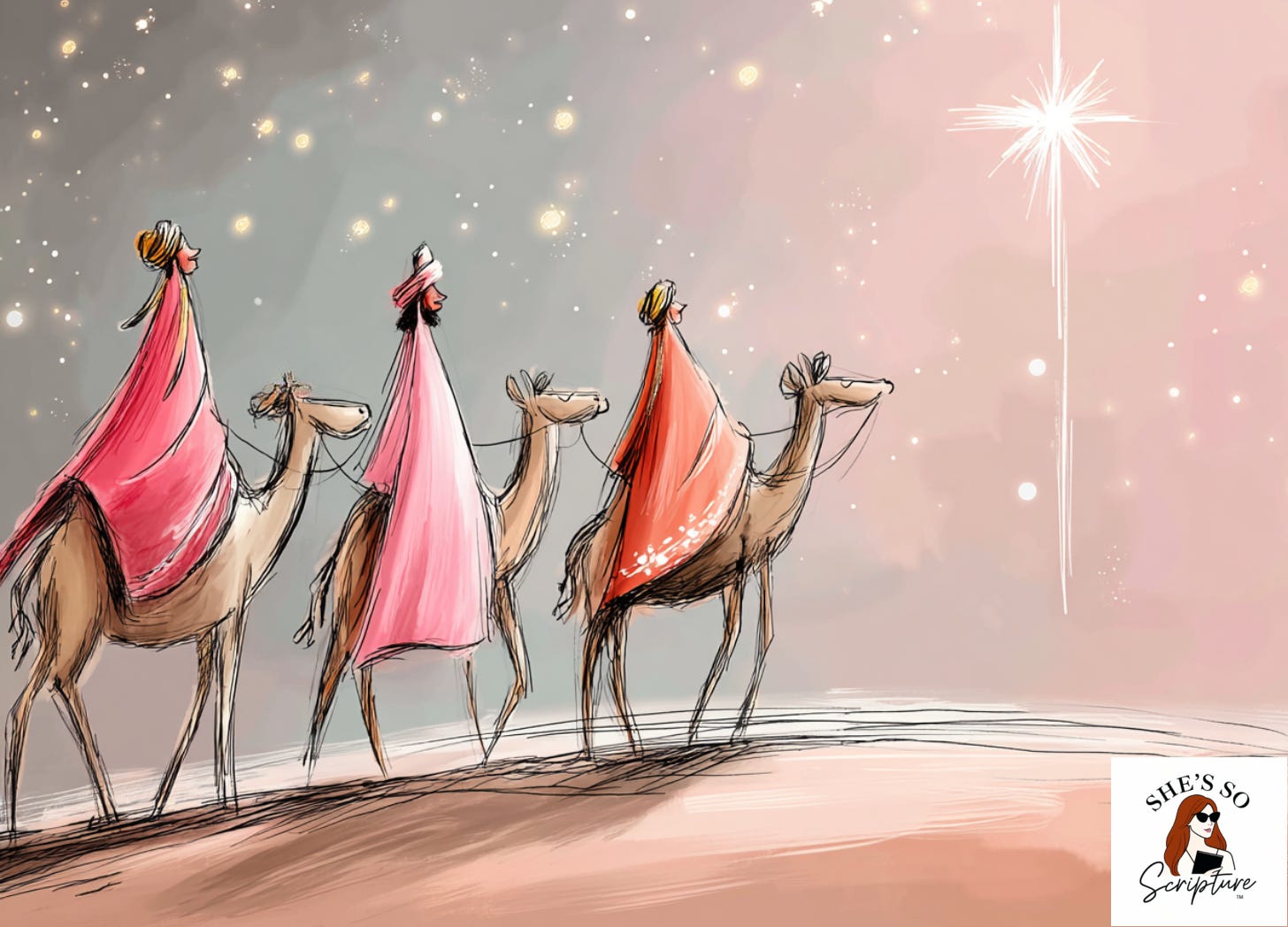
If you grew up with church Christmas programs, you probably saw Mary and Joseph glowing under a spotlight, shepherds huddled nearby, and three robed men awkwardly carrying gold-wrapped shoe boxes toward the manger like they were arriving late to a baby shower.
This isn’t lost on me… I actually played one of them in my school’s Christmas play.
It’s sweet and nostalgic.
It’s also biblically inaccurate.
And look, I get it. Sunday school teachers had crafts to finish and Goldfish crackers to distribute. They did not have time to give six-year-olds a lecture on ancient travel routes and Herodian paranoia. But now that you’re all grown up, it’s time for the real version.
Because the Wise Men showing up at the manger is one of those myths that has lived so long it refuses to retire.
Let’s fix that.
The Magi Arrived Long After the Birth
Matthew tells us the Magi came to a “house,” not a stable, and that they found the “child,” not the “infant.” Our English softens it, but the Greek is clear.
The Greek word used is paidion and means child; young child.
This is not a newborn. This is a toddler.
“And going into the house, they saw the child with Mary his mother, and they fell down and worshiped him.” Matthew 2:11 ESV
Which means the Magi didn’t shuffle in with the shepherds like nativity scenes often display. They arrived much later. Months later. Possibly close to two years later, based on Herod’s own timeline.
Sunday school combined the shepherds and Magi because it keeps the nativity scene cute and symmetrical.
Mary was not still recovering from labor and Joseph was not holding fresh swaddling cloths. The neighbors were probably wondering why a procession of foreigners showed up with treasure chests.
The Magi Weren’t Kings. And There Weren’t Three.
I know the song says “We Three Kings.” It also says they “traveled far,” which is probably the most accurate part of the whole song.
Matthew never tells us there were three Magi. That number got created because three gifts were mentioned. If we used that logic today, weddings would be full of “twelve guests” because the couple received twelve presents.
The Magi were likely a caravan of educated astrologer-priests from the East, probably Persia or Babylon. They were scholars who studied the heavens (something not unfamiliar in ancient Jewish tradition) and recognized a sign that pointed them to a very specific conclusion: a real king had been born.
Numbers 24:17 gives us a prophetic look at this:
I see him, but not now; I behold him, but not near:
a star shall come out of Jacob, and a scepter shall rise out of Israel;
ESV
This scene resonates with prophecies in Isaiah 60 and Psalm 72. Isaiah envisions nations bringing gold and frankincense to Jerusalem to honor the Lord (Isa 60:6), and Psalm 72:10-11 speaks of kings bringing tribute and bowing before the king's son. The magi’s actions, then, align with prophetic hopes about the nations recognizing the Messiah.
They knew something supernatural had broken into history. And they showed up to honor it.
One more layer: the fact that these Gentile sages were the first to recognize Jesus’ significance shows an early sign of what would become a major theme in the New Covenant… that the nations would come to worship the God of Israel through Israel’s Messiah, not by replacing Israel, but by joining in.
Herod Panicked Because This Visit Meant Something Political
Herod was not threatened by a baby in a manger. He was threatened by international recognition of a rival king. When the Magi arrived asking to see “the One born King of the Jews,” that was a political lightning bolt.
Herod’s title “King of the Jews” wasn’t hereditary. Rome gave it to him. So hearing that someone had arrived who actually was born king struck straight at his fragile ego.
That’s why he starts scheming and why he wants details.
And that’s why the massacre of the innocents happens.
It was all geopolitics.
That part gets left out because kindergarten rooms prefer finger-painting over government coups.
The Gifts Were Not Baby Shower Tokens
Gold, frankincense, and myrrh weren’t decorative. They were regal, priestly, and burial-focused. They pointed to a destiny that would not fit neatly inside anyone’s childhood nativity set.
The gifts were:
Gold represents kingship and honor.
Frankincense, used in temple worship, points to divinity and priestly identity.
Myrrh, used for embalming, foreshadows suffering and death.
These gifts were prophetic.
The Magi were honoring the arrival of someone who would reshape history. Their gifts recognized that long before anyone else did.
My Final Thoughts
Sunday school gave us a sweet story. Scripture gives us a complex one. The Magi were not background extras at the manger. They were learned men who traveled a long distance because they recognized that something cosmic had happened.
They didn’t come to complete a holiday aesthetic, they came to acknowledge the Messiah.
Their visit reminds us that God has always been pulling in the nations, long before the disciples ever preached a sermon. It reminds us that the people who “should” understand God’s work often miss it, while outsiders recognize it instantly.
It reminds us that the Messiah’s arrival rattled kings, redirected scholars, and rewrote expectations before He could even walk.
Sunday school introduced the story. Scripture deepens it.
And sometimes that depth is the very thing that wakes us up to the beauty we missed.
Bible Study Questions
What clues in Matthew 2 show that the Magi arrived long after the birth?
How does Herod’s reaction help us understand the political implications of the Messiah’s arrival?
How do the Magi’s gifts point to Yeshua’s mission and identity?
Reflection Questions
Where do cultural traditions shape your understanding of Scripture more than the text itself?
How does the Magi’s journey challenge your view of who recognizes God’s work first?
What part of the nativity story feels newly clarified for you after reading this?
Action Challenges
Read Matthew 2 slowly and note everything the text says and doesn’t say about the Magi.
Identify one Christmas tradition you want to revisit in light of Scripture.
Spend time praying for the nations, remembering that even at His birth, Yeshua was drawing them in.
If this study stirred something in you, share it with a friend who might need it too.
And if it left you wanting to go slower and deeper into the Word, I’ve got you!
Paid subscribers get access to extended studies, devotionals. theological teaching, spiritual formation practices, and a community of women who want depth without pressure or performance.
If you’re ready to step further into the Word, you’re welcome inside.
If a paid subscription isn’t feasible right now but this space has blessed you, you can leave a one-time tip here. Every gift helps sustain this work. 🤍

About Our Author
Diane Ferreira is a Jewish believer in Yeshua, a published author, speaker, seminary student, wife, and proud mom. She is the author of several books, including The Proverbs 31-ish Woman, which debuted as Amazon’s #1 New Release in Religious Humor.
She is currently pursuing her graduate degree in Jewish Studies in seminary, with her favorite topics being the early church and Biblical Hebrew. Diane writes and teaches from a unique perspective, bridging her Jewish heritage with vibrant faith in the Messiah to bring clarity, depth, and devotion to everyday believers.
When she’s not writing, studying, or teaching, you’ll find her curled up with a good book, crocheting something cozy, or playing her favorite video games.
ESV - “Scripture quotations are from The ESV® Bible (The Holy Bible, English Standard Version®), copyright © 2001 by Crossway, a publishing ministry of Good News Publishers. Used by permission. All rights reserved.”
Tickled to read this! What are your thoughts about Daniel’s time in Babylon’s empire setting these star-gazers up to know what to look for?
Check out the often forgotten Parthian Empire — Rome’s competitor “to the east” that also ruled Jerusalem briefly for a few years before Jesus … then it all falls even more into place 👍