


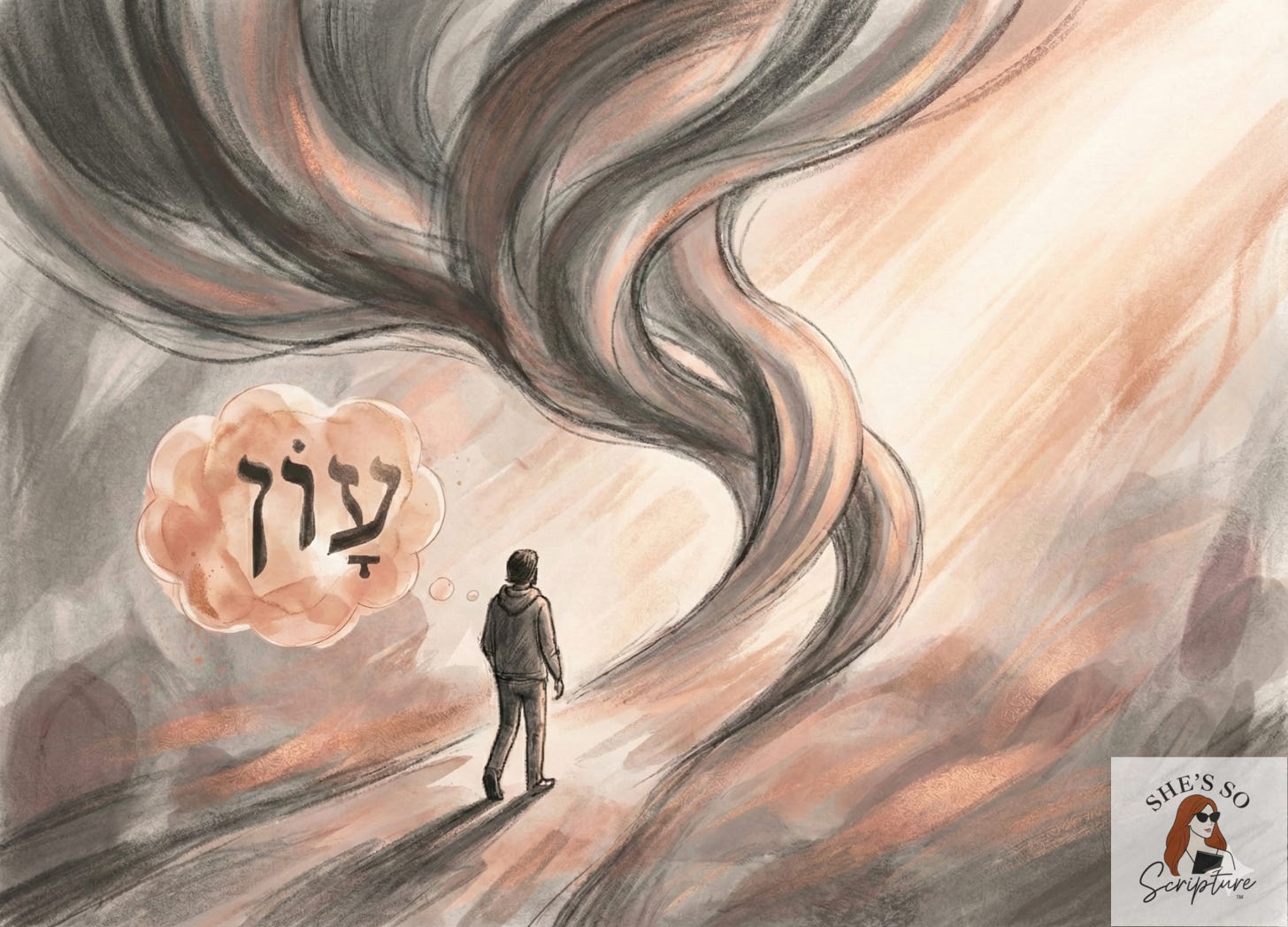
Pronunciation: ah-VOHN
Meaning: iniquity, moral distortion, internal crookedness; guilt that bends what was meant to be straight
Most English translations use three words almost interchangeably: sin, transgression, and iniquity. But in Hebrew, they just aren’t the same thing. Each one carries its own texture.
Sin (chattat) means missing the mark.
Transgression (pesha) means crossing a line.
Iniquity (ʿavon) means being bent out of shape.
If sin is the act and transgression is the rebellion, iniquity is the condition. It’s what happens inside a person when disobedience reshapes them.
It’s not just what you do. It’s what wrongdoing does to you.
Avon Is the Word of Inner Distortion
The root idea behind avon is to twist or bend. Think of a tree that grew under years of pressure… it’s still standing, but it’s permanently curved. That’s what iniquity does to the human soul.
It’s why Isaiah could say,
“So Adonai has laid on Him the iniquity of us all.” — Isaiah 53:6 (TLV)
That line isn’t just some kind of poetic guilt language. It’s describing something deeply spiritual: every internal distortion, every generational pattern, every place the human heart has bent away from God’s design… all of it placed on the Servant.
Jesus didn’t just bear our sins. He carried our crookedness.
The Burden That Bends Generations
The Hebrew Bible (the Tanakh) often links avon with consequences that ripple across generations. It’s what God names in Exodus 34:7 when He declares His character to Moses:
“showing mercy to a thousand generations, forgiving iniquity and transgression and sin, yet by no means leaving the guilty unpunished, but bringing the iniquity of the fathers upon the children, and upon the children’s children, to the third and fourth generation.” — Exodus 34:7 (TLV)
That verse has confused people for centuries, but it’s not describing punishment for the innocent. It’s showing how iniquity reproduces itself when it’s not dealt with. What we don’t confront, we often continue. What we don’t confess, we pass down.
Avon is the word for inherited spiritual crookedness… the cycles of harm that keep replaying until mercy interrupts them.
Forgiveness Isn’t Denial. It’s Release.
The Hebrew verb form nasa ʿavon means “to bear or lift away iniquity.” It’s used all through Scripture for divine forgiveness. When God forgives, He doesn’t pretend the damage didn’t happen. He carries it.
That’s the heart of the gospel.
Psalm 32:5 captures it beautifully:
“I said, “I confess my transgressions to Adonai,” and You forgave the guilt of my sin.”
— Psalm 32:5 (TLV)
The moment David brings his avon into the open, God lifts it off of him. What David had been holding, God carries.
Forgiveness, in Hebrew thought, is transfer. The weight doesn’t disappear; it moves from us to Him.
Why This Word Still Matters
We live in a culture that avoids moral language but still feels moral weight. We call it shame, regret, trauma, consequence; but Scripture names it avon. It’s the invisible heaviness of being bent away from God.
And because God doesn’t deny what’s real, He doesn’t erase avon by ignoring it. He redeems it by absorbing it.
That’s why Isaiah 53 still undoes me every time I read it:
“He was pierced because of our transgressions, crushed because of our iniquities; the chastisement for our shalom was upon Him, and by His stripes we are healed.” — Isaiah 53:5 (TLV)
He took our twistedness and gave us His wholeness.
My Final Thoughts
Avon reminds us that sin is not just rebellion, it’s damage. It bends what was straight, warps what was once beautiful, and leaves people carrying weights they were never meant to hold.
But it also reminds us of a God who doesn’t stand at a distance from that damage. He steps into it. He shoulders it. He bears it away.
When Scripture says He “forgives iniquity,” it’s not describing forgetfulness. It’s describing rescue.
If you’ve ever looked at the wreckage in your own life and thought, “I made this crooked, and I can’t fix it,” avon is the word that says, “You don’t have to. He already carried it.”
Bible Study Questions
How do the three Hebrew words for sin (chattat, pesha, ʿavon) each describe a different layer of brokenness?
Read Exodus 34:6–7. How does God’s description of Himself hold both mercy and justice in tension?
How does Isaiah 53 redefine what it means for God to “bear” iniquity?
What does Psalm 32 reveal about confession and the lifting of avon?
Reflection Questions
Where have you seen the effects of avon—your own or someone else’s—bend what was once straight?
How does knowing that God bears your iniquity change how you deal with guilt or regret?
What patterns in your story might God be inviting you to interrupt through repentance and grace?
Action Challenges
Read Psalm 32 and Isaiah 53 side by side this week. Notice how the personal and the prophetic mirror each other.
Journal one place in your life that still feels “bent.” Offer it to God as something for Him to carry, not you.
Pray for generational healing in your family, asking God to break cycles of avon and replace them with mercy that runs deeper.
Key Cross References:
Exodus 34:6–7 • Psalm 32:1–5 • Isaiah 53:4–6 • Micah 7:18–19 • Romans 8:3–4 • 2 Corinthians 5:21
If this study stirred something in you, share it with a friend who might need it too.
And if it left you wanting to go slower and deeper into the Word, I’ve got you!
Paid subscribers get access to extended studies, devotionals. theological teaching, spiritual formation practices, and a community of women who want depth without pressure or performance.
If you’re ready to step further into the Word, you’re welcome inside.
If a paid subscription isn’t feasible right now but this space has blessed you, you can leave a one-time tip here. Every gift helps sustain this work. 🤍
About Our Author
Diane Ferreira is a Jewish believer in Yeshua, a published author, speaker, seminary student, wife, and proud mom. She is the author of several books, including The Proverbs 31-ish Woman, which debuted as Amazon’s #1 New Release in Religious Humor. She is currently pursuing her graduate degree in Jewish Studies, with her favorite topics being the early church and Biblical Hebrew. Diane writes and teaches from a unique perspective, bridging her Jewish heritage with vibrant faith in the Messiah to bring clarity, depth, and devotion to everyday believers.
When she’s not writing, studying, or teaching, you’ll find her curled up with a good book, crocheting something cozy, or playing her favorite video games.
Tree of Life (TLV) – Scripture taken from the Holy Scriptures, Tree of Life Version*. Copyright © 2014,2016 by the Tree of Life Bible Society. Used by permission of the Tree of Life Bible Society.
This was really good! Sharing with others ASAP.
This is fascinating, Diane! You've given me a lot to think about. I'm going to revisit this later this week and dive deeper into the Scriptures you referenced.