


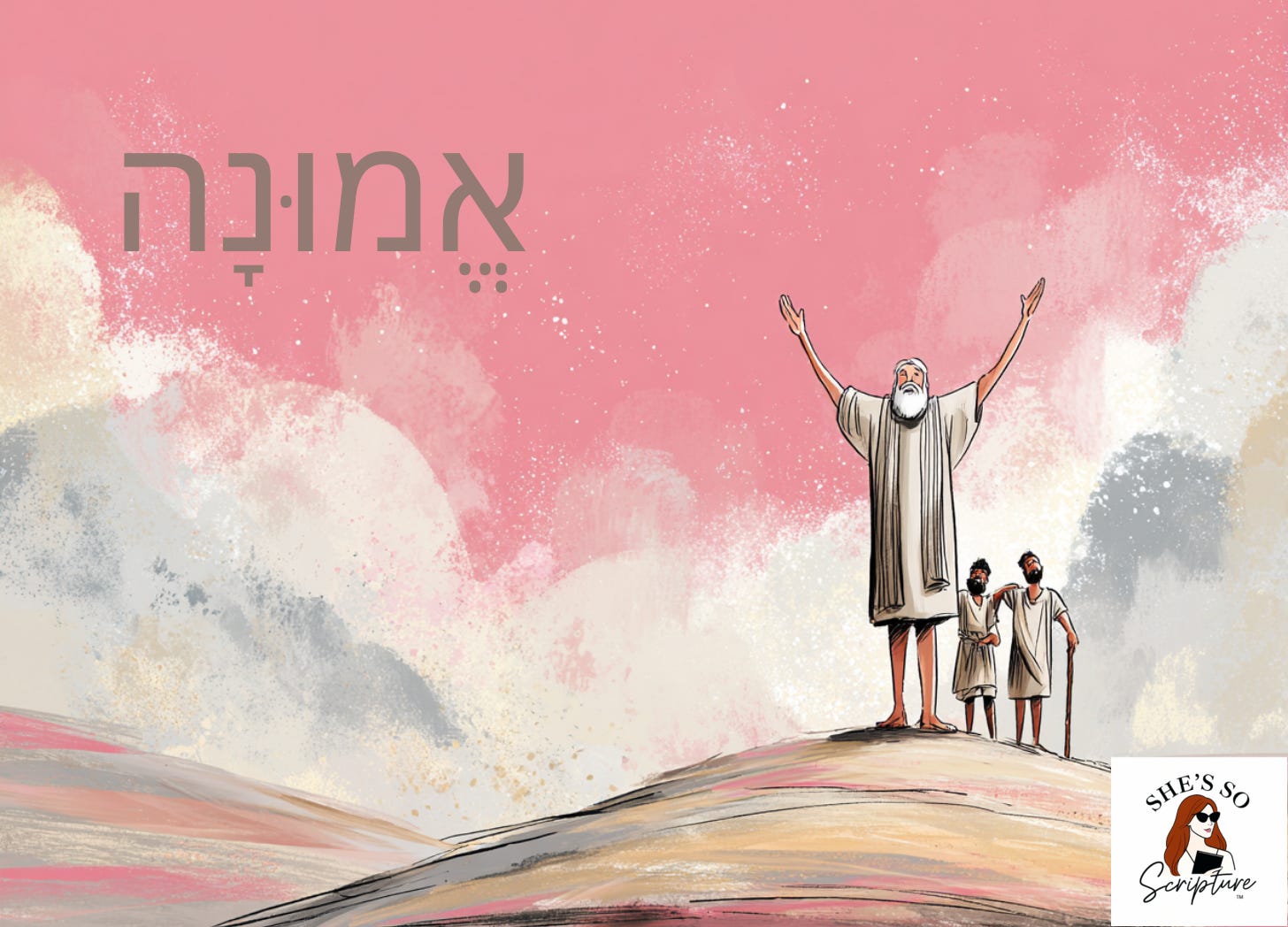
Pronunciation: eh-moo-NAH
Meaning: steadiness, reliability, firmness, faithfulness that shows up over time
Most people read emunah as “faith,” and then immediately imagine belief. Internal. Personal. Invisible. Something you either have or don’t.
That is not how the Bible uses this word.
Emunah is not about what you think… it’s about whether you’re steady.
The root of emunah comes from the same family as amen. It carries the sense of firmness, dependability, and consistency. This is not faith as a feeling… this is faith as something you can lean your weight on.
Faith That Holds
One of the clearest uses of emunah appears in the Exodus story, and it has nothing to do with belief statements.
“When Moses held up his hand, Israel prevailed. But when he let down his hand, the Amalekites prevailed.”
Exodus 17:11 TLV
A few verses later, Aaron and Hur support Moses’ hands until sunset, and the text describes Moses’ hands as steady.
וִידֵי מֹשֶׁה כְּבֵדִים וַיִּקְחוּ־אֶבֶן וַיָּשִׂימוּ תַחְתָּיו וַיֵּשֶׁב עָלֶיהָ וְאַהֲרֹן וְחוּר תָּמְכוּ בְיָדָיו מִזֶּה אֶחָד וּמִזֶּה אֶחָד וַיְהִי יָדָיו אֱמוּנָה עַד־בֹּא הַשָּׁמֶשׁ׃
But Moses’ hands grew heavy; so they took a stone and put it under him and he sat on it, while Aaron and Hur, one on each side, supported his hands; thus his hands remained steady until the sun set.
Exodus 17:13 JPS
That word in bold is emunah. Steady.
Moses’ faith is not internal confidence. It is physical endurance…. steadiness maintained with help. Victory is tied not to Moses’ passion or his enthusiasm, but to his ability to remain held in place.
That should recalibrate how we talk about faith.
Emunah Is Proven, Not Claimed
Habakkuk uses this word in a way that often gets flattened out in translation.
“But the righteous will live by his trust.”
Habakkuk 2:4 TLV
The emphasis here is not belief under pressure, it’s persistence. The righteous person lives by emunah, by staying anchored when circumstances are unstable.
Faithfulness is not about intensity, it’s about remaining.
That’s why Scripture so often pairs emunah with God Himself.
“The Rock—blameless is His work. Indeed, all His ways are just.
God of faithfulness without iniquity, righteous and upright is He.”
Deuteronomy 32:4 TLV (Bolding mine)
God’s emunah is His reliability across generations. He does not flicker. He does not spike and crash. He does not bail when things get complicated.
And when Scripture calls people to faith, it’s calling them into that same pattern of steadiness.
This Is Not Flashy Faith
Emunah doesn’t trend. It doesn’t announce itself loudly. It shows up again tomorrow.
It looks like obedience that doesn’t need novelty. It looks like trust that holds even when outcomes lag. It looks like staying aligned long after the emotional rush wears off.
This is why Scripture rarely celebrates dramatic belief moments without also emphasizing long-term faithfulness. God is not impressed by bursts. He values endurance.
Why This Word Still Matters
A lot of modern faith language prioritizes intensity. Big moments. Big declarations. Grand gestures.
Emunah quietly asks a different question.
Can you remain?
Not perfectly or loudly, or without support. But steadily.
This word gives dignity to the kind of faith that keeps showing up time after time even when nothing feels miraculous. It honors the faith that holds on through repetition, fatigue, and those all too ordinary days.
My Final Thoughts
Emunah reminds us that biblical faith is not proven in moments of certainty. It’s revealed in consistency.
Moses needed help to keep his hands steady. Well, God is still faithful. The people still prevail.
If your faith feels less like fire and more like staying put, Scripture has a word for that. And it’s not disappointment.
It’s emunah.
Bible Study Questions
How does Exodus 17 reshape the way you understand faith and dependence?
What does Habakkuk 2:4 suggest about how faith is lived rather than declared?
How does God’s emunah serve as the foundation for human faithfulness?
Reflection Questions
Where are you tempted to measure faith by intensity rather than steadiness?
What practices help you remain when motivation dips?
How does it feel to consider faith as something sustained, not performed?
Action Challenges
Read Exodus 17:8–13 and notice how community supports faithfulness.
Identify one place where steadiness matters more than enthusiasm and lean into it this week.
Practice saying “amen” slowly, letting it reflect firmness rather than conclusion.
Want to learn more Hebrew? We have a self-paced Basic Beginner’s Hebrew course and if you are aVault or Founding Members you even get a discount!
If this study stirred something in you, share it with a friend who might need it too.
And if it left you wanting to go slower and deeper into the Word, I’ve got you!
Paid subscribers get access to extended studies, devotionals. theological teaching, spiritual formation practices, and a community of women who want depth without pressure or performance.
If you’re ready to step further into the Word, you’re welcome inside.
If a paid subscription isn’t feasible right now but this space has blessed you, you can leave a one-time tip here. Every gift helps sustain this work. 🤍

I love these word studies!
I've always viewed faith as having more in common with trust than belief. After all, even the demons and fallen angels "believe" in Jesus.
🙏❤️