



Here’s something that will rearrange your furniture a bit. The same Hebrew root that speaks of God revealing His secrets also becomes the root for exile. Same letters. Same root. Same Hebrew idea moving in two completely different directions depending on where you find it.
And honestly? The theological weight sitting inside that connection is hard to overstate.
The root is galah (גָּלָה). Pronounced gah-LAH. Once you notice how Scripture uses this root, entire passages start reading differently.
What Does Galah Actually Mean?
At its core, galah means to uncover, to lay bare, to expose something that was previously hidden. But here’s where it gets interesting: the word moves in two totally different theological directions depending on context, and both of them matter for how you read your Bible.
In one direction, galah is glorious. It’s what happens when God pulls back the curtain. When He lets a prophet in on what’s coming. When He discloses what He’s been planning. This is galah as gift.
In the other direction, galah is devastating.
It’s what happens when Israel breaks covenant and gets sent out of the land, stripped of everything, carried off to Assyria or Babylon. This is galah as judgment. The word for exile in Hebrew is rooted in the same idea as uncovering.
When Israel went into exile, they experienced galut. Removal. Exposure. Displacement. Their covering had been taken.
You might have expected God to use different words for those two things. He didn’t.
Galah and the Prophets
The most famous galah verse in the prophetic literature is Amos 3:7, and it shows up right in the middle of a passage where God is making a case against Israel for their covenant unfaithfulness.
Amos has been preaching to people who thought they were fine; comfortable, prosperous, religious enough. And into that scene comes this line:
“For the Lord Adonai, will do nothing, unless He has revealed His counsel to His servants the prophets.” (Amos 3:7, TLV)
That word revealed is galah. God does not act in history without first galah-ing (hmm….works for me!) His purposes to someone. He uncovers the plan. He pulls someone into the inner room and says: here is what is about to happen. Now, go tell them.
But look at the context. Amos isn’t delivering a comforting word about God’s communication style. He is about to announce judgment. And judgment, in Hebrew, is also described with forms of galah. Israel’s idolatry and injustice will result in exile and uncovering — removed from the protection of the land and the covenant.
The root that speaks of God revealing His plan is also the root used for exile and removal. That should make you stop and think.

Galah and Exile
When the northern kingdom fell to Assyria in 722 BCE, and when Babylon carried Judah off in 586 BCE, the biblical writers used galah repeatedly to describe what happened. The people went into galut (גָּלוּת), the noun form of the same root. Exile. Uncovering. Removal.
The land functioned as the covenant home where Israel lived under God’s protection and presence. When Israel rejected the covenant, the covering was withdrawn. Galah happened. They became exposed.
And this is not just a poetic coincidence in the text. It’s a full on theological statement. In the biblical story, exile often follows the refusal of God’s revelation. When God pulls back the curtain and sends the prophets and says here is what I see, here is what is coming, here is what I’m asking — and the people turn away — the covering lifts. The exposure that was avoided becomes the judgment that arrives.
The Verse Mapping Aid
גָּלָה (Galah)
Root: Gimel-Lamed-Hey (ג-ל-ה)
Strong’s H1540
Pronunciation: gah-LAH
The root appears in multiple forms across the Hebrew Bible. As a verb, it means to uncover, reveal, lay bare, or depart. As a noun, galut (גָּלוּת) is the Hebrew word for exile… the state of having been uncovered and removed. Golah (גּוֹלָה) refers specifically to exiles, the people who have been displaced.
The same root also gives us the idea of ear-uncovering. To “uncover someone’s ear” in Hebrew is an idiom for taking them into confidence, revealing a secret to them directly. You see this in 1 Samuel when God “uncovers the ear” of Samuel the night before Saul arrives. It’s intimate. It’s personal. It’s the image of someone leaning close and lifting the hair back from your ear to say something meant only for you.
That’s the register of galah when God is the one doing it to His servants. He is not broadcasting. He is leaning in.
The Turn Toward Yeshua
What do you do with a word that carries both intimacy with God and the devastation of exile?
You look at Yeshua on the cross.
There, in one moment, both meanings of galah collide. He was stripped bare… galah in its most literal, physical sense. He entered into the experience of exile and exposure, bearing the weight of covenant brokenness and human rebellion.
And at the same time, the cross becomes the ultimate uncovering of God’s counsel. It is the final, complete revelation of what God had been planning from before the foundation of the world.
For believers in Yeshua, the cross becomes the place where themes long present in Israel’s story — revelation, exile, covenant failure, and restoration — converge.
The revelation and the exile met at the same place.
My Final Thoughts
There’s a reason the Hebrew Bible doesn’t give us nice, clean, one-meaning-per-word vocabulary. Life just isn’t that simple and neither is theology. Galah holds revelation and exile in the same hand because they are genuinely connected. God reveals. You respond or you don’t. And the nature of covenant is that the response has weight.
This doesn’t mean God is waiting around hoping you mess up so He can strip you down. That is not the character of the God who leans close and uncovers your ear to tell you what He’s about to do. But it does mean that revelation is not neutral. When God opens the curtain, something is being asked of you. The prophets knew this. Every one of them did.
The invitation inside galah is to be the kind of person God leans toward. The kind who listens when the ear gets uncovered. The kind who doesn’t need exile to learn what revelation was trying to say all along.
Let’s Talk About It
These questions are for you to use however works best for where you are. Bring them to your small group or Bible study, use them as journaling prompts, or drop your thoughts in the comments below. I read every single one.
Galah holds revelation and exile in the same root. What does it say about God’s character that He consistently warns before He acts… that He galah-s His counsel to the prophets before judgment comes?
The idiom of “uncovering the ear” describes intimacy and direct disclosure. Where in your own life have you experienced God communicating something that felt less like a broadcast message and more like a lean-in?
Amos 3:7 sits in the middle of a passage about covenant unfaithfulness. If revelation is never neutral, if hearing from God always carries weight, what does that mean for how we approach Scripture on an ordinary day?
Where do you see the two meanings of galah colliding in Yeshua? How does understanding this word change the way you read the cross?
If this study stirred something in you, share it with a friend who’s been sitting on a word from God and hasn’t quite known what to do with it yet.
And if it left you wanting to go slower and deeper into the Word, I’ve got you! Paid subscribers get access to live Bible studies, extended studies, devotionals, theological teaching, spiritual formation practices, and a community that wants depth without pressure or performance. If you’re ready to step further into the Word, you’re welcome inside.
👉🏻 Join The Vault.
If a paid subscription isn’t feasible right now but this space has blessed you, you can leave a one-time tip here. Every gift helps sustain this work. 💕

Also, Can We Talk About This Shirt?
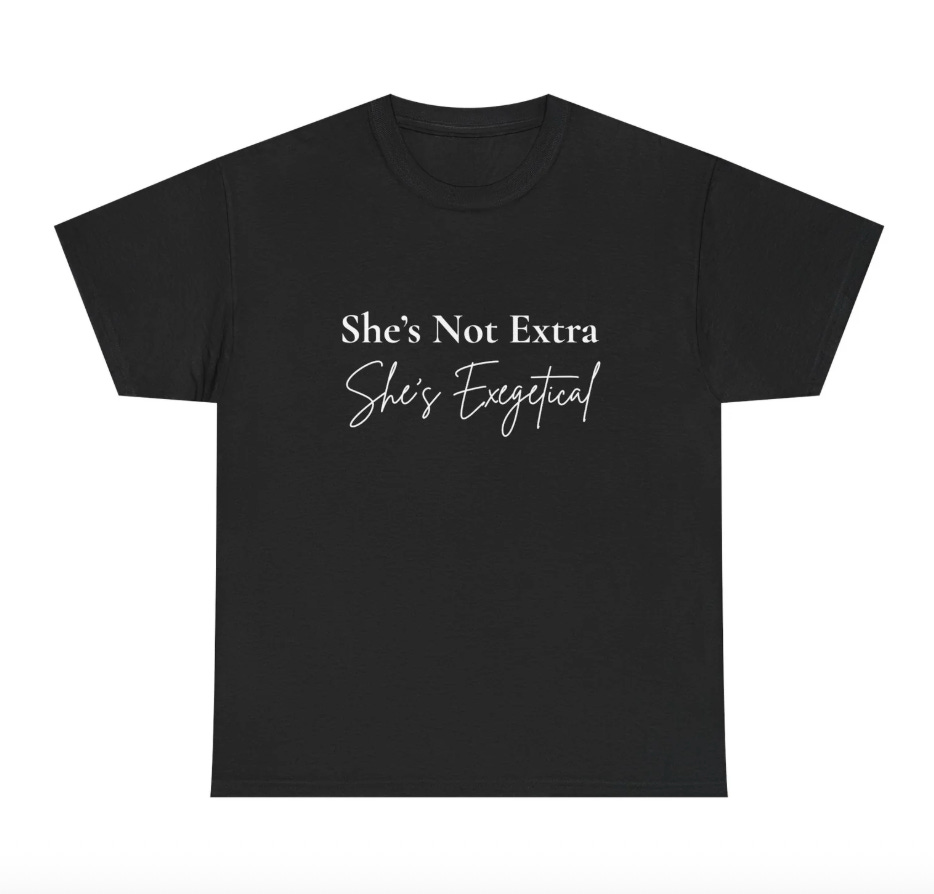
If you’ve ever been told you’re “doing too much” when talking about Scripture, this shirt is for you. 😭
“She’s Not Extra, She’s Exegetical” is basically the entire mission statement around here because apparently asking historical, contextual, linguistic, and theological questions makes some people deeply nervous.
And yes, maybe we ARE a little extra. But if I’m going to be extra, I’d rather be extra about understanding the biblical text than arguing online about nonsense.
Around here we believe:
context matters
words matter
history matters
genre matters
covenant matters
and maybe reading three commentaries for fun is not a personality flaw.
So if you too have ever interrupted dinner to explain a Hebrew word, gotten emotional over a chiastic structure, or dramatically opened seventeen tabs because one verse sent you into a study spiral… welcome home.
Grab yours from the She Opens Her Bible Shop and wear it proudly. 🤍
About the Author
Diane Ferreira is a Jewish believer in Yeshua, a published author, speaker, seminary student, wife, and proud mom. She is the founder of She’s So Scripture and She Opens Her Bible. She is the author of several books, including The Proverbs 31-ish Woman, which debuted as Amazon’s #1 New Release in Religious Humor, as well as Holy, Hormonal and Holding On.
She is currently pursuing her graduate degree in Jewish Studies in seminary, with her favorite topics being the early church and Biblical Hebrew. Diane writes and teaches from a unique perspective, bridging her Jewish heritage with vibrant faith in the Messiah to bring clarity, depth, and devotion to everyday believers.
When she’s not writing, studying, or teaching, you’ll find her curled up with a good book, crocheting something cozy, traveling, or playing her favorite video games.
Tree of Life (TLV) – Scripture taken from the Holy Scriptures, Tree of Life Version*. Copyright © 2014,2016 by the Tree of Life Bible Society. Used by permission of the Tree of Life Bible Society.
And still, people are resting on their laurels refusing to listen to the words of the prophets. Believers hold to false promises that are based on presumption and tradition. It’s so sad, so sad.
Really enjoyed reading it 💙